16th December
December is dull. Grey overcast skies under which the huddled multitudes scurry spending money on presents for people they probably don’t much like. A shortage of daylight limits travel opportunities and everywhere is doing xmas tackiness. You might think that I dislike this time of year. You’d be right. Anyway I made an effort to get out of the house and immediate surroundings and took a train to Richmond without much of a plan of what to do once I got there. Inevitably it turned into an urban ramble passing through Isleworth, Syon Park, and Brentford eventually getting to Kew Bridge at dusk and catching a number 65 bus back to Richmond. I was even home in time for tea.
Who’s afraid of...
I walked through Richmond town centre down to the riverside near Richmond Bridge where I bumped into the controversial and troubled writer Virginia Woolf. Well not the real one obviously since she died in 1941 but a statue seated on a bench beside the river. The Richmond connection being that the town was her home during the Great War, after moving out of London and before the move to Sussex where she ultimately ended her life by walking into the River Ouse near Rodmell. You could sit next to her on the bench but she doesn’t look like you’d be welcome to do so.

I sat on a nearby bench instead and then decided to walk along the river towards Kew.
Crossing the Thames
At Richmond Lock the riverside path was closed so I crossed over the Thames on the ornate Grade II* listed Richmond Lock Footbridge to St. Margarets on the west bank (north bank?) and turned right towards Isleworth.

It was an hour or so before high tide but already the water was beginning to spill across the edge of the riverside footpath by The Boathouse so i was glad to reach the slightly raised grassed area of Isleworth Promenade. No I didn’t know Isleworth had a prom either. It’s entirely devoid of amusement arcades, candy floss stalls or Punch and Judy however, just a broad grassy strip alongside the river leading towards Thisleworth Marina (not a spelling error) where there’s no access to the riverside and you have to bear away to cross the River Crane at the Richmond Road bridge, about a hundred yards from its confluence with the Thames.
I returned to the river’s side at Lion Wharf with a blue crane and a stack of pallets and other materials showed that this is still a working river, as does the number of barges moored nearby and the commercial buildings on the edge of Isleworth Ait.

I turned left and walked past the boats to Town Wharf where the Thames Path and Capital Ring Section 7 pass through the Town Wharf pub, or at least the outside terrace area that they’ve built across the riverside footpath and carried on until I reached The Duke of Norhumberland’s River.
Old Isleworth
The Duke of Northumberland’s River is named after Henry Percy, 9th Earl of Northumberland although he didn’t build it, he inherited it from his wife Dorothy Devereaux upon marriage. It is an artificial watercourse which distributes water from an old acquaintance of this blog, the River Crane, at Whitton and by a roundabout route brings it to Isleworth where it used to power a mill and by way of a system of sluices fills the ornamental ponds in the Duke’s nearby estate Syon Park. To cross it’s outflow into the Thames by Isleworth Ait there’s an old stone bridge at Mill Plat on Church Street which leads into Isleworth’s old riverside. Although the bridge is almost surrounded by modern flats now.

Church Street is blocked to through traffic save for pedestrians and cyclists though I can remember when it wasn’t. It now forms a long cut-de-sac with the open end at the river by the London Apprentice pub. I might have stopped for a swift one but wanted to carry on while there was still plenty of daylight left.

Although I did pause for a while along with everyone else by Isleworth Drawdock where a crane was unloading a container from a barge and depositing it at the roadside. There seemed a good chance they’d drop it on themselves, the dog, or the adjacent parked van but eventually they wrangled it into place. It was a bit like a scene from an earlier time since they eschewed PPE and any kind of guarding to keep the public out of harm’s way. A HSE inspector would have had a fit.

Syon Park
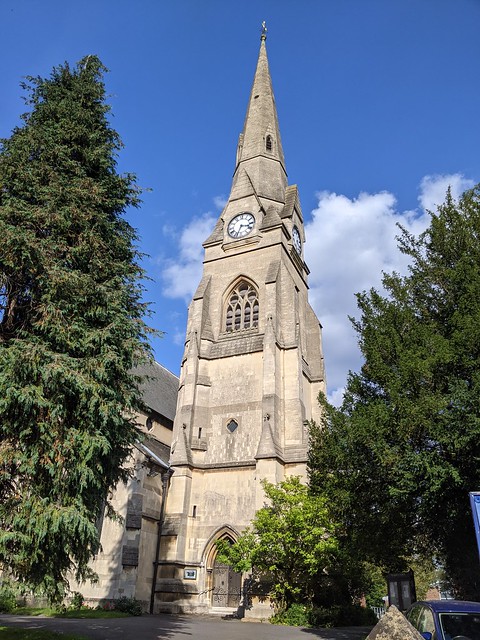
I passed The Isleworth Parish Church All Saints, which is an uncomfortable mix of 14th century tower and late 1960s modern because on the night of 27th May 1943 the church was gutted by fire; arson at the hands of two local schoolboys. Only the tower and outside walls survived. Rebuilding commenced in 1968 and was completed in 1970.
Skirting the churchyard on the raised walkway - the road often floods, along with the cars of anyone unfortunate enough to be using the riverside car park - I entered Syon Park through the gate in Park Road and followed the path towards Syon House. As I did so it occurred to me that the last time I’d walked this way was with my maternal Grandad. So I’d have been at most 8 years old. Grandad used to take me and sometimes my little brother for long walks from Myrtle Road, Hounslow, sometimes to Osterley Park but I clearly recall going to Isleworth one day and through Syon Park to Brentford. I expect Gran wanted him (and probably us) out from under her feet else he’d be in his armchair smoking Guards fags and we’d be being told off for playing with the mangle in the scullery 😀
Anyway back to 2024. Here’s Syon House, the west London residence of the Duke of Northumberland. A Grade I listed building, it lies within the 200-acre (80 hectare) Syon Park. These days it shares the park with a big garden centre and its car park and a Hilton hotel. It’s still not a bad pad for a Duke’s not-quite-country-any-more-etreat though it’s a shame they built it under the Heathrow flight path...

One day I must pay a visit to the inside but it’s shut in the winter. I left the park onto the London Road and made a short diversion to look at the rude lion.

Syon House's 'Lion' Gate is widely recognised. The row of arches, topped off with a lion which originally stood on top of Northumberland House on Strand, the Dukes of Northumberland's town house. The popular story goes, which was also told to me by Grandad Kimbell, is that its arse pointed towards Clarence House as an insult after the Duke of Northumberland fell out with the then Prince of Wales. The Lion Gate was designed by Robert Adam c.1769, oddly in Adam's original drawings the tail hung down naturally rather than being raised and pointing straight.
Brentford, battles and boats
I retraced my steps and continued in the direction in which the lion’s head is looking, towards Brentford town centre. One of the joys of walking around the streets is that you learn things in passing that you never knew. This time it was finding a plaque on the old brick boundary wall of Syon Park commemorating the fact that in 1616 – 1617 Pocahontas, a Native American woman, belonging to the Powhatan people, resided in Brentford with her husband, John Rolfe and son Thomas. You might know her from a Disney film. Or if you’re like me you’ll be reminded of Julian Clary’s “what’s a Hontas?” quip 😉

In November 1642 a Royalist army advancing on London overcame a much smaller Parliamentarian force in battle at Brentford. The town was ransacked in the immediate aftermath of the engagement. Now cynical types might suggest that parts of it haven't been repaired since but that's just the current round of regeneration. Having driven the Parliamentary forces out of Brentford the Royalists advanced to Turnham Green where there was a stand off between them and a large Parliamentary force. But the Parliamentary commanders didn’t think that their troops were trained well enough to risk an attack and and the King decided not to press his advance on London by giving battle against a greater force. He decided, as it was near the end of the campaigning season, to retreat to Oxford where his army could be billeted over the winter. Had the King pressed on the course of history might have been very different. Here’s a view downstream from Brentford Bridge under which the River Brent flows and over an earlier version of which Prince Rupert’s troops advanced. According to Grandad somewhere along that left bank stood the street and the house where Gran was born.

I stopped for a coffee in Brentford High Street before pressing on back to the riverside at Ferry Wharf where the River Brent/Grand union Canal make their confluence with the Thames having passed through Brentford Docks. In the back channel around Lot’s Ait are many houseboats and a boat building yard. Apparently some scenes in The African Queen were filmed at Lot’s Ait. I’ve no idea if that's true though some of the film was shot in Isleworth Studios which gives rise to the persistent urban legend that Isleworth is the origin of London’s parakeet population. Almost certainly not true.

I walked through Waterman’s Park, formerly part of Brentford Gas Works, noting that all but one of the wrecks has now been removed from the river pending redevelopment of the moorings. That can’t go ahead until they work out how to remove the last vessel which is so structurally unsound it can’t be re-floated. Everything is now tied up in red tape waiting permission and environmental mitigation plans. Oops.

As daylight faded I passed the tall tower of the London Museum of Water and Steam (aka Kew Bridge Steam Museum) and arrived at Kew Bridge just in time to hop on a 65 back to Richmond station.