Showing posts with label Rail travel. Show all posts

Friday, 27 June 2025

A Day in Cornwall

As I was going to St. Ives…

No, we’re not getting into that argument. Having arrived in Penzance on the overnight sleeper train I had all day to explore a bit of West Cornwall and 5 hours before I could check into the Western Hotel in St. Ives. My plan was first to take a walk along the coast to the picturesque harbour village of Mousehole via the fishing port of Newlyn. It’s a pleasant 3.6 mile stroll. At least it would be in nice weather. Unfortunately this morning the weather wasn’t nice. Grey skies emitted a fine drizzle into a light breeze making it just wet enough to need a waterproof coat while at the same time being warm enough to make wearing a waterproof coat uncomfortable. I set off trying to convince myself that it would brighten up imminently.

A wet walk, Penzance Harbour.

Organic Maps routed me out of Penzance centre via back roads and alleyways which at least kept away from any traffic before returning to the coast where the Larrigan River meets the sea, near a desolate looking and weed filled Mennaye Boating Lake. From here I walked along the causeway above the beach to the outskirts of Newlyn and passed the fishermen’s memorial statue “Throw Me A Line”.

A wet walk, Newlyn "Throw me a line" fishermen's memorial.

Newlyn is a working fishing port and has more wet fish shops than I’ve ever seen in one town centre. It hadn’t brightened up yet. I climbed out of Newlyn via Fore Street which at least afforded a good view of the busy harbour, the many boats injecting the only colours into the scene.

A wet walk, Newlyn Harbour.

This walk follows the route of the South West Coast Path long distance trail and for a while diverts from the motor road along a foot and cycle path next to the sea below the cliff. At the entrance to which I was nearly hit from behind by a lycra-clad bell-end-on-a-bike determined to get through the entry point before me. There are probably some good views along here but they were hidden behind the worsening drizzle on this morning. Thankfully at least some philosopher with a ladder and a pot of yellow paint had been out to brighten up the scene 😀

A wet walk, cliff graffiti, Newlyn.

The path climbed up and rejoined the clifftop road with fine views along the coast and I could even see St. Michael’s Mount in the distance. When I say see it I mean there was a slightly darker shade of grey where it was located. See if you can spot it 🔍

A wet walk, St. Michael's Mount "seen" from Penlee

Past Penlee’s disused Lifeboat Station the drizzle eased off a little so I could clearly see St. Clement’s Isle and intermittently unzip my coat to cool off a little on the way down into Mousehole, which I reached at about a quarter past ten.

A wet walk, Mousehole Harbour.

"Mouseholians" it seems are not early risers. The only places open at that time of the morning were an upmarket looking restaurant and a twee tea room, the latter was full. This despite the fact that the village was busy with visitors most of whom had had the good sense not to walk there. At least the drizzle had stopped so I could take off my coat and steam gently by the harbour. I had a mooch about the village, laughed at what I assume was a joke about Mousehole property prices (the blackboard against the lean-to building reads "Compact + Bijou Home with lots of potential. Offers over £100k")

A wet walk, Mousehole property prices!

and joined the queue for the bus back to Penzance.

The M6 bus between Mousehole and Penzance runs every twenty minutes during the day. It was not a pleasant experience because they use vehicles not much bigger than a mini-bus with seat spacing that appears to be designed only to accommodate children so I was jammed sideways into a seat on the back row. The bus was almost full leaving Mousehole and picked up more passengers on the way resulting in some juggling of people, seats, and baby-buggies along the way. I was hot, damp, and the windows didn’t open. Even the little old lady next to me remarked on how unsuitable the vehicle was though she said occasionally they go completely to the other extreme and you get a double-decker. Which must be very interesting when they have to turn it round in the centre of Mousehole. I was relieved to get off that bus in Penzance Bus Station I can tell you. I went and found a bakery and had a very large coffee and a sit down. Then since breakfast had been 5 hours ago I went hunting, I got a large Cornish Pasty because when you are in the county why wouldn’t you? This I took to the railway station platform and ate it while waiting for my next train. A big yellow thing started to appear in the sky and a big feathery greedy bastard appeared on the platform nearby. The sun was welcome, the seagull could bugger off. Also it is still a mystery to me how they get Cornish pasties so hot and how they appear to get hotter while you’re carrying them so that when you come to eat it it’s like biting into a volcano? It was a very nice pasty though - the very antithesis of a Ginster’s 😁

As I arrived at Penzance station so did one of GWR’s Intercity 125 HST “Castle” trains. These are soon to be retired and I can remember them when they were first introduced on BR’s Western Region in the 1970s. I was tempted to skip a departure to have a brief ride on it to St. Erth for old times sake. In the end I got the next boring Hitachi IET instead which gave a shorter wait for the St. Ives train at St. Erth.

43 187 Cardiff Castle at Penzance

I was glad to see that summer time four coach train arrive into the crowded platform at St. Erth (outside the summer there are only two coaches). Anxious to get a good seat I forgot that the views were on the right hand side and indeed that side of the train quickly filled up with people, although not the polygamous, sack of cats carrying kind. Anyway, as we rode down the branch line the weather finally improved and we arrived at St. Ives in bright sunshine.

Harbour Beach, St. Ives.

St. Ives was very busy. I walked from the station to the harbour and from the harbour to the Western Hotel, located in the town centre. What can I say about the Western Hotel? Here’s the review that I posted on booking.com which I think sums it up:

Good location, comfortable, not cheap, not very organized.

Liked · Nice big room, comfortable bed. Good central St. Ives location.

Disliked · Arrived to check in at reception, reception is a phone on the desk. Call was answered and waited for receptionist to come and complete check in. I was handed keys and given directions to my room. On finding my room it was immediately obvious that it was already occupied by someone who was fortunately out at the time. Return to reception, call, wait, wait, wait, eventually allocated a different room and given keys. No explanation other than “the booking system made a mistake”. Inconvenience aside this error has security implications if they are giving out keys to rooms already occupied. And of course when I went for breakfast the restaurant staff had not been advised of the room change.

However the room was pleasant, overlooking the Royal Square (bus stop) outside and I was glad to have a shower after which I had a nap for a couple of hours, dunno why I was tired. Later I went for a wander around St. Ives. It was still very busy. Hmm, that’s a lot of clouds and yes, those are spots of rain.

St. Ives Harbour from Quay Street

Cue retreat to hotel with snacks and a bottle of cider. Later: there is music downstairs let’s go and investigate (and get another cider). Ah, Tuesday Night is Jazz Club Night. 

Nice 👌


The audience demographic was pretty much exactly what you’d imagine, the band was four old white men, it was heavy on the double bass, drums and trumpet. I caught the last half hour which in jazz terms means three tunes. What’s with the applauding half way through a song? Is it a jazz thing? At ten past ten they finished and most of the audience rushed across the road, bus passes in hand. I went to my bed and slept like a log.

The next morning I rose, showered, dressed and headed downstairs for a cooked breakfast which was pretty average and preceded by a discussion about why my room number wasn’t on the breakfast list.

I checked out, by which I mean left my key on the empty reception desk as instructed, and made my way to St. Ives station in hazy, humid sunshine with just a trace of fine drizzle. There was quite a crowd on the platform awaiting the train to St. Erth. I remembered to sit on the left side for the views.

 Porth Kidney Sands from the train

 At St. Erth my train to Reading appeared on time and I settled down into my seat up the front in 1st Class. What? You can’t take it with you, you know. Anyway it was only eighty quid Advance Single with a railcard, half what the trip down had cost.

IET 802 110 arriving at St. Erth.

The Americans appeared. They seem to be travelling with everything they own, they put all their huge suitcases in the wheelchair space, whined when told they needed to move them and complained about there not being enough space for their luggage. There was plenty of space under and between their seats. As soon as they got aboard they started stuffing their faces and wanted to know when lunch would be served - it was ten-thirty in the morning at this point. Then they started spreading out the John Lewis tote bags of food onto adjacent seats because their table was full. As the coach filled up through the journey they had to retreat and at last went quiet and disappeared into their devices. Deport them to El Salvador I say 😉

For once the rest of the journey was unremarkable and I arrived home at four in the afternoon, about 46 hours after I’d left.

Would I do the night sleeper again? Well I’ve done it, don’t regret it, don’t need to do it again. It’s always nice to visit Cornwall though, however briefly so if you’re short on time it’s worth considering finding out if you can sleep on a train.

For anyone who avoided spoilers in the previous post here’s a FlickrAlbum of photos from my trip.

Thursday, 26 June 2025

The Night Riviera

The Night Riviera is a sleeper train which runs from London Paddington to Penzance in Cornwall (and from Penzance to Paddington) 6 nights a week. I’d long fancied trying it to see what it was like so booked a brief trip to Cornwall to find out.

This is what I found out:

I booked just over a week in advance with a Railcard and paid £57.70 for a Super Off-Peak Single London Terminals to Penzance plus £89.00 for a sleeper cabin. You can forego the cabin and get an airline-style seat for no charge if you want to try and sleep in a chair in a room full of strangers instead. A cabin also gets you use of the lounges and showers at Paddington, Penzance, and Truro and a complimentary breakfast served to your cabin. Although the Night Riviera picks up passengers at Reading I opted to start at Paddington because who wants to hang around on Reading station at twenty to one in the morning, especially given that nearly everything on the station is shut by eight-thirty in the evening? That was another £21.20 for an off Peak Single with a Railcard but worth it. The 1st Class lounge at Paddington provided free hot drinks and snacks too.

As usual the train I intended to catch to Reading for a connection to Paddington was cancelled and the following one would just get me there in time - assuming it ran at all. Not wanting to risk it I left home early and got the previous departure, itself running twenty minutes late, and arrived in London with quite a bit of time to kill. So I went for a stroll around Tyburnia and had a pint before heading back to the station.

The lounge is located on platform 1 which is from where the Night Riviera usually departs but tonight we were directed to platform 8 instead.

Night Riviera at Paddington

I walked up to the front of the train to get the obligatory photo of the locomotive and then back to find my cabin in Coach F. Once aboard a nice lady came and checked my ticket, gave me the low-down on the train’s facilities, and took my breakfast order and what time I’d like it delivered to my cabin. Once settled in I went to explore the train along the very narrow corridors to the Lounge/Bar coach. This was very busy so I didn’t stop longer than necessary to drink a Coke.I went back to my cabin just as we departed Paddington at 23.46

Night Riviera, sleeper cabin.

The cabins have two bunks but for single occupancy the upper one is stowed away. The bunk is fairly narrow but because it runs across the coach it is plenty long enough for someone 6’5” tall - hence the narrow corridor in the coach. There’s a bedside table that lifts up to reveal a sink with hot and cold running water (and it is hot too) and a rubbish bin beneath. Light switches, 240v AC, and USB power outlets are located by both bunks along with a room service call button. Yes, room service is available all night if you don’t fancy going down the corridor to the lounge car in the night. There’s a connecting door to the adjacent cabin that is locked unless a party of more than two books adjacent cabins. What you will need to go down the corridor in the night for is the loo. Two are located at the ends of the coach. The sign outside your cabin will point to the ones in your coach but if your berth number is above 15 it’s almost certainly closer to the toilets in the adjacent coach and the coaches are all walk-through connected.

Night Riviera sleeper corridor

I sat on my bunk with the window blind open and watched the night slide by. Quite slowly especially since there were some track works going on. Not that the Night Riviera is a fast train. It takes about eight hours including stops to reach Penzance, a daytime express will do it in around five. After the stop at Reading I closed the window blind got under the duvet put my head on the comfortable pillows and prepared to nod off.

Night Riviera, sleeper cabin.

I might even have done so for a few minutes at some points in the next six hours. I have discovered something and that something is that I can’t get to sleep on a moving train. I wasn’t uncomfortable or anything like that but sleep refused to come. I think a lot of the problem was the novelty of the situation which wouldn’t let my brain switch off. The train trundled on through the dark stopping occasionally at a signal raising the question “I wonder where we are now?” and of course the temptation is to check on the map on the phone or take a peek out of the window. The tracks to the West Country are mostly smooth but not always straight and lying horizontal across a train in the dark subjects you to some odd G forces, with no visual references you feel like you are first being gently pointed head down then a moment later feet down. Onward to Devon, occasional sections of jointed rather than welded track for traditional ta-tum-te-tum train noises. At Exeter the train paused and reversed, I heard the locomotive run around the train, passing my window before re-coupling to the other end with a jolt. Clumsy bugger, doesn’t he know people are trying to sleep? 😀 A consequence of this manoeuvre that didn’t occur to me until later was that my cabin window which on leaving London had been on the left side of the train was now on the right so wouldn’t get any spectacular sea views along the coast at Dawlish 😢

By 6 a.m. it was getting light outside (although the window blinds are very effective) and I concluded that I’d had any sleep that I was going to get so cancelled the alarm I’d set on my phone, got up, washed (blimey that water is hot!) and dressed. I opened the blind and watched a very grey Cornwall passing by. Because of course the bright sunny weather we’d had all month had vanished as soon as I set off travelling - payback for having such unseasonably good weather when I was in Scotland I suppose.

Night Riviera, near St. Germans.

We stopped at Liskeard, we stopped at Bodmin Parkway, and as we approached Par the nice young lady knocked on the door bearing a tray with a very welcome pot of tea and a sausage bap on it. Also brown sauce, tomato ketchup, and for some reason some sweet biscuits which I kept for “Ron”. 😋

I watched stops at St. Austell, Truro, and Redruth pass by and resisted the temptation to pull faces out of the window at the few early morning commuters on the opposite platforms. At Hayle I tried to get a photo of the river but mostly got the back of Asda. The penultimate stop was St. Erth where I noted the way to the platform for the St. Ives Bay Line that I’d be on later. I also noted how wet the platforms looked.

Night Riviera calling at St. Erth.

Finally at ten past eight we arrived at Penzance - that was actually 15 minutes late so I might try my luck for Delay Repay 😄 I gathered up my luggage, which consisted of one 30l backpack, and alighted onto the platform with a lot of people who had obviously come equipped for a six month expedition to the outback. I headed directly to the coffee machine in the customer lounge and a seat on which to plan my next move.

Night Riviera final stop, Penzance.

I was in Penzance at 8.30 in the morning with five and a half hours to kill before I could check into my hotel in St. Ives. What the bloody hell am I supposed to do now?

Find out in the next “exciting” episode!


 Spoilers: Flickr Album of my photos from my Night Riviera  trip to Cornwall


EDIT 4th July. Got £14 back in Delay Repay for being 15 minutes late at Penzance and £21.20 (the full ticket price) back for the delay caused by the cancellation on the Sandhurst to Reading journey. Result!

Saturday, 31 July 2021

The Source of the River Thames


Monday 26th July 2021

We’d got back our “freedom” and the rain had let up for the day at least according to the forecast. Time to pick a random destination and get back on the rails.
 
The source of the River Thames lies in a remote meadow near the village of Kemble in Gloucestershire - which used to be in Wiltshire. At least the official source is, some argue that it’s actually at Seven Springs about 11 miles further north at the source of the river Churn because that flows into the Thames and is further from its mouth. That would make it the longest river in the UK but must be wrong otherwise surely the river that runs through Reading,Oxford (yes, I know, Isis), and London wouldn’t be called the Thames and the rowing regatta would be held at Henley-on-Churn. Also the former TV channel would have been Churn Television although you could argue that would have been more apt.
 
Anyway the source in Trewsbury Mead has an official memorial stone and a signpost and all that so ignore the pedants. It’s also conveniently not too far from a railway station (Kemble) and a pub so that’s where I went to find the start of the longest river in England. No, the Severn is partly in Wales so you can delete the comment you were about to write.
 
 GWR Class 165 at Sandhurst
 
We now have a somewhat irregular service pattern on our railway line, introduced last year to go with the replacement trains that we haven’t got yet, which means that as far as I can make out the first off-peak service to Reading, to connect with the GWR main line, is at 1026. That would have got me to Kemble at 1140, plenty of time to walk to the source and then go and have a pub lunch. Unfortunately as well as being irregular the service is unreliable and that train was cancelled due to a points failure and the next was consequently about 20 minutes behind schedule arriving at Reading just in time to watch the 1153 to Kemble (the one an hour later than the one I should have been on) depart from platform 7. There is no 1253 train from Reading that stops at Kemble so I had to go to Swindon and wait for a train to Kemble that started there. Actual arrival at Kemble was 1341 a bit late for lunch (good job i’d bought a picnic on the way) but just qualifying for a 100% Delay Repay refund on my ticket. I’d have preferred to have been on time.
 
 Kemble Station showing the start of the abandoned Cirencester branch line to the right.
 
Kemble Station is small, with long platforms and a large water tower at one end of the down platform in traditional if faded GWR colours. Since this part of the line hasn’t been electrified it also still has its iron lattice footbridge linking the two platforms, not yet replaced in order to provide space for overhead wires such as has happened elsewhere. From the road bridge on the London side a spur of track can be seen leading off to the north. This is the remains of the Cirencester branch line, opened by the Cheltenham and Great Western Union Railway in 1841 and closed on 4th October 1965. This branch crossed the course of the River Thames north of Kemble at about where the A429 does now, making it then the highest/uppermost rail crossing on the river.
 
It’s about a mile and three quarters (2.8km) from Kemble Station to the source of the Thames, leaving the station north car park and turning left for a few yards then right onto a broad grass footpath and you are off the road for the rest of the walk except for crossing the A433.
 
© OpenStreetMapcontributors
 
A little way before getting to the A429 there’s a Thames Path sign pointing left over a wooden footbridge and shortly after you are following the River Thames. It might be a little difficult to spot unless there’s been a lot of rain though. On my visit it was visible only as a reed-filled ditch about 3 yards across.
 
 The River Thames, only a reed-filled ditch here.
 
Further along the path crosses a farm track which itself crosses the Thames on a sort of low bridge or culvert, so water must flow here in some quantity at times although it was bone dry today.
 
 The first "bridge" over the Thames, albeit very dry today.
 
The Thames Path rises to cross the A433 Tetbury to Cirencester road near where it crosses the Thames, which it the highest road crossing on the river although in contrast with the lowest crossing it requires neither bridge nor tunnel to do so, the river being small enough to be culverted so it’s hard to work out where the actual crossing is.
 
 At the A433, the highest road crossing the River Thames, or at least the course of it.
 
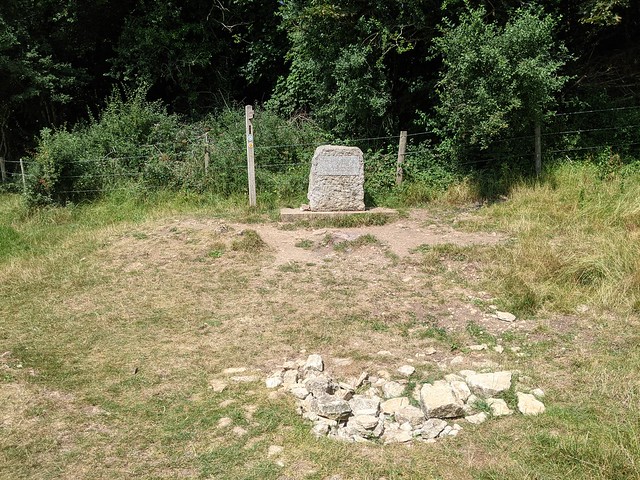
I followed the clearly marked path that climbed gently across the fields of Trewsbury Mead to the obscure corner the edge of the woods where the stone memorial and a pile of rocks in a shallow depression mark the official, accept-no-substitute Source Of The River Thames.
 
 The Official Source of the River Thames
 
The inscription on the stone, unreadable due to wear and bright sunlight, reads
 
"The Conservators of the River Thames
1857 – 1974
This stone was placed here to mark the
Source of the River Thames".
 
Alongside the stone is the first (or last) Thames Path footpath sign, pointing the way down the 184 miles of the national trail to the barrier at Woolwich, which is definitely a lot noisier and busier than this end. I ate a solitary picnic against the only suitable tree that I could find to shelter under from the now quite hot sun, not even disturbed by the middle-aged couple walked down from the other direction, took their selfies, and returned the same way.
 
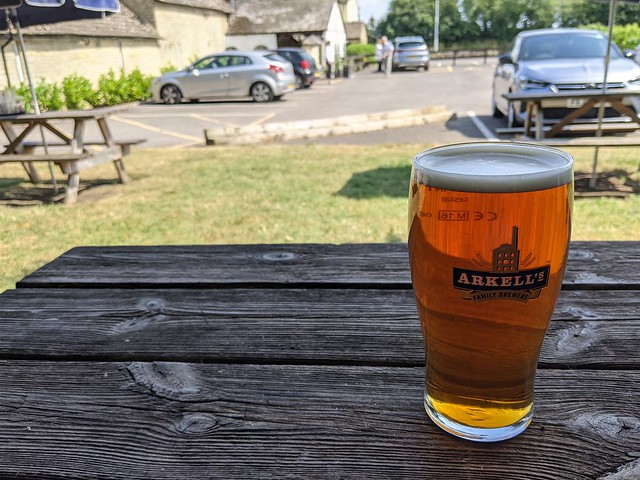
Then I returned along the Thames Path to the A433 and turned right along the road and under the railway to the Thames Head Inn. Because it would be rude not to really. It was the first time I’d set foot in a pub for over a year due to you-know-what but i remembered how it worked and enjoyed a nice pint of Hoperation IPA (ABV: 4.2%) sitting in the shade in the beer garden. I might have had another but had a train to catch from Kemble three quarters of a mile away down a country lane. A train which actually ran on time, as did the connection at Reading, making a better end to the day out than the beginning. 


 A welcome refreshment at The Thames Head Inn.

Sunday, 22 September 2019

In an Air Raid, Don't Stand and Stare at the Sky

Sunday 8th September 2019

Take cover at once!

In Stockport near Manchester you could take cover in the public Air Raid Shelter carved out of the sandstone cliffs.

Now the Luftwaffe aren't (at least for now) making nightly visits to Greater Manchester but you can still take cover in the Stockport Air Raid Shelters because the council have opened them up as a museum. Also £5 per adult and accompanied U16s go free is more than reasonable.

In the reception area you get a short talk from a guide and then issued with a little audio guide. I must say this is one of the best, clearest, and easiest of these that I've come across at any visitor attraction. Eltham Palace take note. When you see a "target" on the wall present the device to it and off it goes with a brief talk related to that location.
First off though there's a short sound and light show in a darkened room about the building (or rather digging) of the shelter, followed by a brief air raid simulation.

Then you're off on your self-guided tour aided by the audio device.

I'm not sure that the group I was with were paying much attention mind you as they soon disappeared ahead leaving me in peace to explore.

The shelter has displays in  various rooms, medical post, canteen, office, and of course the communal khazis.

The shelter is much bigger than the area that's currently open and lit for the public to visit.

The unlit, fenced off bits, I believe are sometimes accessible on special tours.

This picture was  taken using the "night sight" mode on my Pixel 3a smartphone through the fencing and shows more than I could actually see as it was as my Mum would have said "as black as your Grandfather's" in there.

There are lots of information display panels to read if you want to, some of which you'll have to wipe the condensation off first, it's a good job they're made of something waterproof. Imagine how damp it would be down here with several thousand people sheltering from the bombing above. Here's some more pictures:

Stockport

After the shelter I had a look around Stockport town centre. There was a big street market going on which was mostly selling street food of the sugary and/or fatty variety and having failed to find a fruit 'n' veg stall I resorted to lunch from Sainsbury's and a coffee from a cafe in a mostly shut down shopping mall.

Stockport town centre is otherwise nice with plenty of old buildings and on multiple levels. Most of the populace however, even those without their faces buried in smartphones, seem incapable of looking where they're going making it something of a cross between an obstacle course and the dodgems. There's an impressive market hall, holding some sort of craft fair but since charging to enter what is essentially a shop is taking the piss I didn't.

Back to the station and one of the frequent fast trains (it's on the main line} back to Manchester for one last night and a pint in a very empty Lass O' Gowrie.


Blackpool

Saturday 7th September 2019

Blackpool is to Manchester as Brighton is to London.

Never having sampled the delights of Blackpool and being just a train ride away in Manchester it seemed rude not to grab an Off-Peak Return and have a day out at the seaside, especially as the weather forecast was for day-long sunshine.

Up, breakfasted, and at Manchester Piccadilly for 0930 to catch one of Northern's finest Class 319s, Which was not as busy as I'd expected for a Saturday though by no means empty. It was about an hour and a quarter's journey via Preston to Blackpool North station, which is about a 10 minute walk from the North Pier. Which is as good a place as any to start the experience that is Blackpool seafront.

One pier out of three done. 

I walked south along the prom. There's no getting away from that tower is there? Though I baulked at the £25 they wanted in order to stand at the only point in town where you can't see it.

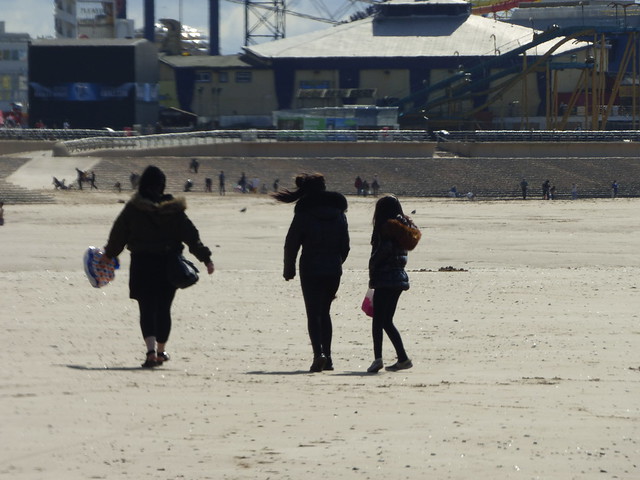
Or from the great expanse of sandy beach, something that Brighton cannot boast, being like so many south east England beaches, all shingle).

They still have donkeys on the beach too, I'm surprised that the animal rights campaigners haven't had them done away with by now.

Pier two, Central Pier, dominated by its ferris wheel and funfair.

Central Pier contrasts from the more genteel North Pier, the emphasis being on family fun. And it would appear drinking given the big "Family Bar" sign painted on the roof of the building on the pier's seaward end. I'll give that a miss.

Onward south past and being passed by Blackpool's famous trams and the pleasure beach to pier three.


South pier is the newest and shortest of the three, originally called Victoria Pier.

It's now largely a funfair and another family bar.
Outside were parked horse-drawn carriages designed solely to extract the contents of the wallets of fathers with small daughters.

It's also on a part of the sea front devoid of any public toilets as attested to by the graffiti on the council information signs and I was desperate for a piss so headed back towards the pleasure beach where there are conveniences hidden away at the back and unsignposted. Head for the car park behind the round building which contains Costa.
I walked back up the beach to Central Pier, then had a mooch around the town and bought sticks of Blackpool Rock because you have to really don't you?

I couldn't come to Blackpool without going on a tram either so took a ride all the way south to Starr Gate, next to the tram depot and at the quieter end of the seafront - if you discount a few fast military jets operating out of the nearby airport. The beach here is dotted with warning signs about the danger of being cut off by the incoming tide but I still saw a dog walker and two anglers leaving it a bit late and being surrounded by the slow advance of the water.

Blackpool was everything that I expected it to be and having returned to the north end of the prom I bought a fish supper and headed back to the station to get the train back to Manchester. A train that was rather noisy with parents who'd been knocking back the lager and the gin all afternoon and their small charges who by this time were over-tired and fractious. The joys of public transport.

Here's a Flickr Album from the day which contains rather a lot of photographs of that tower.

Blackpool

Sunday, 15 September 2019

"Mancunium" "Cottonopolis", Manchester.

5th September 2019

According to Wikipedia, "Manchester is the third-most visited city in the UK, after London and Edinburgh. It is notable for its architecture, culture, musical exports, media links, scientific and engineering output, social impact, sports clubs and transport connections. Manchester Liverpool Road railway station was the world's first inter-city passenger railway station; scientists first split the atom, developed the stored-program computer and produced graphene in the city." Sounded like a good place for a long weekend away then. I've done the first and second.

After a long journey on a Cross Country Trains Voyager (which was only 36 minutes late into Manchester Piccadilly) and a slightly confused walk from the station (exits on different levels, should have come out the lower one on Fairfield St., I later worked out) I found the Pendulum Hotel and booked in. This is part of the University & Conference Centre, close to the city centre and stations, was cheaper than a Premier Inn, and much nicer. The view from my room was pretty much what you'd expect in a city centre hotel (see above). The staff (and the breakfast) made up for the lack of view. Oh, and the giant pendulum swinging back and forth in the middle.

First evening explore on foot around the city centre. They're right, there's a lot of architecture, from ornate red Victorian to shiny steel and glass 21st century. Plenty of history evident on the streets.

Having watched many of Martin Zero's Youtube videos exploring Manchester (it was one of the things that influenced my decision to go there) I found I kept recognizing random bits of the city, particularly around the River Medlock 😃

I also took a ride on a Metrolink Tram out to Media City where amongst the shiny new studio buildings and trendy bars and restaurants they have something that claims to be the Blue Peter Garden.

How can this be true? The real Blue Peter garden for those of us of a certain age will always be the one in London, famously not vandalized by Les Ferdinand and Dennis Wise 😈


Back in the city centre I was finding Manchester an easy place to get lost in. It took a couple of days to get my bearings. But  I found another place I recognized from a Martin Zero video, The Lass O' Gowrie pub in Charles Street.

A splendid looking Victorian glazed tile pub with a good selection of decent ales (and cheap for a city centre as well) and only a short walk from the hotel. I had found my temporary "local" for the duration of my stay.

Also this.

I've seen some interesting and unusual statues in cities but...


Saturday, 31 August 2019

Marston Vale Line (The D Train)

26th August 2019

Some of London Underground's former D Stock trains which were retired from the District line in 2017 have been "up-cycled" by Vivarail to become the new Class 230 main line trains, the first of which in service are operated by West Midland Trains on the Marston Vale Line between Bletchley and Bedford. They're been running since April, I finally got around to checking them out today.

Bletchley

I first came to Bletchley in 1979 for the first of three Post Office Telecommunications engineering apprenticeship courses. These were held at Bletchley Park a short walk from the station, then just a PO and CAA training school but shortly afterwards to become famous for it's previous use as the centre of code breaking in the second world war. Few knew then about "Station X" and those who did mostly didn't talk about it.

Now of course everyone knows and it is the home of Bletchley Park Museum

It's also the home of the National Museum of Computing which is on the same site but now a separate entity with it's own entrance and admission fees. I understand there was some kind of falling out between the two. I last visited when it was all one (and there were still people working there who'd been there when I was an apprentice!) and for my money I'd say the most interesting bits - the Bombe and Colossus machines - are in what's now TNMOC.

Ah yes, the train. The Class 230 arrived in the blazing sunshine. I am told (by @AMinorMuddle) that locally the Class 230/D Train is called the Penguin, I can see why 😀

Inside the new trains are very different from their District Line days. Clean and modern with a mixture of sideways and fore and aft seating, lots of charging points, cycle and wheelchair spaces, and toilets! At the same time they were also familiar. The sounds of the doors and of the traction motors, supplied with current in this version of the train from a diesel generator set under the floor but a battery pack version is also available, and they even smelled like D stock. I might have been hallucinating about that last bit because it was a very hot day and the ventilation system was only just coping, especially when stopped in a station.

Fenny Stratford

The town name is Old English meaning 'marshy ford on a Roman road'. The Roman road in this case is Watling Street. Fenny Stratford should be more famous than it is.
The world's first successful heavy oil engines were invented and built by Herbert Akroyd Stuart in Fenny Stratford. These engines were precursors to what is now known as the Diesel engine: Rudolf Diesel based his designs (1892) on Akroyd Stuart's proven inventions (1890) of direct fuel injection and compression ignition. An experimental model was used at the offices of the Fenny Stratford Times Newspaper, and the first production models were installed at the nearby Great Brickhill Waterworks where they were hard at work from 1892 to 1923. Perhaps we should call them Akroyds rather than Diesels?

Bow Brickhill

In spite of the brickmaking history of the area the village name is a combination of Brythonic (breg) and Old English (hyll) words for 'hill'. The 'Bow' comes from an Anglo Saxon personal name, Bolla. 

Caldecotte & Tilbrook should be a TV detective duo.

The railway station, about half a mile from the village, opened in 1905.


Woburn Sands

The village once had the unfortunate name of  Hogsty End until they changed it. The modern name is credited to a schoolmaster unable to attract business to his "Hogsty End Academy", and was one of the first to promote the use of the new name.

It doesn't have a beach but it does have some nice colourful murals arranged by the community rail partnership and apinted by local schools.


Aspley Guise

Famously the Least Used Station in Bedfordshire - at least it was in 2017, I have a nagging feeling that may have changed now but I'm not sure.

Built as one of seven new halts for a steam rail motor service between Bedford & Bletchley inaugurated in the autumn of 1905 it was initially constructed of old sleepers; it temporarily closed from January 1917 until -May 1919 as a World War 1 economy measure.


Ridgmont

The former station house, built in 1846 in the Cottage Orné architectural style, underwent a total refurbishment in 2014 managed by the Bedfordshire Rural Communities Charity with funding from the Railway Heritage Trust. 

A tea room, gift shop, disabled access and toilets, additional car parking, three small 'start-up' offices and a meeting room have been provided. 

The former Victorian booking office has been restored as a small heritage centre.

By way of contrast the station also serves the big Amazon.com warehouse nearby.

Lidlington

No, it's not named after the supermarket, it's been around much longer - long enough to get a mention in the Domesday Book when it was held by the Abbess of Barkway. It appears next in the historical records in 1247 when the Abbess (likely not the same one) erected a gallows to deal with the lawless, presumably so they could find christian forgiveness at the end of a rope.
Lidlington Station has been modified to have staggered platforms either side of the level crossing in order to reduce the time the barriers spend down, as with a number of others on the line.

Millbrook

Opened as 'Marston' in 1846, changed to 'Ampthill (Marston)' in 1850 and the to 'Millbrook for Marston' in 1877 to avoid confusion with the Midland Railway Ampthill station, and shortened in 1910 to just Millbrook. The station had much coal traffic and served the nearby brickmaking industry, via a siding opened in 1928.

The Millbrook Proving Ground vehicle test facility is nearby but brickmaking is now history.


Stewartby

Opened as 'Wooton Pillinge Halt' until 1928 when the 'Halt' was dropped the village was the site of a thriving brick making industry. In 1926 the London Brick Co. began to build a "garden village" for its employees at Wootton Pillinge. The village was named "Stewartby" after Sir Halley Stewart, former Liberal Party MP and the first chairman of the Wootton Pillinge Brick Company. Following the building of the village, the London, Midland and Scottish Railway renamed the station to Stewartby. The old boys network in action.

Kempston Hardwick

One of three halts opened by the London and North Western Railway in 1905 between Stewartby and Bedford. All three closed as a wartime economy measure during the First World War and two were closed during Second World War, never to reopen, leaving Kempston Hardwick as the only survivor. Its survival can be attributed to its convenient location for the nearby Eastwood's Brickworks which was served from 1928 by a private siding on the up side of the line. Bricks however were the downfall of the station buildings which were demolished after being hit by a lorry carrying the things. In 2003 only 38 passengers a month used the station though by 2017/18 that had risen to around 410 due to the creation of more local jobs.

Bedford St. Johns

St. Johns is was the first station in Bedford, on the Oxford to Cambridge line. After that line closed the station declined and in 1984 a new chord line was built linking the Marston Vale Line to Bedford Midland Station, and a new single platform Bedford St. Johns was built in the former freight yard. The old station site was abandoned, although some of the furniture, such as lamp posts, was not removed. The site has now been reclaimed by nature.


Bedford

Formerly 'Bedord Midland Road' this is where the line from Bletchley now terminates, meeting the Midland mainline from London St.Pancras to the East Midlands. 

Having suffered badly from the attentions of the Luftwaffe a replacement Bedford station 110yds North was opened in 1978 and the lines were re-aligned. This is the station that in 1984 the Marston Vale line was connected to and the old St. Johns station abandoned.
It's a half mile walk from the station to Bedford town centre and bus station, signposted and marked on the pavement with signs and big yellow footprints. The route takes about 10 minutes via marijuana-scented residential streets of Victorian and Edwardian houses and is light in road traffic at least until it emerges at the big roundabout by the Police Station and opposite the Bus Station.

Bedford town centre is an "interesting" place to visit on a Bank Holiday afternoon. At least it still retains it's post-war architecture, reminiscent of Bracknell town centre before it was destroyed and replaced by yet another giant privatised shopping mall.

I got a window seat in the Hallows Cafe & Restaurant, got coffee and cake (table service too) and was entertained by various locals shouting, swearing at, and threatening each other. The cast of this impromptu street theatre included a bus driver, a drunk, and a fat, pallid knuckle-dragger who really, really shouldn't have been allowed out in public shirtless and wearing white knee-length nylon shorts tight around his navel. The cake was nice, the coffee average. I walked back to the railway station and caught another Penguin back to Bletchley.