Showing posts with label History. Show all posts

Thursday, 9 February 2023

Gone to the Tower

27th January 2023

To the best of my knowledge I had never in almost six decades stepped inside the Tower of London. A Christmas present of a year’s Historic Royal Palaces membership gave the opportunity to rectify that omission. It was much as I expected and yet in some ways not. For a start in January it was less crowded than I had feared. 
 
 Tower Of London, White Tower
 
Even so I’d had to book a timed ticket for entry, a lingering after effect of the COVID pandemic that’s now common to many public attractions. Arriving at my allowed time I joined the next guided tour of the grounds led by a Yeoman Warder. These are worth taking for a general scene-setting laced with some mild squaddie humour - the 33 YWs being  all long serving military personnel - and you get a slick, well practiced performance covering the history of the castle, majoring on the infamous and bloody bits.Those bits include  the well known beheaded queens, missing presumed murdered princes etc. but there’s a lot of other stuff covered as well including about the Yeoman Warders themselves.
 
After being dismissed on Tower Green by the former site of the scaffold you can explore on your own.
 
 Tower Of London, Tower Green.
 
 I went for an amble around the smaller towers and inner ward then past the armed guards into Waterloo Block to see the Crown Jewels which you’re not allowed to photograph. Several items were off site being prepared for this summer’s coronation of King Charles III. Where he will be crowned, not effing “coronated” as I heard said more than once in there.
 
Having been funnelled out through the “Jewels Gift Shop” at the East end of Waterloo Block I eschewed the Fusiliers Museum - regimental museums tend to be much alike - and headed instead for the cafe in the former Royal Armouries where I can tell you they do a decent cuppa and you get 10% off as a member. I can come back again for the Fusiliers.
 
 Tower Of London, Armouries, Hospital, & Fusiliers Museum blocks, Inner Ward
 
 After that it was time to follow the group of French students up the wooden stairs into the White Tower, the central keep that is the feature of many a classic view the Tower of London. This is several floors mostly stuffed with arms and armour including that of the ever present Henry VIII and his massive codpiece.
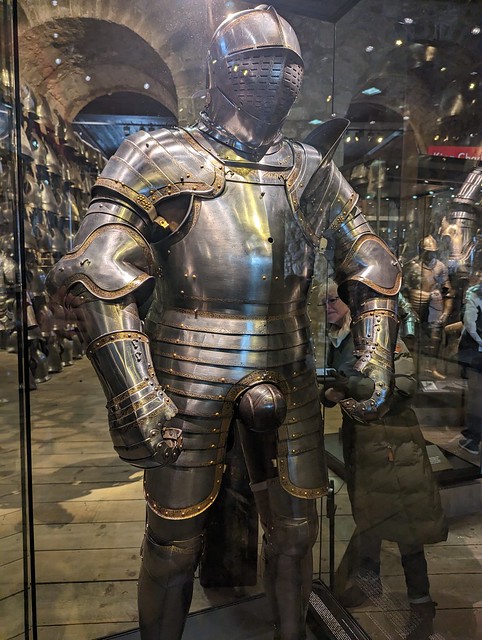
 
 Tower Of London, Armouries Exhibition, Henry VIII
 
 There’s a lot to see inside the White Tower, it’s really a museum within a museum, the Royal Armouries Collection is huge and due to the one way system employed to keep the tourists flowing I’m convinced there was a bit that I missed. Still, membership, I can go again. The Yeoman Warder on the earlier tour had warned that there was something truly horrific located in the basement, yet another gift shop to negotiate in order to reach the exit. There’s also an exhibition about the other methods of torture formerly employed at the tower but that’s located in the Lower Wakefield Tower across the inner ward.
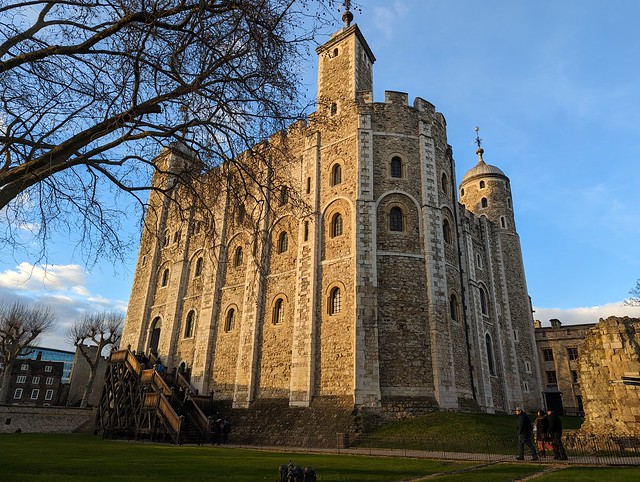
 
 Tower Of London, sunset at the White Tower.
 
Having explored most of the rest of the Tower’s nooks and crannies, or at least those open to the public, the day was drawing on and I was rewarded with a shot of the early evening sunset illuminating the White Tower before I handed for the exit. The Tower of London is one of the city’s biggest tourist attractions and worth a visit, probably needs ore than one. I’d avoid the main summer tourist season though, it’s probably absolute torture.
 
Visit the Tower of London  Official Web Site
 
 
Oh, and I can confirm that the ravens are still there. Most of them currently confined to an aviary to protect them from Avian Flu but one has escaped and is flying about scaring the shit out of tourists from the far east who are unwise enough to attempt to get a selfie with him.
 
 Tower Of London, Ravens Enclosure.
 
 Which means that there must be a different reason that the Kingdom appears to be headed down the crapper.


Saturday, 11 April 2020

Avoiding Steep Hills where possible

A recent Twitter post by Paul Whitewick about an early road atlas reminded me that on my map shelf (What? Don't you have one?) are some AA "prepared routes" made for my parents in the early 1960s.

AA Prepared Route Maps
While not as old as the one Paul's looking at they do provide a reminder of road travel in a time before sat-nav, largely before motorways, and when the performance of cars required careful route planning to help ensure a trouble-free journey.

The earliest from 1960 goes from Kingston-upon-Thames to Sidmouth in Devon, a journey of 158¼ miles according to the front cover, Google maps suggests 154 miles today. A year later they were off to another favourite holiday haunt, Hayle in Cornwall - probably to join Mum's parents who rarely went elsewhere - a much longer 267¼ miles. Although the AA route starts at Harrow & Wealdstone Station and they lived at Heston so you can knock about 7 miles off that.

This route has on the cover the endorsement "(Avoiding Steep Hills where possible)". This isn't some thing that we often need to think about now with most modern cars having ample power to tackle any hill in this country excepting the few exceptional steep mountain passes.

It was a factor in 1961 however, particularly if your "sports car" only had a 328cc motorcycle engine (and only three wheels). Failure to plan ahead might result in your passenger having to get out and carry the suitcases!

Having said which the photo here was taken in Wales where nothing is flat except sometimes the beer.
The prepared route maps are a little odd to look at at first.

 The list of instructions on the left of the page run from top to bottom.

The strip map on the right of the page runs from bottom to top so that you are looking at the map in the direction of travel, which is logical once you've thought about it but a little confusing at first.

A North-pointing arrow is included in the map for orientation purposes and at the top of the page a brief description of the terrain through which you;ll be travelling is given.

The return trip is printed on the reverse of the pages so when you want to come home you simply open the booklet at the back cover and follow the instructions and maps as you did on the outward trip.

For 1963 the destination was Skegness, the Berkeley had been replaced by a Ford Popular 100E and the passenger count was increased by one. For 1965 it was Skeggy again though by then an Austin A35 Countryman (like Wallace and Gromit's van but with side windows) had replaced the Ford. Steep hills were less of a concern and something else had appeared on the maps.

Section Mill Hill to Baldock
North of Hatfield was  Welwyn "The Clock" Motorway Terminal. The southern end of the A1(M) motorway section between Welwyn and Stevenage had opened in 1962. (This is now Junctions 6 to 8.)

If you didn't fancy driving on this new-fangled invention a footnote gave an alternative:

"If all purpose roads are preferred take 3rd exit B197 & proceed via Knebworth, Broadwater & Stevenage where bear rt to rejoin old road at Graveley".

I like the distinction between Motorways and "all purpose roads". If you had been letting rip on the new motorway, which you might well have been doing given that until just before Christmas 1965 there was no speed limit, you are cautioned in the route notes to "watch your speed" on rejoining the A1 at Graveley. Even if the 70mph limit had been in force I'm not sure either of Dad's cars could have broken it though I'm sure he'd have tried to find out 😀


Images: Route to Hayle and route to Sidmouth:

Scans of the outward trips to Hayle and to Sidmouth, 1960 and 1961.

If you wanted to try and follow the 1961 route to Hayle and back avoiding steep hills where possible (and once the COVID-19 lockdown has been lifted obviously) there's a PDF of the document here although I rather think 59 years of changes in the road system might turn that into a bigger challenge than the original trip regardless of how many cc your car's engine has 😃

Sunday, 19 January 2020

Clifton Rocks Railway

Sunday 12th January 2020
While looking at the map around Clifton Suspension Bridge something else of interest sprang off the page. In Sion Hill a little south of the suspension bridge was marked “Clifton Rocks Railway”. Searching the web revealed a disused funicular railway. In a tunnel. I had to go and have a look obviously.
The former top station is next to the Avon Gorge Hotel and is where there is most to see from the street. There were two entrances for passengers which lead down to the ticket hall and platforms below street level and you can look down through the iron railings into this area. A gap in the old awning of glass and iron pavement lights allows you to throw donations into a dustbin with a bell in. These donations go to the Clifton Rocks Railway Trust which has been formed by a group of volunteers to restore the Railway. Not as a working railway unfortunately as subsequent re-use of the tunnels since the railway closed in 1934 make that an impractical proposition.
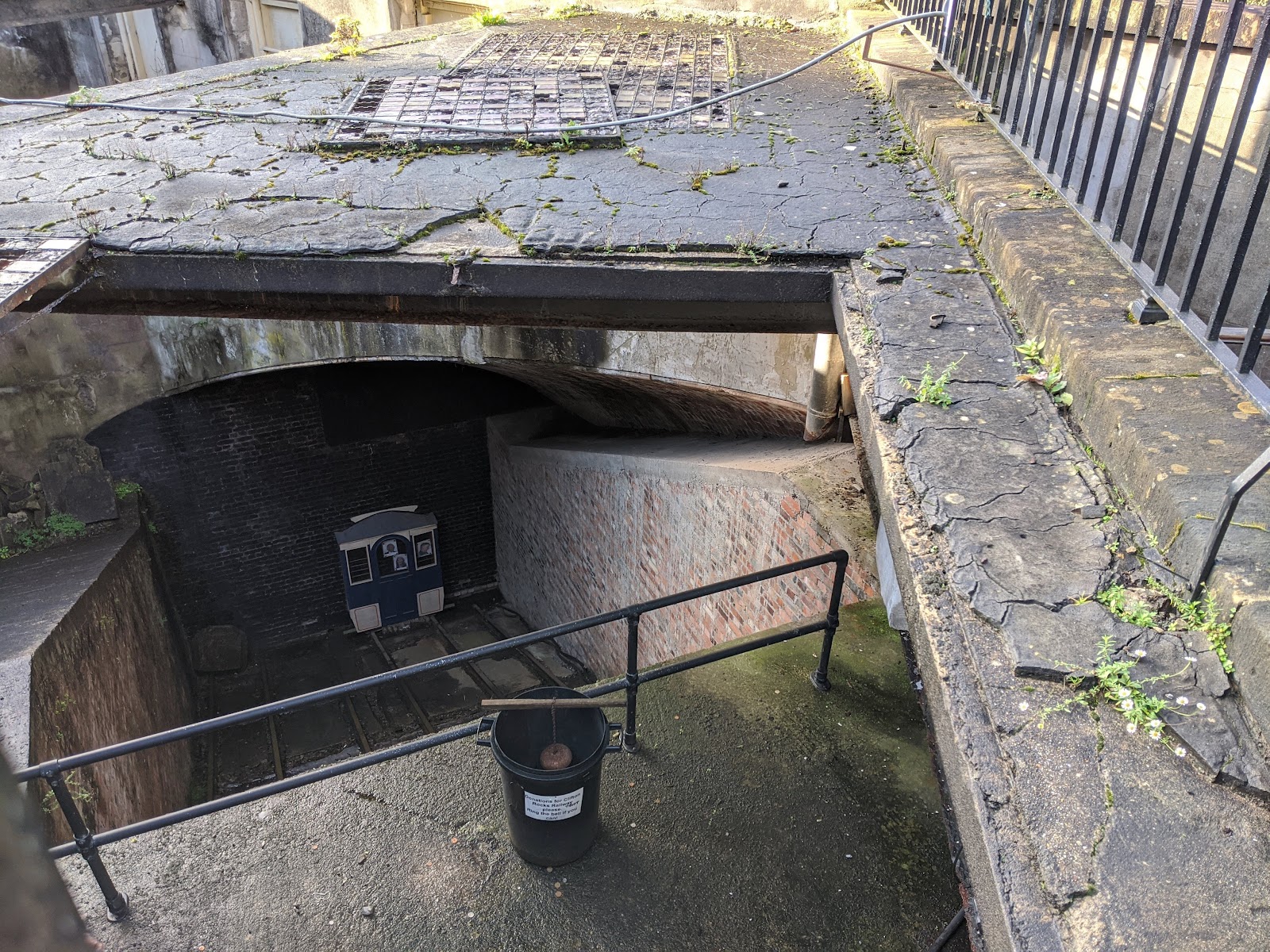
The railway opened in 1893 it had taken two years to build and cost £30,000 -twice as long and three times as much as originally planned. (Sound familiar?)
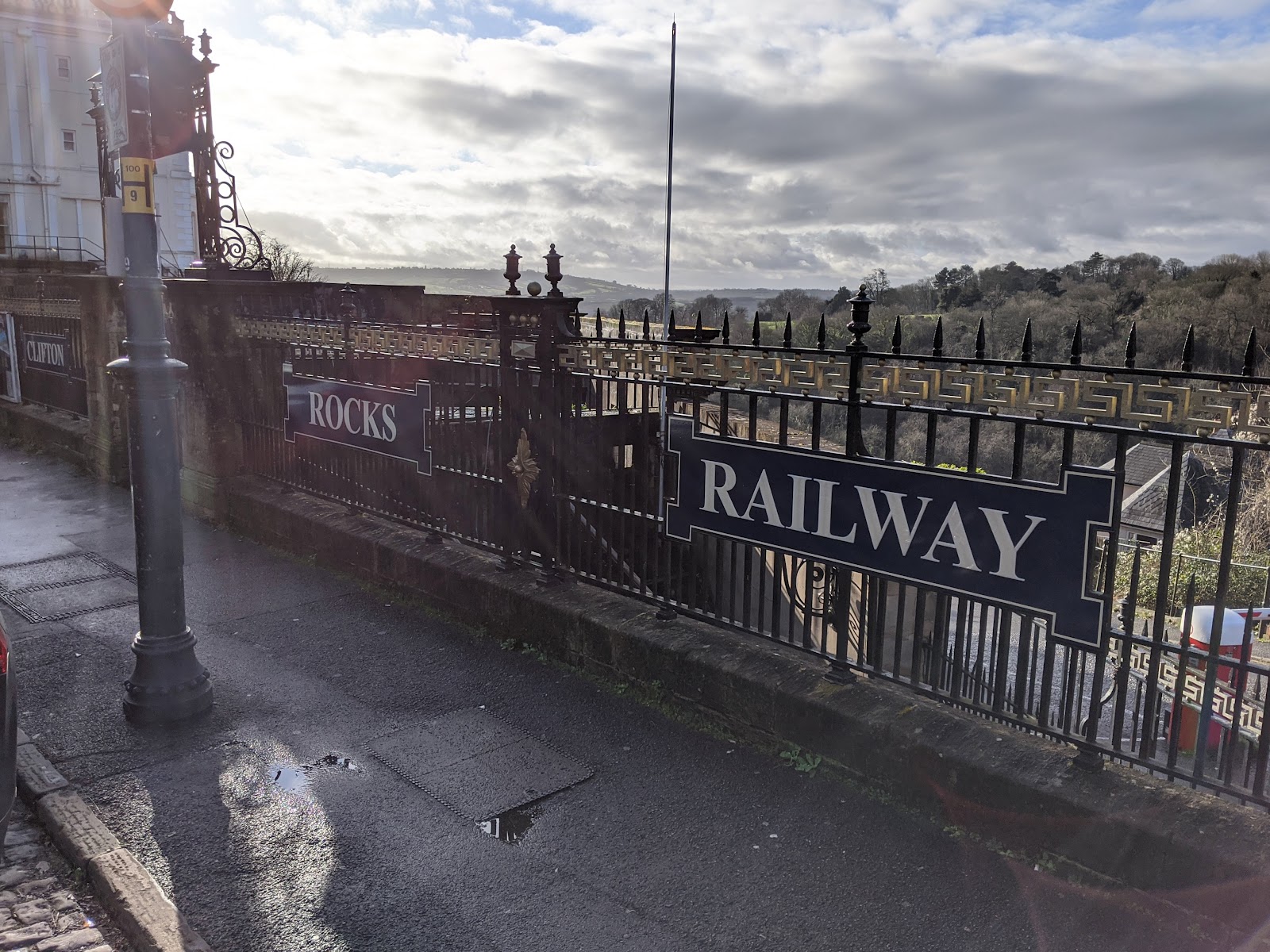
The tunnel is 500 feet long rising 240 feet at a gradient of 1:2.2. Semi-elliptical and lined with bricks it is 27 feet 6 inches wide andv18 feet high with two pairs of tracks allowing operation of four cars, in pairs connected by steel cables.
The cars were raised and lowered by means of adding or removing water from tanks under the car floors to balance the weight of car, passengers, and water tank so that the upper car going down pulled the lower car up the incline.
The railway was very popular on opening but that didn’t last and in 1908 it went into receivership, being purchased by the Bristol Tramway and Carriage Co.
In 1922 The Portway road (now the A4 Hotwell Road) was widened. This required the closure and demolition of the Bristol Port and Pier Railway from Sneyd Park junction up to and including the Hotwells terminus, leaving the Rocks Railway somewhat isolated. Also having a major road placed only inches from the bottom station made, and still makes, access difficult.
That rather heralded or at least hastened the end for the operation of the Clifton Rocks Railway and in 1934 it ceased operations.
This wasn’t the end of the line for the tunnel though. Well it was the end of the line as a railway obviously but five years later the tunnel, like so many others, got a new use.
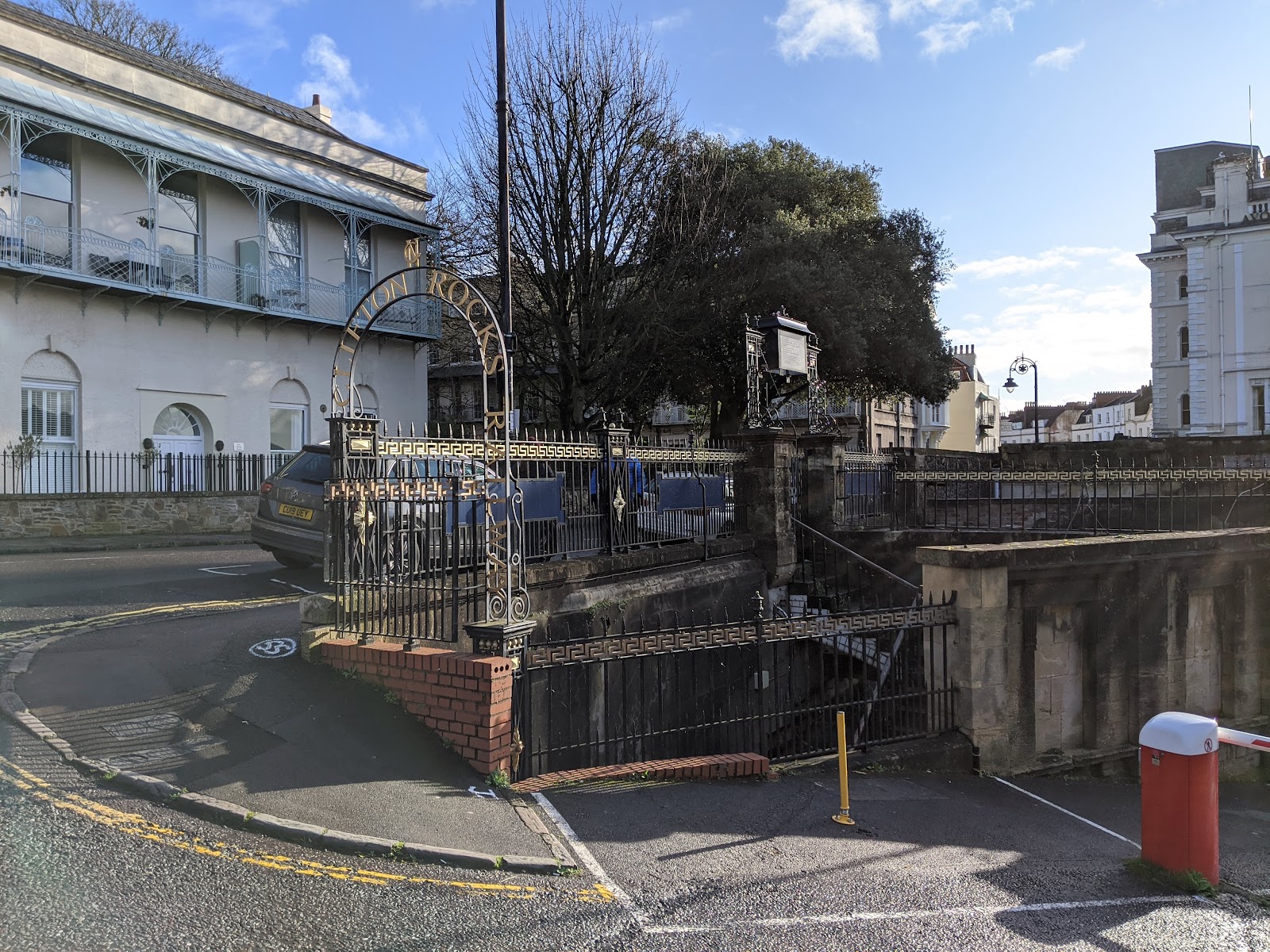
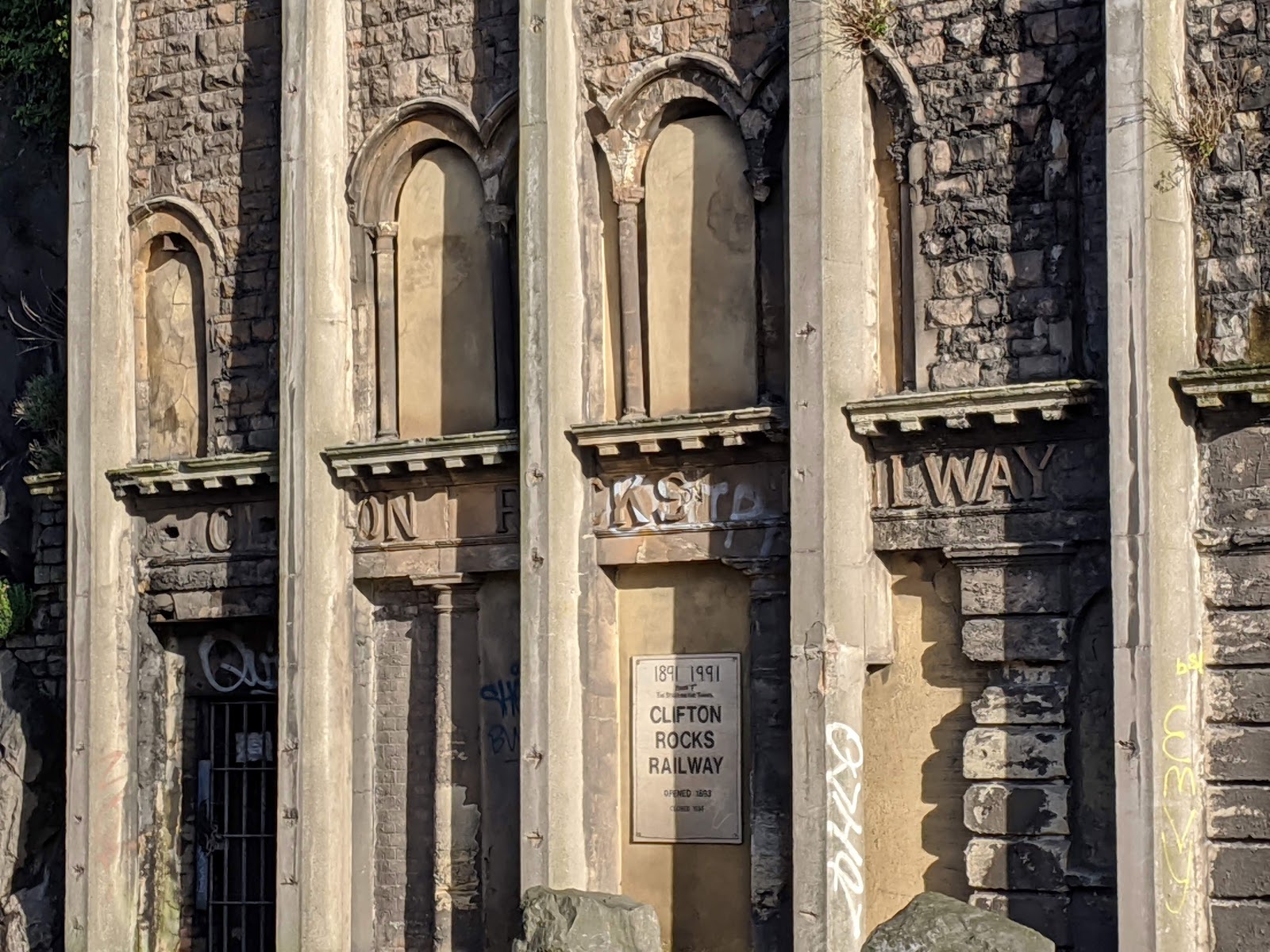
At the outbreak of the Second World War the Ministry of Works and Buildings leased the tunnel from the Tramways Company. In March, 1940. British Overseas Airways built an office suite and used part of the upper tunnel for storage. The ARP (Air Raid Precaution) Committee established air raid shelter number 1898.
In 1941 the four cars which had remained at the bottom of the tunnel since the railway closed were removed and the BBC moved in. They built a complex in the tunnel of four main chambers and three smaller rooms in the bottom station. From the top these contained transmitters, a studio for creating programmes, a recording room to record programmes which also contained enough recorded material for several weeks’ broadcasting, and a control room where eighty GPO land lines to other BBC sites could be switched. 
The three small rooms contained generators, ventilation plant, and of course a canteen because you can’t fight against Lord Haw-Haw without plenty of tea.
In the event the main BBC Bristol studios were never put out of action by the German bombing so the emergency studio at Clifton was never needed but the useful control room alone made the tunnel conversion worthwhile. The BBC continued to make use of the site until 1960 when advances in radio technology rendered it redundant.
In the late 1950s it became apparent that the facia of the bottom station was beginning to part company with the cliff face, a four inch wide crack having appeared between it and the rock face.As a result a series of tied buttresses were constructed along the face of the tunnel in Hotwell Road. These steel sections encased in concrete were anchored to the cliff using inclined anchors connecting the top of the assembly down into the rock behind. This has rather defaced the original facia of the bottom station.
The information above is just a brief summary of that supplied by Richard Hope-Hawkins on the excellent Cliff Rocks Railway website which is well worth visiting if you want to know more. You can also book tours via that site when they are running. I do hope they manage to open the site properly as a tourist attraction, given its proximity to the suspension bridge it surely has great potential.

Thursday, 16 January 2020

A Bigger Boat

Saturday 11th January 2020
Bored on a Friday night in the pub and with a couple of days off work I got to wondering where I could go and what I could visit that would be open at this time of year. Armed with a pint and smartphone I’d soon booked a hotel and a train ticket and on Saturday morning was speeding West towards Bristol on one of Hitachi’s finest. Brunel’s steamship the SS Great Britain my destination. As it was too early to book into the hotel I walked straight from Bristol Temple Meads station to Great Western Dock where the ship lies in dry 
SS Great Britaindock since it was brought back from the Falkland Islands in 1970.
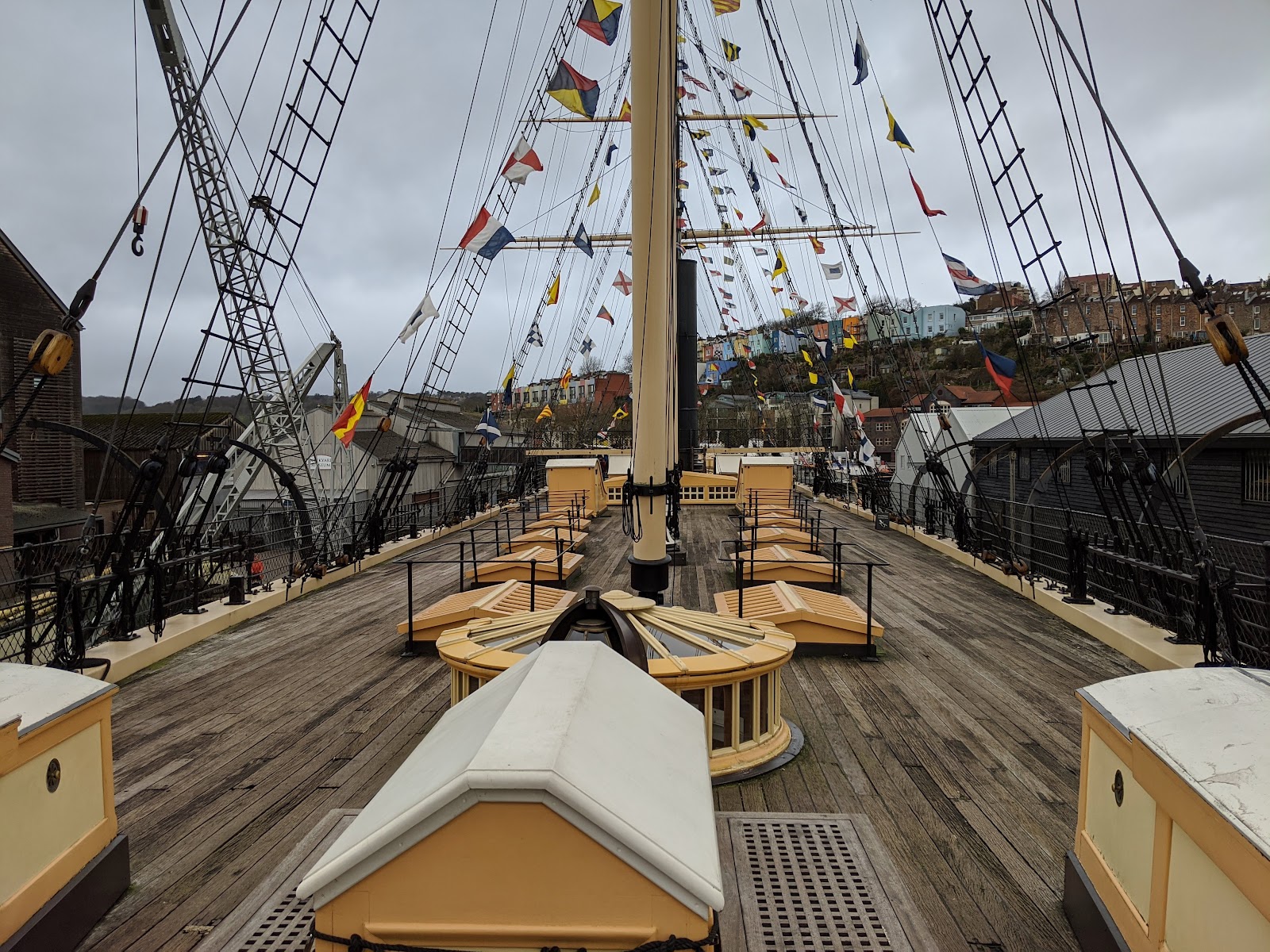
As well as the ship itself the dock site contains two museums, a cafe, and of course a gift shop through which you must pass to enter and exit the site. Alas no cloakroom or luggage lockers so I had to leave my bag with the ticket sales staff behind the counter. It was that or drag it round the ship.
Having coughed up my entrance fee of £17, about average for a tourist attraction in the UK I suppose, a  guide gives you a quick run down of the site and suggested route to take although you’re not constrained to follow a set path.
First up in a building on the starboard side of the ship is the Being Brunel exhibition. Being Brunel explores the life and legacy of Isambard Kingdom Brunel. This covers the life and achievements of one of the greatest engineers of the 1800s. He built bridges, tunnels, ships and railways that were longer, faster and bigger than anyone before. Brunel was also an innovator, a dreamer, an artist, and frequently a gambler with other people’s (i.e. investors) money. Extraordinary, but also human. He had faults and sometimes failures, but he never gave up.There’s a massive figure of the man dominating the exhibition space with his “trademark” top hat and cigar.
Next come back around the stern of the ship and descend into the dry dock to see the underside of the 322 feet long hull and the great iron propeller - SS Gt. Britain was the first large ocean-going ship to have both an iron hull and a propeller rather than paddle-wheels. Also the first iron ship to cross the Atlantic, it took 14 days.
The iron hull has plenty of rust holes and repairs and the dry dock isn’t that dry despite the glass ceiling around the ship’s waterline so the hull is cocooned in a “blanket” of warm dry air (as dry as a desert) fed from ducts and nozzles below. This should prevent it rusting away altogether.
Climbing out of the dry dock (or there’s a lift) you then go through the Dockyard Museum. This takes you back in a reverse timeline from the 1970 salvage operation and return to Bristol, through two world wars, the ships conversion into a sail-powered “Windjammer” cargo ship, and back to it’s days as a luxury liner. 
There’s a huge amount so see here from documents and pictures to machinery such as the propeller lifting gear - the propeller could be lifted out of the water to reduce drag when the ship was under sail.
If you’re the sort of person who likes to dress up in historical costume and have your photo taken you can do that too. I don't, I didn’t.
From the 1st floor of the museum you access the SS Great Britain’s Weather Deck. You get a pretty good view of Bristol’s Floating Harbour from the pointy end of the ship and can wander the whole length and breadth of the deck - even crossing the line on the deck beyond which only first class passengers were permitted and who doesn’t like to cross the line occasionally?
Then you open the door in one of the small deckhouses, duck, and go below to the passenger decks. Unless you’re short you’ll be doing a lot of ducking and minding your head from here on. 
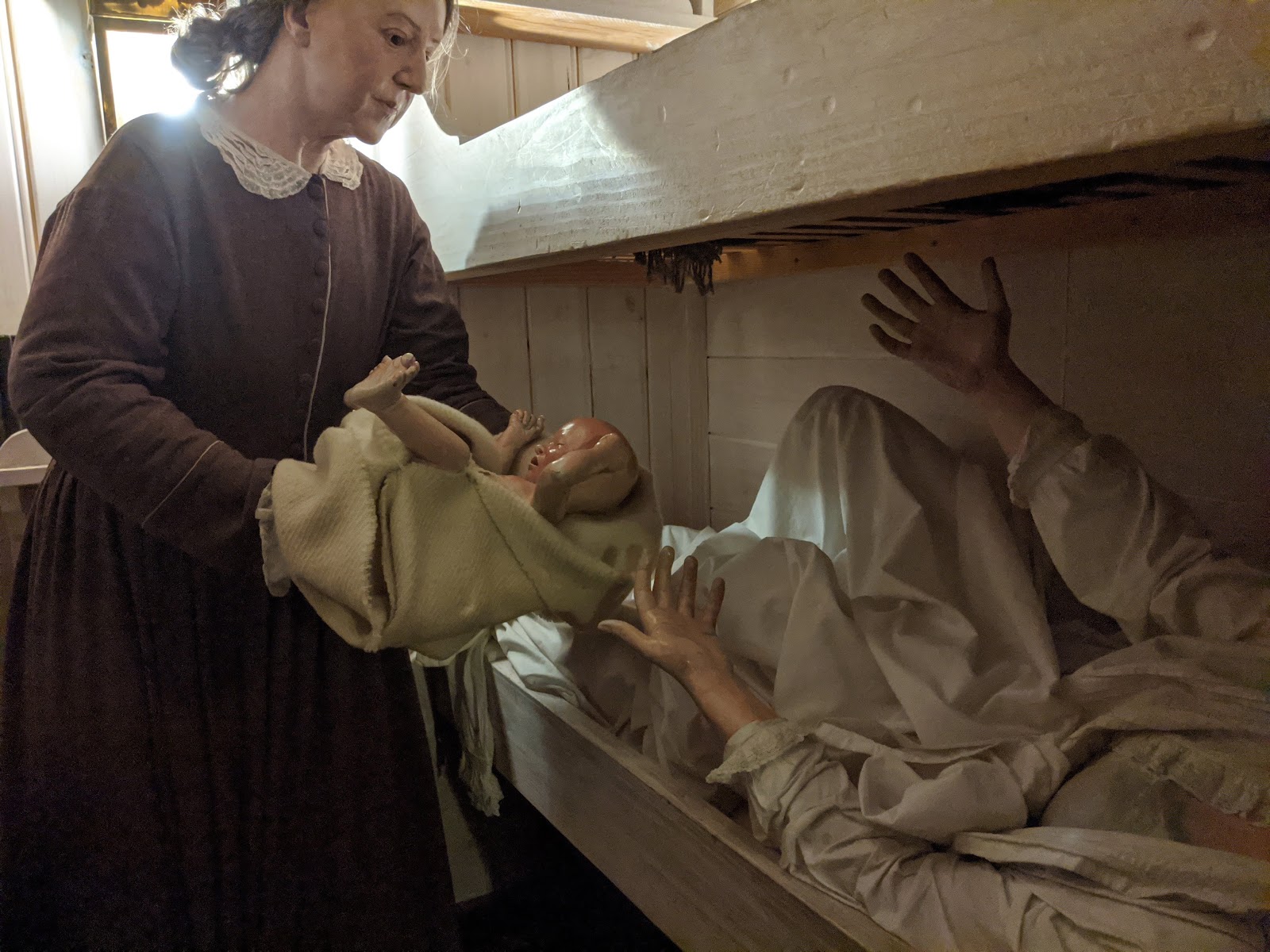
The reconstruction of the passenger areas is superb. From the opulent dining saloon, through the first class cabins, doctors, bakers, butchers, and kitchens through to the cramped 3rd class or “steerage” accommodation. All atmospherically lit, populated by life-like mannequins, and with sound effects which enhance rather than intrude.
Better still none of this is cordoned off or behind perspex screens. There are many scenes of life on board as it was in the 19th century and you can get right in amongst it all. It’s one of the best museums I have ever visited. And there’s a fair dose of humour here too, as you’ll find if you try to open certain cabin doors!
Of course it helps that this is a reconstruction so it’s only the ship’s structure that needs to be conserved not the interior but it does make a change from the restrictions found in most historical sites.
They’ve also installed replicas of the two steam engines amidships, which slowly turn, showing how the drive to the propeller shaft was conveyed from the engine via huge wrought iron chains.
And there are the cargo holds, depicting their use as stables for the cavalry when the Great Britain was used as a troopship carrying soldiers to the Crimean War and the Indian Mutiny.
I really enjoyed my visit, helped of course by the fact that being January even on a Saturday afternoon it wasn’t crowded. I might even return at some point as the £17 ticket is valid for a year, as is common with many tourist attractions now.
A decent cup of tea and a very nice piece of cake was to be had in the Harbourside Kitchen cafe before I headed for my hotel.
Brunel's SS Great Britain is billed as Bristol's number one visitor attraction and it’s hard to disagree. Go if you can. Take lots of photos, I did:

SS Great Britain

Monday, 9 December 2019

London - Portrait Of A City

Monday 9th December 2019

The latest exhibition at Clerkenwell's London Metropolitan Archives deals with images of the capital from the 11th century to the present day.

From wax seals to digital photographs, images of London and Londoners are displayed on the walls and in glass cases of the small exhibition space and the stairs.

There are drawings, paintings, and prints, along with film and sound from the LMA's extensive archives. They are displayed by image-making technique with explanations of how the different technologies work. That's something that you don't usually get at an art gallery and it makes this an informative exhibition well worth visiting.

The LMA is a slightly odd place to visit. It's very low-key, the entrance in Northampton Road opposite Spa Fields is an unobtrusive doorway into what looks like just another office block save for a couple of vertical banners o the wall above and discreet "City of London" and "London Metropolitan Archives" signs over the door. On entry there's just a small reception/security desk where people coming in to access original material from the archives sign in but visitors to the exhibition are allowed through unmolested. I was asked if I'd visited before, which I had, once, and that was it. If you've not been before it might not be obvious where to go next - there's no big "To the exhibition" sign that you might expect. Take the stairs (or lift if you can't do stairs although some of the exhibits are on the walls in the stairwell). There's a Visitor Lounge n the mezzanine floor where you are able to leave coats and bags in free lockers. The rules say you must do this if going into the study areas but it's not clear if that applies to the exhibition as well. Do it anyway, it doesn't cost anything and you'll be more comfortable.

Most of the exhibition is on the first floor outside the doors to the information area and is well laid out if not particularly well lit. There are paper exhibition guides in standard and large print varieties which replicate the information in the displays but also contain a little map of the exhibition area. The toilets are adjacent to the exhibition area, should you need them.

I reckon you should allow an hour to study the pictures and read the words, and there is a short film to watch and some audio too. This is I have to point out not the sort of exhibition which is going to excite small children. As a somewhat older child I found it interesting and informative. If you're interested in London's history in pictorial form go and take a look. You've got until July the 8th when no doubt it will be replaced by something new and probably equally excellent. You'll be too late to get your name on the first line of the visitor comments book though cos' I've already done that 😀

London - Portrait Of A City
London Metropolitan Archives, 40 Northampton Rd, Farringdon, London EC1R 0HB
9th December 2019 to 8th July 2020
FREE ENTRY
020 7332 3820
ask.lma@cityoflondon.gov.uk


Thursday, 24 October 2019

Engines and ironwork, Crossness.

20th October 2019

I took a drive around the M25 to Bexley on Sunday, not the nicest road trip but rail replacement buses made going by train a bit impractical on this occasion, to visit the Victorian sewage pumping station at Crossness on the banks of the River Thames.

 The Crossness Pumping Station is a former sewage pumping station designed by the Metropolitan Board of Works's chief engineer Sir Joseph Bazalgette and architect Charles Henry Driver at the eastern end of the Southern Outfall Sewer.

It was built between 1859 and 1865 by William Webster, as part of Bazalgette's redevelopment of the London sewerage system, it features spectacular ornamental cast ironwork, and still contains four large beam engines. one of these has been restored to working condition. On Sunday this engine, named Prince Consort, was in steam. Interestingly the reason the four engines are still there is because the cost of dismantling them when they were no longer required in the 1950s was considered too high. Which was lucky for us six decades later.

 If you want to know the history of the works I suggest having a read of the Wikipedia Article which gives far more detail than I have space for here, however since 1987 the Crossness Engines Trust, a registered charity, has been overseeing the restoration of the site. They have a huge job on their hands frankly.

What was the boiler house now contains a museum with displays of information about the subject of London's sewage problems and solutions. Also quite a lot of "toilet exhibits". And a cafe and gift shop obviously, which always helps when trying to restore what is really a huge money pit!

Surrounded by toilets it took me a minute to spot the signs for the actual conveniences, which are tucked away behind the cafe and rather disappointingly modern 🙂

Off the boiler house is the engine hall. This is a mandatory hard-hat area and volunteers are on hand to issue suitably sized titfers to visitors. (It was nice to see that they were cleaning and sanitizing them when they were handed back before reissue too.)
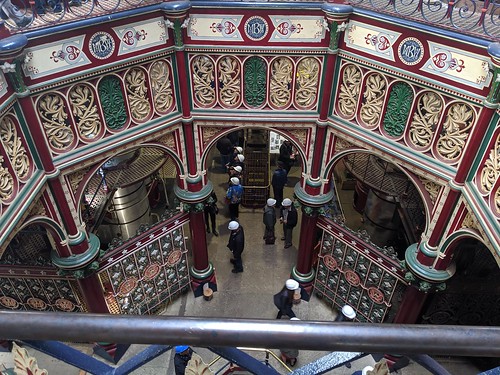
The engine hall is where the real action takes place. Nikolaus Pevsner described Crossness Pumping Station as "a masterpiece of engineering – a Victorian cathedral of ironwork".

He wasn't wrong. As well as getting Prince Consort running a lot of work has gone into restoring the decorative ironwork. The Victorians didn't do plain and functional engineering. A nice humourous touch is that the capitals of the iron columns are decorated with fruit and leaves - figs and senna plants 😀

Even had the space not been busy with hard-hatted visitors and volunteers the scale of the steam engines (strictly speaking, steam pumps) means that it's impossible to adequately photograph them. From basement to upper deck they're three-storey behemoths of 19th century engineering. And yet when Prince Consort is running it's actually quieter than the crowd watching it.

Outside the main building there are machine workshops and in the former Valve House a collection of smaller engines and pumps, some of which were also running albeit on compressed air as the works now only has a small boiler producing enough steam to run Prince Consort.

Once you've visited that you can take a scenic (depending on your definition of scenic) walk along the Thames Path. I wandered down as far as the pier that was used to bring in coal for the boilers and later to take away sludge for disposal at sea before that was outlawed in 1998. Oh and there's also the RANG Railway.

For a flavour of visiting Crossness watch:


And there are more photos too:

Crossness


Saturday, 28 September 2019

Foragers of the Foreshore

 Foragers of the Foreshore


Wed 25 - Sun 29 Sep, 11am - 6pm 

Bargehouse, Barge House Street, SE1 9PH (behind the Oxo Tower)

Free Entry 

 https://totallythames.org/event/foragers-of-the-foreshore

Friday 27th September 2019

From the website: "Foragers of the Foreshore is the most expansive exhibition on Mudlarking that has ever taken place; it unearths the history of London through items recovered from the Thames. Discover the weird and wonderful world of mudlarking, from its origins in the Victorian era, to its popularity today. Meet the mudlarkers who have dedicated themselves to finding London’s lost treasures, and marvel at the fascinating collections that have shaped their lives."

Bargehouse is easy to find, just walk along the South Bank until you get to the Oxo Tower and it's the (deliberately I suspect) scruffy looking building just behind the river front building with all the fancy galleries in. It's a multi-storey space which inside feels a bit like a building site has been taken over as a temporary art gallery, which it is in a sense as it is used as an event space rather than a permanent home for a collection. 

Mudlarking in it's modern sense, as opposed to in the 19th century when it was an occupation of the most poverty stricken, involves searching the Thames foreshore for historical artefacts or anything else of interest that the receding tide exposes. People have been dropping or chucking things in the river for centuries making this one of the largest archaeological sites there is. So everything from pottery and glass, through metal buttons, coins, and wartime ordnance, to modern plastic objects and messages in bottles comes out of the thick anaerobic Thames mud. Also clay tobacco pipes. Lots of them!

Before you go rushing off with a bucket and spade though note that there are strict rules about where you can search and you need a permit from the Port of London Authority Also the Thames has a huge tidal range. This will kill you if you don't take tide times into account.

This exhibition isn't just about the objects that come out of the river though, it's also about the mudlarkers themselves, how they got into mudlarking, and what they do with what they find. In many cases they create art.

One of those artists is Nicola White  who had recreated her workshop at Bargehouse as "Mudlark In Residence".  A space crammed with all sorts of finds (that's a selection of her clay pipes above) both ancient and modern and examples of her artworks. Dominating the space was a huge sinister-looking bird made from discarded plastic items retrieved from the river.

I've followed Nicola's muddy adventures for a long time on her YouTube Channel so this was a chance to be a massive fan boy and chat to her in person. 

Elsewhere in the building there were many more displays of artefacts, art pieces and audio and video installations and Hannah Smiles portraits of mudlarkers. There were experts on hand to give advice and to help identify your own found objects and though it wasn't in use while I was there a "virtual mudlarking experience".

I recommend getting down to Bargehouse before Foragers of the Foreshore ends on Sunday if you can. I found when I emerged (from the building not the mud) that over two hours had passed, usually I get itchy feet in art galleries before then. I also came out wishing I lived a bit nearer the tidal Thames as well.

While you're there find the display case in this picture and see if you think that's what I think it is, which amused me rather more than it really should 😄

Sunday, 22 September 2019

Power Points

Saturday 21st September 2019

Between two houses in a suburban street in Woking, Surrey behind a metal gate is a low Art Deco building. Normally off-limits to the public except for two weekends in September (so you've missed it this year) this is the British Railways Electrical Control Room.

The Woking Electrical Control Room was built in 1936 as a control centre for the electrification of the Southern Railways lines, the room was taken out of operational use in 1997, although parts of the building remain occupied.

The building has many art deco features both outside and inside, and retains many original fittings including three copper and iron uplighters, track diagrams with working lights and switches, and the original control desk.

The building is Grade II listed so has escaped the usual fate of redundant railway buildings.

Inside you first see the backs of the track diagram panels, complete with exposed electrical  wiring and Do Not Touch signs, in the outer corridor. Passing through a double door you enter the control room proper which is is much the same state as it was when retired in 1997.

It's an impressive space. The high domed ceiling means that a person speaking normally at one end of the room can be clearly heard at the other (making it quite noisy with a group of visitors split into two tour groups).

The tours are conducted by retired BR power engineers so they know about the building, its
history, and how it all works. They explained clearly how power for the trains and signalling was distributed, how it could be switched on or off, and how the control system could be used to locate faults. Obviously they also have a stock of interesting and amusing anecdotes from their time working on the network.

The track diagram and some other control equipment is powered up for demonstration purposes too which is much better than just a static display. Flashing lights and things that go round are always good 😃

Also on the control desk were some old log books including that covering the great storm of 1987  when trees blown onto the line and onto the line side power equipment kept the control room operators and engineers very busy indeed.

Once the tour was done there was no hurry to move visitors out, it wasn't very busy and I understand visitor numbers per day over the two weekends were in dozens rather than hundreds. 

That meant there was plenty of time to talk with the volunteer guides and I had a long and wide-ranging discussion covering the similarities and differences between the world of railway electrical supply and that of public telecommunications, amongst other things. 
I really enjoyed this visit and if you can get to Woking next year when it's open again it's definitely worth it whether you're interested in architecture, railways, or engineering. Or even if you're just curious - it doesn't cost anything to go in and you don't need to book ahead.


Woking BR Electrical Control Room

In an Air Raid, Don't Stand and Stare at the Sky

Sunday 8th September 2019

Take cover at once!

In Stockport near Manchester you could take cover in the public Air Raid Shelter carved out of the sandstone cliffs.

Now the Luftwaffe aren't (at least for now) making nightly visits to Greater Manchester but you can still take cover in the Stockport Air Raid Shelters because the council have opened them up as a museum. Also £5 per adult and accompanied U16s go free is more than reasonable.

In the reception area you get a short talk from a guide and then issued with a little audio guide. I must say this is one of the best, clearest, and easiest of these that I've come across at any visitor attraction. Eltham Palace take note. When you see a "target" on the wall present the device to it and off it goes with a brief talk related to that location.
First off though there's a short sound and light show in a darkened room about the building (or rather digging) of the shelter, followed by a brief air raid simulation.

Then you're off on your self-guided tour aided by the audio device.

I'm not sure that the group I was with were paying much attention mind you as they soon disappeared ahead leaving me in peace to explore.

The shelter has displays in  various rooms, medical post, canteen, office, and of course the communal khazis.

The shelter is much bigger than the area that's currently open and lit for the public to visit.

The unlit, fenced off bits, I believe are sometimes accessible on special tours.

This picture was  taken using the "night sight" mode on my Pixel 3a smartphone through the fencing and shows more than I could actually see as it was as my Mum would have said "as black as your Grandfather's" in there.

There are lots of information display panels to read if you want to, some of which you'll have to wipe the condensation off first, it's a good job they're made of something waterproof. Imagine how damp it would be down here with several thousand people sheltering from the bombing above. Here's some more pictures:

Stockport

After the shelter I had a look around Stockport town centre. There was a big street market going on which was mostly selling street food of the sugary and/or fatty variety and having failed to find a fruit 'n' veg stall I resorted to lunch from Sainsbury's and a coffee from a cafe in a mostly shut down shopping mall.

Stockport town centre is otherwise nice with plenty of old buildings and on multiple levels. Most of the populace however, even those without their faces buried in smartphones, seem incapable of looking where they're going making it something of a cross between an obstacle course and the dodgems. There's an impressive market hall, holding some sort of craft fair but since charging to enter what is essentially a shop is taking the piss I didn't.

Back to the station and one of the frequent fast trains (it's on the main line} back to Manchester for one last night and a pint in a very empty Lass O' Gowrie.


Wednesday, 18 September 2019

People's History Museum

Friday 6th September 2019

I had few firm plans for what to see while I was in Manchester but this was one of them. In a former Edwardian pumping station next to the River Irwell, the People's History Museum "is the national museum of democracy, telling the story of its development in Britain: past, present, and future".

 The two main exhibitions are found in Main Galleries One and Two on the first and second floors respectively.

Main Gallery One covers the period from the Peterloo Massacre of 1819 until the end of the Second World War in 1945.

I'd already visited the excellent Peterloo 200th anniversary exhibition on the ground floor, so gallery one took the story on from there, covering the industrial revolution, reformers, workers' organizations, political parties, and the fight for universal suffrage. The display pictured above is the first thing you see on entry to the gallery, it says "Abuse of Power Two hundred years ago Britain's political system was corrupt and controlled by a few rich men. Without the right to vote, ordinary people had no power to change their lives." Reading that it's hard not to think that, apart from more people having a vote, the situation in 2019 isn't very different. 😞

The personal stories of ordinary people living through extraordinary times are the most interesting part of the way the exhibition presents the history of social change, along with many many physical and multimedia exhibits. There is a lot of information here although the way the space is laid out sometimes makes it hard to follow as you walk around.

Moving up to the second floor and to Main Gallery Two where postwar politics is the main theme, from the hopefulness of the new Labour government of 1945, through the difficulties of the 1950s and the swinging back and forth between Labour and Tory governments, both promising to deliver the best for ordinary people but by differing means, into the 1970s when ambitious union leaders led their members down a path that eventually led to Thatcherism, erosion of the hard-won rights of workers, and ultimately the rise of the right wing in this country to an extent I never thought I'd see. This gallery covers the period of my working life and evoked memories of standing on picket lines trying to stop the Tories from selling the people that which the people already owned and then the disappointment of Blair's New Labour, the part of her legacy of which Thatcher was most proud. The exhibition also covers the issues of the day such as the anti-war and nuclear disarmament movements, environmental, race relations and immigration, and LGBT+ issues.

It's not all doom and gloom. There's also the matter of how workers gained more time off and what they did with it (football, music, etc.) and a section on the Co-Operative movements, which began in Greater Manchester.

And then there's the banners section. A high ceiling allowing the display of many union and other workers society banners, both home and professionally made, which were carried when the people took to the streets to protest, to demand change, and to try to improve the lives of their fellow ordinary people.

I recommend that you visit this museum if you're in Manchester. It may not answer the questions of how and why we've ended up again with a rich, corrupt, lying, self-serving, un-elected shower of shit running our country but it will give you a better understanding of the journey that got us here.

It may also make you angry. If so that's a good thing, use that anger, protest, fight for what's right. Maybe it's not too late.

Opening times
  • Open: every day 10.00am – 5.00pm
  • Radical Lates: second Thurs each month until 8.00pm
  • Closed: 24, 25, 26 Dec, 1 Jan
Entry is free although they suggest a £5 donation which if you can afford it is a bargain so put your hand in your pocket.


Right, normal service involving mostly transport-nerdery will resume shortly, until then:


 ðŸ˜‰

Tuesday, 3 September 2019

Gunnersbury Park

1st September 2019

Gunnersbury Park lies in the London Borough of Hounslow, only about 5 miles from where I was born but I'd never been there (at least not as far as I remember) so it was a good place for a random Sunday afternoon excursion.

The house and grounds were purchased for the nation from the Rothschild family, it was opened to the public by Neville Chamberlain, then Minister of Health and later appeaser of right-wing dictators, on 21 May 1926. The park is currently jointly managed by Hounslow and Ealing borough councils.

I'd parked at Osterley and got the tube to Acton Town, having intended to go into town afterwards but in the event didn't do so. From Acton Town it's only a 10 minute walk to the museum and cafe at the mansion in Gunnersbury Park.

The museum is located in the larger of the two mansions, which were built at the beginning of the 19th century, replacing the original 1663 Paladian mansion, Gunnersbury House. The large mansion becoming Gunnersbury Park and the small mansion Gunnersbury House.
In 1835, the merchant and financier Nathan Mayer Rothschild purchased the Large Mansion and park shortly before he died. The Small Mansion and its grounds were acquired in 1889 by the Rothschilds, reuniting the original estate. The Rothschilds extended Gunnersbury further, acquiring most of the Old Brentford Common Field to the west, as well as land to the north.

Downstairs the drawing room, long gallery, and dining room have been restored to how they were when the Rothschilds lived, schemed, and entertained in them whilst finacing the British gonvernment's wars and the expansion of the British Empire, and investing in  various industries across the globe. 

The historic kitchen was closed while I was there although the Butler's Pantry was open for a comparison of conditions 'above' and 'below' stairs. 

Other publicly accessible rooms in the house are used as galleries to showcase an extensive and varied collection of objects connected to the local area and which I found very interesting, also being connected to the local area. (Despite having moved away when I was 8 if asked where I'm from I still say "Heston originally".)

I particularly liked the second floor Industry Gallery with it's collection of goods and artefacts from the many companies that established factories in the 1920s and 1930s along the "Golden Mile" of the Great West Road to the north of Brentford.

There are also galleries devoted to People and Place, Home, Toys and Games, and Entertainment. All linked to the local area - the Leisure Gallery includes a video installation covering the contribution of Ealing Studios and other nearby locations to Film and TV and includes some films I never knew had been partially made "round here".

In the middle of the house is the double-height Skylight Gallery which contains part of the Lucozade sign that I remember used to be on the side of the factory and visible from the M4 motorway. The sign was an example of “kinetic sculpture” in advertising, it lit up to make the Lucozade appear to pour from the bottle to the glass. It was installed in 1954, on the side of what was then known as the “Lucozade Annex” which was knocked down in 2004. The sign originally said "Lucozade aids recovery" but this was changed in the 1980s to "Lucozade replaces lost energy" as the powers that be decided it might be offensive to sufferers from HIV.

Back outside I decided to head south across the 200 acre park but that plan was thwarted as much of the centre is cordoned off by barriers where a huge new outdoor sports facility is being built. So instead I had to make my way around the edge of the park, passing the small mansion (also behind barriers) and Priness Amelia's Bath House. Princess Amelia was the favourite daughter of George II. Plans for her to marry Frederic (who later became Frederic the Great of Prussia) had come to nothing, and when her father died, Amelia lost her apartments at St James's Palace. She took a house in Hanover Square and used Gunnersbury House (the original one not the present one) and estate as a country summer retreat. It was she who landscaped the park in the 18th-century landscape style and made Gunnersbury famous with her parties and political intrigues.

I walked down to the southern tip of the park past the Potomac Lake (private fishing and almost unseen behind its spiked railings and surrounding trees) and exited into Lionel Road North, passed under the M4 on its concrete flyover and continued down to the River Thames at Kew Bridge where I got refreshments and then followed the north bank along the Thames Path to Brentford. But that's (possibly) a subject for a separate blog entry.

Until then here's a Flickr Album of photographs from Gunnersbury Park.


Gunnersbury Park