Showing posts with label architecture. Show all posts

Friday, 21 August 2026

By train to Ludlow and Hereford.

Rail Trip 17th to 20th August 2026  

Monday 

By train to Ludlow. All three trains ran on time which might be a first. My forward facing reserved seat on GWR from Reading to Newport (South Wales) turned out to be neither forward facing nor indeed reserved. Fortunately the train wasn’t too busy. Lots of people waiting at Newport on the station platform, I hope they’re not all getting on the train to Ludlow. OK, just stand around the door to the toilets and pile your luggage against it then dickheads. No trouble getting a seat on the train in the end. Transport For Wales having all the announcements in Welsh then repeated in English makes for double the noise pollution.

Wedi sylwi. Wedi sรดn. Wedi setlo.

The slightly bewildered looking man across the aisle had a transparent G4S branded backpack and was travelling on a Rail Warrant. I guessed he was just out of gaol. I was right. His welcome back to the world outside included being unable to buy a coffee from the refreshments trolley because “it’s card only, we don’t take cash for security reasons”. I suspect that excuse isn’t strictly true. Also in a world where cash may not be accepted should perhaps the prison service provide part of the discharge grant on a pre-loaded card rather than just an envelope of cash? I stepped off the train at Ludlow to find that although it was a little cooler it was still very humid. 

It wasn’t far to the Feathers Hotel but the last bit was uphill.

The Feathers Hotel, Ludlow.

The Feathers is very old and a bit of a labyrinth inside, very characterful but you feel like you should leave a trail of chalk marks to find your way back out from your room. It was a nice room mind you, with a fine view of the car park and a good selection of teabags. I unpacked and chilled for a bit then set out to explore Ludlow and find some food.

Ludlow is very photogenic. There are so many half timbered buildings, including the Feathers Hotel which has an ornate frontage constructed in 1619 over an earlier core building - which explains the higgledy-piggledy nature of the interior. There are narrow streets with Tudor buildings, also wide streets with Georgian fronted buildings, and a wide market place in front of a Norman castle. In the centre of town it would be easier to count the buildings which don’t have blue plaques provided by the Ludlow Civic Society! Ludlow contains more than 420 listed buildings, nine of them Grade I and 25 of them Grade II*

Church Street, Ludlow.

It is also quite hilly, especially if you walk down to the River Teme and back as I did. There’s a nice walk along the far side of the river between Dinham Bridge and Ludford Bridge with views of the castle and town. Just enough distance to build up an appetite.

Dinham Bridge, River Teme, Ludlow.

I dined at Pietro Lounge, a modern cafe bar located on the Market Place in what used to be The George pub. A pint of Henry Weston’s Vintage Cider and a very tasty Nasi Goreng set me back £15.40 and though it did not occur to me at the time I think maybe they forgot to charge for the cider. Maybe it was some happy hour deal, I was certainly happy ๐Ÿ˜€. 

I went to walk some of it off around the outside of Ludlow Castle and then through the streets and little lanes of Ludlow. I stopped for a hydration break at the Church Inn and sat in the beer garden which is actually part of St. Laurence’s churchyard. This proved to be a bit of an error. The church bells immediately commenced with a bloody loud and largely tuneless peal. It was lovely when they stopped. Trouble is after a pause they started again. And again. And again. I don’t know if they were ringing them or throwing them down the stairs and carrying them back up again - hence the pauses. I retreated to my room at the Feathers and slept like the proverbial log.

Tuesday

On Tuesday morning I spent a couple of hours exploring Ludlow Castle. £10 admission is very reasonable these days considering there’s quite a lot of castle here. There are a lot of ruined nooks and crannies to explore, also many uneven steps. Ninety-six of these will take you to the very top of the Great Tower where you can see a lot of Shropshire because obviously that’s why the Norman occupiers built it here.

Ludlow Castle, view from the top of the Great Tower

Judging by the number of dismembered pigeons scattered about the castle I don’t think that the local raptors are going hungry. A round tower stands isolated in the middle of the bailey, the Chapel of St Mary Magdalene, the ground floor of which is set out with rows of chairs beneath a wooden roof. Nearly every woman who walked in said “Oh look you can get married here!” Which caused some worried expressions on the faces of some of the men ๐Ÿ˜

Despite the proliferation of uneven surfaces it was on a wide level modern set of stairs that a little old lady went down like a sack of hammers, first drawing a small crowd and then much running back and forth by the castle staff. She stayed down for a worrying amount of time but eventually was able to sit up at least. An ambulance was sent for ๐Ÿ˜Ÿ

Ludlow Castle

I completed a couple of circuits of the castle ruins and then sat on a bench between the castle and the market. You could tell that it was lunchtime even with your eyes closed from the number of folk with pungent takeaways. I noticed that Ludlow is very well provided for when it comes to benches to sit on, other towns should take note. An ambulance arrived at the castle, I estimate that it must have been about an hour since the fall down the steps.

Mill Street Weir, River Teme, Ludlow

I walked down to Mill Gate and the adjacent weir on the River Teme then back up into the town centre. Looking around inside St. Laurence’s church I found that they have the mechanism for a carillon on display although since 1989 a computer controlled electro-mechanical version has been used instead. I assume that wasn’t what was ringing the bells last night unless the computer had crashed.

Altar, St Laurence's Church, Ludlow

What else to do on a Tuesday afternoon in Ludlow. All that walking around had made me thirsty. I found the Rose and Crown tucked away in a courtyard between the cheese shop and the pottery shop in Church Street. A Joule’s Brewery pub, not familiar to me so having tried a pint of very nice Blonde at only £3.90 I decided it would be remiss of me not to try the Pale as well (£3.80). From my window seat overlooking the courtyard I watched several groups stop and look at the pub, and a couple of times they came through the door, looked around, and then walked out again. I’m not sure what they were expecting to find. Not a traditional wood panelled pub interior with a large range of drinks obviously. I resisted the temptation of a third pint, went back to my room at the Feathers to chill and read for a bit until it was time for dinner again. Since it had been good before I went to the Pietro Lounge once more, I can recommend the Mediterranean grill washed down with a pint of Murphy’s if you're hungry.

After dinner I walked down Linney and across the fields to Burway, crossing the River Corve first on a footbridge in the fields then again at Corve Bridge and back up Corve Street past more half-timbered buildings, almshouses, the cemetery, and Tesco to The Feathers where I retired to my room to watch YouTube. Using the Pipe Pipe app because I’m not a masochist.

Unicorn Inn, Corve Street, Ludlow.

Around midnight there was an unfamiliar sound drifting in through the window from outside. It was actually raining.

Wednesday

I had time to kill after checking out of hotel so got a Tesco sandwich and had a last wander around Ludlow. I went through the cemetery and up Linney, which was much harder than it had been walking down it. The sun was out, last night’s rain had dried, it was still humid. My phone said "20 degrees, feels like 25, 67% humidity". I returned to the station in good time to catch the train to Hereford.

The train was showing as “delayed due to overcrowding”! This did not bode well.

67010 at Hereford Station.

When it eventually arrived it wasn’t actually crowded. Also it was a real train with a locomotive 67 010 at the front drawing 5 carriages! Alas the sort of carriages with sod all legroom between the seats so just as well it was only a 25 minute journey.

I arrived in the ’ford. I’ve not been back since I think 2014. They’ve had the builders in, I stepped out of the station and didn’t recognise anything.

I killed time before I could check in to The Green Dragon hotel sitting by Elgar and his bike trying to book something on the Open House London site. Failed, by the time the site loaded what I wanted to visit (BT Tower) was fully booked ๐Ÿ˜ก By the way Elgar is the only cyclist in Hereford who obeys the signs saying to dismount when passing through Cathedral Green.

Edward Elgar & his bicycle, Cathedral Green, Hereford

At The Green Dragon. Quickest check in ever, key issued (actual real key) and in my room in about a minute from walking through the front door. So all the multiple emails saying check in online (having first registered an account on a third party website? - no thanks) to “save time” was bollocks. Single room, recently decorated. Ideal for an overnight stay. It must be over 20 years since I last stayed here, I had a bigger room then but my little brother was the manager at the time.

The new shopping development on the old Cattle Market site has hollowed out the city centre a bit as I expected when I came here not long after it opened. Many empty shops now, my former go to cafe, The Matabeau, is long gone. Plenty of barbers and nail/eyebrow bars of course. Money has to be laundered somewhere.

Food service seems to stop at 3pm in the pubs in Hereford - again the Cattle Market development has the usual chain restaurants present. Co-incidence? The Imperial had no cask ales on either, what is the world coming to? I gave up and I resorted to a quick Burger King before walking to the concert venue, The Courtyard Theatre, or rather the big tent surrounded by people in hi-vis in the car park behind the Courtyard Theatre. This trip away initially started off as just a plan to come to Hereford to see Elkie Brooks in concert, I expanded it to include Ludlow afterwards. Ticket scanned and passed through the cordon of tabard-wearing stewards with a little more than an hour before the show start time. The Stowford Press was £5 a can and if you wanted a re-useable plastic “tankard” they’d be happy sell you one. I observed that it was mostly only the women who felt the need for a glass.

Elkie Brooks is amazing live. What a voice and a talent that she’s been honing longer than I’ve been alive. Lots of classics were performed especially from the Pearls album. But also covers including Jimi Hendrix (with an anecdote about him chatting her up in the Speakeasy club in London), Prince (Purple Rain), and Rag’n’Bone Man (Human). Elkie can hold a note for a very long time. Also there was more jumping about on stage (in heels!) than you might expect of an eighty-one year old. The crowd went wild, or as wild as a big tent full of geriatrics gets. My advice would be if you get the opportunity to see Elkie Brooks live grab it while you still can, you won’t regret it.

After a couple of very enjoyable hours we were discharged through the waiting “chuggers” into a night which was much cooler but not quite chilly. I considered going to see if the Black Lion was still open but in the end settled for another Stowford Press in the hotel bar.

I was woken in the night by some machine, possibly an a/c unit on another building being very loud and then again later by loud dripping water sounds outside somewhere echoing in the space between the hotel and the adjacent building. I had to close the window in the end, not ideal.

Thursday

High Town, Hereford.

I got up, checked the trains. Oh dear. I went to the station and got the 1036 to Newport which actually arrived in Hereford at 1150 and reached Newport at 1236. If I’d waited for the 1208 as originally planned no way would I have made my 1304 connection.

From Newport to Reading I had a seat reservation again, carriage H seat 09. The train arrived, it comprised carriages A to E. GWR is a bloody joke.

I had 6 minutes scheduled for the connection at Reading, if I missed it I’d be hanging around for an hour at least. I came off the train from Newport like Mick The Miller out of the traps. Made the connection with a couple of minutes to spare. The Giant Suitcase Cult were much in evidence on the train home, making their way to the temple at Gatwick. A woman with two large suitcases she couldn't control, couldn’t find anywhere to stow, and was trying to manoeuvre without her phone leaving her hand. Must be the high priestess. Or a blithering idiot ๐Ÿ™„

Home at last and I didn’t even get wet walking back from the station ๐Ÿ˜€

Lots of photos on Flickr, mostly of Ludlow. Opens in a new page or as a slide show below if your viewer supports it.


 Trip to Ludlow & Hereford


Wednesday, 18 September 2024

Open House 2024 (3): The Victorian Society


1 PRIORY GARDENS, BEDFORD PARK, CHISWICK , W4 1TT

Open House web site says:

 Part of the original Bedford Park development restored by the Victorian Society and used as their headquarters since the 1970s. Picturesque style; 3-storeys, Red and yellow brick; Dutch gable; oriel windows. Dated 1880, designed by E. J. May.

What better place for the society which works to protect Victorian and Edwardian buildings from demolition and destruction than a very 1880s house on a corner of a Victorian suburban development. 

 Open House, The Victorian Society, 1, Priory Gardens Chiswick.

 It's mostly used as offices now and for Open House they'd put up some displays explaining what they do and were doing a bit of low intensity recruiting. Tea and cake was available but I gave it a miss as they appeared only to have chocolate cake left.

There are some nice original features but to be honest I've worked in any number of similar houses converted to offices.

Open House, The Victorian Society, 1, Priory Gardens Chiswick.

Which I suppose is rather the point, these Victorian places are well built and can be adapted to new uses rather than being knocked down and replaced by buildings with a shorter designed life expectancy.

Open House, The Victorian Society, 1, Priory Gardens Chiswick.

The entry on the Open House programme listing gives a more detailed description of the house and the work of the society. While I was there the local press photographer turned up to get some shots of people enjoying their Open House visit so you never know, my "Peoples Republic of Middlesex" tee shirt might find fame in the Chiswick Herald, the Hounslow & Chiswick Guardian, or on some other clickbaity local news website ๐Ÿ˜„

I enjoyed the walk there from Mortlake via the Thames at Barnes. The unexpected walk back to Mortlake due to the almost inevitable early termination of the E3 bus I enjoyed a bit less but I made it in time to catch my train.

There are more photos in my Open House 2024 Flickr Album

Friday, 6 September 2024

Lincoln

A visit to Lincoln
 
When I was about 17 or 18 one of our Scout Leaders bought a plot of land in Lincolnshire where we used to go camping. I don’t recall the exact location but it was a few miles from the city of Lincoln so it’s possible I might have been there back then. I have no memory of doing so though so I’m calling September 2024 my first time. 
 
On Monday 2nd I took the train and to avoid Kings Cross and any disruption following the strike the previous day took the Elizabeth Line from Reading to Farringdon, then Thameslink to Peterborough and finally East Midlands Railway to Lincoln.  I rejected the suggestion of GWR from Reading to Paddington then changing to the #purpletrain to Farringdon because though in theory it would be 40 minutes quicker the GWR train would most likely be late and crowded and to change at Paddington would mean weaving through crowds of drunken sheep worriers and confused elderly couples on their first trips east of the Tamar. I wasn’t in that much of a hurry ๐Ÿ™‚
As it turned out taking this route was much more relaxing, no tight connection times and plenty of empty seats on the trains. 
 
 Approaching Lincoln on a train
 
Lincolnshire has a reputation for being very flat but Lincoln itself certainly isn’t. The railway station is down near the River Witham, my hotel was up next to the castle. Between the two is the main shopping area of the city followed by a picturesque long narrow street lined with old buildings and shops called Steep Hill. It’s not mis-named. It didn’t get any easier to climb in the following 3 days. I stayed at Charlotte House, opposite the West Gate of the castle, a neo-Georgian building built in the 1930s as nurse’s accommodation for the adjacent lunatic asylum, The Lawns, now HQ of Stokes coffee and tea who also own the hotel. I got a good deal with a booking.com discount and a free room upgrade to a suite with a similar square footage to my house ๐Ÿ˜€ It was also convenient for The Victoria PH, The Castle, the historic area of the city, and the nearby Museum of Lincolnshire Life. Ideal place for a short break in fact. Although a search for cheap eats meant I did another trip down and back up that hill that evening. 
 
 Steep Hill / Well Lane, Lincoln
 
The Museum of Lincolnshire Life 
 
 
The next day after breakfast I took a short walk north to the former barracks that houses the Museum of Lincolnshire Life. It’s open Friday to Tuesday so I had to visit today. The first of two Victorian brick wings contains recreated domestic rooms as they would have been in the 19th century which then leads into an area dealing with the history of  the Royal Lincolnshire Regiment (the barracks was built for the Royal North Lincoln Militia in 1857) and its previous incarnations since 1685, it’s part of the Royal Anglian Regiment now. They’ve a couple of VCs and an atmospheric bit of WW1 trench with appropriate soundtrack to scare small children. 
 
Next comes a large open hall containing farming machinery, railway and road locomotives (Ruston & Hornsby being a Lincolnshire firm), and the prize exhibit of a genuine WW1 British tank, the first tanks having been designed and built in the county. 
 
 WW1 tank, Museum of Lincolnshire Life, Lincoln
 
The next barrack block contains recreations of 19th and early 20th century commercial premises, chemist, post office, Printers etc. One some days they have the printing press working but today wasn’t one of them. In the yard outside there are two large Ruston-Bucyrus cable operated excavators (and the kiddies play area).
 
 Ruston-Bucyrus excavators, Museum of Lincolnshire Life, Lincoln
 
Above the shop and reception are some more recreated rooms - a Victorian school with essentially the same desks we had at school in the 1960s and 70s - and the temporary exhibition space which at the time of my visit was given over to “The Tank At Home” which they describe thus “This exhibition looks at a lesser-known aspect of the first tanks and their impact on the home front. Rather than concentrating on the battlefield, the focus is on displays of tank related items such as toys, money boxes, ornaments, trench art and photographs of the works who built them.” There was everything from model tanks through ceramic tank-shaped teapots to the cover of the weekly comic Warlord  from 1974 featuring a WW1 tank. Because the kids' publications from my childhood are now museum exhibits! ๐Ÿคจ
 
 Warlord Comic, Museum of Lincolnshire Life, Lincoln
 
I really liked this museum and admission is free too, donations are welcomed obviously.
 
Lincoln Castle
 
 
My next stop was the castle. That definitely isn’t free, £17 for an adult and the senior citizens concession rate doesn’t apply until you’re 66. That price is about average I suppose and gives you access to the castle walls walk, the Magna Carta display, and the Victorian Prison. The ward or bailey of the castle is free to enter during the day or indeed to walk through between the west and east gates, making a good short cut as out of hours it’s much further around the outside. Free access to the ward has to be maintained since Lincoln Crown Court is located within, near the Westgate. Having paid my money I first climbed the steel spiral staircase (the lift was out of order) to the top of the curtain wall and did the approximately third of a mile circuit. You certainly get a good view from up there, especially if you climb to the top of the tall narrow Observatory Tower, which is not for anyone who’s uncomfortable with heights, lowish parapets, and long drops!
 
 Lincoln Castle, view from the Observatory Tower
 
Next I went in the opposite direction down into the subterranean David P J Ross* Magna Carta Vault A small dark room, a prominent “no photography” sign, 3 glass cases containing Lincoln Cathedral’s copies of the Charter of the Forest from 1217, and Magna Carta from 1215, and at the back a “guest document” case containing, er, a highly decorated German crossbow for some reason. Magna Carta is something most English people rarely think about but seems to be a magnet for US tourists who seem to regard it with much more reverence so of course there was a couple present to view the “holy grail of democracy”. In the adjacent 210 degree cinema there’s a really good film about King John, William Marshall, and the circumstances that led to Magna Carta. I can confirm that she did not die in vain ๐Ÿ˜‰
 
Lastly to the Victorian Prison, well preserved and with lots of information boards and audio visual displays in the cells, plus activities for the younger inmates - who were thankfully largely absent on this particular Tuesday afternoon else it might have been a bit loud in there. I confess that I couldn’t help thinking of Porridge. No sign of McKay or any other screws though. The manikins in the prison chapel were particularly creepy. 
 
 Lincoln Castle, Victorian Prison
 
By mid afternoon my feet demanded to be put up so I returned to my hotel room and had a long hot soak before heading across the road to The Victoria for a couple of beers. 
 
Saxilby
 
 
I took a little train excursion on Wednesday to the village of Saxilby which lies on the Roman Fossdyke canal. Just because I wanted to see it. I might have been influenced by watching this Minimal List video recently on YouTube. The Fossdyke is very straight as you’d expect. I had a nice walk along it in the flat countryside then returned to the city and explored along the River Witham.
 
 Fossdyke Navigation, Saxilby
 
I gave in and got the bus back up that hill, £2 well spent. Later I considered going on the evening ghost walk but it wasn’t really dark enough at 7pm and it looked like I was going to be the only person to show up. Didn’t fancy that idea so I went and explored the various city gates, got chips, went to the Victoria again, and went back and watched episode 1 of Slow Horses season 4.
 
 Pottergate, Lincoln
 
The way home
 
My return journey was a reversal of the outward one, Lincoln - Peterborough - Farringdon - Reading - home. Avoided Paddington again and had time for a coffee at Reading accompanied by the deafening sound of torrential rain on the station roof, so loud it overwhelmed the continuous PA safety and security announcements. See it. Say it. Sodden.
The rain hadn’t given up by the time I walked home from the station. I was glad I had a waterproof coat!
 
It was a good city break, Lincoln is really interesting and if you like old buildings you’ll find it hard to move without bumping into one. I recommend Charlotte House, especially as with the discount it came in at £278 inc. continental breakfast which was at the low end of what was being asked in the city centre. Using the slightly slower train route made for a relaxed journey and was £79 for two off-peak flexible single tickets with a National Railcard. 


 Trip to Lincoln
 
 
* Lincolnshire born billionaire, co-founder of Carphone Warehouse. I had to look it up.
 

Monday, 31 January 2022

Metroland Modernism: Harrow.

January 17th 2022
 
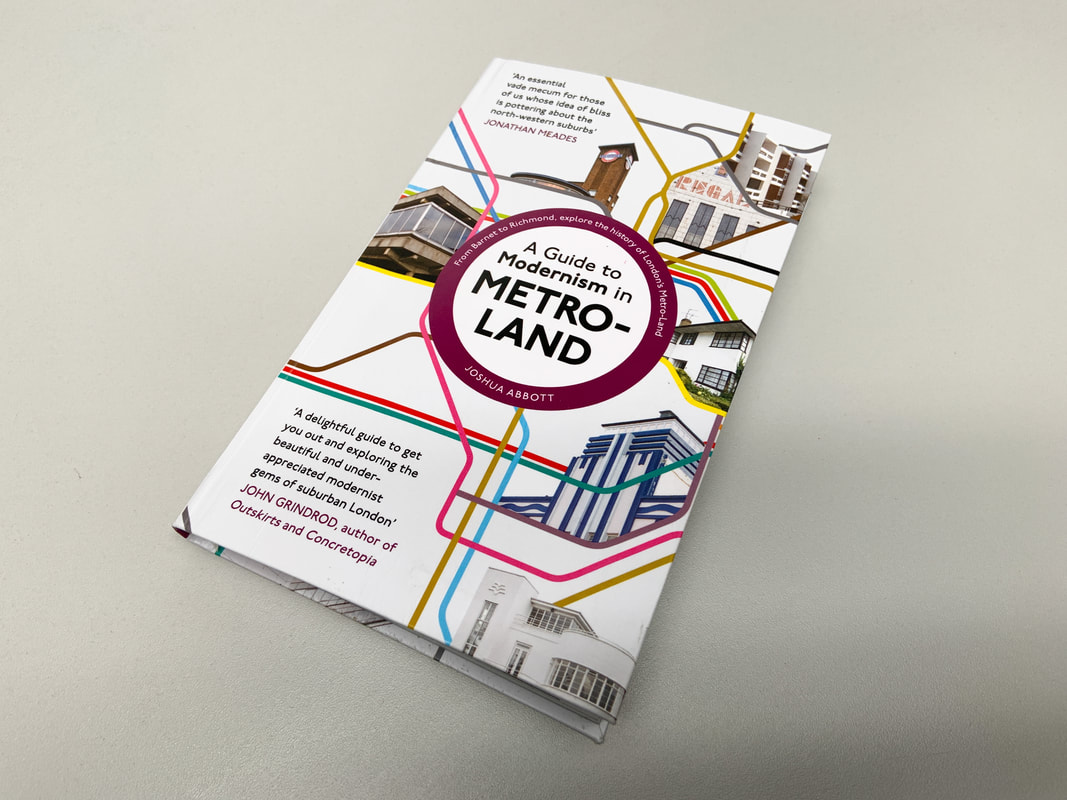
I treated myself to Joshua Abbott’s A Guide to Modernism in Metroland for Xmas so a bright dry sunny day seemed like a good opportunity to make use of it. For my first venture out I picked the borough of Harrow to take a walk around some of the modernist buildings there and get some pictures. 
 
Book cover, A Guide to Modernism in Metroland 
 
I plotted them all and the nearby tube stations on a Google Map first to aid navigation although there wouldn’t be time to visit them all.
 
Starting off at Sudbury Hill Station and making my way to Harrow via Pinner it proved to be a good afternoon for exploring and taking pictures which can be seen here in my Flickr album. (Which should embed in this page but that seems to be broken these days so click on the picture below to view it on Flickr.)
 
 Metroland Modernism: Harrow.
 
I look forward to exploring the rest of the chapters over the next months/years.


Sunday, 12 September 2021

Open House London 2021. Part 1, an old new church.


Saturday 5th September 

I live too far from London to really take advantage of the annual Open House Festival. Travel time cuts into the hours available to visit, especially on this Saturday with much of the south western Underground that I would normally use out of action for planned works. So mainline into Paddington it was and tube to Euston Square, a short walk along the Euston Road from which lies my first venue.
 
 St. Pancras New Church, the west entrance.
 
St. Pancras New Church was open for guided tours with the crypt also open for self-guided creeping about. The Open House London guide (web only this year) description says "Unique Greek-style parish church. Grade I listed building inspired by the ionic temple of the Erechtheum on the Acropolis. A notable feature are the Caryatids guarding the entrances to the crypt. On entering the building and having completed covid formalities there was a brief wait before our informal tour could begin while some church related activity completed at the far end of the nave. This is still a working church and the vicar, Revd. Anne Stevens was present in her “office”.
 
 St. Pancras New Church, what a big organ!
 
And an impressive place it is too.  St Pancras Church is in a Greek Revival style, built in 1819–22 to the designs of William and Henry William Inwood. Despite being a couple of centuries old it's often referred to as St Pancras New Church, in order to distinguish it from St Pancras Old Church, which stands some 940 yards away to the north.

I’m no architectural expert so what follows has been cribbed from the interwebs. The church is in a Greek revival style, using the Ionic order. It is built from brick, faced with Portland stone, except for the portico and the tower above the roof, which are entirely of stone. All the external decoration, including the capitals of the columns is of terracotta.

Henry William Inwood had travelled much in Greece and indeed was in Athens at the time that the plans for St Pancras were accepted. The Inwoods drew on two ancient Greek monuments, the Erechtheum and the Tower of the Winds, both in Athens, for their inspiration. Henry William brought back plaster casts of details of the Erechtheum, along with some excavated fragments, to assist with the design.
 
As for St. Pancras himself, there aren’t many churches in the UK dedicated to the 14 year old boy soldier, as depicted by his statue inside the church, supposedly beheaded for his faith in 304. Let’s face it, if someone says “St. Pancras” the first thing that comes to mind is trains rather than 4th century martyrs.
 
 St. Pancras New Church, caryatid columns above the crypt entrance.
 
Having been shown around the inside and outside of the above ground parts I walked down the south side to the entrance to the crypt, beneath four of the “famous” caryatids. There are another four on the north side and they are “famous” for the story that persists that they were constructed off site, of terracotta around a cast iron core, but when brought to site to be fitted were found to be a few inches too tall. The apparent solution was to slice the extra inches out from the middle to make them the correct height. Is it true? I don’t know but it would explain the rather awkward appearance they have around their midriffs.
 
 St. Pancras New Church, a pile of memorials in the crypt.
 
A few hundred former parishioners are buried in the crypt but you don’t get to “meet” any of them and the only memorials I saw were these piled up in one of the vaulted sections. There was an exhibition of photographs of the church spread around the walls of the crypt and a short video about the history of the church projected, in fine parish church “make do” style, onto a sheet in the chamber below the north entrance. The foundation stone of the church is inscribed in Greek, translated as "May the light of the blessed Gospel thus ever illuminate the dark temples of the Heathen”. In the video the vicar suggests that it might have been intended to counter the fact that the building is in what would at the time have been regarded as a pagan style, which raised a few chuckles.
 
 St. Pancras New Church, looking up at the north entrance to the crypt.
 
After St. Pancras Church my intended next Open House visit was to have been St. Bart’s Hospital but the queue for that stretched all the way around the courtyard and if I’d stood in the scorching heat for that long I’d have needed admitting to the place rather than just getting a look around. So instead I had a wander off around the Barbican, which is always worth a visit, and Smithfield for a refreshing pint.
 

Sunday, 16 August 2020

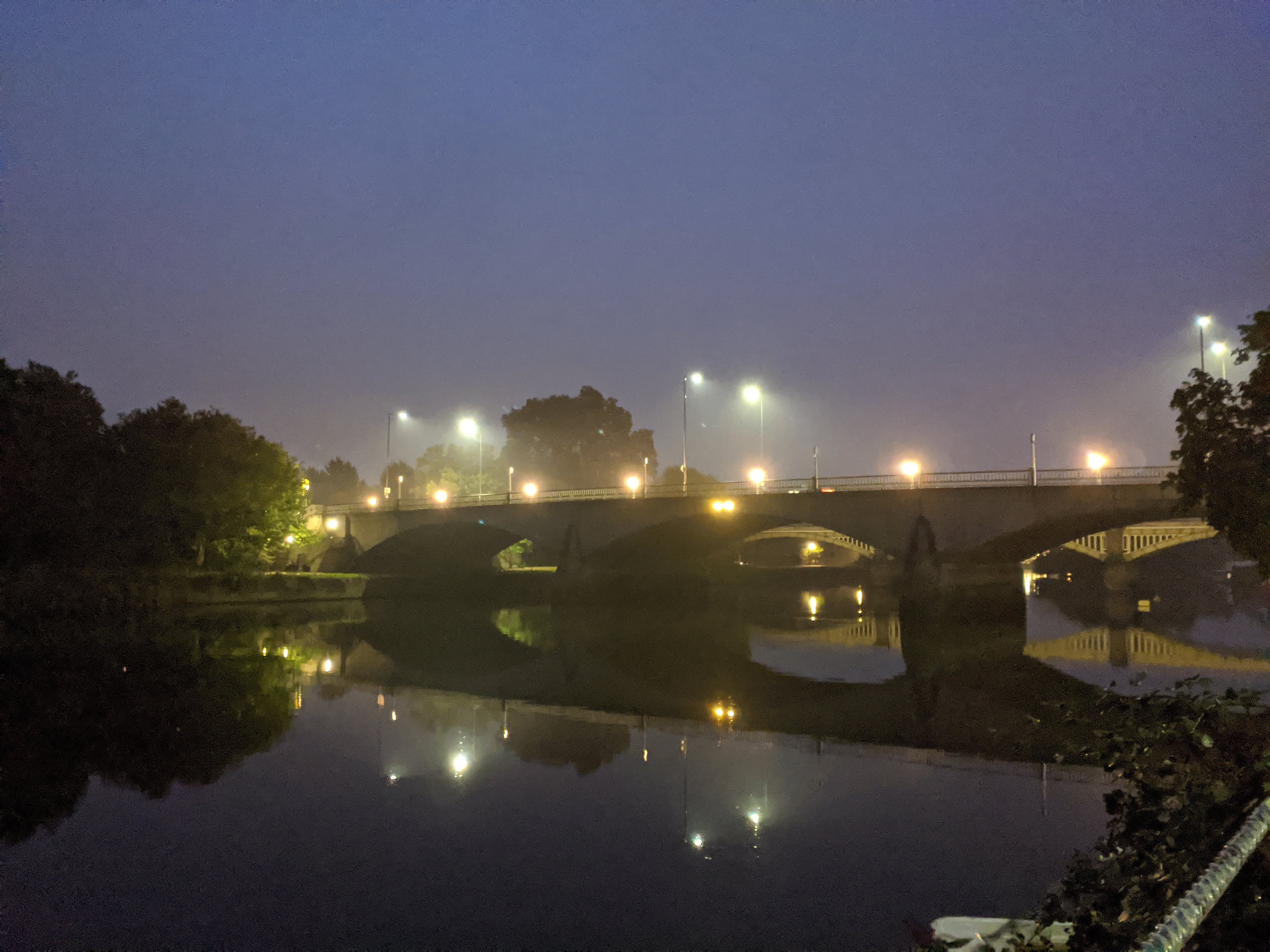
Three Richmond Bridges at night.

 Saturday 15th August 2020

A little nocturnal exploration of three bridges that cross the River Thames close together at Richmond, South West of London.

Richmond Lock & Footbridges

This interesting structure was what drew me to Richmond on a dull, damp post-lockdown Saturday evening when I had nothing better to do. So I parked by the river in Ranelagh Drive and went for a little walk.

Designed by F.G.M. Stoney (careful how you search for him!), Grade II listed, and opened in 1894 it combines a low-tide barrage with a lock at one end with a pair of footbridges. 


The footbridges support the suspended sluice gates which are used to maintain a navigable depth of water in the River Thames upstream when the tide goes out. Until some time in the second world war there was a 1d toll charged to pedestrians when crossing the bridge. Now it's free but the four disused toll-booths, one at each end of each bridge remain in situ. The bridge closes at night at 2130hrs in the summer or 1930hrs in the winter so I had about 15 minutes to cross it and take some photos which was ample. 

Richmond Lock is the furthest lock downstream on the River Thames and falls under the jurisdiction of the Port of London Authority. 

For about two hours either side of high tide the sluice gates are raised up into the footbridge structure and boats can pass through under the bridge arches. At other times they need to go through the lock for which there's a charge - currently £7 and only payable by card because of You Know What.


From the footbridge walkway you can see upstream to the other two bridges.

Twickenham Bridge

Despite lying between Richmond Lock and Richmond Railway Bridge this road bridge comprising three reinforced concrete arches is named Twickenham Bridge because it carries the road to the town of Twickenham, home of the world's largest Rugby stadium.

They couldn't call it Richmond Bridge of course because an 18th century arched bridge linking the two halves of Richmond already existed. Which I didn't go to on this visit. Twickenham Bridge was built in 1933 as part of the Chertsey Arterial Road - now the A316 which links southwestern suburban London to the M3 motorway at Sunbury - it was opened by Edward, Prince of Wales, (later King Edward VIII until he abdicated to marry Wallis Simpson, and was thereafter Duke of Windsor and an alleged Nazi sympathizer).

The bridge is Grade II listed, largely because of its Art Deco bronze lamp standards and balustrades. In 1992 the first Gatso speed camera in the UK was installed on Twickenham Bridge. 

Richmond Railway Bridge

Close to Twickenham Bridge the London Waterloo to Reading railway line crosses the River Thames approaching through the Old Deer Park on a viaduct.

Richmond Railway Bridge designed by Joseph Locke originally opened in 1848 when the line was extended from Richmond to Windsor. It was rebuilt in 1908 by the L&SWR chief engineer J W Jacomb-Hood replacing the 100ft iron girders with a steel truss design on the original piers and abutments as there were concerns over the integrity of the original structure. The main girders and decking were replaced again in 1984.


The Grade II listed bridge now carries multitudes of commuters (well not so much at the moment because of You Know What) on South Western Railway services.

I crossed back over the river and returned to the car past the night anglers and other characters lurking in the shadows just in time to get out of the returning rain.


This Flickr Album contains some more photos

The Bridges of Richmond

Sunday, 29 December 2019

An Urban Ramble, Art Deco Factories and Charles Holden stations.

Osterley Station to Acton Town Station

4.9 miles, about 1h 40m. Mostly level but with three flights of steps.

In theory urban walking means not getting muddy but that probably depends on the weather and time of year. My shoes will need to be cleaned.


This gentle urban ramble links five Piccadilly Line stations, three of which were designed by Charles Holden and two of which look like they were but in fact weren't. It also passes along part of the Brentford "Golden Mile" of Art Deco style factories.

Osterley station is the starting point for this walk.


Starting in the station car park, exit up the ramp and turn left. If you want a better photo you'll have to run across the Great West Road but in spite of the trees the concrete illuminated obelisk on top of Stanley Heaps' 1934 station building stands out. This is one of the not-Holden stations but in the same modern European style that Holden employed elsewhere.
Walk East along the A4 Great West Rd towards Thornbury Road. If you want to take a look at the former Osterley & Spring Grove station, which is now a book shop then head north up Thornbury Rd. and then come back to rejoin this walk.

Sticking up between the pre-war semis on the far side of the road is the St. Francis of Assisi church which opened in 1934 and was designed by Ernest C. Shearman, who also designed a number of similar churches in the London area.
More about its history can be found on the church's own web site.


Gillette Corner marks the western end of the Golden Mile beyond which the land belonged to the Church Commissioners, who would allow no factories to be built.

The Gillette Factory, designed by Sir Banister Flight Fletcher in 1936–1937. Gillette stopped using this factory in April 2006, moving production to Poland. The building was sold in 2013 for conversion into a mixed use complex with a hotel and residential apartments. It has also been used as a filming location.


The Coty Cosmetics Factory, 941 Gt. West Rd., designed by Wallis, Gilbert and Partners opened in 1932. The building now operates as BMI Syon Clinic. The factory was used for the manufacture of Coty soaps, lipsticks, scents and creams until 1979.


Only the boundary fences an gateways remain of the Firestone Tyre Company factory. Built 1928, designed by Wallis, Gilbert and Partners.The building frontage was demolished in an act of corporate vandalism by contractors working for Trafalgar House Plc. during a public holiday in August 1980, shortly before a preservation order was due to be served on it to retain the Art Deco architecture. What a bunch of bastards ☹️ The Art Deco gatehouse was demolished in 2004 to make way for increased parking facilities. The remaining gates, railings, and piers are in a Jazz Modern style and are Grade II listed.

The Pyrene Fire Extinguisher Company, 981 Gt. West Rd., built between 1929 and 1930, designed by Wallis, Gilbert & Partners. Pyrene established the concept of major fire demonstrations with the construction of a large demonstration ground alongside the Brentford factory, to simulate an oil storage depot. Now called Westlink House and available to let if you fancy it.

The Currys Factory and head office, 991 Gt. West Rd., built in 1936 as the distribution centre for Curry's chain of shops a wide variety of goods including bicycles, toys, radios and gramophones. Curry's started as a bicycle makers but are now much better known as an electrical retailer - Currys PC World. Now Grade II listed, the front office building was restored by Foster & Partners between 1997 and 2000 for JCDecaux.


Just before the A4 crosses the River Brent take the stairs on the left down to the Capital Ring walk and continue along the riverbank and over the river via the footbridge to enter Boston Manor Park.

Continue diagonally across the open area following the worn and at the time I was there rather muddy path that passes under the M4 motorway.
There is a rather unsettling rattling from the motorway bridge above as vehicles pass overhead.
The park was created in 1924 from part of the historic estate of the 17th-century stately home Boston Manor.

 The manor house itself was swathed in scaffolding and plastic sheeting but the lake was busy with gulls, and the gullible feeding them.

Exit the park at the other side of the lake onto Boston Manor Road and turn left. Continue past the suburban semis, some of which have heavy iron chains that appear to hold up their porches but are almost certainly only decorative. Eventually you reach Boston Manor Station.

Originally opened in 1883 by the District Railway, Boston Manor station was reconstructed in 1932 to a design by by architect Charles Holden, the Art Deco styled structure features a tall tower which acts as a landmark of the area and is Grade II listed. If you cross the road in front of the booking hall and (if you're tall enough) look over the bridge parapet you get a good view of Northfields Train Depot, the other side of which is our next destination, Northfields station. Head back down Boston Manor Rd. on the opposite side to the station and turn left through the iron gates into Blondin Park.

 Continue past the allotments on your left and into the open space of the park. The land was acquired by the Municipal Borough of Ealing in 1928 and opened as a public park called Northfields Recreation Ground. In 1957 it was renamed Blondin Park after Charles Blondin the famous French tightrope walker, who lived locally in Niagara House. Exit the park into Blondin Avenue and at the end of the street turn left and walk up the road to Northfields Station.

The current Northfields station opened in 1932 replacing that of around 1911. Located on the east side of Northfields Avenue, the new station was designed by Charles Holden in a modern European style using brick, reinforced concrete and glass. Like the stations at Sudbury Town, Sudbury Hill, Acton Town and Oakwood that Holden also designed, Northfields station features a tall block-like ticket hall rising above a low horizontal structure that contains station offices and shops. The brick walls of the ticket hall are punctuated with panels of clerestory windows and the structure is capped with a flat concrete slab roof. Our next stop is not far away. Turn left out of Northfields station and left into Bramley road. Continue straight ahead into Airedale Road and at the end of the street turn left. Soon you will come to South Ealing Station.

The platforms of Northfields and South Ealing are only 300m apart. For the story of why they're so close see here.
South Ealing isn't a Charles Holden design but does have a little tower in his style even though the building only dates from 1988. Since our next stop is a bit further away this is a good place to stop for a coffee in one of the cafes in the parade of shops either side of the station. Once refreshed cross the road and walk south, turning left into Sunderland Road. Continue into Maple Grove and when you come to the open grass area of Village Park Recreation Ground take the path diagonally across it and walk up Almond Ave. Turn right into Elderberry Rd. passing the huge Ealing Electricity Substation on your left and being glad you don't live in one of the houses opposite. At the end of the road turn left onto Popes Lane and cross the road.

Follow Popes Lane for about half a mile. It's not the most interesting road to walk along being mostly semi detached houses on the right and sports grounds on the left. I've not been able to determine which Pope gave it its name either.
Eventually however it will bring you to Gunnersbury Park.


I've covered Gunnersbury Park in more detail in a previous posting. It's worth diverting into the park for a look around before continuing this walk, and both refreshment and relief may be obtained therein subject to opening hours. If you've more time to linger then a visit to the museum in the large mansion will well repay your time spent inside.

Onward to the final leg. Turn right out of Gunnersbury Park onto Pope's Lane (or if you didn't go in, then carry on along Pope's Lane) and cross over the A406 Gunnersbury Avenue dual-carriageway into Gunnersbury Lane.

About five minutes further walking brings you to our last stop, Acton Town Station, on your right.
Acton Town station was opened as Mill Hill Park on 1 July 1879 by the District Railway (now the District line).It remained as a terminus until on 1 May 1883 and 23 June 1903 the DR opened two branches from Acton Town to Hounslow Town and Park Royal & Twyford Abbey respectively. On 4 July 1932 the Piccadilly line was extended to Acton Town and now it serves both Piccadilly Line and District Line trains. The original brick-built station was built in 1879 and in February 1910 the station building was reconstructed. In 1931 and 1932 the station was rebuilt again in preparation for transferring the Uxbridge branch service from the District line to the Piccadilly line. The new station was designed by Charles Holden in a modern European geometric style using brick, reinforced concrete and glass. Similar to other Holden designed stations, Acton Town features a tall block-like ticket hall rising above a low horizontal structure housing the station offices and shops. The ticket hall has a projecting London Underground roundel sign over a canopy, the brick walls of the ticket hall are punctuated with panels of clerestory windows and the structure is capped with a flat concrete slab roof. It was given Grade II listing in 1994.

From Acton Town you can either get the tube back to Osterley or... well the world's your lobster really ☺️


More photos, a Flickr Album:

Urban Ramble. Osterley to Acton Town