Showing posts with label London at night. Show all posts

Thursday, 22 January 2026

Canary Wharf Winter Lights 2026

20th January

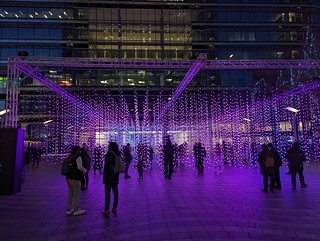
London light festivals seem a bit thin on the ground this year. Battersea Power Station is taking a break from theirs and Westfield West London’s “Here We Glow” looks to have been a one off last year. At Canary Wharf however it’s business as usual so I headed up on day one for a look.

Free to visit Winter Lights is on from 20th to 31st of January and runs from 5pm to 10pm each day. Sixteen temporary installations are spread throughout the Canary Wharf estate alongside the nine permanent works which are there year round.

Canary Wharf Winter Lights 2026. Lacto-Reacto-Light, Jack Wimperis, Riverside

They vary in size and wow factor with some being full-on sound and light shows and others a bit underwhelming. If you look near each there will be an explanatory panel but it’s easy (and advisable) to ignore the Art Bolx and just enjoy the exhibits for themselves. Pick up a free map from the pink-tabard clad stewards on site or download it before you go else you’ll probably miss something. I never found 6b (indoors somewhere and I wasn’t the only person having trouble locating it) and another one, outdoors in this case I could have missed even though I had a map if there hadn’t been a crowd round it.

Canary Wharf Winter Lights 2026. FloWeR PoWeR, Aerosculpture/Jean-Pierre, David and Christian Thellier, Westferry Circus

Stand outs for me were FloWeЯ PoWeЯ by Aerosculpture/Jean-Pierre David and Christian Thellier down near Westferry Circus, Hulahoop by Scale in Union Square, and Manifestation by Marcus Lyall in West Lane. Several others were pretty good too, again mostly the ones with the benefit of movement.

Canary Wharf Winter Lights 2026. Trispheric Garden, REELIZE.STUDIO, Cabot Square

I arrived at about 5pm and by 7.30pm had managed to do the whole circuit (not necessarily in order) and by that time the temperature had begun to drop sharply so I took my frozen fingers indoors to find something to eat before heading back to Waterloo and the train home.

Canary Wharf Winter Lights 2026. Blueprint, Studio Vertigo, Water Street

Although it was fairly busy with plenty of “phone zombies” to try and dodge I’d recommend visiting midweek and avoiding the weekends especially if you want to photograph or video anything. That’s because from previous experience the weekends are like someone left the gate to the twat farm open and it’s harder to even get a good look at the installations.

If you can’t get there at all here’s a Flickr Album (69 photos).

Canary Wharf Winter Lights 2026

And here’s a video (YouTube, 14 minutes).

Wednesday, 31 January 2024

Battersea Power Station Light Festival 2024

30th January 2024

More winter lights, this time at the shopping mall that was formerly Battersea Power Station.

I made a wee video.

I also took some photos, available in this Flickr Album.


Battersea Power Station Lights Festival 2024

Verdict: Worth a look if you're nearby or really like this sort of thing. Could be a bit underwhelming if you've come a long way. Battersea Power Station has much too high ambient light levels to really pull this sort of display off.

Saturday, 20 January 2024

Canary Wharf Winter Lights 2024

19th January 2024

A quick look around the Canary Wharf Winter Lights Festival for 2024. It was bloody cold and I'm glad I arrived early to avoid most of the crowds.

There's a bunch of photos here on Flickr

Canary Wharf Winter Lights 2024

Sunday, 16 August 2020

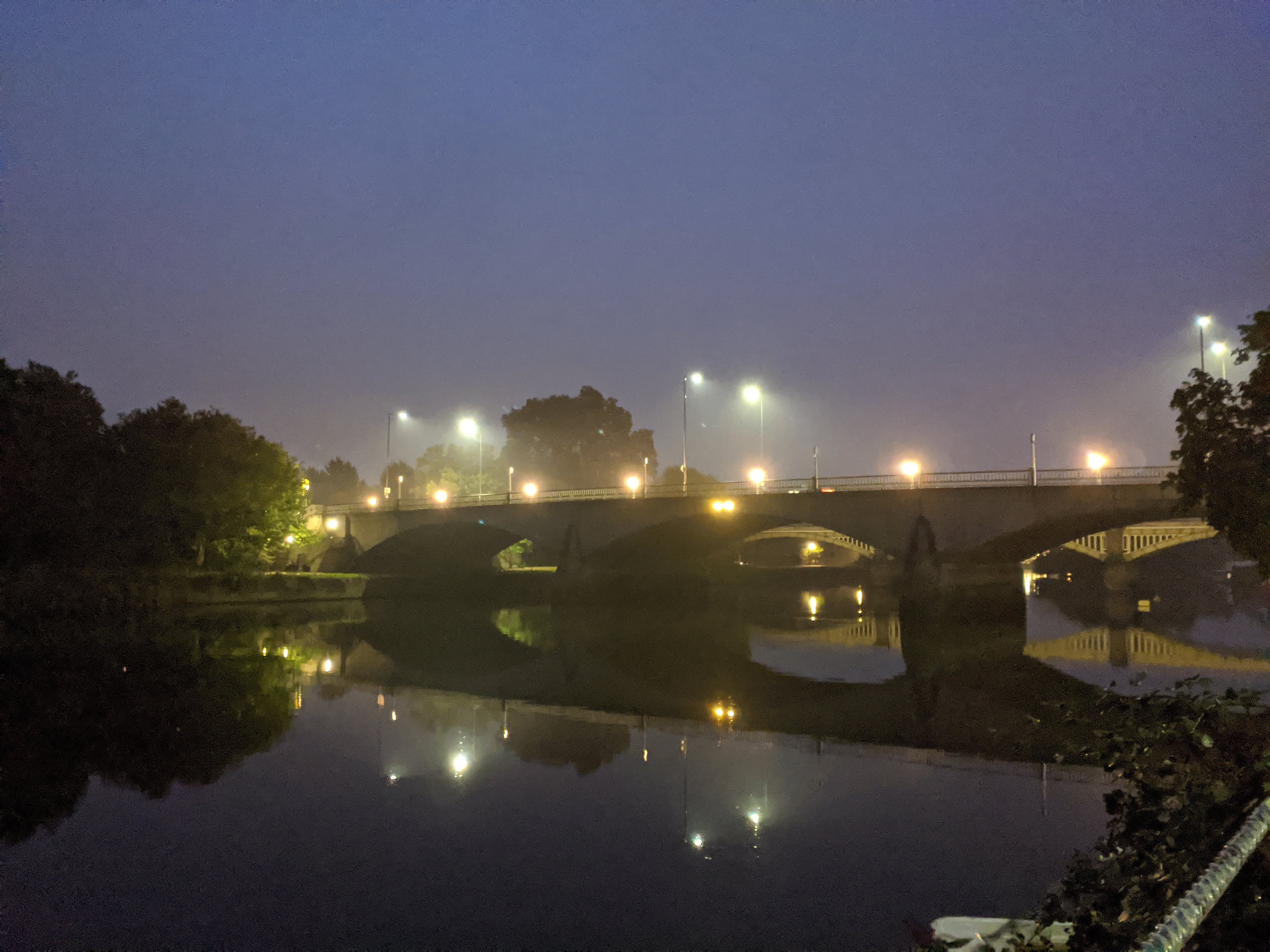
Three Richmond Bridges at night.

 Saturday 15th August 2020

A little nocturnal exploration of three bridges that cross the River Thames close together at Richmond, South West of London.

Richmond Lock & Footbridges

This interesting structure was what drew me to Richmond on a dull, damp post-lockdown Saturday evening when I had nothing better to do. So I parked by the river in Ranelagh Drive and went for a little walk.

Designed by F.G.M. Stoney (careful how you search for him!), Grade II listed, and opened in 1894 it combines a low-tide barrage with a lock at one end with a pair of footbridges. 


The footbridges support the suspended sluice gates which are used to maintain a navigable depth of water in the River Thames upstream when the tide goes out. Until some time in the second world war there was a 1d toll charged to pedestrians when crossing the bridge. Now it's free but the four disused toll-booths, one at each end of each bridge remain in situ. The bridge closes at night at 2130hrs in the summer or 1930hrs in the winter so I had about 15 minutes to cross it and take some photos which was ample. 

Richmond Lock is the furthest lock downstream on the River Thames and falls under the jurisdiction of the Port of London Authority. 

For about two hours either side of high tide the sluice gates are raised up into the footbridge structure and boats can pass through under the bridge arches. At other times they need to go through the lock for which there's a charge - currently £7 and only payable by card because of You Know What.


From the footbridge walkway you can see upstream to the other two bridges.

Twickenham Bridge

Despite lying between Richmond Lock and Richmond Railway Bridge this road bridge comprising three reinforced concrete arches is named Twickenham Bridge because it carries the road to the town of Twickenham, home of the world's largest Rugby stadium.

They couldn't call it Richmond Bridge of course because an 18th century arched bridge linking the two halves of Richmond already existed. Which I didn't go to on this visit. Twickenham Bridge was built in 1933 as part of the Chertsey Arterial Road - now the A316 which links southwestern suburban London to the M3 motorway at Sunbury - it was opened by Edward, Prince of Wales, (later King Edward VIII until he abdicated to marry Wallis Simpson, and was thereafter Duke of Windsor and an alleged Nazi sympathizer).

The bridge is Grade II listed, largely because of its Art Deco bronze lamp standards and balustrades. In 1992 the first Gatso speed camera in the UK was installed on Twickenham Bridge. 

Richmond Railway Bridge

Close to Twickenham Bridge the London Waterloo to Reading railway line crosses the River Thames approaching through the Old Deer Park on a viaduct.

Richmond Railway Bridge designed by Joseph Locke originally opened in 1848 when the line was extended from Richmond to Windsor. It was rebuilt in 1908 by the L&SWR chief engineer J W Jacomb-Hood replacing the 100ft iron girders with a steel truss design on the original piers and abutments as there were concerns over the integrity of the original structure. The main girders and decking were replaced again in 1984.


The Grade II listed bridge now carries multitudes of commuters (well not so much at the moment because of You Know What) on South Western Railway services.

I crossed back over the river and returned to the car past the night anglers and other characters lurking in the shadows just in time to get out of the returning rain.


This Flickr Album contains some more photos

The Bridges of Richmond

Sunday, 1 December 2019

The lights, the lights!

Sunday 24th November

It is that time of year again. You can barely move it the supermarkets for piles of tat that no one needs to buy (the war against single-use plastic seems to have been temporarily suspended) and the shelves are full of festive fayre much of which will have passed its use by date before the big day.

On the plus side however it's also the time of year that the lights go on. Town centres - or their modern replacement, Shopping Centres - across the land put up their best seasonal illuminations in an effort to draw as many spenders as possible in competition with other local towns. So far, so standard.

As well as your usual Christmas Lights from Bromyard to Oxford Street there are more ambitious, or maybe more artistic displays. Canary Wharf has "spectacular light installations and interactive art"  but you'll have to wait until January to see that. In the meantime you can already see some spectacular light installations and interactive art by heading up the Metropolitan or Jubilee lines to Wembley Park. (Other transport choices are available if not coming from central London.)

For here near the home of English football (that will probably be disputed by those in the north) and the London Designer Outlet, is Winterfest 2019. Or Christmas in technicolour as it says on their website. The website also says that you can, "Experience Wembley Park’s first-ever immersive winter lights trail. Artists from all over the world have curated light and sound artworks that will transform Wembley Park into an immersive playground of unique art installations, combining light, sound and touch into a truly multi-sensory experience. From the acclaimed Sonic Runway, making its European debut in Wembley Park via Nevada’s Burning Man festival, to London’s tallest-ever LED light Christmas Tree, get ready to be enveloped by a technicolour trail of lights and interactive sounds."

And that's a pretty good description, as I discovered on a Sunday evening with nothing better to do. Here's a flavour (with cheesy music but no sleigh bells I promise) of what I found:


Winterfest is on until January 3rd so they'll be hoping you'll come and see it and spend money on Christmas presents and in the Boxing day sales. Or you could just go and see the lights - there is no admission charge. I succumbed to the lure of a Pret filter coffee as it was a chilly night so I suppose they acheived their aim of attracting more trade to the tune of £1 😀

Season's Greetings.

Sunday, 10 February 2019

Clapham South Deep-level Shelter

9th February 2019

Another Hidden London visit to break up the monotony of winter. This time to a very deep hole in the ground. I got the train from Sandhurst via Guildford and Clapham Junction to Balham (Gateway to the South) and despite it being Saturday all the trains ran within a couple of minutes on time and none were cancelled. I mention this because I'm not usually that lucky.

A 15 minute stroll up Balham High Road brought me to Clapham South station, or more accurately to the Costa opposite for refreshments, impeccably timed so that I missed the rain shower that occurred whilst I was inside. Filled up on cappuccino and cinnamon brioche bun (those are nice) and with some time to kill before the tour of the shelter was due to start I crossed the road and had a wander around the southern half of Clapham Common. 

Clapham South shelter surface building
The first thing you come to (ignoring the robot khazi) is one of the entrance "pillbox" buildings to the deep level shelter. Just behind it is the top of one of the ventilation system shafts. 

This entrance is not the one used for the tour though, that's further south back along Balham Hill, now incorporated into a modern apartment block and known locally as the drum. 

Further wandering across the common brought me to the bandstand and Mount Pond before heading back to Clapham South station to meet the Hidden London tour guides and be registered and fitted with a fetching pink paper wristband. While waiting we were entertained by the leaping beggar outside the station entrance who would occasionally and for no discernible reason jump up into the air. I'm not sure care-in-the-community is working quite as well as we'd hope. Just be glad it isn't you - unless it is you and you're reading this in which case you've dropped your lighter by the south entrance door to the station.

South London Women & Children's Hospital
Across the road from the station is an impressive bit of 1920s neo-classical architecture.

A quick Google informed me that it was the
South London Hospital for Women and Children. Designed by Sir Edwin Cooper it was for women patients and staffed by women only right up until its controversial closure in 1984.

It is now a Tesco store. Or at least the bits that remain that they weren't allowed to destroy are. Thankfully the Tesco branding on the exterior is unusually understated, to the extent that I hadn't noticed its new use until I looked it up.

Back to the main subject of this post and back to Clapham South station. The tour party met up under the high lantern over the station entrance and once all were present and correct lead the short distance
Clapham South entrance
down Balham Hill to an anonymous door at the bottom of a modern apartment block.

Inside we were given a short safety briefing - all sources of ignition are banned and anyone who thinks they might have trouble climbing back up the 179 stairs is requested to seriously consider whether they should proceed on the tour. There is no working lift. There is definitely no step-free access!

Clapham South is one of 8 deep-level air raid shelters built between 1941 and 1942 (10 were planned but two were abandoned before completion due to difficulties) after it became horribly apparent that the tube stations that people were using as air raid shelters were not adequate. There was great loss of life at Bank station and again at Balham, where the bombs shattered water and sewerage mains resulting in many of the victims being drowned in effluent which flooded into the tunnels. Each shelter was intended to house 10,000 people although that was later reduced to 8000 as it was decided that 10,000 would be overcrowded. The shelters were all attached to tube stations on the Northern and Central Lines because they utilised pre-war plans for express tube lines intended to run beneath the existing lines.
The 10 shelters were located at:

  • Belsize Park
  • Camden Town
  • Goodge Street
  • Chancery Lane
  • St. Pauls (not completed due to concerns about undermining the cathedral).
  • Oval (not completed because it kept flooding while they were building it).
  • Stockwell
  • Clapham North
  • Clapham Common
  • Clapham South
Of the eight built only Clapham South is currently open to the public, by Hidden London tour only. Although that is about to change as Clapham Common shelter, now an underground farm, are currently taking bookings to run tours of their own hole in the ground. I expect it will look a bit different to its neighbour to the south.

Direction sign in the tunnels
Spiralling down the 179 steps we went (insert your own reference to the "15 storeys" gag here) to the bottom and into one of the cross tunnels.

The shelter consists of two parallel quarter-mile long tunnels connected by cross passages at the bottom of the vertical access shafts. Each tunnel is divided into four sections and each section split horizontally by a floor giving a total of 16 sub-shelters.

The tunnels are 16' diameter tube train tunnels, dug by hand, lined with iron or concrete rings. It's not what you'd call spacious accommodation.

The whole shelter was connected to a powerful ventilation system. It had to be, this was the 1940s, almost everyone smoked!


Upper floor within the tunnel
In order to aid users in finding their way to their allotted space the shelters were given the names of Royal Navy admirals, 16 of them.

Some civil servant had to find 16 admirals with names starting with the letters A to P.

Within the shelter were were medical facilities, toilets and showers, and canteens as well as administrative offices for the Civil Defence staff under the control of the Shelter Superintendent.


Wartime bunk beds
Triple layer steel bunks were installed. There's not much space between them and the bottom bunk on the lower floor is rather short due to the curvature of the tunnel wall.

The shelter had to be evacuated during the day, it was important that people carried on as normally with their lives as possible and didn't become troglodytes. Only those who had been bombed out and had lost their homes were allowed to leave possessions in the shelter. Everyone else had to drag their bedding and everything else in and out up those spiral staircases.


Newspaper article 1944
By the time the shelters were completed the heaviest part of the Blitz had come and gone.

The shelters were mothballed as it wasn't felt to be economically viable to run them for the much reduced number of people who would need them.

They were actually opened later in mid 1944 when the German V1 and V2 weapons were falling on London but never saw anything like the 8000 people a night that they could accommodate.


After the end of the war the shelters were used as cheap 1d/night hotels, troop accommodation for the funeral of King George VI, briefly although famously to accommodate some of the migrant workers from the MV Empire Windrush, and then in 1951 as the Festival of Britain Hotel. A fire at Goodge Street in 1956 which was being used by US troops meant the shelters were deemed no longer suitable as sleeping accommodation and closed.

Secure archive shelving
Since then the shelters have found alternative use as secure archive storage. They are dry, ventilated, and have a fairly constant temperature which is suited to the storage of paper and other items.

As well as installing purpose built shelving many of the wartime bunk beds were converted to shelves by placing sheets of chipboard over the steel bed-springs.

Clapham South is a Grade II listed structure and if you can get a ticket (and if you can climb 179 stairs) it's well worth the entry fee. The Hidden London staff put on a really good tour (Pat is especially good) and you'll be surprised at just how extensive the shelter is while being quite cramped at the same time. At 6'5" tall I spent a lot of time ducking.

Clapham Common shelter
If you walk up past the common as I did past Clapham Common station then on the right on the corner of Carpenter's Place you can see the surface building for Clapham Common deep-level shelter. this is now Growing Underground hydroponic farm so has been spruced up a bit compared with Clapham South.

Next to it is the Maharani restaurant.

I can confirm that they do a bloody excellent curry 😊 

Wednesday, 23 January 2019

Winter Lights

Sunday 20th January 2019

From Tropical London to decidedly not tropical Canary Wharf. Wrapped up well to see the Winter Lights exhibition of art installations in and around Crossrail Place, Canary Wharf Shopping Centre, and Jubilee Gardens.

It was a tad nippy down the docks under the full moon.


Last Parade - Alexander Reichstein

Submergence - Squidsoup

Floating Islands - Mürüde Mehmet

Flow - Squidsoup

Floating Islands - Mürüde Mehmet

Prismatica - Raw Design

Everyone's photo op.

Two Hearts - Stuart Langley
More photos here Flickr Album but photographs don't really capture the exhibits as well as video:

Tuesday, 1 January 2019

New Year's Eve

Choose going to the pub, which will be full of strangers (some of them very strange indeed), drinking too much and walking home fed up and depressed to a new year beginning with a hangover.

Choose sitting at home watching the mindless TV, overdosing on snacks, toasting the new year in alone, and then watching Jools Holland long after you should give in and go to bed.

Or...

... choose a mini-adventure to watch the fireworks over London, with a mini-picnic, from the top (well half way up at least) Primrose Hill.

The last one, for a change.


Saturday, 24 November 2018

London Lights Up

18th November 2018

After my walk through the deer in Richmond Park I caught a train from Mortlake to Waterloo to see some of the Xmas lights in London. Crossed over the Thames and had a quick coffee and phone-charge I walked up to Charing X Rd. and Strand.

Rather traditional lights on Strand, giant baubles with blue stars suspended across the road above the busy traffic.


Irving Street has nets of myriad tiny white lights suspended above the West End crowds below. Though these may not be just for Xmas as some central London streets have permanent decorative lights - Villiers Street next to Charing Cross Station is another.


Leicester Square has been taken over for an event "Christmas In Leicester Square" in order to extract maximum cash from the tourists and the trees have been dressed with stars (or are they snowflakes?) and vertical strings of fairy lights. But there is too much light from below so the effect is somewhat lost.


Oxford Street's shopping canyon has again its simple but effective white and purple baubles. Possibly the classiest thing in the street. Apparently new lights are planned for 2019.


Christmas is calling at Oxford Circus, between the Oxford Street baubles an animated display of multi-coloured "laser flashes" radiating out from the middle of the road.

Not real lasers though as in 1978 which to be fair were fairly unimpressive though did concern one American tourist I met then that the lasers might cut the tops off the double-decker buses. A level of intelligence that might explain the election of the current POTUS.


Regent Street has again its large "winged angels" flying up John Nash's sweeping curved shopping street from Oxford Circus to Piccadilly Circus.


Carnaby Street this year has a suitably flamboyant Bohemian Rhapsody theme to its lights - a promotion for the recently released film of the same name about the band Queen.


Foubert's Place (part of what I see is now branded "Carnaby Sohoho") is a bit more Christmassy though.


Ho Ho Ho!


Though from the other side the message appears to be more X rated than Merry Xmas - reminiscent of Meg Ryan perhaps.


And while William Shakespeare looked down upon the Soho revellers from the corner of Great Marlborough Street some of us had to get a train home so headed to Green Park Station to get the tube back to Richmond. 

There to find Southwestern Railway definitely not running to schedule and having nearly an hour's wait on a freezing cold Ascot station en route to Camberley.


They could at least unlock the sodding waiting rooms.

Or provide a seat on the covered over-bridge which was the only shelter from the wind.