Showing posts with label Hidden London. Show all posts

Saturday, 25 January 2025

Dover Street - Alight here for Green Park

23rd January 2025

I’ve been down another hole in the ground thanks to the London Transport Museum’s Hidden London tours. This time it was to parts of Dover Street station, or as we no it now, Green Park. This is a new Hidden London tour for 2025 and follows a similar theme to many others. We were met outside Green Park station (by the Diana Fountain) and once our tickets and photo ID had been checked and safety and other formalities completed Eesa and Becky led us into the station and down towards the Piccadilly Line platforms. Just before reaching the platforms however we went through a private door into the “lost world” of Dover Street station’s passages from the platform over-bridges to the disused lift shafts.

Dover Street - Alight Here for Green Park. Piccadilly Line platform from overbridge..

These now redundant passages took passengers to and from the lifts to the platforms but the station became too busy to carry on using lifts. When the lifts were replaced by escalators there wasn’t room for them at the Dover Street site so in 1933 a new ticket hall was opened below ground, accessed from entrances on Piccadilly and in Green Park and the station took its new name from the park.

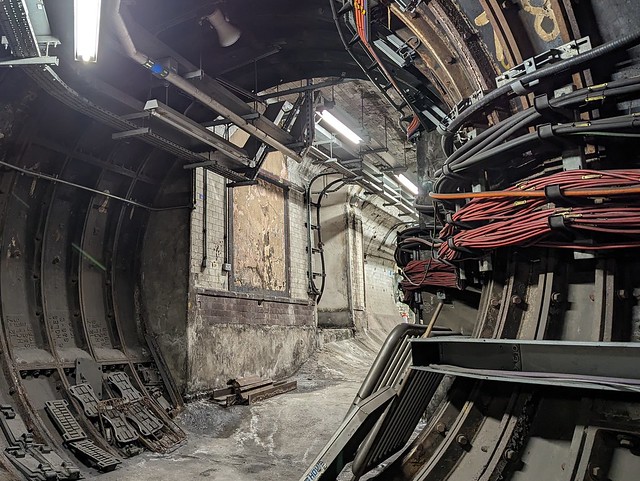
The passages retain much of the original tiling in a light blue and white colour scheme and some original sign-writing too.

Dover Street - Alight Here for Green Park. To The Trains.

No Hidden London station tour can escape the system’s role in the second small disagreement of the 20th century and in the case of Green Park it was initially used for storage by some of London’s museums but after London Transport’s headquarters at 55 Broadway received a wee present from the Luftwaffe the museums were turfed out and the redundant passages converted to an operational headquarters for the LT board. This included a suite for the Chairman, Lord Ashcroft, at the foot of one of the lift shafts. Considerations of class meant he got newly plastered and painted walls whereas lesser mortals working and living down there kept the station tiling.

Dover Street - Alight Here for Green Park. Chairman's accomodations plan.

The tour returned along the passage to the Piccadilly Line before heading back into the public part of the station.

Dover Street - Alight Here for Green Park

Then along the long tunnel to the Victoria and Jubilee lines. The tunnel where the mosaic tiles on the walls gradually turn from white and blue (Piccadilly end) to white and grey (Jubilee end). Also the long tunnel which makes some people avoid changing lines at green Park.

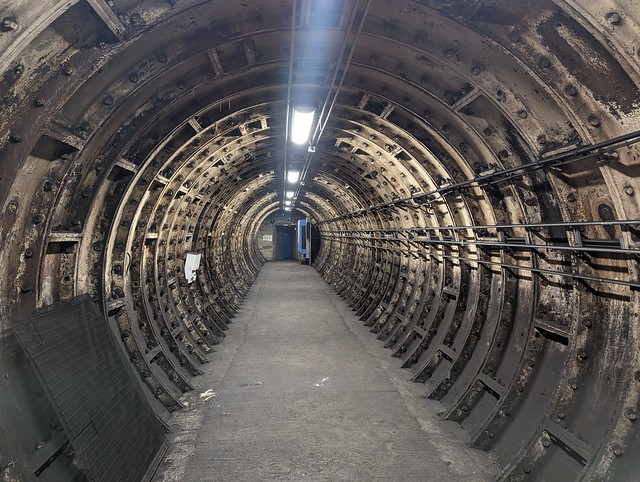
The point of this trek through the station was to get to the huge ventilation tunnel that expels warm air from the station and draws cooler air from the surface. There are no fans in the ventilation tunnel for this, the movement of the trains through the station platform tunnels is used, the trains being effectively huge pistons.

A long staircase leads down from Victoria Line level to Jubilee Line level.

Dover Street - Alight Here for Green Park. Ventilation tunnel from Jubilee Line.

and from the Victoria line level the tunnel rises vertically to the world above. In January this space is noticeably colder than the rest of the station.

Dover Street - Alight Here for Green Park. To the fresh air.

Of course one of the fun parts of a station tour is getting to peek down at the trains and platforms from the hidden spaces behind the vents. So here’s the Jubilee Line platform seen from above the track.

Dover Street - Alight Here for Green Park. Peeking at the Jubilee Line.

And apart from making our way all the way back up to the ticket hall and handing back our visitor’s badges that was another tour done. Almost 90 minutes had passed but it didn’t feel like it. Considering it’s a new tour it all went very smoothly, nobody got lost and nobody was gained on route despite it being a busy station. The guides were knowledgeable and enthusiastic as ever. If you fancy yourself as a bit of a Tim Dunn/Siddy Holloway then Hidden London tours can be booked here.

There are more photos on my Flickr Album too.

Dover Street - Alight here for Green Park

Tuesday, 6 August 2024

Hidden Holborn

1st August
 
I went on another Hidden London tour, Holborn - The Secret Platforms, run by the London Transport Museum. This was I’m pretty sure the second day of running tours at Holborn tube station but the guides were already well into the swing of things and as usual it was all well organised and very interesting. Our group was met outside and after safety briefing, ticket and ID checks led through the ticket barriers and through a door into a swelteringly hot small space for the initial introduction by our enthusiastic lead guide Becky. this lasted only a few minutes but it was still a relief to move on to the slightly cooler spiral staircase and go down the 193 steps (I didn’t count them but I reckon that’s about the equivalent of a 15 storey building 😉 ) with walls still covered in original tiles in a white, brown, and blue combination unique to Holborn.
 
 Holborn - The Secret Platforms
 
 After briefly emerging onto the eastbound Piccadilly Line platform we passed through another private door onto the disused platforms that formerly served the branch line to Aldwych. The first of which, that used to be the terminating platform, is now a row of disused offices and other spaces e.g. toilets. One of the rooms bore a sign for the “Central Line Model Railway Club”, sadly no longer used.
 
 Holborn - The Secret Platforms
 
 At the far end of the platform we were able to get to down the the tunnel towards Aldwych, with the tunnel lights switched on else we’d have just been looking into a black hole. We had a shuffle round to take photos and a quick plug for the Hidden London Aldwych tour (I’ve already done that one back in 2018) before returning to the office/platform area.
 
 Holborn - The Secret Platforms
 
 Before the station got too busy the disused platforms at Holborn were often used for filming. These days Aldwych or Charing Cross disused platforms tend to be used as they’re easier for film crews to access. We got a little film show here to remind us of some of the music videos filmed at Holborn and just how awful Superman 4 was, particularly the low-budget special effects!
 
Another short walk via tunnels and stairs took us past more original coloured tiles and a large fragment of early Piccadilly Line map to the other disused platform. This is the through platform, still connected to the tunnel in the photo above and to the live Piccadilly line to the north of the station so if you look down the tunnel in that direction and are patient you can get a view of the eastbound trains leaving the adjacent open platform. This platform has been used by TfL to test new platform decor so has some rather confusing signage.
 
 Holborn - The Secret Platforms
 
 Holborn - The Secret Platforms
 
The tour ended here with the customary round of applause for our four guides. It didn’t seem like about 90 minutes had passed which is the sign of a good tour and I even got used to the “Holl-born” pronunciation being used throughout, it’s always been “Ho-b’n” to me 😀. We returned to the ticket hall, thankfully not via the 193 stairs but taking time to appreciate the very long escalators instead. 
 
I took a lot more photos: Flickr Album
 
 Holborn - The Secret Platforms
 
I’ve only given a brief outline of the tour here, there’s a lot more to discover by actually going there and yes, it’s not a cheap day out but it is worth it so if you fancy doing it yourself bookings are being taken for Wednesday, Thursday, Friday, Saturday, and Sunday between now and November 10th with more dates to come in March 2025.

Thursday, 23 February 2023

Deep in the Bush

Wednesday 22nd February 2023

I had a personal tour of Shepherd’s Bush Underground station today.
 
 Shepherd's Bush Underground Station
 
I wasn’t expecting it to be a personal tour but I’d managed to book the 14:35 Hidden London Shepherd’s Bush tour and no one else had. So it was just me, the Hidden London guide, and the safety man that set off down to the platforms and then through locked doors to the parts of the station you don’t get to see as a passenger.
 
These include disused passenger tunnels from the several extensions and reconfigurations of the station, tunnels dug for ventilation, and former lift shafts whose function has been replaced by escalators.
 
 Hidden London, Shepherd's Bush, ventillation tunnel.
 
 As with the other Hidden London station tours I’ve been on it’s all atmospheric and grubby but underneath the dirt and later added behind-the-scenes infrastructure there’s a lot of original Central London Railway features.
 
 Hidden London, Shepherd's Bush, disused passenger tunnel and lift exits.
 
 Including these built in tiled poster cases at the end of one of the disused passenger tunnels.
 
 Hidden London, Shepherd's Bush, tiled poster frames in a former passenger tunnel.
 
Not having another 15 guests on the tour meant this time I could get pictures without other people in them for a change. My guide whose name rather embarrassingly has escaped my mind was keen and knowledgeable so I got the full show and as there was only two of us we were able to go into spaces where a full tour group would be unmanageable.
 
One of the other fun things about these tours is that you get to look out on the platforms from hidden spaces, to the amusement of the two young ladies who looked across the track to see two people waving and grinning from behind a ventilation grille.
 
 Hidden London, Shepherd's Bush, "Hello on the platform!", view through a ventillation grille.
 
 More photos in this Flickr Album
 
I can recommend this Hidden London tour, although I can’t guarantee that you’ll get the personalised version :-)


Sunday, 22 August 2021

Hidden London - The Kingsway Tram Subway

19th August 2021

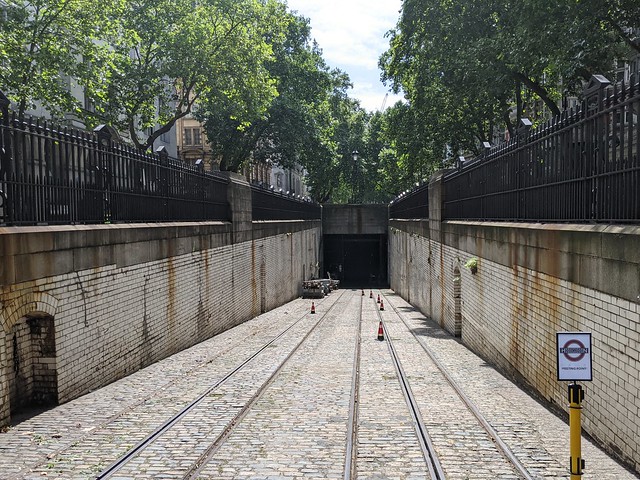
At the junction of the A4200 Southampton Row and A40 Theobald’s Rd. there is a set of metal gates flanked by ornate lamps beyond which a cobbled slope runs down to the darkened portal of a tunnel. Set into the cobbles (yes, I know they’re properly called setts) there are metal rails for this is the north entrance to the Kingsway Tram Subway and is somewhere I’ve long wanted to get into. Thanks to London Transport Museum’s resumed Hidden London tours, I now have.
 
 Kingsway Tram Tunnel, north portal.
 
A bit of history:
The Kingsway Tram Subway was built by the London County Council and opened in 1906, as part of the regeneration programme for the Holborn and Aldwych areas, which had become slums. The building of the new roads gave the opportunity to link the tramways in the north with those in the south but the occupants of the fancy new buildings wouldn't want to have to look at all those working class people who mostly travelled by tram. So after the pattern of New York and Boston it was decided to put the tramway below ground in a subway. The southern end of the subway emerged on the Embankment next to (later under) Waterloo Bridge, permission for the lines to continue over the bridge having been refused.
It had relatively short active life, closing in 1952, but despite this, the Subway underwent several major upgrades during its time, in particular the enlargement to enable the passage of double deck trams in 1930-31.
 
 Kingsway Tram Subway
 
More than half of the subway still exists to this day - complete with original features such as the longest section of surviving tram track in London (Croydon doesn't count in this context) and the remains of Holborn tram station with its steps to street level. Part of the southern section of the subway was repurposed in 1962-1964 as part of the Strand Underpass road and the very southernmost section between the underpass and Embankment under Waterloo Bridge was converted into a bar/restaurant, currently it is Proud Cabaret Club 
 
 
The northern section visited on the tour is mostly used for storage by Camden Council and others and has also been used as a film set several times. The tour isn't allowed to continue south into the part of the remaining tunnel which lies in Westminster council area. 
 
 Kingsway Tram Subway
 
 Kingsway Tram Subway
 
As usual with Hidden London tours it was all well organised and guided. If you get a chance go and have a look in the Kingsway Tram Subway yourself, it’s the only one of its kind in the country.


Friday, 3 April 2020

Hidden London - Moorgate Station

4th March 2020

In a previous era when we were able to leave home without the risk of catching the plague, having our shopping examined by the police, or being abused by self-appointed guardians of society on Twitter, I paid a visit to the disused parts of Moorgate Underground station by means of a Hidden London Tour by the London Transport Museum. Was it really only a month ago? For anyone old enough to remember 1975 Moorgate is synonymous with one terrible thing but there's more to the station than that.


Moorgate Station - Metropolitan Line

 Moorgate station in the City of London opened in 1865 as the terminus of the first extension of the Metropolitan Railway, intended to bring the line closer to the financial heart of the city. A year later extra platforms were added for the Metropolitan Widened Lines, a.k.a City Widened Lines, which gave more capacity in peak times. In 1868 these lines were extended to King's Cross and used by the Great Northern, London Chatham & Dover, and Midland Railways for services to that station. The Metropolitan Railway altered their terminal platforms in 1875 when they extended the line to Liverpool Street and Moorgate became a through station.


Moorgate Station - Northern Line

 Moving forward 25 years a second Moorgate Station was built when the City & South London Railway (now part of the Northern Line) arrived in 1900. This tube station on the other side of the road also incorporated a fancy 6 storey office building which became the company headquarters. Four lifts took passengers to the platforms deep below the ticket hall. In 1904 the Great Northern & City Railway joined the C&SLR at Moorgate, bringing main line trains through larger than normal tube tunnels from Finsbury Park direct to the city, relieving congestion at King's Cross. This meant there were two separate Moorgate stations (actually both called Moorgate Street at the time) and passengers wishing to change lines had to come up to the surface and cross the road. 


Old signage in subway tunnel

 Since this was a pain in the neck the three railway companies built a passenger subway to link the stations. This opened in 1912 and contained ticket offices for the three underground lines and mainline trains running over the City Widened Lines.

These subway tunnels form the first part of the Hidden London tour, (Were you wondering when I'd get to that?) where the guides explained much of the above history in the now very grubby tunnels after descending the spiral staircase - no lifts any more. As always the presentation given was excellent, pitched at the right level for "tube nerds" and "normal" visitors both.


Greathead Shield

The next section of the tour took us to Moorgate's "unique selling point" as far as station tours go. The Great Northern & City had always intended to extend it's line to Lothbury, further into the heart of the city and so a Greathead Shield was installed at the southern end of the tunnel ready to excavate the new line southwards. This required supporting money from the Great Northern Railway but they pulled out of the project and the tunnel went no further. The GN&C, heavily reliant on peak hour traffic was bought by the Metropolitan Railway in 1913. The Greathead Shield however was left in place and over 100 years later it's still there. After  being strongly warned against taking photos of the trains - the shield is located just beyond the live platform, ducking through a narrow service tunnel, and waiting until the platform is empty a raised walkway takes us to something you really won't see anywhere else on the network. (Though if you've walked through the pedestrian tunnel between the DLR and Waterloo & City at Bank station you'll have passed through the remains of a Greathead shield left in place after the line was completed and rediscovered when the DLR was built, look for the red metal ring partly embedded in the tunnel walls.)


Moorgate "catacombs"

During the Blitz the Metropolitan station at Moorgate was very heavily damaged being a subsurface station with open platforms not a deep tube. (So this is one Hidden London station tour where "used as an air raid shelter" isn't a theme.) Temporary repairs were carried out post-war pending the area's redevelopment. That redevelopment was part of the Barbican and entailed re-aligning the Metropolitan tracks between Barbican station and Moorgate. Between 1962 & 1967 a steel and concrete raft was built over the Metropolitan platforms and Moorgate Underground station actually became an underground station. Three seven storey office blocks were then built above. As part of the Thameslink project the City Widened Lines platforms were closed in 2009. Sometimes humorously referred to as the Moorgate Catacombs these are intended to be re-used as storage sidings for the Hammersmith & City and Circle line trains in 2020. The tour takes us through the working platforms and into the construction site to the end of the Widened Lines platforms where on the day I went we were lucky that the builders had left the lights on, affording a good view down the lines under the Barbican.


Metropolitan Railway "Diamond & Bar"

Moorgate station will be joined to Liverpool Street by the platforms of the new Crossrail* station - whenever that eventually opens, adding another chapter to the history and complexity of a station which I hitherto had rarely thought about except in connection with that terrible accident on 28th February 1975 when a train from Drayton Park failed to stop at the terminal platform, hitting the tunnel end wall at about 35mph and resulting in the deaths of 43 people. This was the Underground's worst peacetime accident but was the catalyst for the introduction of the automatic safety system, sometimes called the Moorgate System, that will stop a train entering a station too fast and that has been adopted on railways across the world.


(*Cross/Eliz/Purple/rail/train/Line 😉 )


Tuesday, 27 August 2019

Blimey! It's like Piccadilly Circus round here!

23rd August 2019

The London Transport Museum's Hidden London programme has now added Piccadilly Circus station to its list of behind-the-scenes tours. Having previously visited Euston and Aldwych I signed up as soon as tickets went on sale for another 75 minutes exploring disused holes in the ground.
My plan to arrive in good time 30 minutes before the tour start was scuppered by signal failure on the Bakerloo, necessitating a more circuitous route from Paddington. Which meant I was five minutes late and only just in time to join the party in the main ticket hall of the "new", 1929 station. There we had a briefing on the construction of the new station and ticket hall directly under Piccadilly Circus and the statue of Anteros above, all of which is supported by the steel roof and supporting columns of the station below. This huge project took 5 years to complete and was London's "flagship" Underground station, decorated in Art Deco style using the best materials as befitted the "Hub of the Empire". Some of that decoration remains despite the 1984 makeover of the station.
Then it was down the long spiral staircase (the equivalent of a 15 storey building 😉 ) to the disused tunnels of the earlier 1906 station.
Disused that is from a passenger point of view but carrying many cables and other services and used for storing engineering kit.
There's a lot of unique original glazed tiling still extant on the tunnel walls beneath the grime of decades and modern services clutter. Our guides gave a good presentation on the development of the original station.

As with the other central London Underground stations Piccadilly was used as a public shelter during the Blitz, albeit initially against the wishes of London Transport and much of the rest of the tour focused on this aspect of the station's history. As it wasn't a purpose built shelter conditions were not good and eventually consideration had to be given to the toilet requirements of several hundred shelterers and how to then remove the resulting matter from the station deep underground - it doesn't flow uphill after all.
In the old station stairwell an ejection system using compressed air was installed, some of the supporting structure is still evident at the bottom of the shaft.

As well as London's theatre-goers the station was also used to secretly store safely 150 works of art from the Tate collection and London Museum. these had previously been at Dover Street station (Green Park) but London transport wanted the space there for it's own wartime operations centre.

Where the new station has two levels of escalators to get from ticket hall to platform the old station had eight lifts and we were able to look up into the huge lift shafts from the lift lobby near platform level.

Returning to the ticket hall (thankfully not via all those stairs) we exchanged hi-vis jerkins for souvenir booklets at the end of the tour and then I had a chance to look around the ticket hall at things you usually pass without
noticing such as the World Time clock and original exit direction signs.

As usual another very interesting Hidden London tour and a chance to see places from which the public are usually excluded.

For more dates at Piccadilly and other venues check the Hidden London pages at the London Transport Museum website.

Sunday, 17 February 2019

City of London Alleyways & Courtyards

16th February 2019

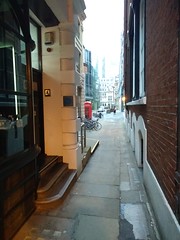
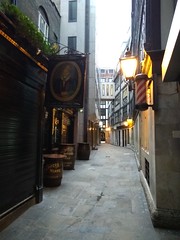
The City of London sometimes appears to consist mostly of shiny modern office buildings, all stainless steel, glass, ventilation grilles, CCTV cameras and private security guards. In amongst all that though weaves the city's history, old inns, bombed out churches, and little noticed details down narrow passages between and sometimes beneath the shiny new stuff. There are many walking tours to be had on which knowledgeable guides will show you bits of this "hidden London", frequently adding ghosts and ghouls to the mix. Or you could have a wander about on a Saturday afternoon when the city boys and girls are off spending their over-inflated bonuses elsewhere and see what you can find while the City is less busy. I did.

Lombard Court EC3


Running between Gracechurch St. and Clements Lane. with a kink in the middle so you can't see from one end to the other.
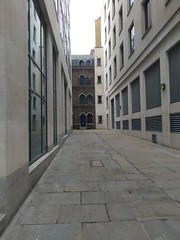
Lombard Court EC3 Lombard Court EC3 Parish Boundary Markers, Lombard Court Lombard Court EC3

On the wall of one of the modern buildings two old parish boundary markers have been remounted, one for St Benet Gracechurch, the other for All Hallows Lombard Street. Further up Lombard Court passes under the buildings for a short way and then becomes a very narrow road open to traffic rather than a footpath. Plough Court, another narrow passageway leads off to the right to Lombard Street.


Bengal Court, Castle Court, & Ball Court


In George Yard next to the back of the historic George and Vulture pub, once a haunt of Charles Dickens and perhaps also the notorious "Hellfire Club" a very small opening, little more than a doorway, leads to Bengal Court. This had several former names, taking its current one in the 19th century from the Bengal Arms Tavern that once stood in it. No more alas, now it's lined with more modern office buildings although on one side these have been given the appearance of old shop fronts. Sort of.

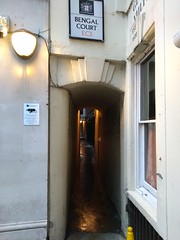
George Yard EC3 Bengal Court EC3 Bengal Court EC3

The other end of Bengal Court comes out into Birchin Lane, passing under the first floor of what is now a sandwich shop. Turning right and past two shops there is the entrance to Castle Court. There's no castle so it might be another one named after a long-gone pub. There is a barber's shop though, which seems to be a feature of many of these alleys, and a number of other small shops which enhance the feeling of "Olde Worlde London".
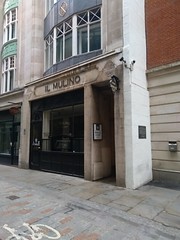
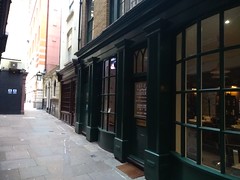
Bengal Court EC3 Castle Court EC3

Turning left into St. Michael's Alley brings you out onto Cornhill alongside the impressively carved doorway to St. Michael's Cornhill church. Burnt down in the great fire of London and apparently not rebuilt by Wren even though he is sometimes given the credit.
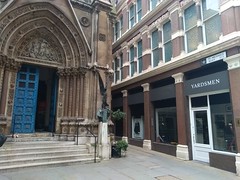
St. Michael's Alley EC3

Turn left along Cornhill for a short distance to find the atmospheric Ball Court on the left. This leads back up to Castle Court by Simpson's Tavern, quiet on a Saturday afternoon on account of it being closed but I suspect quite popular during the week. And probably has been since the early 18th Century.
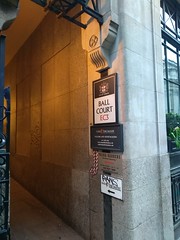
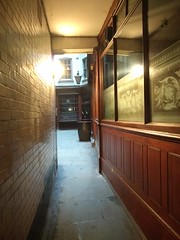
Ball Court EC3 Ball Court EC3 Ball Court EC3

Newman's Court, Sun Court, & White Lion Court


Returning down Ball Court and crossing Cornhill there are three alleyways which are dead ends. The first two, Newman's Court and Sun Court hold little of interest unless you count the yellow sign above Sun Court entrance, being service entrance and cycle parking for the offices above. Though wandering in and out of them taking photos probably gave interest to the people watching the CCTV.
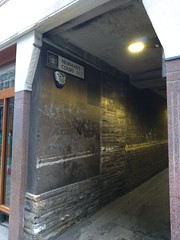
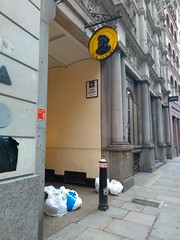
Newman's Court EC3 Sun Court EC3 White Lion Court EC3

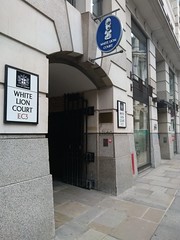
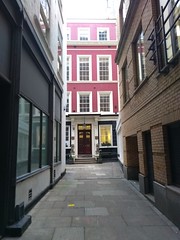
White Lion Court also at first glance appears to be similar to the other two but with a set of large iron gates. They were open, I don't know if they get closed. Maybe they do because there's something special up there. As well as a bicycle rack.
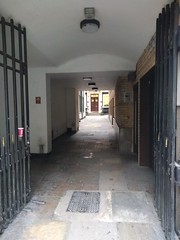
White Lion Court EC3 White Lion Court EC3 White Lion Court EC3

2 White Lion Court is a Grade II listed 18th Century 4 storey house with a basement and a red stucco front and stone lions guarding the front door. Also there's a curious small building to the left I can't find anything about which looks old. Heavy carving over the side door and a plaque, possibly a coat of arms on the other door. It looks like a very fancy garage so I suppose it could have been a coach house. Also two parish boundary markers on the house wall above. Apart from the front door of number 2 none of this is visible from Cornhill if you're just walking by.

St. Peter's Alley


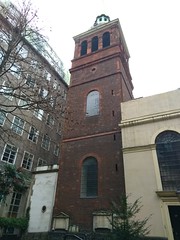
On the opposite side of Cornhill from Sun Court is St.Peter's Alley. This leads around the back of St. Peter upon Cornhill church and out to Gracechurch Street.
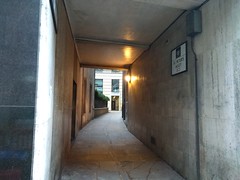
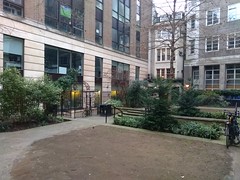
St. Peter's Alley EC3 St.Peter's Cornhill churchyard St. Peter's Cornhill

The church stands on the highest point of the City of London although it's not immediately apparent and don't expect far reaching views! It may also be the site of London's first church if it really was set up by King Lucius in AD 179. The present building replaces that lost in the great fire and this one is by Wren. It seems to have escaped the worst attentions of Herman Goering's boys as well. The churchyard has been turned into a garden on the site of the former burial ground. As a tour guide once pointed out to me if you have to climb steps to get into a churchyard in this city it's because you're standing on a pile of corpses. There are steps.

Star Alley


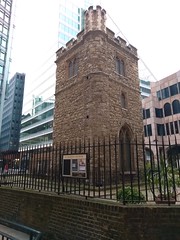
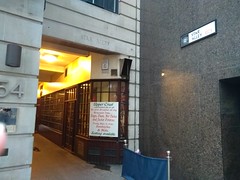
Cross Gracechurch Street, go through Leadenhall Market out to Lime Street then via Cullum Street to Fenchurch Street, cross over and turn left. A little way up is Star Alley. This leads under an office building and out into the open by the Tower of All Hallows Staining which has a very long history. Staining in this case meaning built of stone instead of wood as was more usual when the first one was built.
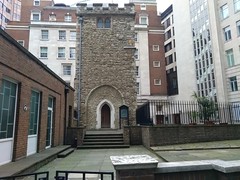
Star Alley EC3 Tower of All Hallows Staining EC3 Tower of All Hallows Staining EC3

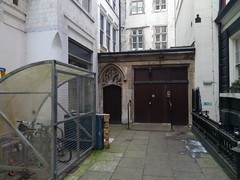
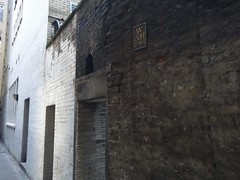
Austin Friars Passage


Austin Friars Passage off Great Winchester Street didn't appear to offer much of interest other than an ornate archway and a lot of white glazed bricks but half way down was a bit of older wall with another parish boundary marker. All Hallows London Wall this time.

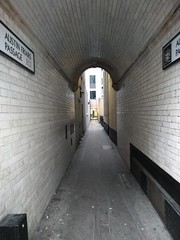
Austin Friars Passage EC2 Austin Friars Passage EC2 Austin Friars Passage


Tokenhouse Yard


A little to the north of Bank station Tokenhouse Yard runs between Lothbury and Telegraph Street. Most of it is a street, which incidentally crosses the course of the Walbrook, but at the north end there's a covered alleyway through to Telegraph Street and Copthall Buildings. The Token House from which it gets its name refers to a place where tradesmen's tokens were issued to be used in lieu of small denomination coins.
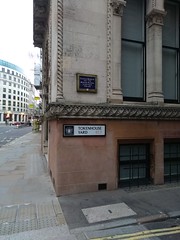
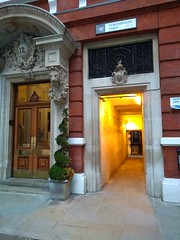
Tokenhouse Yard EC2 Tokenhouse Yard EC2 Copthall Buildings EC2 alleyway

Above the entrance to the alley is a cast iron grille and a carved stone City of London arms. Telegraph Street was formerly part of Great Bell Alley until 1859 and the opening of the General Office of the Electric and International Telegraph Company when it was renamed.

Mason's Avenue


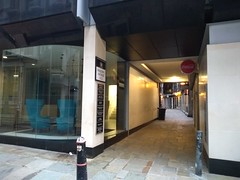
Turning left up Telegraph Street, crossing Moorgate, up Great Bell Alley, and over Coleman Street brings you to Mason's Avenue. Now to me an avenue suggests something wide and tree lined, probably in Metroland but this is definitely an alley. What's more it has both an old pub and a barber's shop to end this little exploration.
Mason's Avenue EC2 Mason's Avenue EC2

It being Saturday and this being the City The Old Doctor Butler's Head wasn't open, which was a shame as I could have done with a pint about this point. Old Dr. Butler was, not to put too fine a point on it, a quack. But a very successful quack, From the pub's own website:

History of The Old Doctor Butler's Head
One of the City of London’s most historic pubs, The Old Doctor Butler’s Head was originally established in 1610 - with the present building dating back to just after the Great Fire of London in 1666. 

The pub takes its name from one Dr Butler, a 17th century self-proclaimed specialist in nervous disorders. His 'miracle cures' included holding consultation on London Bridge, during which the unfortunate client would be dropped through a trapdoor into the torrent below. 

As a cure for epilepsy, he would fire a brace of pistols near his unsuspecting patient, to scare the condition out of them. In cases of the plague, he’d plunge the poor soul into cold water. 

So highly was he considered, that despite his lack of qualifications he was appointed court physician to King James 1. 

At a similar time, he developed a medicinal ale for gastric ailments, which was available only from taverns which displayed Dr. Butler's head on their signs. This led to him acquiring a number of ale houses in the capital - of which The Old Dr. Butler's Head is the last one standing.

The ale is no longer on the menu…

In this little exploration I've not even begun to cover the multitude of alleyways in the City of London but it was an interesting afternoon's exercise. If you want to know more then I can't do better than to point you towards the website Ian Visits whose section on London's Alleyways was the inspiration for my trip.

For this post I've tried something a little different and embedded the Flickr photos into the blog. Clicking them should take you to the original full size version.