Showing posts with label LT Museum. Show all posts

Saturday, 25 January 2025

Dover Street - Alight here for Green Park

23rd January 2025

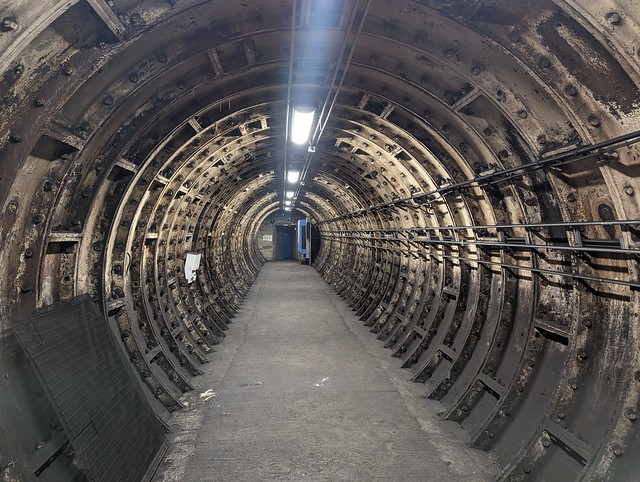
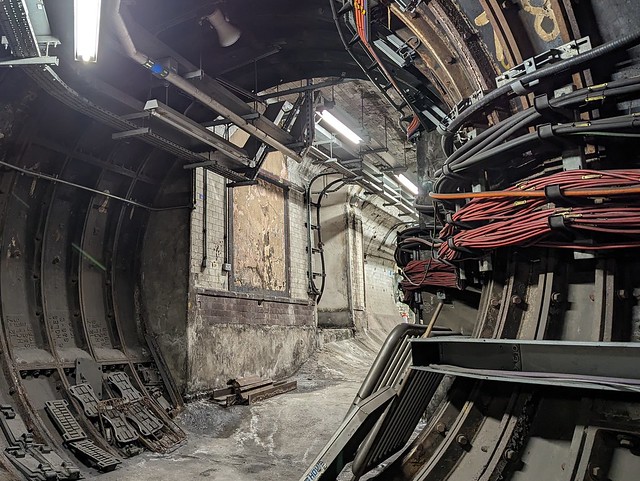
I’ve been down another hole in the ground thanks to the London Transport Museum’s Hidden London tours. This time it was to parts of Dover Street station, or as we no it now, Green Park. This is a new Hidden London tour for 2025 and follows a similar theme to many others. We were met outside Green Park station (by the Diana Fountain) and once our tickets and photo ID had been checked and safety and other formalities completed Eesa and Becky led us into the station and down towards the Piccadilly Line platforms. Just before reaching the platforms however we went through a private door into the “lost world” of Dover Street station’s passages from the platform over-bridges to the disused lift shafts.

Dover Street - Alight Here for Green Park. Piccadilly Line platform from overbridge..

These now redundant passages took passengers to and from the lifts to the platforms but the station became too busy to carry on using lifts. When the lifts were replaced by escalators there wasn’t room for them at the Dover Street site so in 1933 a new ticket hall was opened below ground, accessed from entrances on Piccadilly and in Green Park and the station took its new name from the park.

The passages retain much of the original tiling in a light blue and white colour scheme and some original sign-writing too.

Dover Street - Alight Here for Green Park. To The Trains.

No Hidden London station tour can escape the system’s role in the second small disagreement of the 20th century and in the case of Green Park it was initially used for storage by some of London’s museums but after London Transport’s headquarters at 55 Broadway received a wee present from the Luftwaffe the museums were turfed out and the redundant passages converted to an operational headquarters for the LT board. This included a suite for the Chairman, Lord Ashcroft, at the foot of one of the lift shafts. Considerations of class meant he got newly plastered and painted walls whereas lesser mortals working and living down there kept the station tiling.

Dover Street - Alight Here for Green Park. Chairman's accomodations plan.

The tour returned along the passage to the Piccadilly Line before heading back into the public part of the station.

Dover Street - Alight Here for Green Park

Then along the long tunnel to the Victoria and Jubilee lines. The tunnel where the mosaic tiles on the walls gradually turn from white and blue (Piccadilly end) to white and grey (Jubilee end). Also the long tunnel which makes some people avoid changing lines at green Park.

The point of this trek through the station was to get to the huge ventilation tunnel that expels warm air from the station and draws cooler air from the surface. There are no fans in the ventilation tunnel for this, the movement of the trains through the station platform tunnels is used, the trains being effectively huge pistons.

A long staircase leads down from Victoria Line level to Jubilee Line level.

Dover Street - Alight Here for Green Park. Ventilation tunnel from Jubilee Line.

and from the Victoria line level the tunnel rises vertically to the world above. In January this space is noticeably colder than the rest of the station.

Dover Street - Alight Here for Green Park. To the fresh air.

Of course one of the fun parts of a station tour is getting to peek down at the trains and platforms from the hidden spaces behind the vents. So here’s the Jubilee Line platform seen from above the track.

Dover Street - Alight Here for Green Park. Peeking at the Jubilee Line.

And apart from making our way all the way back up to the ticket hall and handing back our visitor’s badges that was another tour done. Almost 90 minutes had passed but it didn’t feel like it. Considering it’s a new tour it all went very smoothly, nobody got lost and nobody was gained on route despite it being a busy station. The guides were knowledgeable and enthusiastic as ever. If you fancy yourself as a bit of a Tim Dunn/Siddy Holloway then Hidden London tours can be booked here.

There are more photos on my Flickr Album too.

Dover Street - Alight here for Green Park

Tuesday, 6 August 2024

Hidden Holborn

1st August
 
I went on another Hidden London tour, Holborn - The Secret Platforms, run by the London Transport Museum. This was I’m pretty sure the second day of running tours at Holborn tube station but the guides were already well into the swing of things and as usual it was all well organised and very interesting. Our group was met outside and after safety briefing, ticket and ID checks led through the ticket barriers and through a door into a swelteringly hot small space for the initial introduction by our enthusiastic lead guide Becky. this lasted only a few minutes but it was still a relief to move on to the slightly cooler spiral staircase and go down the 193 steps (I didn’t count them but I reckon that’s about the equivalent of a 15 storey building 😉 ) with walls still covered in original tiles in a white, brown, and blue combination unique to Holborn.
 
 Holborn - The Secret Platforms
 
 After briefly emerging onto the eastbound Piccadilly Line platform we passed through another private door onto the disused platforms that formerly served the branch line to Aldwych. The first of which, that used to be the terminating platform, is now a row of disused offices and other spaces e.g. toilets. One of the rooms bore a sign for the “Central Line Model Railway Club”, sadly no longer used.
 
 Holborn - The Secret Platforms
 
 At the far end of the platform we were able to get to down the the tunnel towards Aldwych, with the tunnel lights switched on else we’d have just been looking into a black hole. We had a shuffle round to take photos and a quick plug for the Hidden London Aldwych tour (I’ve already done that one back in 2018) before returning to the office/platform area.
 
 Holborn - The Secret Platforms
 
 Before the station got too busy the disused platforms at Holborn were often used for filming. These days Aldwych or Charing Cross disused platforms tend to be used as they’re easier for film crews to access. We got a little film show here to remind us of some of the music videos filmed at Holborn and just how awful Superman 4 was, particularly the low-budget special effects!
 
Another short walk via tunnels and stairs took us past more original coloured tiles and a large fragment of early Piccadilly Line map to the other disused platform. This is the through platform, still connected to the tunnel in the photo above and to the live Piccadilly line to the north of the station so if you look down the tunnel in that direction and are patient you can get a view of the eastbound trains leaving the adjacent open platform. This platform has been used by TfL to test new platform decor so has some rather confusing signage.
 
 Holborn - The Secret Platforms
 
 Holborn - The Secret Platforms
 
The tour ended here with the customary round of applause for our four guides. It didn’t seem like about 90 minutes had passed which is the sign of a good tour and I even got used to the “Holl-born” pronunciation being used throughout, it’s always been “Ho-b’n” to me 😀. We returned to the ticket hall, thankfully not via the 193 stairs but taking time to appreciate the very long escalators instead. 
 
I took a lot more photos: Flickr Album
 
 Holborn - The Secret Platforms
 
I’ve only given a brief outline of the tour here, there’s a lot more to discover by actually going there and yes, it’s not a cheap day out but it is worth it so if you fancy doing it yourself bookings are being taken for Wednesday, Thursday, Friday, Saturday, and Sunday between now and November 10th with more dates to come in March 2025.

Thursday, 23 February 2023

Deep in the Bush

Wednesday 22nd February 2023

I had a personal tour of Shepherd’s Bush Underground station today.
 
 Shepherd's Bush Underground Station
 
I wasn’t expecting it to be a personal tour but I’d managed to book the 14:35 Hidden London Shepherd’s Bush tour and no one else had. So it was just me, the Hidden London guide, and the safety man that set off down to the platforms and then through locked doors to the parts of the station you don’t get to see as a passenger.
 
These include disused passenger tunnels from the several extensions and reconfigurations of the station, tunnels dug for ventilation, and former lift shafts whose function has been replaced by escalators.
 
 Hidden London, Shepherd's Bush, ventillation tunnel.
 
 As with the other Hidden London station tours I’ve been on it’s all atmospheric and grubby but underneath the dirt and later added behind-the-scenes infrastructure there’s a lot of original Central London Railway features.
 
 Hidden London, Shepherd's Bush, disused passenger tunnel and lift exits.
 
 Including these built in tiled poster cases at the end of one of the disused passenger tunnels.
 
 Hidden London, Shepherd's Bush, tiled poster frames in a former passenger tunnel.
 
Not having another 15 guests on the tour meant this time I could get pictures without other people in them for a change. My guide whose name rather embarrassingly has escaped my mind was keen and knowledgeable so I got the full show and as there was only two of us we were able to go into spaces where a full tour group would be unmanageable.
 
One of the other fun things about these tours is that you get to look out on the platforms from hidden spaces, to the amusement of the two young ladies who looked across the track to see two people waving and grinning from behind a ventilation grille.
 
 Hidden London, Shepherd's Bush, "Hello on the platform!", view through a ventillation grille.
 
 More photos in this Flickr Album
 
I can recommend this Hidden London tour, although I can’t guarantee that you’ll get the personalised version :-)


Tuesday, 27 August 2019

Blimey! It's like Piccadilly Circus round here!

23rd August 2019

The London Transport Museum's Hidden London programme has now added Piccadilly Circus station to its list of behind-the-scenes tours. Having previously visited Euston and Aldwych I signed up as soon as tickets went on sale for another 75 minutes exploring disused holes in the ground.
My plan to arrive in good time 30 minutes before the tour start was scuppered by signal failure on the Bakerloo, necessitating a more circuitous route from Paddington. Which meant I was five minutes late and only just in time to join the party in the main ticket hall of the "new", 1929 station. There we had a briefing on the construction of the new station and ticket hall directly under Piccadilly Circus and the statue of Anteros above, all of which is supported by the steel roof and supporting columns of the station below. This huge project took 5 years to complete and was London's "flagship" Underground station, decorated in Art Deco style using the best materials as befitted the "Hub of the Empire". Some of that decoration remains despite the 1984 makeover of the station.
Then it was down the long spiral staircase (the equivalent of a 15 storey building 😉 ) to the disused tunnels of the earlier 1906 station.
Disused that is from a passenger point of view but carrying many cables and other services and used for storing engineering kit.
There's a lot of unique original glazed tiling still extant on the tunnel walls beneath the grime of decades and modern services clutter. Our guides gave a good presentation on the development of the original station.

As with the other central London Underground stations Piccadilly was used as a public shelter during the Blitz, albeit initially against the wishes of London Transport and much of the rest of the tour focused on this aspect of the station's history. As it wasn't a purpose built shelter conditions were not good and eventually consideration had to be given to the toilet requirements of several hundred shelterers and how to then remove the resulting matter from the station deep underground - it doesn't flow uphill after all.
In the old station stairwell an ejection system using compressed air was installed, some of the supporting structure is still evident at the bottom of the shaft.

As well as London's theatre-goers the station was also used to secretly store safely 150 works of art from the Tate collection and London Museum. these had previously been at Dover Street station (Green Park) but London transport wanted the space there for it's own wartime operations centre.

Where the new station has two levels of escalators to get from ticket hall to platform the old station had eight lifts and we were able to look up into the huge lift shafts from the lift lobby near platform level.

Returning to the ticket hall (thankfully not via all those stairs) we exchanged hi-vis jerkins for souvenir booklets at the end of the tour and then I had a chance to look around the ticket hall at things you usually pass without
noticing such as the World Time clock and original exit direction signs.

As usual another very interesting Hidden London tour and a chance to see places from which the public are usually excluded.

For more dates at Piccadilly and other venues check the Hidden London pages at the London Transport Museum website.

Thursday, 21 March 2019

Riding The Red Train

17th March 2019

At twenty to nine on a bright sunny Sunday morning I found myself outside Northfields Station on the Piccadilly Line in West London to catch a very special train to Upminster.

At Northfields
Today was the second 2019 excursion day for London Transport Museum's 1938 Stock tube train which has been restored to a high standard and for now at least is able to travel over the underground network. At least until the new "on train" signalling system is completed, which means the 1938 stock will no longer be compatible.

So I got a ticket for Journey 1: Northfields to Upminster departing at approximately 10:00 from Northfields and arriving around 90 minutes later at Upminster, travelling most of the way on the District Line tracks.

At Upminster
I can remember these trains in service as they weren't withdrawn from London until 1988. They certainly weren't in such good condition as this one then. 

Inside there are 1970s and 1980s adverts - odd to see adverts for tobacco products and betting - lights with bulbs rather than fluorescent tubes, and wooden slatted floors. The line diagrams above the windows are for the Northern Line, the last to see 1938 stock trains in service. This is slightly confusing when travelling on the District Line as your eyes are naturally drawn to check where you are.

The distinctive sounds of the motors and braking systems brought back memories. After a while I realised what was absent from a normal 21st century tube journey. No continuous audible announcements of destination and next stop, or exhortation to take all your belongings with you and mind the gap between the train and the platform. Although just before Upminster the museum volunteer looking after our car did come around and warn everyone that when getting off there would be a big step up from train to platform - Upminster was not built for diminutive tube trains.

In the afternoon the train made a second journey back to Acton Town via Baker Street and Rayners Lane but I wasn't on that one. I did see it on its way through West Ham though. 

I made this video of quite a lot of the trip - it's not easy to film in a bouncy 80 year old train in a tunnel but it captures the "scenery" and possibly just as important, the soundtrack.


Tuesday, 26 February 2019

Chasing The Red Train

24th February 2019

London Transport Museum have a restored 1938 stock tube train. Today it got an outing on the underground running two excursion trips, first from Ealing Broadway via High Street Kensington and a complete circuit of the Circle Line to terminate at Moorgate. The second from Moorgate out to Amersham and then back to Ealing Common via Rayner's lane.


Had I been a bit more organised when tickets went on sale I'd have been able to ride the red train but instead I decided to see if I could intercept it along its route and capture it on film.

So I was at Acton Town rather too early on a Sunday morning to see it come in from Northfields Depot before reversing to pick up the lucky passengers at Ealing.

Failed to catch it at Turnham Green as it somehow managed to slip by me while I was travelling there but caught up with it again at Gloucester Road on its way around the Circle Line.
After an essential Pret stop I met the red train out in the wild west at Amersham and was able to get back to Harrow-on-the-Hill in time to film it there before it went on its way back to Ealing Common.


It really was an unseasonably warm day for February, clear skies and brilliant sunshine which made for excellent photography and filming conditions.

There will be few opportunities for the 1938 Stock (or as LT Museum have taken to calling it The Art Deco Train) to run over this route in future. Once the new signalling system is implemented on the sub-surface lines it won't be possible to take this 80 year-old train on the Circle Line. So when the next opportunity to ride the red train comes along I'm going to try a bit harder to grab a ticket!


Sunday, 14 October 2018

Aldwych Station

13th October 2018

Hidden London Tour of Aldwych Tube Station

Aldwych station is at the end of a short branch line from Holborn on the Piccadilly Line. There has been no service on this branch since 30th September 1994 but it would be inaccurate to describe it as a disused station. It is still connected to the network and used for training emergency workers and as a film and TV location. The sign outside refers to it as a "non-operational station" which seems like a better description.

Public access is only usually available on one of the Hidden London tours run by the London Transport Museum.

The station opened in 1907 as Strand Station and was renamed in 1915 to Aldwych. At the same time nearby Charing Cross Strand station became just Strand.

The station was never heavily used and money was therefore always in short supply. In fact many parts of the station were never completed as the expenditure could not be justified. At the time of its closure in 1994 the branch was only being used by about 450 passengers a day.

It has however proved useful for other functions. In both world wars it was used as an air raid shelter and for storage of valuable national artworks. It was also useful for building mock-ups of proposed station designs, for staff training, and as a filming location - V for Vendetta, 28 Days Later, Sherlock, and Superman 4 amongst others.


For the tour we met up in outside the Surrey Street entrance and once the formalities were completed and we had our fetching pink wristbands (not hi-vis jerkins on this tour) we entered via the Strand entrance into the ticket hall.


The hall has original tiling though a more plain "economy" version of that found in other contemporary Leslie Green stations - economy being a recurring theme at Aldwych as it was realised from the outset that it would not be a busy station.


Down the spiral staircase 160 steps from ground to platform level (the equivalent of a 15 storey building) as the lifts are no longer working, again the original tiling still exists.


The eastern platform which wasn't normally used for trains has some of the original 1907 track, a lot of film set props, some station mock-up designs, and some interesting old posters.


Including this ironically topical one:

Bollocks to Brexit

Good to see someone has been upgrading the cabling to meet 2015 fire regs:


On the western platform there is a train used for training and filming purposes (and on the tour for an audio presentation about the station as an air raid shelter in WW2). 


Dark in here, isn't it?


Tube aficionados will note that this 1972 stock train would never actually been used on the Aldwych branch and in fact this one hails from the Northern Line according to the line diagrams inside the cars.


The tunnel entrance to the rest of the Underground network. Note the partial decoration, another economy measure as the original trains were only two cars long only half the platform length was fully finished, later trains being three cars some extra basic decoration was added.


This way to Holborn...


The lift cars. Three double-car shafts were built but only one was actually equipped with two cars. Also the entrance passages to the cars were never finished and passengers entered and exited via the exit passages - another money-saving measure.


The lift controls. In 1922 the ticket office was shut and ticket booths built into the lift cars so the lift operator could issue and collect tickets as well, reducing the number of station staff required.


End of the tour. This old sign shows that Aldwych was considered an interchange with Temple station a short walk away on the District Line though not shown as such on tube maps. Temple is about the nearest station to use if you're going on an Aldwych tour being at the other end of Surrey St.


The Surrey Street station building. The odd spacing of the "PICCADILLY RLY' lettering is because it originally said Piccadilly Tube but the Underground Electric Railways Ltd. who opened the line (as the Great Northern, Brompton and Piccadilly Railway) didn't like the use of the term tube so it was changed.


As always this Hidden London tour was well run, informative, and enjoyable. You need to get in quick as spaces are limited and tickets not cheap but you get to see parts of London that most people never see and it's worth doing. If you are an LTM Friend you get advance notice of tour dates and early access to the booking system.