16th February 2019
The City of London sometimes appears to consist mostly of shiny modern office buildings, all stainless steel, glass, ventilation grilles, CCTV cameras and private security guards. In amongst all that though weaves the city's history, old inns, bombed out churches, and little noticed details down narrow passages between and sometimes beneath the shiny new stuff. There are many walking tours to be had on which knowledgeable guides will show you bits of this "hidden London", frequently adding ghosts and ghouls to the mix. Or you could have a wander about on a Saturday afternoon when the city boys and girls are off spending their over-inflated bonuses elsewhere and see what you can find while the City is less busy. I did.
Lombard Court EC3
Running between Gracechurch St. and Clements Lane. with a kink in the middle so you can't see from one end to the other.
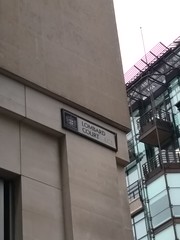
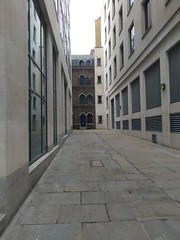
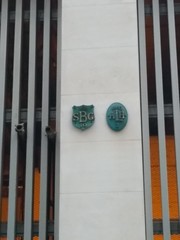
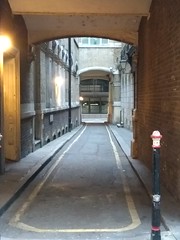
On the wall of one of the modern buildings two old parish boundary markers have been remounted, one for St Benet Gracechurch, the other for All Hallows Lombard Street. Further up Lombard Court passes under the buildings for a short way and then becomes a very narrow road open to traffic rather than a footpath. Plough Court, another narrow passageway leads off to the right to Lombard Street.
Bengal Court, Castle Court, & Ball Court
In George Yard next to the back of the historic
George and Vulture pub, once a haunt of Charles Dickens and perhaps also the notorious
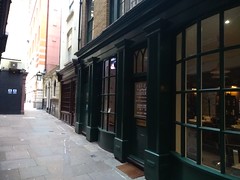
"Hellfire Club" a very small opening, little more than a doorway, leads to Bengal Court. This had several former names, taking its current one in the 19th century from the Bengal Arms Tavern that once stood in it. No more alas, now it's lined with more modern office buildings although on one side these have been given the appearance of old shop fronts. Sort of.

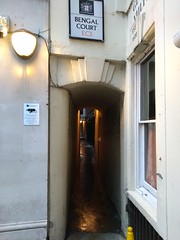

The other end of Bengal Court comes out into Birchin Lane, passing under the first floor of what is now a sandwich shop. Turning right and past two shops there is the entrance to Castle Court. There's no castle so it might be another one named after a long-gone pub. There is a barber's shop though, which seems to be a feature of many of these alleys, and a number of other small shops which enhance the feeling of "Olde Worlde London".
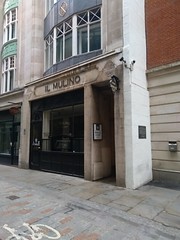
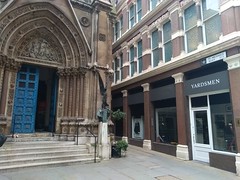
Turning left into St. Michael's Alley brings you out onto Cornhill alongside the impressively carved doorway to
St. Michael's Cornhill church. Burnt down in the great fire of London and apparently not rebuilt by Wren even though he is sometimes given the credit.
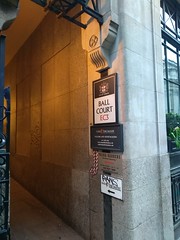
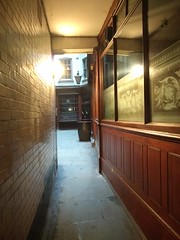
Turn left along Cornhill for a short distance to find the atmospheric Ball Court on the left. This leads back up to Castle Court by Simpson's Tavern, quiet on a Saturday afternoon on account of it being closed but I suspect quite popular during the week. And probably has been since the early 18th Century.
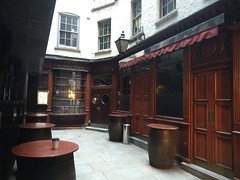 Newman's Court, Sun Court, & White Lion Court
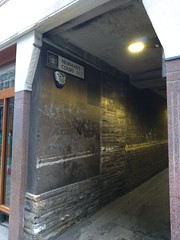
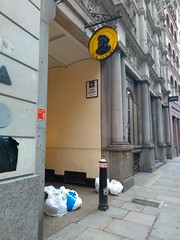
Returning down Ball Court and crossing Cornhill there are three alleyways which are dead ends. The first two, Newman's Court and Sun Court hold little of interest unless you count the yellow sign above Sun Court entrance, being service entrance and cycle parking for the offices above. Though wandering in and out of them taking photos probably gave interest to the people watching the CCTV.
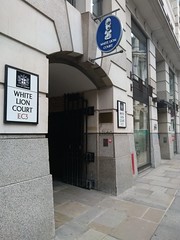
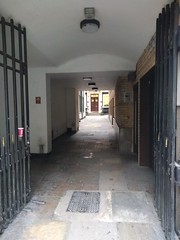
White Lion Court also at first glance appears to be similar to the other two but with a set of large iron gates. They were open, I don't know if they get closed. Maybe they do because there's something special up there. As well as a bicycle rack.
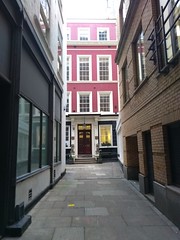
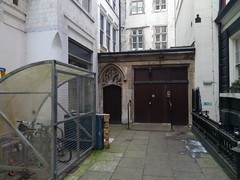
2 White Lion Court is a Grade II listed 18th Century 4 storey house with a basement and a red stucco front and stone lions guarding the front door. Also there's a curious small building to the left I can't find anything about which looks old. Heavy carving over the side door and a plaque, possibly a coat of arms on the other door. It looks like a very fancy garage so I suppose it could have been a coach house. Also two parish boundary markers on the house wall above. Apart from the front door of number 2 none of this is visible from Cornhill if you're just walking by.
St. Peter's Alley
On the opposite side of Cornhill from Sun Court is St.Peter's Alley. This leads around the back of St. Peter upon Cornhill church and out to Gracechurch Street.
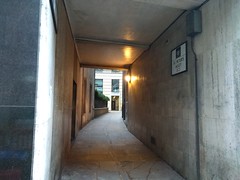
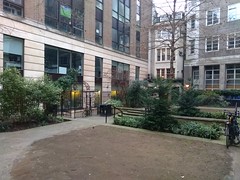
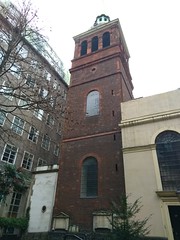
The church stands on the highest point of the City of London although it's not immediately apparent and don't expect far reaching views! It may also be the site of London's first church if it really was set up by King Lucius in AD 179. The present building replaces that lost in the great fire and this one
is by Wren. It seems to have escaped the worst attentions of Herman Goering's boys as well. The churchyard has been turned into a garden on the site of the former burial ground. As a tour guide once pointed out to me if you have to climb steps to get into a churchyard in this city it's because you're standing on a pile of corpses. There are steps.
Star Alley
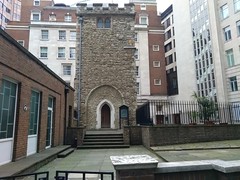
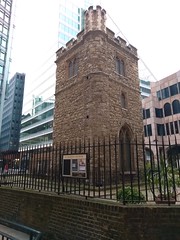
Cross Gracechurch Street, go through Leadenhall Market out to Lime Street then via Cullum Street to Fenchurch Street, cross over and turn left. A little way up is Star Alley. This leads under an office building and out into the open by the
Tower of All Hallows Staining which has a very long history. Staining in this case meaning built of stone instead of wood as was more usual when the first one was built.
 Austin Friars Passage
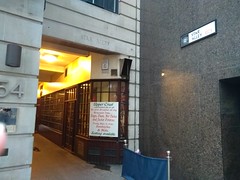
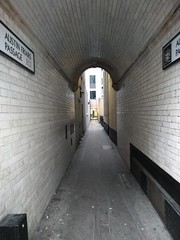
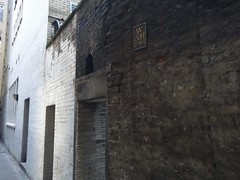
Austin Friars Passage off Great Winchester Street didn't appear to offer much of interest other than an ornate archway and a lot of white glazed bricks but half way down was a bit of older wall with another parish boundary marker. All Hallows London Wall this time.

Tokenhouse Yard
A little to the north of Bank station Tokenhouse Yard runs between Lothbury and Telegraph Street. Most of it is a street, which incidentally crosses the course of the
Walbrook, but at the north end there's a covered alleyway through to Telegraph Street and Copthall Buildings. The Token House from which it gets its name refers to a place where tradesmen's tokens were issued to be used in lieu of small denomination coins.
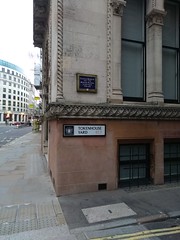
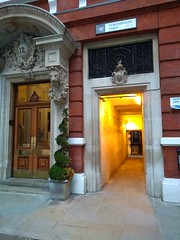
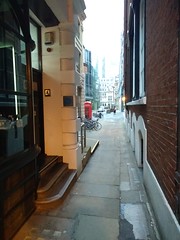
Above the entrance to the alley is a cast iron grille and a carved stone City of London arms. Telegraph Street was formerly part of Great Bell Alley until 1859 and the opening of the General Office of the Electric and International Telegraph Company when it was renamed.
Mason's Avenue
Turning left up Telegraph Street, crossing Moorgate, up Great Bell Alley, and over Coleman Street brings you to Mason's Avenue. Now to me an avenue suggests something wide and tree lined, probably in Metroland but this is definitely an alley. What's more it has both an old pub
and a barber's shop to end this little exploration.
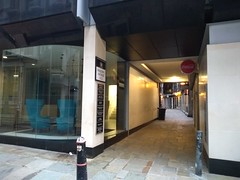
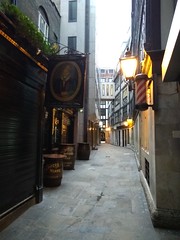
It being Saturday and this being the City The Old Doctor Butler's Head wasn't open, which was a shame as I could have done with a pint about this point. Old Dr. Butler was, not to put too fine a point on it, a quack. But a very successful quack, From
the pub's own website:
History of The Old Doctor Butler's Head
One of the City of London’s most historic pubs, The Old Doctor Butler’s Head was originally established in 1610 - with the present building dating back to just after the Great Fire of London in 1666.
The pub takes its name from one Dr Butler, a 17th century self-proclaimed specialist in nervous disorders. His 'miracle cures' included holding consultation on London Bridge, during which the unfortunate client would be dropped through a trapdoor into the torrent below.
As a cure for epilepsy, he would fire a brace of pistols near his unsuspecting patient, to scare the condition out of them. In cases of the plague, he’d plunge the poor soul into cold water.
So highly was he considered, that despite his lack of qualifications he was appointed court physician to King James 1.
At a similar time, he developed a medicinal ale for gastric ailments, which was available only from taverns which displayed Dr. Butler's head on their signs. This led to him acquiring a number of ale houses in the capital - of which The Old Dr. Butler's Head is the last one standing.
The ale is no longer on the menu…
In this little exploration I've not even begun to cover the multitude of alleyways in the City of London but it was an interesting afternoon's exercise. If you want to know more then I can't do better than to point you towards the website
Ian Visits whose section on
London's Alleyways was the inspiration for my trip.
For this post I've tried something a little different and embedded the Flickr photos into the blog. Clicking them should take you to the original full size version.