Thursday, 31 March 2022

Exe-ploring in Devon. Part 3.

Monday 28th March 2022

Dawned overcast and much cooler than yesterday. It would not be a day for laying about on beaches so I decided to take a ride down the Western side of the Exe estuary to Teignmouth. There were no crowds on the seafront today and hot coffee was more appropriate than ice cream for a walk along the prom’.
 
 Teignmouth Beach
 
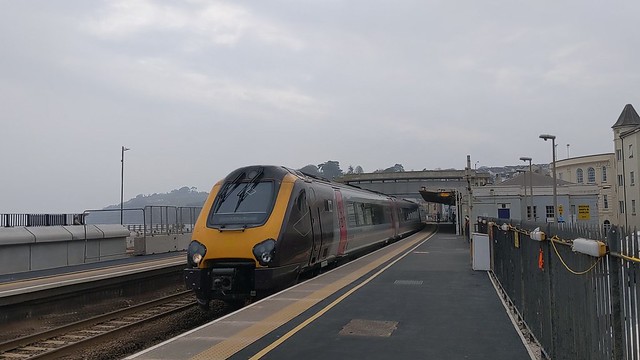
At least it stayed dry. I walked out along to the east of the town where the South Devon main railway line runs along the shore edge and shot some photos and video of the trains and then got a train to Dawlish for lunch sheltering from a brief rain shower in the park in the centre of town with a warm pasty from the local bakery. Of course ‘warm’ in pasty terms means something akin to the contents of a volcano and they always seem to get hotter before cooling enough to consume without fear of injury. It must be an anomaly of physics. But a tasty one :-)
 
 Dawlish, South Devon Main Line
 
Dawlish has some very good spots for watching the trains traveling along the seafront - it’s not trainspotting if you don’t write down numbers - and so I got some more footage. Dawlish Station and the area nearby is a bit of a building site still as part of the sea wall repair works so part of the beach is behind barriers. It will be better when it’s finished I’m sure.
 
 Dawlish, South Devon Main Line
 
I hope when they finish the station works there will be more than the one seat on the platform to go with the planned new lighting. And they can fix the dot-matrix sign which inexplicably thought it was at Taplow and couldn’t display any train information :-)
 
I was going to break my journey back to Exeter at Starcross but the weather was looking a little threatening and the seat on the train was comfortable so that will be somewhere to visit at another time. 
 
I had a quiet last evening in Exeter and made an earlier train home the next morning. I enjoyed my first 2022 holiday and given that it snowed today (Thursday 31st) I seem to have timed it just right :-)
 

Wednesday, 30 March 2022

Exe-ploring in Devon. Part 2.

Sunday 27th March 2022

Off to the seaside, by train from Exeter Central for a scenic ride along the coast to Exmouth. Alas unable to get a suitable window seat since everyone else appeared to have had the same idea! Glorious sunshine and actual tee-shirt temperatures probably responsible for that.
 
 Exemouth Beach
 
A long walk along the seafront, up onto the cliffs, and back down to the town centre where ice creams and coffees could be obtained without joining the incredibly long queues on the seafront. Exmouth is a pleasant resort and I had considered staying there for the weekend rather than Exeter but the extra cost of seaside hotels helped make that decision.
 
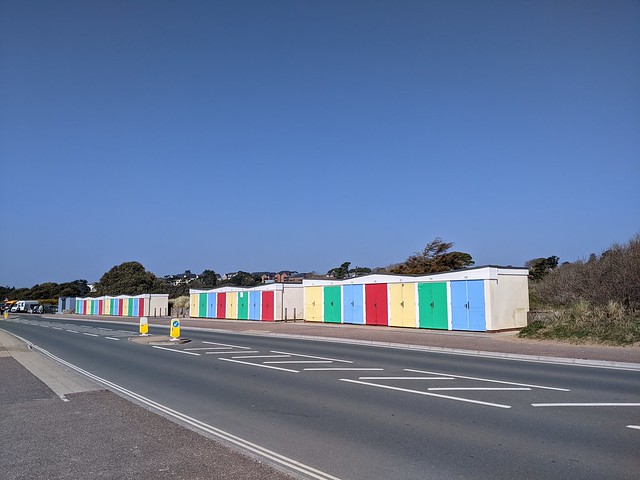
 Exemouth Beach Huts
 
Nice beach huts but not the best location with a busy road between them and the beach. It was beach and book time for a while then I noticed an interesting local feature on Google Maps:


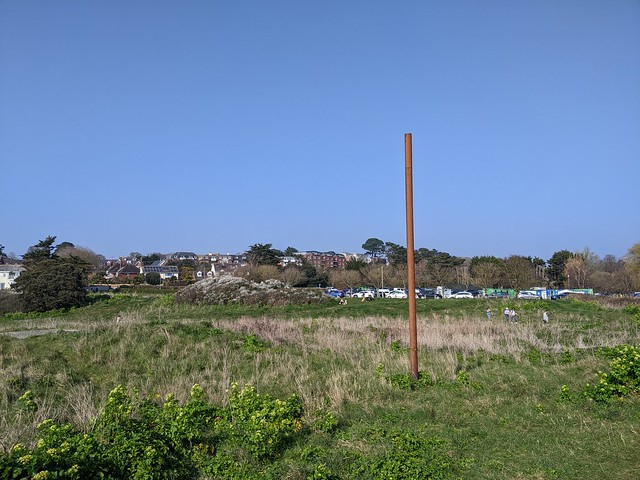
Well I just had to investigate, didn’t I? One of the good things about Google Maps is that anyone can suggest locations to be added to the map. Now from experience Google don’t always accept even genuine places so it’s nice to see the tables turned and users have a little innocent fun :-) Not that Exmouth’s Rusty Pole isn’t a genuine place.
 
 Exemouth's Rusty Pole
 
So if you are in the area make sure you visit this unusual tourist attraction. And make sure you give it a review on Google Maps :-)
 
Part 3 later. Lots of trains.

Exe-ploring in Devon. Part 1.

Saturday 26th March 2022

The end of the annual leave year and a goodish wether forecast means time for a little railway trip holiday. I might have visited Exeter once long ago but I’d never stayed there so booked 3 nights at Jurys inn, being not too far from the railway stations, and an off peak return to St. James Park (Exeter). At Reading GWR was providing its usual Saturday menu of late-running trains and I could have caught the delayed service prior to that on which i had a seat booked. I thought it might be a bit crowded so let it go which turned out to be a mistake really since the 1230 departure hadn’t even left Paddington by the time it was supposed to have reached Reading and we all spent a windy hour on platform 7 wondering if it would turn up or be cancelled. It turned up about 27 minutes late and everyone piled on board and off to Exeter St. Davids I went, arriving 30 minutes later than expected. This would have meant a longish wait for a connection however a late-running train to St. James Park turned up after a few minutes thus getting me to my final destination 29 minutes late and alas only eligible for the lowest Delay Repay compensation band.
 
I hadn’t made the mental connection between St. James Park and Exeter City’s football stadium and as it turned out they were at home to Stevenage that afternoon but by the time I got there the crowds were all inside and cheering loudly - Exeter won 2-1 - so that was an advantage. On the other hand there were two dozy women who suddenly decided that they were on the wrong train, having been told they’d need to get off at SJP and catch the following one instead decided to stand in the doorway and have a prolonged discussion about it so that everyone else had to struggle to get past them and onto the platform. As the train pulled out I realised that somewhere in the scrum I’d dropped my hat :-( I’ve just jumped through the hoops to register it with GWR lost property which surprise, surprise involves creating an account with some hitherto unknown third party that they’ve contracted out to. 
 
Anyway, I found the hotel and in spite of the 1600hrs check in time specified on the booking, which seemed unusual to me, they let me in just after 3 o’clock and I was able to get my feet up and a brew on.
 
Suitably refreshed and no longer dragging a large holdall about I went off to explore Exeter.
 
 Exeter High Street
 
Having been heavily bombed during the war in the 1940s Exeter has some fine examples of post-war buildings in the city centre and unlike some other places they haven’t yet been demolished and replaced with a shiny, USAnian style, privatised shopping mall. Also they appear to have been kept in a good state of repair - or perhaps refurbished?
 
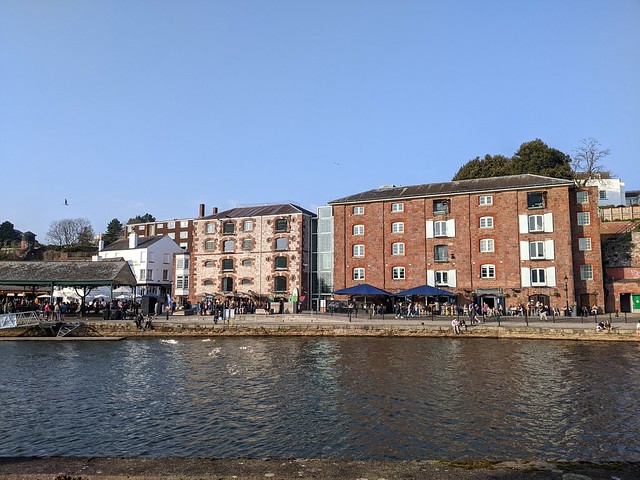
 Exeter, The Quay
 
It’s a fair walk down to the Quay but that’s where much of the action is early on a Saturday evening when it’s sunny. I went for a walk up and down the banks of the Exe and then headed back up towards the city centre to find a pub where I could get near the bar to buy a beer (The Ship) and not being able to make up my mind where to go for dinner did the obvious and got fish and chips and sat on the green outside the cathedral.
 
 Exeter Cathedral
 
Then back to the hotel for a couple of beers and some interesting conversations in the bar :-)
 
Part 2 will follow, Exmouth, sunshine, a beach, and a rusty pole.

Trains By The Sea

South Devon Main Line at Teignmouth and Dawlish.

Shame the sun didn't come out as well.

Thursday, 3 March 2022

Rochester.

28th February - 2nd March 2022

I had some leave to use up so between the “end” of the plague and the beginning of World War Three I took a little train trip to Kent.
 
 
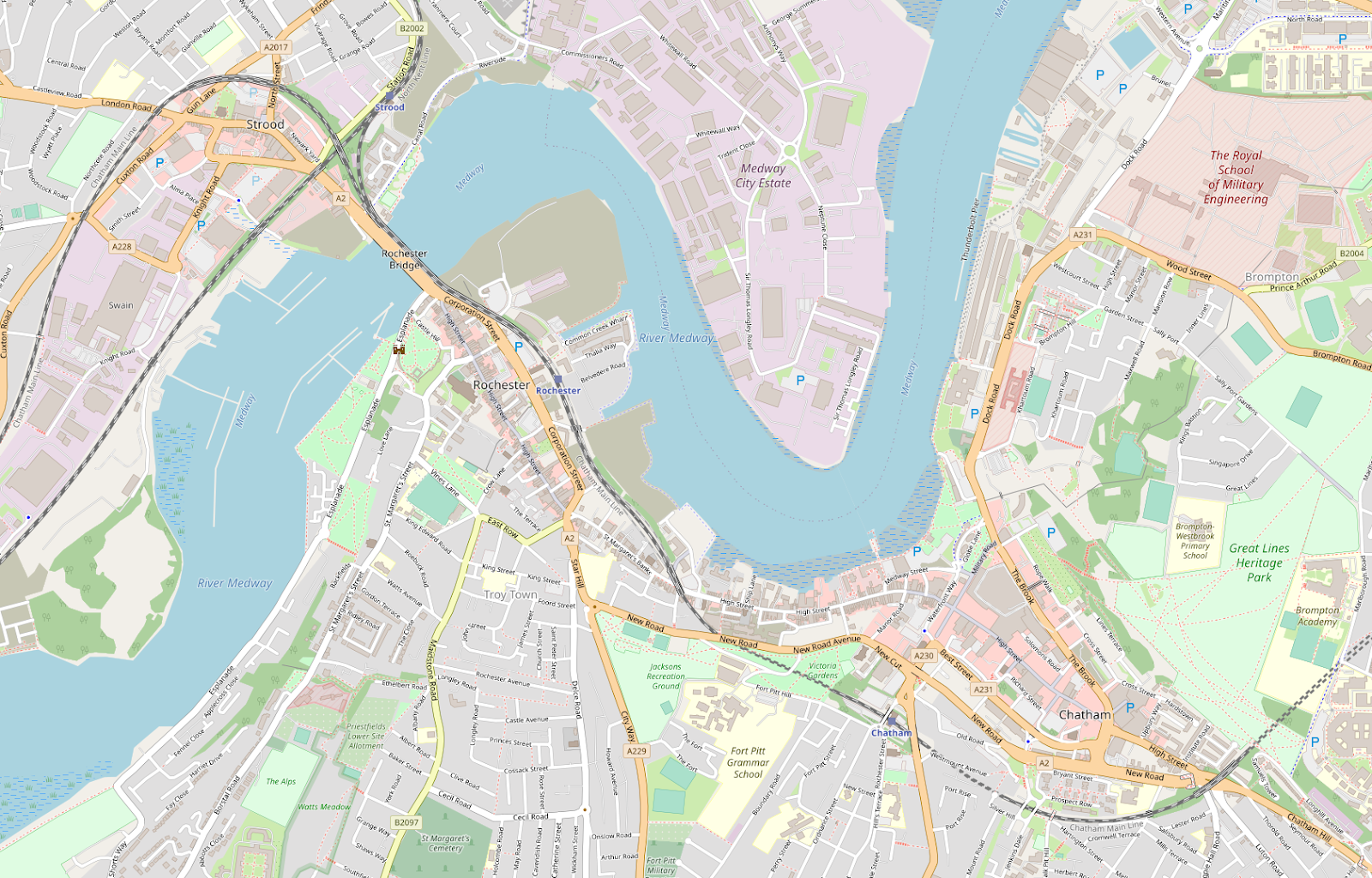
Rochester sits on a bend the River Medway about 30 miles from London. Historically it’s a city but due to an administrative cock-up officially it isn’t any more. In its favour as a tourist destination it does have a castle, a cathedral, a high street with a lot of interesting buildings, strong connections to Charles Dickens, and frequent trains from London Victoria (as well as sitting astride the main A2 road from London to the channel port at Dover). I took the train via Guildford, Clapham Junction, and London Victoria and at £25 return with a Network Railcard it was almost certainly cheaper than if I’d driven. And the trains all ran to time for once!
 
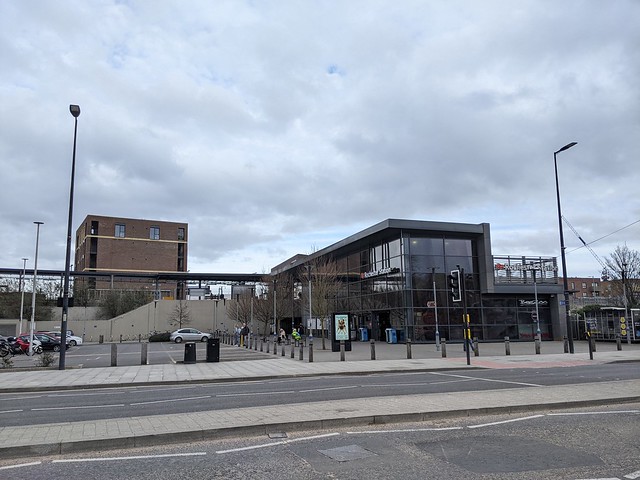
 Rochester Station
 
The station is close to the city centre (to hell with the bureaucrats) and has a Travelodge just behind it which is fine for a couple of nights and being quite new hasn’t had a chance for the fixtures and fittings to fall apart yet. From the third floor I could watch the trains arriving and departing the station below. I took advantage of the lack of rain and went for a walk around the city centre to get my bearings and in search of victuals. The Crown at the bridge end of the high street was quiet - it was Monday and early evening - and provided a decent burger and chips and pint of Spitfire. 
 
 Rochester High Street
 
The High Street was mostly quiet, quite a few places didn’t open on Mondays.
 
 Rochester and the River Medway at night.
 
I walked across the river bridge to Strood which appears to be the shopping area for Rochester, having a retail park and supermarkets and was rewarded with a view of the illuminated castle and cathedral across the Medway. And so to bed.
 
The next morning was predictably wet, I’ve decided that when I book leave it adversely affects the weather, I’m used to it now and fortified with a flat white from Costa I headed first for the castle.
 
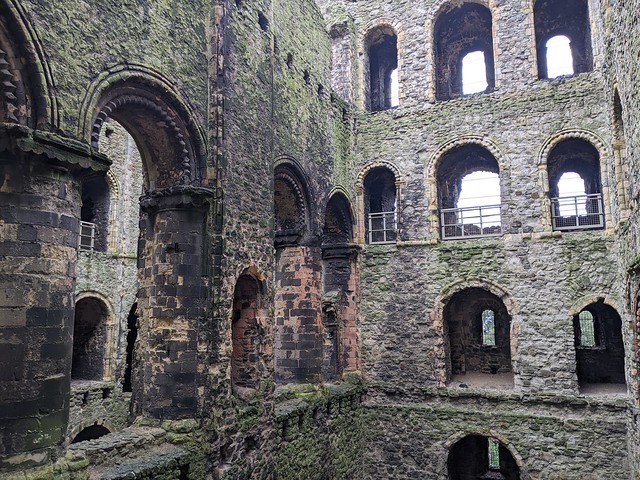
 Rochester Castle
 
It isn’t hard to find, sitting high on a hill in the city centre. Rochester Castle was started in the late 11th century and the tall stone keep built in the early 12th century by Gundulf, Bishop of Rochester and later Henry I granted it to the Archbishop of Canterbury in perpetuity because obviously the leader of a peaceful religion needs a ruddy great castle. The scene of many battles and sieges of the the centuries the castle and its grounds were opened to the public in the 1870s as a park, the grounds are free to enter when open in daylight hours.The castle is protected as a Grade I listed building and Scheduled Monument, the ruins are managed by English Heritage and open to the public for an entry fee of £7.20 at the time I visited. 
 
 Rochester Castle
 
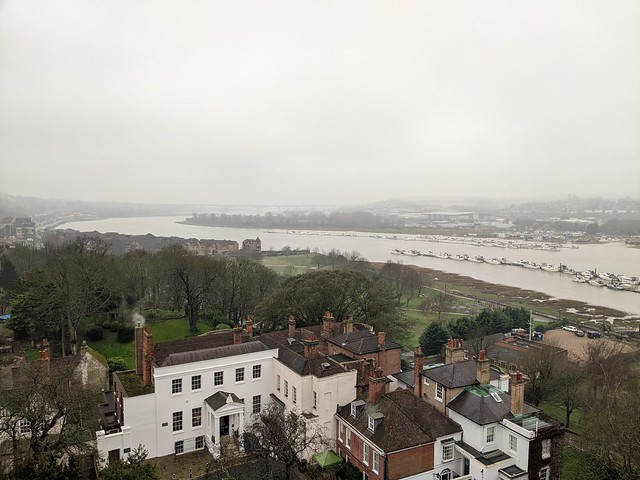
Which isn’t too bad considering there’s quite a bit of the keep still standing and accessible - in the sense that if you can climb lots of irregular staircases you can access it rather than the modern sense of accessible to people with disabilities. It’s worth the climb of 200-odd steps because even in fairly crappy weather there’s good views over the Medway and surrounding area. Which is why it’s where it is of course.
 
 River Medway from Rochester Castle.
 
Topically you can even see a Russian Soviet Navy submarine although this one’s no longer a threat to anyone.
 
 Rochester Castle
 
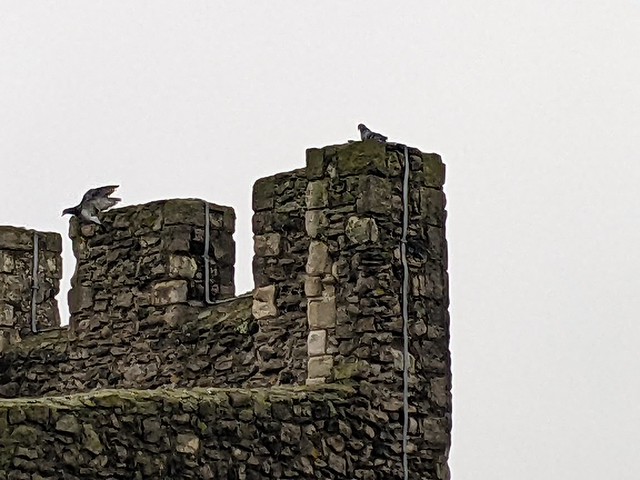
These days the castle keep is besieged only by feral pigeons in spite of the defences erected to counter them.
 
 Rochester Castle
 
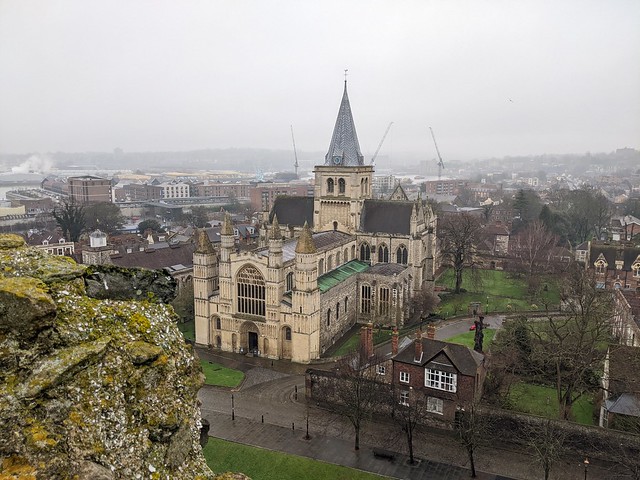
From the top of the keep I could see my next place to visit, Rochester Cathedral being gently rinsed by the falling drizzle.
 
 Rochester Cathedral from the castle.
 
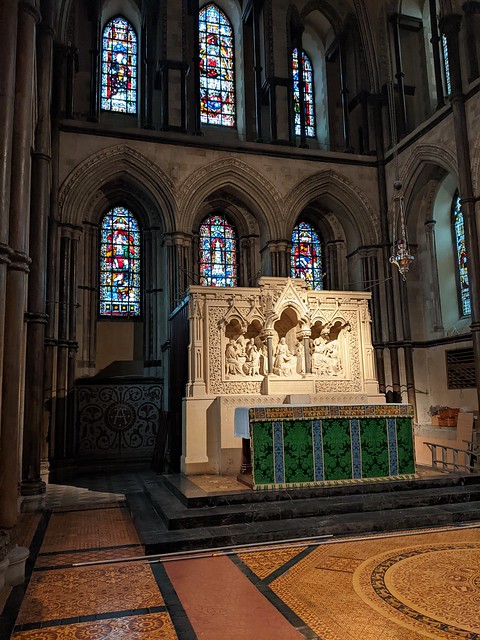
Even as a godless heathen I can appreciate church and cathedral buildings. Particularly when they’re free to enter and warmish and dry. The cathedral has had a turbulent history since its founding in 604 and the original Saxon church has been replaced by a Norman and later building. It’s not a huge cathedral but impressive nonetheless.
 
 Rochester Cathedral
 
At the time of visiting there were more electricians working there than ecclesiastical types apparently installing new lighting, in the 21st century even the light of the world is by LEDs! I did notice a distinct military theme to the various memorials around the walls inside the church. Many of those memorialised seemed to have spent their time on earth helping to expand the empire. A striking number meeting a premature end in obscure parts of it possibly at the hands of the locals who didn’t appreciate the efforts of the great and good of Rochester to bring them civilisation.
 
 Rochester Cathedral
 
It hadn’t finished raining when I emerged and showed no sign of doing so. Heading through the city centre it was clear that many businesses made the most of the Dickens connection with the city and in the grounds of Eastgate House is his writing chalet looking a little out of place next to the Elizabethan house. There are a few other interesting old buildings too as befits Rochester’s long history and location on the route from Dover to London. Fairly free of chain shops too. I followed the High Street east and out of Rochester to Chatham, about a mile and a half away, to Fort Amherst, built centuries after Rochester Castle but for similar reasons. Built in the 18th century to defend the landward side of Chatham’s Royal Navy Dockyard from any invading army - OK, the French - it replaced the old town of Chatham which was then rebuilt in a bog at the bottom of the hill.
 
 Fort Amhurst, Chatham.
 
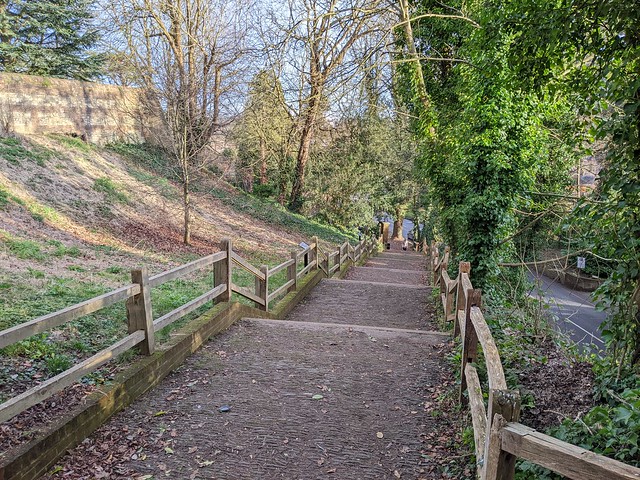
It’s a fair climb to the fort from the town and being still winter the main attraction, tours of the extensive tunnel system below, wasn’t open but it was free to wander around before walking back through Chatham town centre to the railway station.
 
 Fort Amhurst, Chatham.
 
Chatham and its Historic Naval Dockyard will have to wait for a future visit. I caught a train to Strood for the shops and retreated to the hotel for the remainder of the evening to dry out. The next day reversing the train journey rather than the journey planner’s suggestion of returning via Victoria, Paddington, and Reading which would have been disrupted by delays on the tube, falling between two strike days.
 
I feel a re-visit to Medway is on the cards as there’s much more to see than I had time for and it’s not too far away from home for a short break.
Meanwhile the usual Flickr Album is here.
 

Thursday, 3 February 2022

Farnham, Surrey.


Wednesday 2nd February 2022

Farnham is a market town in the very western end of the county of Surrey, very close to the border with Hampshire, across which lies Aldershot. It’s about 36 miles southwest of London, from which it can be reached by train from London Waterloo or by road via the A3 and A31. Having been here since the 7th Century when the Saxons named it Fearnhamme (fern/bracken + water meadows) the town has a long history and a good collection of old buildings to look at and many interesting nooks and crannies.
 
A good way to explore them is to download and follow the circular Farnham Heritage Trail published by the town council. You can also pick up a copy at the town council offices in South Street. The trail starts at the bottom of Castle Street but the cheapest (although not by much) car parks are down by the riverside so I parked there and picked up the trail at point 8. If you arrive by train then point 8 or 9 are the closest to the station too.
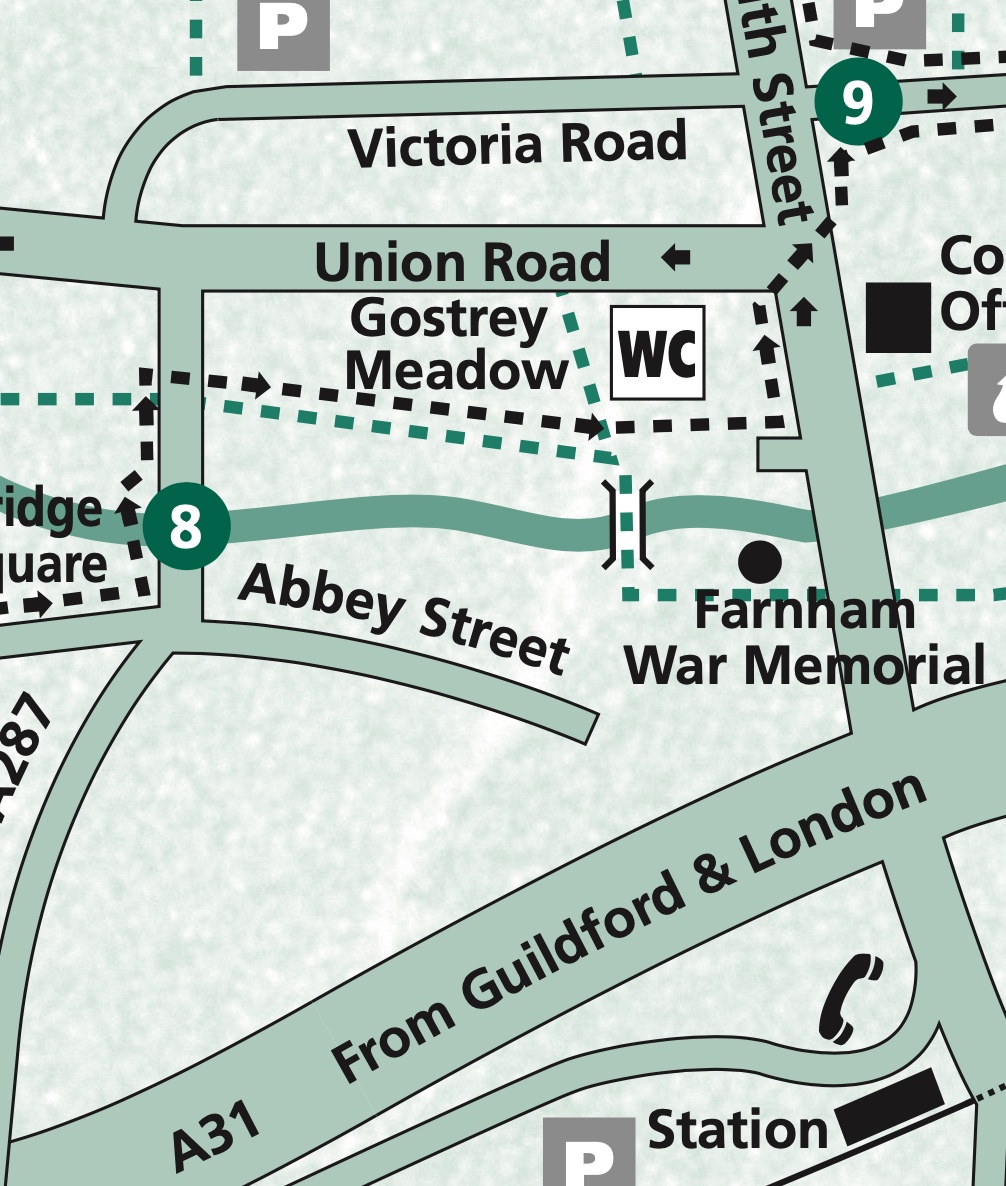
 
Map extract p8-9
 
 War memorial, Gostrey Meadow, Farnham.
 
An open space through which flows the River Wey and contains a children’s play area, a handy public convenience, and the town’s war memorial. On your left with the weather vane is the former Church House (now The Vineyard Church) which was built in 1909. Past the memorial emerge into South Street, cross over and turn left passing the town council offices and the Methodist Church to arrive at the Liberal Club. This was the architect Edwin Lutyens’ first public work to be built, there’s an information plaque on the building giving more details. It’s also point 9 on the trail map.
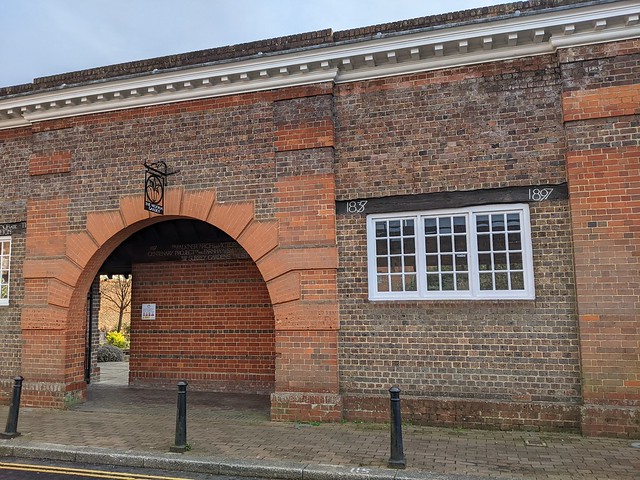
 
 The Victoria Garden, Brightwells Rd. Farnham.
 
Down the side of the Liberal Club in what is either Brightwells Road or Falkner Court depending which map you look at is a large arch leading into Victoria Garden. This garden was formerly an open air swimming baths built in 1897, as attested by the lettering on the wooden lintels above the windows. Go trough the arch and in the garden you will find a wooden sign from the swimming baths advertising that bathing was mixed and at the far end a statue of a small boy in swimming trunks who looks bloody frozen! Returning to South Street and turning right will bring you to the main crossroads in the town centre. On the far side is a milestone showing the distances to London (38 miles), Bagshot (12 miles), and Alton (9 Miles). Behind the milestone is a wooden hoarding over which can be seen the top of a pile of rubble. This is the remains of the 1960s Brutalist Woolmead House complex  of shops and flats. Condemned as “ugly” and by the developer as “lacking the quality associated with Farnham and the adjoining conservation area and lacking civic presence” it was demolished in the winter of 2018/2019. Supposedly to be redeveloped but still in 2022 just a wasteland spreading dust across the town centre. Strangely there’s no reference to Woolmead House in the trail leaflet. Not all heritage is equal.
 
Heading West from the crossroads along The Borough on the left is the entrance to the courtyard of the Bush Hotel, at 500 years old it’s the town's oldest hostelry and a former coaching inn. It’s point 11 o the trail map.
 
 Courtyard of the Bush Hotel, The Borough, Farnham.
 
Further along The Borough is Borelli Yard, named for local businessman and councillor Charles Borelli whose family’s clockmakers shop was nearby in The Borough and held a Royal Warrant from Queen Victoria. This is point 12 in the trail leaflet says that the date 1610 can be seen by looking up under the archway but I was obviously not looking in the right place.
 
Borelli and local architect Harold Faulkner acted in the early 20th century to restore many of Farnham’s old buildings and had much influence over planning in the town. Looking at some of the development currently underway in the town centre I think there’s a chance both are now spinning in their graves. In Borelli Yard there is a bronze sculpture by local artist Ben Franklin called ‘Matriarch’, which I’m sure that the artist understood and a panel on the wall giving information about a medieval tile kiln which was excavated here in the 1980s.
 
Returning to The Borough and crossing the road to the corner of Castle Street brings you to point 1, the official start of the Heritage Trail. I wouldn’t have started it here as previously mentioned point 8 or 9 would be more logical for visitors but I suppose the trail was devised by locals and Castle Street is regarded as one of the town’s highlights. 
 
 Castle Street, Farnham.
 
In the middle of the road at the bottom of Castle Street between 1566 and 1866 stood the Market House and jail, see plaque on the wall of the adjacent bank. There are still market buildings here albeit not in the middle of the road and as far as I know people are not incarcerated in them now.
 
Castle Street is broad and with many historic buildings many older than they appear having gained Georgian facades. A row of Almshouses on the right were built in 1619 according to the plaque outside for “The habitation and relief of eight poor honest old impotent persons”. I assume that last is i the sense of powerless rather than unable to get it up.
 
 Almshouses, Castle Street, Farnham.
 
Carrying on past the Nelson Arms (shouldn’t that be ‘Arm”?) pub to the end of Castle Street where it becomes Castle Hill a long set of steps leads up to Farnham Castle, formerly a bishop’s palace and now "An award winning venue for Weddings, Private Hire, Meetings and Events, overlooking the beautiful, historic town of Farnham”, according to its web site.
 
 Blind Bishop's Steps, Castle Hill, Farnham.
 
The steps are set out in blocks of seven steps set seven paces apart, built to enable Bishop Richard Fox to walk unaided to and from the town. Successively Bishop of Exeter, Bath and Wells, Durham, and Winchester, Fox gained political power under Henry VII. With the rise of Cardinal Wolsey under Henry VIII Fox's political career waned and he returned to his episcopal duties. In the last ten years of his life his sight failed, hence the special arrangement of the steps.
 
Back down the hill and across Castle Street and turn right into the alleyway called Long Garden Walk opposite the large Plane trees planted in 1897 to celebrate Queen Victoria’s Diamond Jubilee. Long Garden Walk leads to the Hop Blossom pub and rope was once made here in lengths stretching to the far side of Castle Street. It strikes me that must have interfered somewhat with traffic on one of the main roads in and out of the town centre.
 
 The Hop Blossom, Long Garden Walk, Farnham.
 
At the end of Long Garden Walk outside the supermarket is Lion & Lamb Yard. Turn left here into this shopping area the first part of which dates from the 1980s but looks older apart from the barn on the left formerly a vehicle repair garage and now an (empty at the time of writing) retail unit. At the bottom of the yard is an old water pump and the former Lion & Lamb Hotel building whence the yard derives its name.
 
 Water pump, Lion & Lamb Way, Farnham.
 
Pass through the arch and turn right into West Street and walk past the Post Office, one of the few modernist buildings and not getting any attention in the trail leaflet, note the multi-coloured concrete frieze on the ground floor. Look up Malthouse Yard at the unusual building (and many Private Property signs) the yard was once owned by a hop garden tallyman.
 
 Malthouse Yard, Farnham.
 
The lane running north alongside the timber-framed 98-99 West Street - most Farnham town centre streets number consecutively rather than odds and evens on opposite sides - is Timber Close.
 
 Timber Close, Farnham.
 
Now mostly lined with modern buildings it is believed to be the site of an early prefabricated construction site where in 1395, the hammer-beam roof of Westminster Hall, in London, was constructed and then taken, piece by piece, to London and erected there where it can still be seen today.  Continuing across The Hart to a small green space called College Gardens a plaque set in the grass records that this was  the site of the Senior Department of the Royal Military College from 1814 to 1820 when it moved to Sandhurst, later becoming the Staff College. Across the road at number 38 is the Museum of Farnham in a Grade 1 listed building which due to lack of time had to wait until another day. I headed back towards the centre of town passing number 28, Vernon House.
 
 Vernon House, West Street, Farnham.
 
A ceramic roundel on the wall here records that 'CHARLES I STAYED HERE ON THE NIGHT OF 20 DECEMBER 1648’. From here he was taken to London to face trial and execution. In thanks for his hospitality he gave his host, Sir Henry Vernon, his blue silk morning cap decorated with gold and silver thread. A little over a year later he had nothing on which to wear a cap anyway.
 
Onward past the Bishop’s Table Hotel at 27, West Street, reputed to be haunted, and 25, the large Victorian building, the Farnham Adult Learning Centre. in the past this building has been Farnham Grammar School, Farnham Girls’ Grammar School and Farnham School of Art, now elsewhere in the town. At 24, West Street is Harold Falkner’s house, the aforementioned associate of Charles Borelli.
 
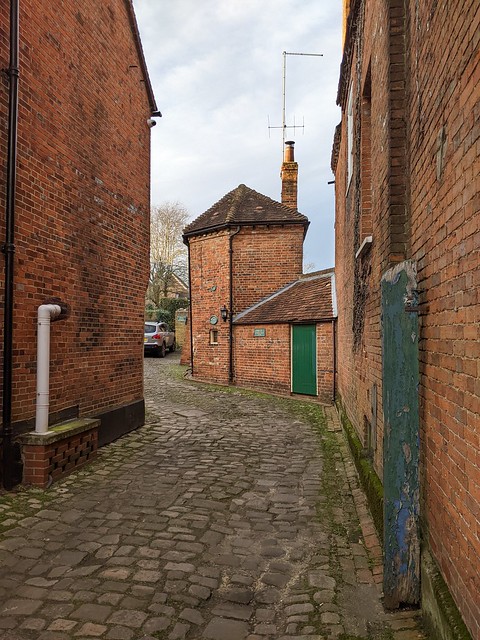
Turn right into Church Passage. According to the leaflet "this passage is also known as Streaky Bacon Lane. Look at the setts beneath your feet for the reason!" Didn't look like bacon to me. Perhaps its name owes more to the former bacon factory that occupied the building on the right. Decide for yourself.
 
 Church Passage, Farnham.
 
I did spot an interesting cast iron cover among the setts though I’m not sure what it covers, possibly a coal hole although those are normally circular. (My job means I now notice things like this almost out of habit, spending much time looking for telephone network infrastructure. This is probably a bit sad.)
 
 A little bit of Chelsea in Surrey, Church Passage, Farnham.
 
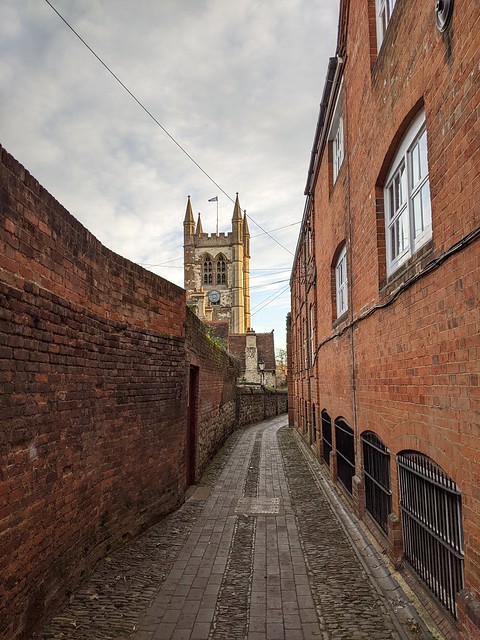
Church Passage leads to St. Andrew’s Parish Church, one of Surrey’s largest and the oldest parts of which date from the 12th century. It has been modified, restored, and changed in nearly every century since and is Grade II listed.
 
 St. Andrews Church, Farnham.
 
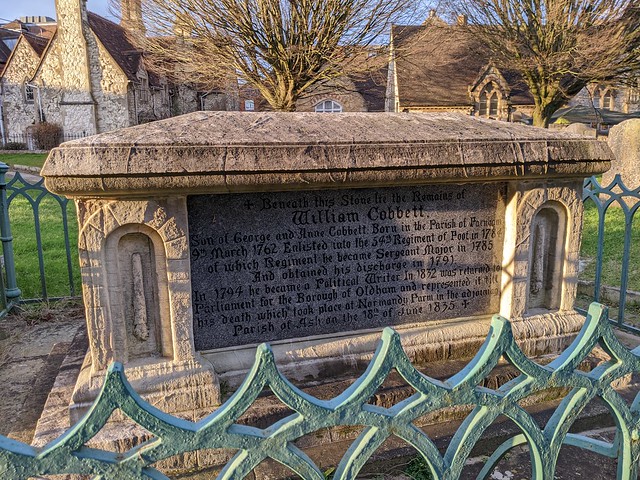
Near the church door is the tomb of William Cobbett, which records a series of journeys by horseback through the countryside of Southeast England and the English Midlands. Cobbett was born into poverty in 1763, yet rose to become an MP, an advocate of political reform and an author whose most well known work is Rural Rides, which records a series of journeys by horseback through the countryside of Southeast England and the English Midlands.
 
 William Cobbett's tomb, St. Andrews Church, Farnham.
 
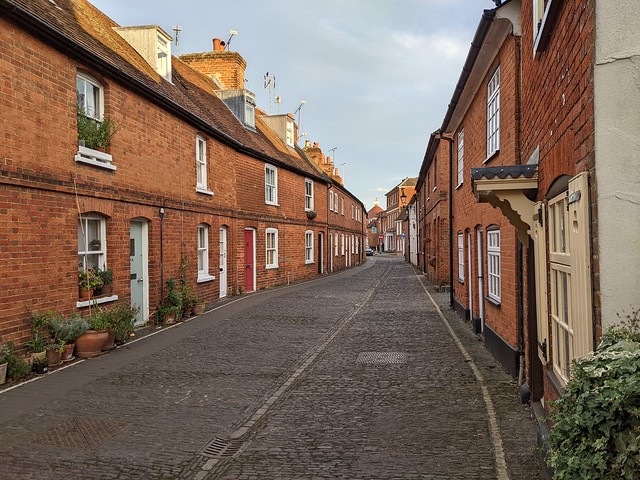
Out through the churchyard gates and turn left past the row of cottages in Middle Church Lane, often used for period scenes by television companies and left into the even more picturesque Lower Church Lane complete with central gutter, thankfully no longer used as an open sewer as it was in Tudor times.
 
 Lower Church Lane, Farnham.
 
Just before the end of the lane turning right into Wagon Yard car park. The wagons from which it takes its name would have carried goods including wheat and must have been a major transport site if what the man told Daniel Defoe was true, that he had "once counted 1,100 teams of horses, all drawing wagons or carts, loaded with wheat, in Farnham on this piece of ground”. Must have resembled the post-Brexit lorry parks in Kent 300 years later. On the other side of the car park and the River Wey is the cultural and arts centre Farnham Maltings, 
 
 Farnham Maltings.
 
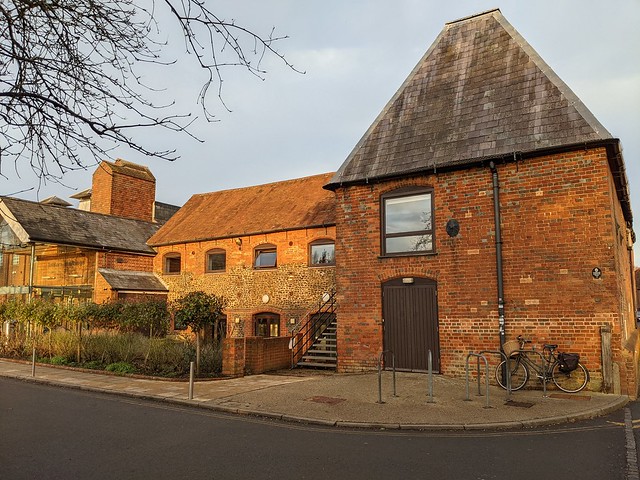
This was a tannery and then a malting house for brewer’s malt until purchased in the 1960s from Courage Brewery by Farnham residents to save it from being demolished. On the corner of the Maltings building, point 7 on the leaflet map, turn left into Red Lion Lane which contains some brewery related “ghost signs” and one of Farnham’s oldest buildings dating from the 1500s but when I passed all but invisible behind builders’ hoardings.
 
 Red Lion Lane, Farnham.
 
At the end of the lane across the road is William Cobbett’s birthplace, an inn then called the Jolly Farmer but now bearing his name because that’s what they do for renowned MPs. There probably aren’t many jolly farmers around here anyway.
 
 The William Cobbett, Bridge Square, Farnham.
 
Following the road around to the left and over Longbridge brought me back to where I started at point 8, Gostrey Meadow. Following this link will take you to more photos taken on my walk.
 
If you lost a small red plastic tractor in Gostrey Meadow speak up, otherwise it can remain decorating my mantlepiece :-)

Monday, 31 January 2022

Metroland Modernism: Harrow.

January 17th 2022
 
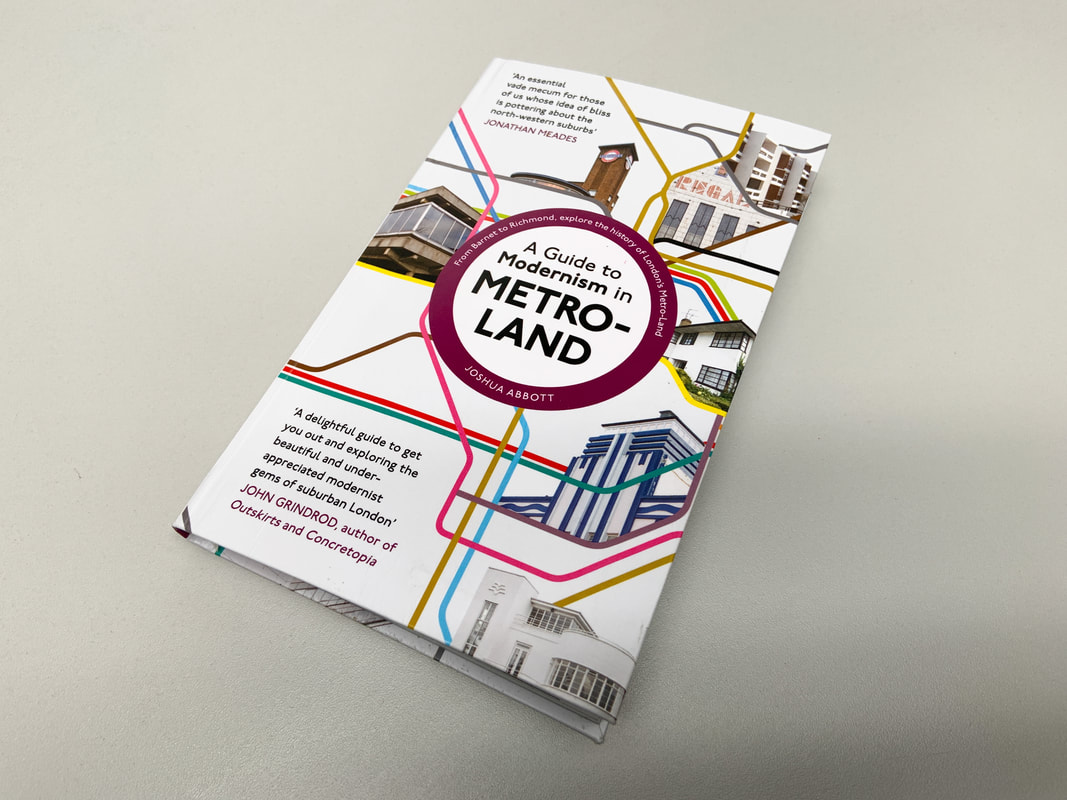
I treated myself to Joshua Abbott’s A Guide to Modernism in Metroland for Xmas so a bright dry sunny day seemed like a good opportunity to make use of it. For my first venture out I picked the borough of Harrow to take a walk around some of the modernist buildings there and get some pictures. 
 
Book cover, A Guide to Modernism in Metroland 
 
I plotted them all and the nearby tube stations on a Google Map first to aid navigation although there wouldn’t be time to visit them all.
 
Starting off at Sudbury Hill Station and making my way to Harrow via Pinner it proved to be a good afternoon for exploring and taking pictures which can be seen here in my Flickr album. (Which should embed in this page but that seems to be broken these days so click on the picture below to view it on Flickr.)
 
 Metroland Modernism: Harrow.
 
I look forward to exploring the rest of the chapters over the next months/years.