6th October 2026
Something a bit different to my usual posts. Sculpture in Regent’s Park.
After a meeting in Westminster I had some time to spare so I walked up to Regent’s Park to check out the artworks which have landed there this year for Frieze Sculpture Autumn 2026. I had just enough time for a wander around before I started to lose the light.
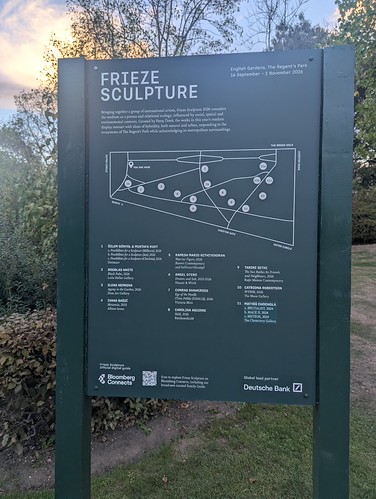
Here’s some photos of the exhibits:
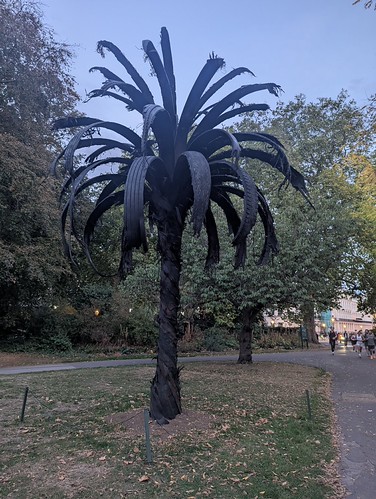
Title: ‘Black Palm’, 2026
Artist: Douglas White
Material: Reclaimed tyre rubber and steel.
Art-bolx: The sculpture reimagines the palm tree as a meditation on movement, ecology and the industrialized nature of urban environments. Rather than mimicking the setting’s vegetation, Black Palm engages with The Regent’s Park’s curated landscape, drawing attention to the systems of labour and global trade that influence public spaces. By using discarded rubber to depict once-thriving palms, the piece reflects on colonial exploitation and its impact on tropical beauty, where Europe’s fascination with the exotic depleted its natural resources by transforming rubber into a global commodity.
I liked it, though in a park full of trees you might accidentally walk past without noticing it. Yes, yes I did.
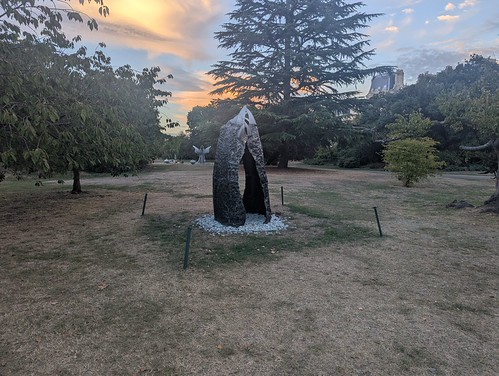
Title: ‘Agony in the Garden’, 2026
Artist: Elena Nemkova
Material: Forged metal.
Art-bolx: Agony in the Garden draws its title from a moment of spiritual crisis, yet the piece transforms this reference into physical, rather than narrative, form. Two paws rise in a prayer-like gesture, their shape evoking both an architectural arch and a familiar human expression of uncertainty. The crossed claws add an undertone of hesitation and defence.
It’s a pair of hands, it’s OK. If it was bigger you could walk through the middle. They’ve taken measures to try and stop small people doing that though.

Title: ‘Eye of the Needle (Time Pebble (E30A13))’, 2026
Artist: Conrad Shawcross
Material: Metal
Art-bolx: This elliptical monolith reinterprets the traditional clock as a cosmic occurrence. Through its perforated exterior, the sculpture generates an interplay of material, light and shadow, encouraging viewers to reflect on the measurement of time and the celestial history of the universe.
If nothing else I was impressed by the sheer amount of physical work that went into this one. It would probably have looked even better in sunshine.
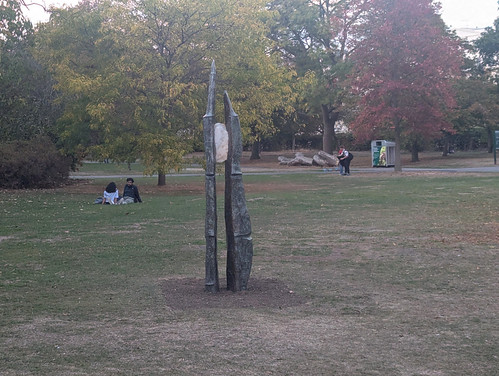
Title: ‘Held’, 2026
Artist: Carolina Aguirre
Material: Bronze metal and white quartz.
Art-bolx: Both bronze and rock are forged through fire, but bronze can be reshaped while stone remains fixed. Together, they speak of the delicate relationships that hold us—to one another, to time and place, and the Earth itself.
I liked this one too. I’m also impressed that by happy accident there’s a couple holding each other in a similar pose in the background of my photo.
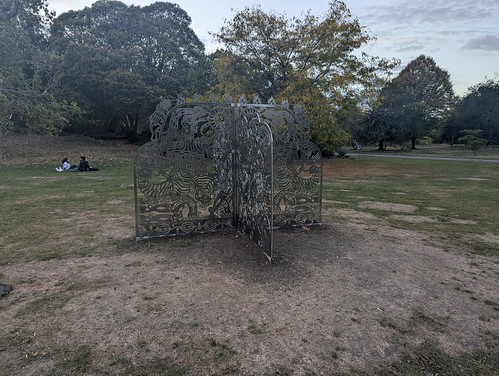
Title: ‘The Sun Bathes Its Friends and Neighbours’, 2026
Artist: Tarini Sethi
Material: Stainless Steel
Art-bolx: a four-panelled stainless steel work, which presents an Indofuturist vision of a utopian and psychosexual world. Sethi’s compositions intertwine eroticism and abjection, portraying bodies that are simultaneously seductive and confrontational.
Shiny fence.
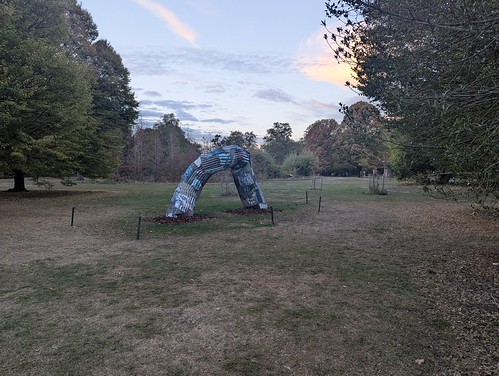
Title: ‘WYRM’, 2026
Artist: Catriona Robertson
Material: Recycled corrugated iron sheet
Art-bolx: presents a speculative ecology where colossal worm-like structures appear to weave through the earth, symbolising a subtle but persistent transformation of the city landscape.These organisms are imagined as an advanced species adapted to metabolise industrial waste. By converting ‘new age sediments’ into the foundations of future environments, they represent deep time cycles of adaptation and renewal.
It is worm-like. Chained off to prevent small people running underneath - or maybe being eaten by the armoured wyrm.
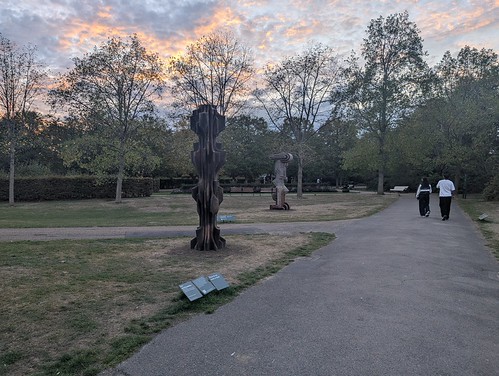 |
| MACE II & BRUTALIST |
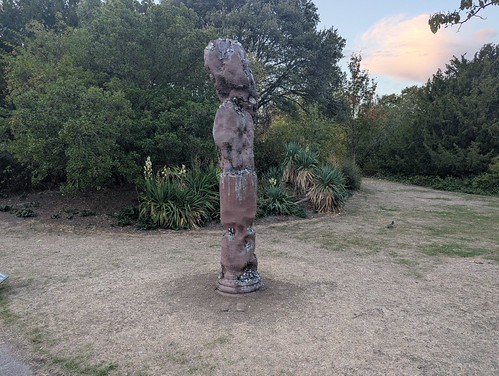 |
| METEOR |
Title: ‘METEOR’, ‘BRUTALIST’ and ‘MACE II’, 2024
Artist: Matyáš Chochola
Material: 3D-printed concrete with glass, copper powder, bronze and brass.
Art-bolx: The series reimagines Matthias Bernard Braun’s 1718–20 Baroque sculptural series ‘Virtues and Vices’, turning the originals into an ensemble of cryptic totems, exploring timeless human qualities.
Three sculptures place just far enough apart that I couldn’t get them in one photo. I think they’re good. They wouldn’t look out of place in a 60s Brutalist town centre. Of course if they were in a 60s Brutalist town centre they’d have been demolished and replaced by a privately owned shiny shopping mall.
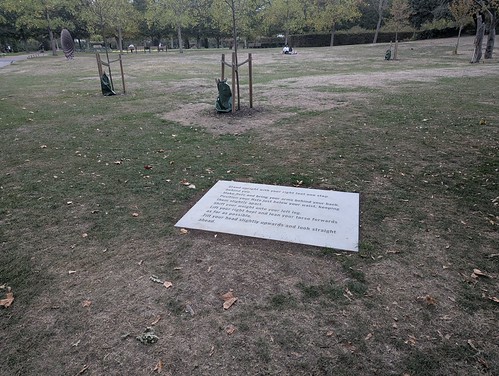
Title: ‘Possibilities for a Sculpture’, 2026
Artist: Özlem Günyol and Mustafa Kunt
Material: Concrete
Art-bolx: they reinterpret three figurative London monuments, removing the sculpted figures and preserving only the plinths. These are recreated at ground level in concrete and inscribed with lettering, maintaining the original dimensions of the pedestals while radically altering their function. The instructional texts describe the poses of the figures that once crowned the plinths, transforming these sculptures into prompts or propositions rather than static representations.
The sculptors who couldn’t be arsed to scuplt. There are two others somewhere in the park which I didn’t find. Stop sniggering at the surname.
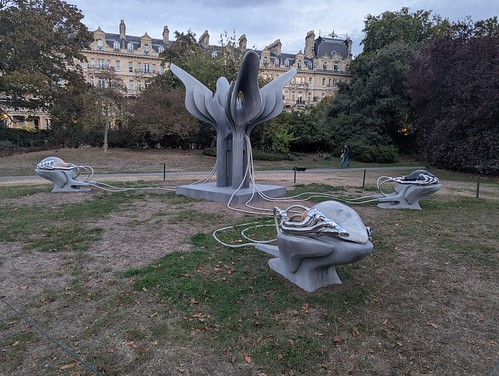
Title: ‘Metanoia’, 2025
Artist: Ivana Bašić
Material: concrete, glass, copper, breath, and race-car exhaust components.
Art-bolx: Balancing between memorial and organism, Metanoia addresses separation, longing and the unattainable desire for wholeness. It transforms the public language of a monument into something intimate and unstable, where rebirth is envisioned but never fully realised.
I have to admit this was my favourite. A cross between a war memorial and a flower with three V8 engined toilet pans 😉
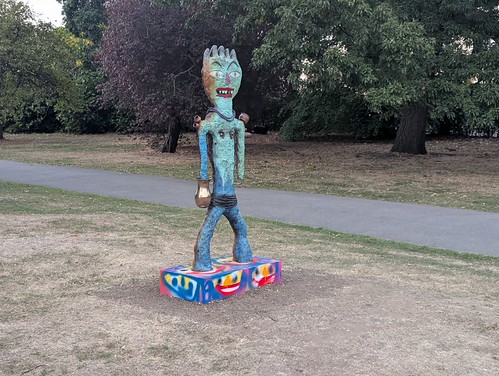
Title: ‘Warrior Figure’, 2026
Artist: Ramesh Mario Nithiyendran
Material: Painted bronze
Art-bolx: one side features a painted and patinated face emerging from textured bronze, referencing Hindu, Buddhist and Christian idolatry and votive objects. The reverse side presents a highly polished bronze face that gleams and reflects the light. Viewers are encouraged to engage with the work by moving around it, encountering both identities within the figure.
Because of where it was positioned I missed the polished side - as indeed do all the official photos. I did have the “can’t do hands or feet” thought too. And are those ducks painted on the base?

Title: ‘Dreams and Salt’, 2025-2026 Artist:
Angel Otero
Material: Painted wood.
Art-bolx: By embedding the door in the ground and leaving it partially open to an unseen interior, Otero creates a boundary that is both physical and emotional. The work suggests that what lies beneath the surface may be the sculpture’s most active element.
I liked this but it cannot be denied that it would work better in an under-cover location. The reflections and the accumulated twigs, leaves, and assorted detritus rather spoil the effect.
Frieze Sculpture 2026 runs until the 1st of November in case you wanted to see for yourself. The art is dotted around the English Gardens, in the South East corner of the park just north of Regent’s Park tube.
More details can be found on the Frieze Sculpture 2026 website whence I cribbed a lot of the above. Also proper write-ups by proper art critics 😀

No comments:
Post a Comment