Showing posts with label Kent. Show all posts

Wednesday, 26 February 2025

London Loop Section 3: Petts Wood to Hayes (Kent)

26th February 2025 

Petts Wood to Hayes (Kent)

The promise of a dry day in between wet days (should have thought about that) saw me out again to complete another section of the London Loop trail. A fairly long one at 9.3 miles from station to station but mostly through countryside with very little road walking. Alighting at Petts Wood station about 11:40 I retraced my steps from 15thOctober 2024 to the start of the section at Jubilee Country Park.

London Loop Section 3 Start, Jubilee Country Park, Petts Wood.

The path soon became a bit wet and muddy, ideal opportunity to try my new walking gaiters, a Christmas present, and hopefully keep most of the shite off my trousers. After exiting the park came the only significant bit of suburban road walking along Faringdon Avenue lined with classic interwar semis before entering Crofton Woods and climbing gently up a path that was more like a shallow stream. Where possible it was better to walk in the flowing water because where it wasn’t flowing the mud was quite deep. After crossing the East Kyd Brook on a small wooden bridge the land rose and it became a little easier to avoid the mud. In between the detritus of winter a few patches of Crocus were pushing up. Spring is on the way.

London Loop Section 3, East Kyd Brook, Crofton Wood.

I came out of the woods at the top of Tubbendon Meadow, a high grassy area with far reaching views to the south. I paused to admire the view and had a chat with a lady sitting on a bench and her Old English sheepdog. Yes it was the dog that initiated contact. I’d have stopped for lunch here but I suspect I might have had to share my picnic with my new-found four-legged friend :-) So I carried on downhill to Farnborough, passed through the village centre and around the church of St. Giles the Abbot (no relation to Russ) whose churchyard also contained a lot of crocuses, and stopped on a bench just outside the churchyard overlooking a wide open field with woods to the left.

London Loop Section 3, St. Giles the Abbot, Farnborough.

Fortified by a cheese and ham pasty and some Bovril (always take a flask of Bovril on winter walks is my advice, it travels better than coffee and tea from a flask is an abomination) I carried on down the hill following the signs to High Elm Country Park.

Of High Elms the Loop guide says:

High Elms Country Park was originally the country home of the Lubbock family. It covers over 400 acres of woodlands, orchid rich grasslands and a golf course. Sir John Lubbock, an MP, wealthy banker, author and scientist lived at High Elms and was a close friend of Charles Darwin. The park now features the BEECHE Centre, a sustainable education and visitor centre, run by Bromley Council and ID Verde, which also offers refreshment and toilet facilities.

The latter were certainly welcome. An unusual feature near the toilets is an outdoor Eton Fives court. Further on in the park is the site of the former Lubbock mansion house which was destroyed by fire. Its location marked between the formal gardens with bricks inset into the grass to indicate where the corners of the building were.

London Loop Section 3, High Elms Country Park.

I passed through an avenue of Yews, through the golf club car park, across the road, through a small rather sparse Community Orchard, and turned up the steepish hill to pass between the 13th and 18th fairways to enter the woods of Blacklands. I emerged from the woods onto North End Lane and followed it left for a short distance alongside a high hedge with many Hazel catkins dangling in the weak sunshine. After about 60 yards I turned right onto the childishly amusingly named Bogey Lane. This ancient sunken greenway runs uphill between hedges and being sunken naturally collects “moisture”. For the first part an alternative path runs parallel on the edge of the field above the lane but where the field edge bears away left it is necessary to drop back down into the sunken lane. The fields on either side contain a number of small paddocks and pony stables so naturally the surface of Bogey Lane has been churned into a quagmire by thoughtless gits on their hay-burners. In places it’s very much boggy lane, I wonder if that might have been the origin of the name? A search of the web reveals no clues.

London Loop Section 3, the end of Bogey Lane.

The tarmac of Farthing Street almost came as a welcome and some long grass at the side helped lighten the load on my boots before heading down the twisty lane and across Shire Lane to a footpath hemmed in between a hedge and a barbed wire fence that ran beside the busy road for a short distance before turning away to go around a farm shop and pet food warehouse. Looking up to the right from this path there’s a good view of Holwood House up on the hill, of which the Loop guide notes: 

 The house became an important meeting place for political figures after it was acquired by William Pitt the Younger in 1784. The house was destroyed by fire and rebuilt in 1826 by Decimus Burton.

London Loop Section 3, Holwood House from Shire Lane.

Now the path turns steeply up a long hill, crossing the drive to Holwood House just outside its very firmly closed gates with prominent CCTV, and carries on climbing until it reaches the Wilberforce Oak and the Wilberforce Seat memorials. The Loop guide explains that: 

The Wilberforce Oak commemorates the spot, where it is said, William Wilberforce had a conversation with William Pitt the Younger in 1788 and vowed to promote the abolition of the slave trade. He led a campaign which resulted in the passing of the Slave Trade Act in 1807.

The stone Wilberforce Seat is secured behind stout steel fencing. Fortunately alongside is a very welcome public bench seat affords a view past the oak over the landscape to the south-west but more importantly somewhere to rest after the long climb (and drink the remainder of your Bovril).

London Loop Section 3, Wilberforce Oak and view.

The path levels out here and leads on through the woods - sunlit at this point - before dropping down to cross Westerham Road and entering Keston Common, where it runs downhill alongside an Iron Age bank and ditch to reach a car park. Beyond the car park a set of steep steps leads to Caesar’s Well. It’s not actually a well but the spring which is the source of the River Ravensbourne which runs north from here to eventually make its confluence with the Thames at Deptford. I walked the lower part of the Ravensbourne from Catford Bridge to the Thames back in January2023

London Loop Section 3, Caesar's Well, Keston Common, source of the River Ravensbourne.

I had a brief paddle in the spring, sending some of the Kent that had stuck to my boots downstream towards that London. Then I followed the path around and between the upper and middle of Keston Ponds and past the lower pond into the woods north of Fishponds Road to reach Keston village centre. After passing the village green with its pubs, old public drinking fountain, and heavy traffic I bore north-west along wooded paths parallel to and for a short spell alongside the roads to reach West Wickham Common. I soon came to a London Loop signpost that said it was only 1 mile to Hayes Station. This was welcome but inaccurate, by my reckoning (and plotting on a map) if you’re following the waymarked route it’s at least one and a half miles.

West Wickham Common is managed by the City of London Corporation so their name appears on the signage. It also contains some impressive ancient earthworks although the information board suggests no one is entirely confident as to what purpose the served. Iron Age fort, part of a Medieval field system, artificial rabbit warren? All three perhaps.

London Loop Section 3, West Wickham Common, The Earthworks.

I skirted around the earthworks, taking in the view to the south-west over towards New Addington, then headed down hill to the end of Section 3 at Gates Green Road, Coney Hall.

London Loop Section 3 finish, Coney Hall.

This is the end of section 3 - and the start of section 4 so at some point I should be back here - but not the end of the walk because from here there’s still the Loop Link to Hayes railway station to do. This heads uphill back along Croydon Road for a short distance before turning left into a fenced tarmac footpath which the guides describes as “leading up and down” but neglects to add “like a bloody roller-coaster”. Just what I needed after 9 miles. After passing some houses, a small sports ground, and along one last muddy track it goes down Station Hill. At the bottom of the hill I found a bench and made myself at least semi-presentable before going to the Real Ale Way opposite the station and rewarding myself with a pint of Larkins Pale. Which went down so well that I rewarded myself with a second one before heading to the station (via the chippy) to begin the train journey home.

London Loop Section 3 ✅

Flickr Album for London Loop Section 3

London LOOP Section 3

London Loop Guides by Inner London Ramblers

Tuesday, 15 October 2024

London Loop Section 2

Old Bexley to Petts Wood
 
Looking for a shortish Loop section to do in October as the daylight hours reduce and one which wasn’t too involved to get to and from by train I settled on this section through former-Kent. It’s mostly green with few road bits, follows a pleasant stretch of the River Cray for a while and later on is mostly in woodland. It was a very nice walk and that was helped no end by having picked a brilliantly sunny Friday on which to do it.
 
Section 2 starts right alongside Bexley railway station, up Tanyard Lane and through the arch under the Dartford Loop Line before emerging to run along the edges of first Burnt Ash Hockey Club and then Bexley Cricket Club.
 
 London Loop Section 2, Tanyard Lane, Bexley
 
 Then it climbs gently up between the open fields of Upper College Farm, which is a landfill site in an old gravel working but you wouldn’t guess from looking at it. The cattle in the adjacent field were all lying down so obviously hadn’t got the memo about the weather forecast. Down the other side of the hill I took a left past Bexley Pumping Station into the woods to a narrow footbridge over the River Cray where I had to wait for the oncoming gaggle of schoolgirls armed with compasses, maps, and sheets of A4 and with “Sir” trailing along at the back. There were several of these groups out doing some sort of field work or map reading exercise and they couldn’t have picked a better day for it.
 
 London Loop Section 2, River Cray, Woolett Hall Farm
 
 What followed next was a really pleasant walk alongside the clear flowing waters of the River Cray through Footscray Meadows, relatively peaceful save for the chattering of the schoolgirl groups, to Five Arch Bridge over which they passed leaving me to carry on to Pennyfarthing Bridge  meeting only the occasional rambler or dog-walker. I’d have paused for a picnic lunch along here but the only benches were in the shade and therefore still too damp for comfort.
 
 London Loop Section 2, River Cray, Footscray Meadows, Five Arches Bridge
 
 Crossing Pennytfarthing Bridge, so called because it has one large and one small arch over the River Cray, I passed All Saints Church and out onto the first significant bit of road walking of the section, through Foots Cray village centre. As I crossed the busy crossroads of the A211 and A224 roads in the middle of Foots Cray I got a phone call from an old work mate. I sat on a handy bench by the traffic lights to talk with him and congratulate him on his recent transfer into idle retirement and so that’s where I ended up having my picnic lunch. Not the most scenic spot but at least it was a dry comfortable seat. Fortified by ham sandwiches I continued through the streets of Foots Cray, now sans jumper as it was actually warm enough for shirt-sleeves, emerging onto the recreation ground and past Cray Wanderers FC then between some allotments and the backs of the houses to enter a small woodland. The path climbed through this to emerge into Sidcup Place park.
 
 London Loop Section 2, nearing Sidcup Place
 
 The way ahead to follow the Loop isn’t too clear on the ground at this point (it’s not the obvious path in the above photo) but it’s vaguely up, along the right hand side of the open space, trough the line of trees and then sort of head right-ish towards Sidcup Place house. If there are any Loop way marks here I didn’t see them which was actually unusual along this Section. Anyway I found the large London Loop Sidcup Place information sign and turned left then right to pass the grand house and walled gardens to reach the A222 Chislehurst Road.
 
 London Loop Section 2, Sidcup Place
 
 A short way south along the Chislehurst Road lie the obstacles of Queen Mary’s Hospital, Frognal and the roaring A20 Sidcup Bypass trunk road. Fortunately here the way marking is good as the route makes it’s slightly tortuous way down ramps, up steps, over bridges etc. to get to the far side of the road to Dover but once across you reach Scadbury Nature Reserve and delve into Little Wood.
 
 London Loop Section 2, Little Wood, Scadbury
 
 I continued through the woods making a short loop off the main route to see Scadbury Moated Manor House, seeing few other walkers and the odd bear. Scadbury Manor goes back to the 13th century taking its name from the de Scathebury family who later sold it to the Walsinghams, wealthy London merchants close to the royal household. This is the Walsingham family which provided Henry VIII with a head gaoler and Elizabeth I with a spymaster. After the civil war they were a bit skint despite staying on the winning side and sold the estate on. There’s a history of Scadbury here.
 
 London Loop Section 2, Scadbury Moated Manor Ruins
 
 Crossing the busy A208 St. Paul’s Cray Road, not without some risk to life, I entered Petts Wood. Part of Petts Wood is owned by the National Trust and contains a couple of interesting memorials, the better of the two being the sundial memorial to Chislehurst builder William Willett who campaigned for the introduction of Daylight Saving hours, the idea having occurred to him while riding near Petts Wood on a summer morning in 1905 when he noticed how many of the window blinds and shutters were still closed well after sunrise. The sundial is “set” to GMT+1 (BST) and the Latin inscription translates as "The hours Do Not Count Except In The Summer” or “I only count the Summer hours” depending who you ask. Daylight savings was introduced in 1916 due to the need to save energy during the Great War but by then Willett had died of the flu.
 
 London Loop Section 2, Willett Memorial Sundial, Petts Wood
 
 The other memorial is to Colonel Francis Edlmann a former owner of the land who helped protect it from development and eventually led to it being sold to the NT by subsequent owners and namedas the Edlmann Memorial Wood. On the far side of the wood the Loop turns right alongside the Chatham Main Line railway before crossing the Kyd Brook on a wooden footbridge. The Kid Brook here being just a tiny stream running between the trees before ducking into a culvert under the railway.
 
 London Loop Section 2, bridge over the Kyd Brook, Petts Wood
 
Next follows a high footbridge accessed, slowly at this point, via many steps to cross the Chatham Main Line railway followed by another to cross the single track Chislehurst to St Mary Cray Line and then a little way into Towncourt Wood I came to the entrance to Jubilee Country Park and the end of Section 2.
 
London Loop Section 2 ✓
 
Another half a mile brought me to Petts Wood station, the train home and a welcome fish and chips supper.
 
There are a lot more photos in my London Loop Section 2 Flickr Album. 
 
 London Loop Section 2
 

Saturday, 15 June 2024

A Trip to Ramsgate

I’d only been to Ramsgate twice before, one afternoon in 2012 while touring Kent and in 1980 to get the hovercraft to the continent so it was essentially a new place for me. 
 
There was a particular place that I wanted to visit, only open at the weekend and it’s too far to go for a day trip, or would make for an unpleasantly long day, so I made a long weekend of it. I travelled by train and scored a rather nice seafront “suite” in a historic terraced house overlooking the harbour. The trains behaved (on the way there at least) and the accommodation was very comfortable with a fine view. 
 
 Ramsgate Harbour from Paragon
  
This Museum Is (Not) Obsolete
 
 I’d been itching to go and visit This Museum Is (Not) Obsolete for some time having watched a lot of the Youtube videos on old electronic music and other noise-making stuff and of particular interest to me, old electromechanical telephone exchanges. The museum is billed as "AN INTERACTIVE MUSEUM CELEBRATING OBSOLETE AND EXPERIMENTAL TECHNOLOGY” and the emphasis is on the interactive, there’s lots of stuff to play with. Some of it truly weird!
 
 Furby Organ, This Museum is (Not) Obsolete, Ramsgate
 
 If you’re a musician type (and I’m definitely not) there are a lot of synthesisers here to play. Or if you’re not musical, to play about with and make a noise 😀 
The place is packed with old electronic games, equipment, and computers. There are display cases of all kinds of obscure stuff some of which has been wired up to do stuff at the push of a button. Then there’s the telephone stuff. A working Strowger UAX rural exchange connected to telephones (and some other things) around the museum so that you can make calls and watch the switches connecting the call. 
 
 UAX13, This Museum is (Not) Obsolete, Ramsgate
 
 You might find yourself having to explain to younger visitors (i.e. those under 40) how to use a rotary dial telephone though. That will remind you that you are old but you knew that already because you used to work on this stuff and now it’s only found in a museum 😀 There’s also an older UAX12 exchange wired into the mix, a GEC Private Automatic eXchange connected to a dial, and dotted about quite a lot of test equipment that was familiar from my working life. If you’ve any interest in this sort of thing I highly recommend  getting yourself down there, it’s only £6 to get in. Be aware though that time is distorted within the building and you’ll find two hours have gone by while you weren’t paying attention. I seem to have been to busy enjoying it to take many photos. And yes it’s tech geek/nerd heaven.
 
Ramsgate Tunnels
 
Having decided not to travel on Sunday because Rail Replacement Buses are not something I’m keen on I had another day in town so booked a tour of the Ramsgate Tunnels.
These are partly a disused railway tunnel that took the London Chatham & Dover Railway down to the seafront Ramsgate Harbour station. This station and the line through the tunnel closed in 1926 when the lines through Ramsgate were reconfigured and linked via the new station on the landward side of town. In the 1930s part of the tunnel was used for a miniature railway serving the amusement park and zoo on the site of the old harbour station. In the late 1930s the local council and the Mayor could see what was coming and that Ramsgate would be a bit too close for comfort to the action - it had been bombed by the Germans during the previous bout of unpleasantness - so they pushed hard to get a network of air raid shelter tunnels built leading in an arc under the town and connected to the former railway tunnel. It’s these, or part of them anyway which form the location of the tours.
 
 Ramsgate Tunnel Tour
 
 And very good they are too. Following a brief introductory film and a safety briefing (accept their advice to use a hard hat) you’re issued a torch and a couple of knowledgeable guides take you down into the tunnel shelter system, explaining how it all worked and pointing out various things of interest. This includes quite a bit of graffiti from the time before the tunnels re-opened for tours in 2014 and local urbex "enthusiasts" used to get in. Visitors who left their mark allegedly include Charles Darwin and inevitably Norma Stitz. They’ve decided to preserve the existing graffiti but request that no more is added. And yes at the limit of exploration they turn all the lights and torches off for a minute. It’s dark in there.
 
Back at the railway tunnel there’s a recreation of the “tunnel town” that developed to house residents displaced by the bombing with wood and canvas rooms for families who had lost their homes, and ablutions and medical facilities.
 
 Ramsgate Tunnel Tour
 
 It’s all very well done. Not overdone or Disneyfied, well able to hold it’s place against the large shelters you can visit such as Clapham South in London or Stockport, Greater Manchester. It has the advantage over Clapham in that being entered from the railway tunnel access is level-ish so no long climb down and back up 180 steps! 🙂
It has to be a “must do” when visiting Ramsgate.
 
 Ramsgate Tunnel Tour
 
 The rest of Ramsgate is worth a wander around too with a lot of interesting nooks and crannies in the backstreets, a busy harbour although it now lacks any cross-channel ferries, and some nice pubs. Although a warning to the easily offended, maybe it was just the fine weekend weather, maybe it was the proximity to Wetherspoons but the harbour front and town centre do seem to attract a noticeable number of shouty, sweary people.
 
I enjoyed my third visit to Ramsgate, there are more photos here on Flickr.
 
 Trip to Ramsgate
 
 Oh and the train journey home? Yeah, that was severely disrupted by someone getting themselves under a train at Maidenhead. Terminally 🙁

Thursday, 3 March 2022

Rochester.

28th February - 2nd March 2022

I had some leave to use up so between the “end” of the plague and the beginning of World War Three I took a little train trip to Kent.
 
 
Rochester sits on a bend the River Medway about 30 miles from London. Historically it’s a city but due to an administrative cock-up officially it isn’t any more. In its favour as a tourist destination it does have a castle, a cathedral, a high street with a lot of interesting buildings, strong connections to Charles Dickens, and frequent trains from London Victoria (as well as sitting astride the main A2 road from London to the channel port at Dover). I took the train via Guildford, Clapham Junction, and London Victoria and at £25 return with a Network Railcard it was almost certainly cheaper than if I’d driven. And the trains all ran to time for once!
 
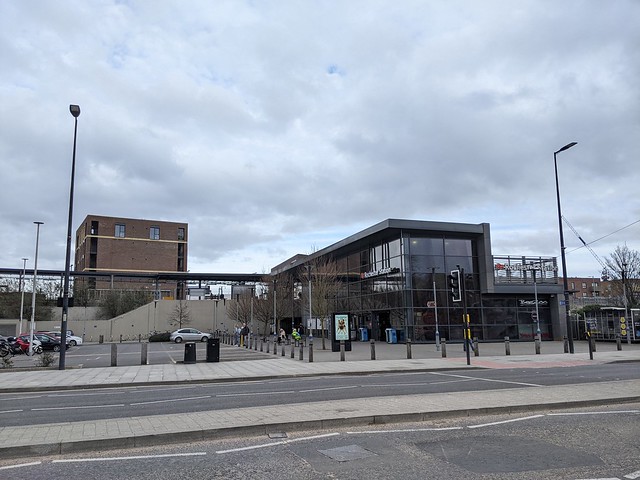
 Rochester Station
 
The station is close to the city centre (to hell with the bureaucrats) and has a Travelodge just behind it which is fine for a couple of nights and being quite new hasn’t had a chance for the fixtures and fittings to fall apart yet. From the third floor I could watch the trains arriving and departing the station below. I took advantage of the lack of rain and went for a walk around the city centre to get my bearings and in search of victuals. The Crown at the bridge end of the high street was quiet - it was Monday and early evening - and provided a decent burger and chips and pint of Spitfire. 
 
 Rochester High Street
 
The High Street was mostly quiet, quite a few places didn’t open on Mondays.
 
 Rochester and the River Medway at night.
 
I walked across the river bridge to Strood which appears to be the shopping area for Rochester, having a retail park and supermarkets and was rewarded with a view of the illuminated castle and cathedral across the Medway. And so to bed.
 
The next morning was predictably wet, I’ve decided that when I book leave it adversely affects the weather, I’m used to it now and fortified with a flat white from Costa I headed first for the castle.
 
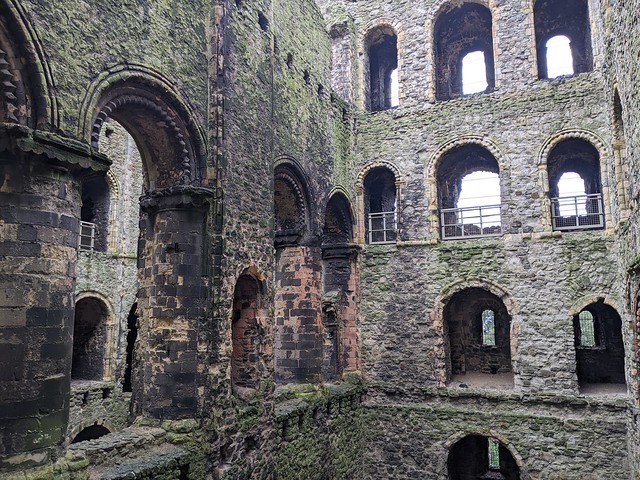
 Rochester Castle
 
It isn’t hard to find, sitting high on a hill in the city centre. Rochester Castle was started in the late 11th century and the tall stone keep built in the early 12th century by Gundulf, Bishop of Rochester and later Henry I granted it to the Archbishop of Canterbury in perpetuity because obviously the leader of a peaceful religion needs a ruddy great castle. The scene of many battles and sieges of the the centuries the castle and its grounds were opened to the public in the 1870s as a park, the grounds are free to enter when open in daylight hours.The castle is protected as a Grade I listed building and Scheduled Monument, the ruins are managed by English Heritage and open to the public for an entry fee of £7.20 at the time I visited. 
 
 Rochester Castle
 
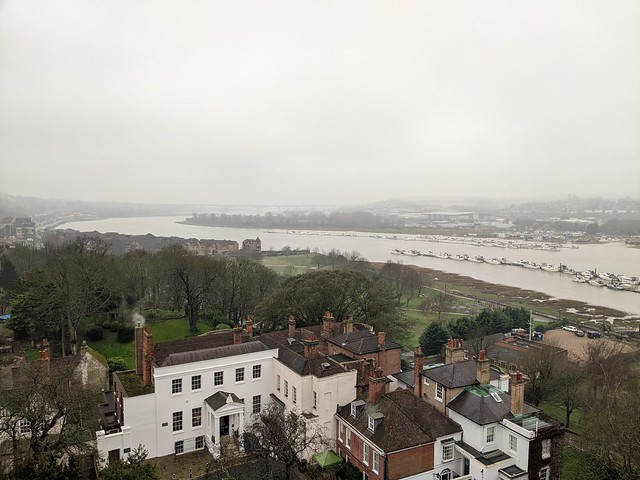
Which isn’t too bad considering there’s quite a bit of the keep still standing and accessible - in the sense that if you can climb lots of irregular staircases you can access it rather than the modern sense of accessible to people with disabilities. It’s worth the climb of 200-odd steps because even in fairly crappy weather there’s good views over the Medway and surrounding area. Which is why it’s where it is of course.
 
 River Medway from Rochester Castle.
 
Topically you can even see a Russian Soviet Navy submarine although this one’s no longer a threat to anyone.
 
 Rochester Castle
 
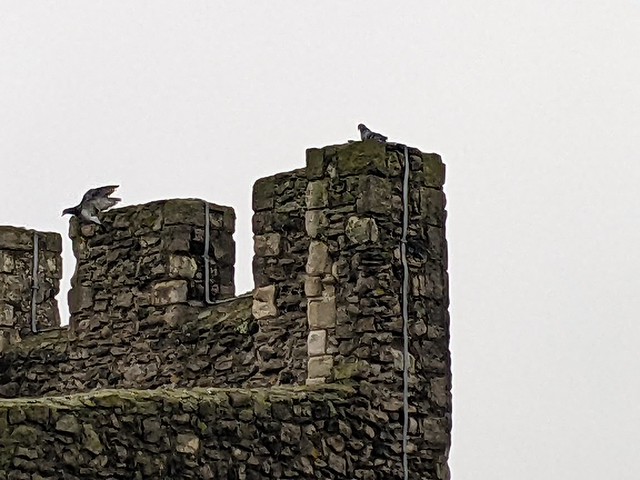
These days the castle keep is besieged only by feral pigeons in spite of the defences erected to counter them.
 
 Rochester Castle
 
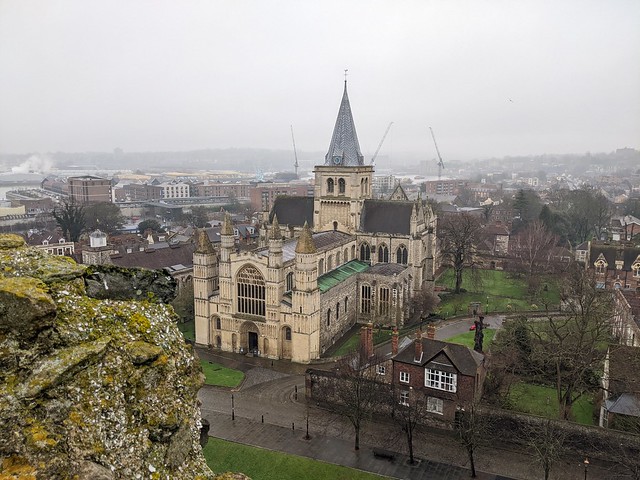
From the top of the keep I could see my next place to visit, Rochester Cathedral being gently rinsed by the falling drizzle.
 
 Rochester Cathedral from the castle.
 
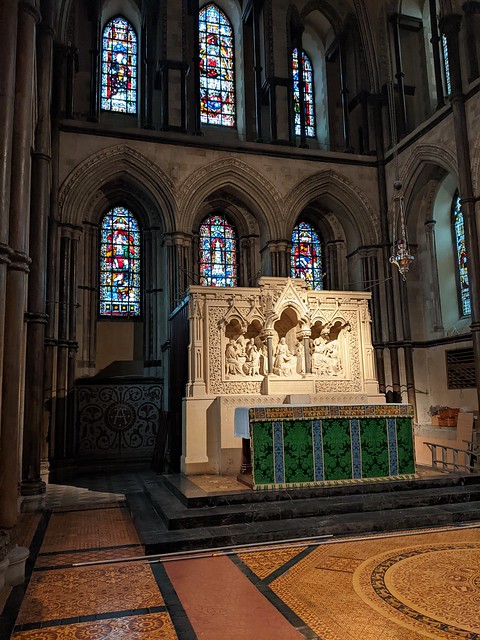
Even as a godless heathen I can appreciate church and cathedral buildings. Particularly when they’re free to enter and warmish and dry. The cathedral has had a turbulent history since its founding in 604 and the original Saxon church has been replaced by a Norman and later building. It’s not a huge cathedral but impressive nonetheless.
 
 Rochester Cathedral
 
At the time of visiting there were more electricians working there than ecclesiastical types apparently installing new lighting, in the 21st century even the light of the world is by LEDs! I did notice a distinct military theme to the various memorials around the walls inside the church. Many of those memorialised seemed to have spent their time on earth helping to expand the empire. A striking number meeting a premature end in obscure parts of it possibly at the hands of the locals who didn’t appreciate the efforts of the great and good of Rochester to bring them civilisation.
 
 Rochester Cathedral
 
It hadn’t finished raining when I emerged and showed no sign of doing so. Heading through the city centre it was clear that many businesses made the most of the Dickens connection with the city and in the grounds of Eastgate House is his writing chalet looking a little out of place next to the Elizabethan house. There are a few other interesting old buildings too as befits Rochester’s long history and location on the route from Dover to London. Fairly free of chain shops too. I followed the High Street east and out of Rochester to Chatham, about a mile and a half away, to Fort Amherst, built centuries after Rochester Castle but for similar reasons. Built in the 18th century to defend the landward side of Chatham’s Royal Navy Dockyard from any invading army - OK, the French - it replaced the old town of Chatham which was then rebuilt in a bog at the bottom of the hill.
 
 Fort Amhurst, Chatham.
 
It’s a fair climb to the fort from the town and being still winter the main attraction, tours of the extensive tunnel system below, wasn’t open but it was free to wander around before walking back through Chatham town centre to the railway station.
 
 Fort Amhurst, Chatham.
 
Chatham and its Historic Naval Dockyard will have to wait for a future visit. I caught a train to Strood for the shops and retreated to the hotel for the remainder of the evening to dry out. The next day reversing the train journey rather than the journey planner’s suggestion of returning via Victoria, Paddington, and Reading which would have been disrupted by delays on the tube, falling between two strike days.
 
I feel a re-visit to Medway is on the cards as there’s much more to see than I had time for and it’s not too far away from home for a short break.
Meanwhile the usual Flickr Album is here.