Showing posts with label canal. Show all posts

Friday, 6 September 2024

Lincoln

A visit to Lincoln
 
When I was about 17 or 18 one of our Scout Leaders bought a plot of land in Lincolnshire where we used to go camping. I don’t recall the exact location but it was a few miles from the city of Lincoln so it’s possible I might have been there back then. I have no memory of doing so though so I’m calling September 2024 my first time. 
 
On Monday 2nd I took the train and to avoid Kings Cross and any disruption following the strike the previous day took the Elizabeth Line from Reading to Farringdon, then Thameslink to Peterborough and finally East Midlands Railway to Lincoln.  I rejected the suggestion of GWR from Reading to Paddington then changing to the #purpletrain to Farringdon because though in theory it would be 40 minutes quicker the GWR train would most likely be late and crowded and to change at Paddington would mean weaving through crowds of drunken sheep worriers and confused elderly couples on their first trips east of the Tamar. I wasn’t in that much of a hurry ๐Ÿ™‚
As it turned out taking this route was much more relaxing, no tight connection times and plenty of empty seats on the trains. 
 
 Approaching Lincoln on a train
 
Lincolnshire has a reputation for being very flat but Lincoln itself certainly isn’t. The railway station is down near the River Witham, my hotel was up next to the castle. Between the two is the main shopping area of the city followed by a picturesque long narrow street lined with old buildings and shops called Steep Hill. It’s not mis-named. It didn’t get any easier to climb in the following 3 days. I stayed at Charlotte House, opposite the West Gate of the castle, a neo-Georgian building built in the 1930s as nurse’s accommodation for the adjacent lunatic asylum, The Lawns, now HQ of Stokes coffee and tea who also own the hotel. I got a good deal with a booking.com discount and a free room upgrade to a suite with a similar square footage to my house ๐Ÿ˜€ It was also convenient for The Victoria PH, The Castle, the historic area of the city, and the nearby Museum of Lincolnshire Life. Ideal place for a short break in fact. Although a search for cheap eats meant I did another trip down and back up that hill that evening. 
 
 Steep Hill / Well Lane, Lincoln
 
The Museum of Lincolnshire Life 
 
 
The next day after breakfast I took a short walk north to the former barracks that houses the Museum of Lincolnshire Life. It’s open Friday to Tuesday so I had to visit today. The first of two Victorian brick wings contains recreated domestic rooms as they would have been in the 19th century which then leads into an area dealing with the history of  the Royal Lincolnshire Regiment (the barracks was built for the Royal North Lincoln Militia in 1857) and its previous incarnations since 1685, it’s part of the Royal Anglian Regiment now. They’ve a couple of VCs and an atmospheric bit of WW1 trench with appropriate soundtrack to scare small children. 
 
Next comes a large open hall containing farming machinery, railway and road locomotives (Ruston & Hornsby being a Lincolnshire firm), and the prize exhibit of a genuine WW1 British tank, the first tanks having been designed and built in the county. 
 
 WW1 tank, Museum of Lincolnshire Life, Lincoln
 
The next barrack block contains recreations of 19th and early 20th century commercial premises, chemist, post office, Printers etc. One some days they have the printing press working but today wasn’t one of them. In the yard outside there are two large Ruston-Bucyrus cable operated excavators (and the kiddies play area).
 
 Ruston-Bucyrus excavators, Museum of Lincolnshire Life, Lincoln
 
Above the shop and reception are some more recreated rooms - a Victorian school with essentially the same desks we had at school in the 1960s and 70s - and the temporary exhibition space which at the time of my visit was given over to “The Tank At Home” which they describe thus “This exhibition looks at a lesser-known aspect of the first tanks and their impact on the home front. Rather than concentrating on the battlefield, the focus is on displays of tank related items such as toys, money boxes, ornaments, trench art and photographs of the works who built them.” There was everything from model tanks through ceramic tank-shaped teapots to the cover of the weekly comic Warlord  from 1974 featuring a WW1 tank. Because the kids' publications from my childhood are now museum exhibits! ๐Ÿคจ
 
 Warlord Comic, Museum of Lincolnshire Life, Lincoln
 
I really liked this museum and admission is free too, donations are welcomed obviously.
 
Lincoln Castle
 
 
My next stop was the castle. That definitely isn’t free, £17 for an adult and the senior citizens concession rate doesn’t apply until you’re 66. That price is about average I suppose and gives you access to the castle walls walk, the Magna Carta display, and the Victorian Prison. The ward or bailey of the castle is free to enter during the day or indeed to walk through between the west and east gates, making a good short cut as out of hours it’s much further around the outside. Free access to the ward has to be maintained since Lincoln Crown Court is located within, near the Westgate. Having paid my money I first climbed the steel spiral staircase (the lift was out of order) to the top of the curtain wall and did the approximately third of a mile circuit. You certainly get a good view from up there, especially if you climb to the top of the tall narrow Observatory Tower, which is not for anyone who’s uncomfortable with heights, lowish parapets, and long drops!
 
 Lincoln Castle, view from the Observatory Tower
 
Next I went in the opposite direction down into the subterranean David P J Ross* Magna Carta Vault A small dark room, a prominent “no photography” sign, 3 glass cases containing Lincoln Cathedral’s copies of the Charter of the Forest from 1217, and Magna Carta from 1215, and at the back a “guest document” case containing, er, a highly decorated German crossbow for some reason. Magna Carta is something most English people rarely think about but seems to be a magnet for US tourists who seem to regard it with much more reverence so of course there was a couple present to view the “holy grail of democracy”. In the adjacent 210 degree cinema there’s a really good film about King John, William Marshall, and the circumstances that led to Magna Carta. I can confirm that she did not die in vain ๐Ÿ˜‰
 
Lastly to the Victorian Prison, well preserved and with lots of information boards and audio visual displays in the cells, plus activities for the younger inmates - who were thankfully largely absent on this particular Tuesday afternoon else it might have been a bit loud in there. I confess that I couldn’t help thinking of Porridge. No sign of McKay or any other screws though. The manikins in the prison chapel were particularly creepy. 
 
 Lincoln Castle, Victorian Prison
 
By mid afternoon my feet demanded to be put up so I returned to my hotel room and had a long hot soak before heading across the road to The Victoria for a couple of beers. 
 
Saxilby
 
 
I took a little train excursion on Wednesday to the village of Saxilby which lies on the Roman Fossdyke canal. Just because I wanted to see it. I might have been influenced by watching this Minimal List video recently on YouTube. The Fossdyke is very straight as you’d expect. I had a nice walk along it in the flat countryside then returned to the city and explored along the River Witham.
 
 Fossdyke Navigation, Saxilby
 
I gave in and got the bus back up that hill, £2 well spent. Later I considered going on the evening ghost walk but it wasn’t really dark enough at 7pm and it looked like I was going to be the only person to show up. Didn’t fancy that idea so I went and explored the various city gates, got chips, went to the Victoria again, and went back and watched episode 1 of Slow Horses season 4.
 
 Pottergate, Lincoln
 
The way home
 
My return journey was a reversal of the outward one, Lincoln - Peterborough - Farringdon - Reading - home. Avoided Paddington again and had time for a coffee at Reading accompanied by the deafening sound of torrential rain on the station roof, so loud it overwhelmed the continuous PA safety and security announcements. See it. Say it. Sodden.
The rain hadn’t given up by the time I walked home from the station. I was glad I had a waterproof coat!
 
It was a good city break, Lincoln is really interesting and if you like old buildings you’ll find it hard to move without bumping into one. I recommend Charlotte House, especially as with the discount it came in at £278 inc. continental breakfast which was at the low end of what was being asked in the city centre. Using the slightly slower train route made for a relaxed journey and was £79 for two off-peak flexible single tickets with a National Railcard. 


 Trip to Lincoln
 
 
* Lincolnshire born billionaire, co-founder of Carphone Warehouse. I had to look it up.
 

Monday, 16 January 2023

Hanwell

Hanwell is a town in the London borough of Ealing. It lies on the River Brent which forms its boundary with Southall to the west. The earliest known reference is as Hanwelle in CE 959. Apparently the name Hanwell possibly derives from a stream or spring where there are cocks - the chicken sort that is. There is enough of interest in and around Hanwell for a January afternoon’s walkabout.
 
Hanwell Station
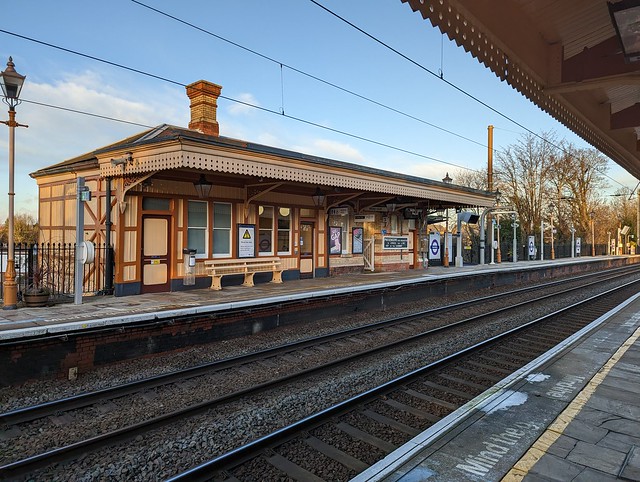
The Great Western Railway came to Hanwell in 1838 and built a station on the north side of the town. Now run by Transport for London as part of the Elizabeth Line trains run between Heathrow Airport and Abbey Wood, meaning that coming in from the west I had to change at Hayes & Harington. The station has been modernised to provide step free access but also much restored into its GWR station colour scheme which looks great.
 
 Hanwell Station, Elizabeth Line.
 
There are even some restored signs on the platform showing ‘Hanwell & Elthorne’, the name by which the station was known between 1896 and 1974.
 
 Hanwell Station, Elizabeth Line.
 
The Wharncliffe Viaduct
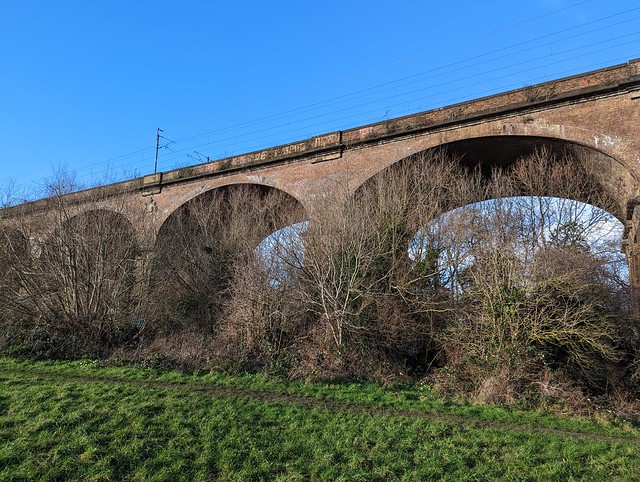
For the GWR to get west from Hanwell to Southhall it needed to cross the valley of the River Brent. To achieve this Isambard Kingdom Brunel designed his first major engineering construction project, the Wharncliff Viaduct. Built in brick with hollow piers it rises 66 feet (20m) above the valley and is 890 ft (270m) long with 8 arches. It was built in 1836-1837 ready for the opening of the GWR main line.
 
 The Wharncliffe Viaduct, Hanwell.
 
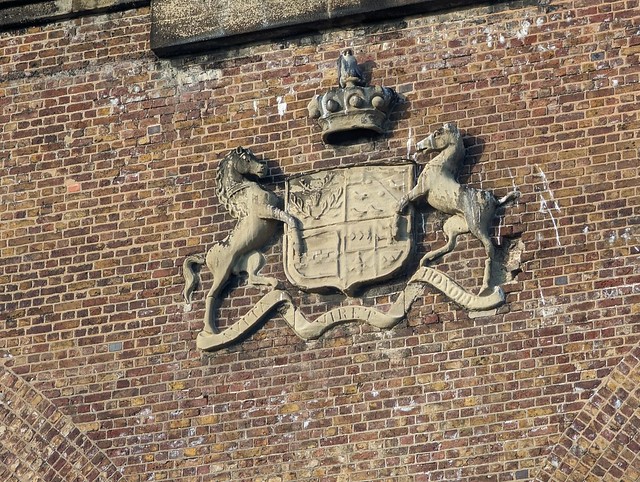
On the central pier on the south side is a carving of the coat of arms of James Stuart Wortley Mackenzie, Lord Wharncliffe, who was chairman of the parliamentary committee that steered the passage of the GWR Bill through Parliament. If you have money and influence you’re allowed to tag railway bridges.
 
 The Wharncliffe Viaduct, Hanwell.
 
Hanwell Flight of Locks
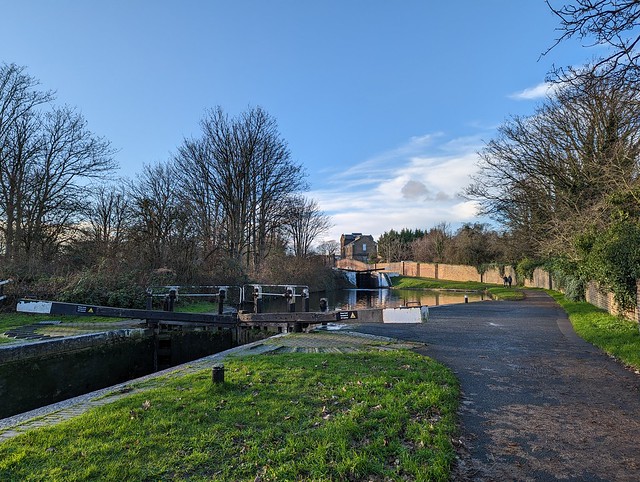
Lying just across the boundary in Southhall but named after Hanwell because it’s much closer are the six locks on the Grand Union Canal. These raise the canal about 53 feet (16m). The flight has a clever system of side ponds to conserve water by holding water let out of a lock to refill the one below. The flight runs alongside the former Middlesex County Lunatic Asylum (now a housing development and a psychiatric hospital) and low down in the high brick boundary wall are four small red doors. These are to enable the fire brigade to run hoses out to take water from the canal in the event of a fire in the asylum.
 
 Hanwell Flight of locks on the Grand Union Canal.
 
The Three Bridges
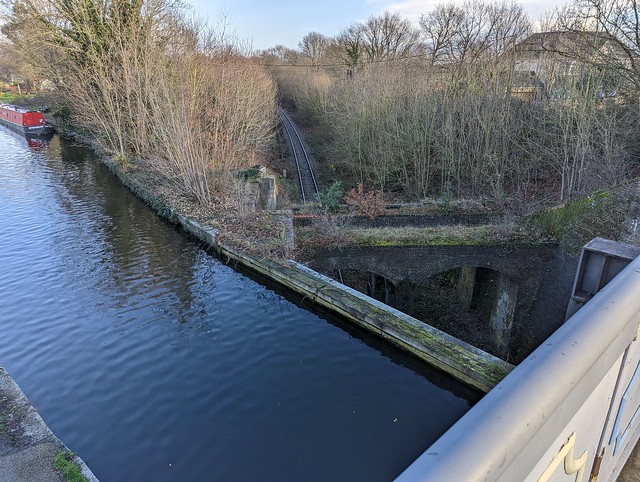
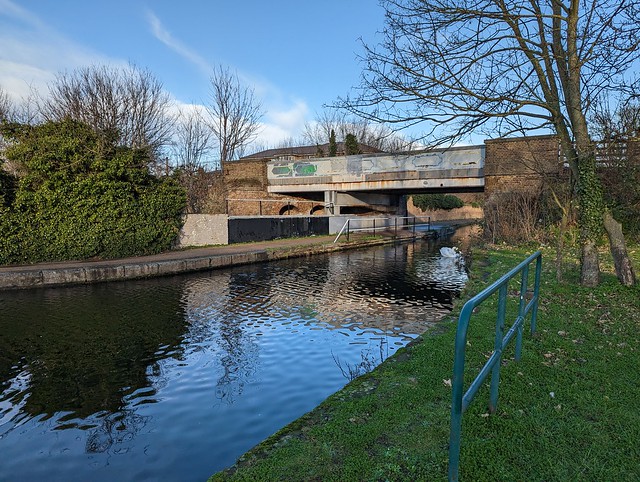
A little further west along the canal from the Hanwell Flight is another local landmark and another I K Brunel creation. The Three Bridges were originally known as Windmill Bridge and enable the crossing over of the canal by Windmill Lane and the crossing under the canal by the Great Western and Brentford railway at the same point.
 
 Three Bridges, Hanwell.
 
Technically there are only two bridges, road over canal and canal over railway which is hidden in a deep cutting. Although as shown in the photo above there is another bridge-like structure across the railway between the bridge abutments. It’s also very hard to get a decent photo of all three unless you’re standing on the railway. The Three Bridges project was Brunel’s last to be completed before his death in September 1859, so Hanwell can claim a “first and last”.
 
 Three Bridges, Hanwell.
 
Hanwell Clock Tower
Returning to the town centre there’s a nice and rather unusual modernist clock tower. This was built in 1937 to commemorate the coronations of King George VI and Queen Elizabeth (later known as the Queen Mother). Since then the design has occasionally sparked controversy, particularly from a local estate agent whose views were seen as arrogant and insulting. An estate agent being a dick, who’d have imagined that.
 
 Hanwell Clock Tower
 
It has survived though through bouts of neglect and threats of demolition and then restoration, the latest in 2002 to mark the late Queen Elizabeth II’s Golden Jubilee. Even the aforementioned estate agent relented in the end and accepted the clock tower as part of Hanwell’s streetscape. It tells the right time too, at least when I was there. 
 
City of Westminster Cemetery, Hanwell.
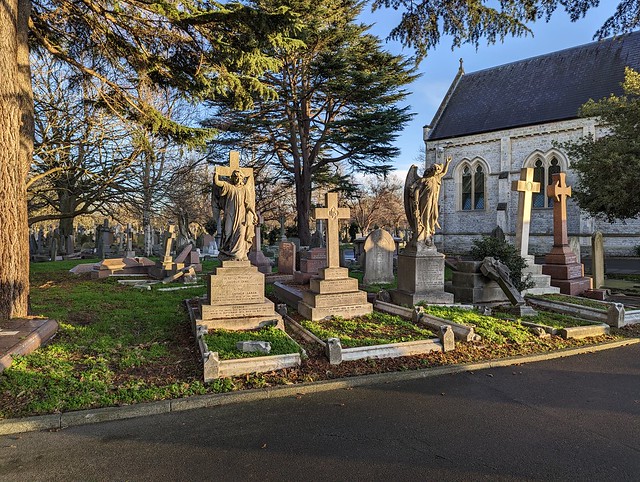
The dead centre of town is actually to the eastern side of Hanwell town centre. In the 1840s the cemeteries in the middle of London were full to overflowing, some messily so, and alternative sites for interment needed to be found outside the city. In 1853 the St. George's Hanover Square Burial Board purchased 12 acres in Hanwell for a new burial ground. A Victorian Gothic revival style church was built, designed by Robert Jerrard and the first interment took place in 1854. In 1883 another 11 acres of land was added.
 
 City of Westminster - Hanwell Cemetery
 
The cemetery suffered bomb damage during World War 2 and repairs were carried out to the chapel afterwards including a new stained glass window on the south side. There are quite a lot of impressive Victorian and later memorials and mausolea to be seen and a few notable burials to be found if you have more time than I had. There are some public toilets too but these were closed due to “antisocial behaviour”. In 1987, the cemetery was subject to some Tory shithousery when it was one of three that Shirley Porter's Westminster City Council controversially sold to land developers for 15p. However, like East Finchley and Mill Hill, it was reacquired by the new City of Westminster in 1990, and renamed at that point as their Hanwell Cemetery. 
 
 City of Westminster - Hanwell Cemetery
 
North of the Uxbridge Road there is another large cemetery, the Royal Borough of Kensington and Chelsea Cemetery, Hanwell but since they close at 4p.m. in the winter there was no time to visit that one.
 
My afternoon exploring Hanwell done I walked back to the railway station and caught a #PurpleTrain back to the west.
 
All my Hanwell photos are here in this Flickr Album.

Sunday, 11 October 2020

Lydney

 Monday 7th September 2020

Lydney Harbour

Day three on holiday and I'm looking for local history. Nearby in Lydney the map shows an ancient monument, Lydney Harbour which as well as a harbour has a canal and disused railway. Out into the wet and windy morning I went.
Lydney Harbour tidal basin
The harbour at Lydney wasn't quite what I'd imagine a harbour to look like (if I hadn't already checked the map) being long and narrow and looking more like a lock.

It lies at the end of a 1 mile canal and gives access to the tidal River Severn. The gates of the tidal basin shown here appear to be stuck open so that it is filling up with silt from the river. They're spending a couple of million on the site to upgrade the tourist facilities (hence the digger and wire fencing) so hopefully that will include fixing the gates. Parking is currently free though after the refurbishment who knows.


Between the tidal basin and the canal is a lock and the canal serves as a marina for small craft.

A bit of history: The canal opened in 1813 and the outer harbour was completed in 1821. Coal and iron ore from the Forest of Dean was shipped out, brought down by a tramway which was in 1868 converted to a broad gauge railway although in 1872 that was converted to standard gauge. 
As can be seen from the early 20th century map below there were extensive sidings serving the harbour.

Reproduced with the permission of the National Library of Scotland

Lydney Harbour former railway
Parts of the track bed can be seen and walked along and there are markers pointing out wrecks on the river shore and "sighting stones" core drilled through pointing at distant landmarks.

Also a circle of standing stones, not ancient but dating from the refurbishment of the harbour around 2006 - apparently it works as a compass, something I failed to notice at the time.


I walked along the track bed on the west side of the
Lydney Harbour marina

inner harbour then crossed the swing bridge and back up the east side to the lock and harbour entrance.

There are a lot of boats moored here, I'm not sure if they can get out onto the Severn until the tide gate is repaired? The Environment Agency page doesn't mention it.

The last coal was shipped from the harbour in 1960 but imported wood was still being brought in by barge from Avonmouth. In 1977 the harbour closed and began to fall into disrepair, scheduled as an ancient monument in the 1980s with the swing bridge Grade II listed the harbour re-opened after a two-year project of restoration and enhancement in 2005.

Lydney Harbour lock
There are still a few old buildings around the lock and harbour and if you look closely on the west side the remains of the coal tip shown on the above map where coal was offloaded from the trains to the barges.

The old mortuary building was inaccessible due to the ongoing building works - I gather it's going to be made into public toilets which will be dead convenient. Sorry.

Crossing back over via the lock gates I went out to the rather windy harbour entrance where I could see up and down the Severn. 


Severn Bridges
On a clear day you'd get a really good view of the Severn road bridges downstream, this wasn't a clear day and with occasional showers as well but the bridges were just about visible anyway. The view of the Berkeley Nuclear Power Station on the far side of the river was much clearer.

A short but heavier shower sent me from my perch on a bollard on the harbour wall back to the car.

So Lydney Harbour was interesting with quite a bit to look out for, let's hope they don't spoil it.


Lydney Junction

I parked in the railway station car park so that I could walk into Lydney town centre, between the two
lies Lydney Junction station, the southern terminus of the Dean Forest Railway. Crossing over the tracks at the level crossing this very shiny Brush Type 2 diesel locomotive was hard to miss. Newly overhauled I think.

I'd have liked to take a ride on the DFR but when I tried to book for the Wednesday trip discovered that it was not possible to book only one ticket. No doubt trying to maximise their income under COVID-19 restrictions which I can sort of understand during the busy summer period but mid week after the schools had (finally) returned? I doubt that the train was going to be full. I note that this restriction remains in place even now in mid October. Alienating potential customers could be a policy that comes back to bite them in the arse.

Lydney Town

I can tell you that the walk from Lydney railway station to the town centre isn't very interesting, apart from trying to get across the A48 without being mown down by traffic at the roundabout. That the River Lyd near the boating lake smells quite unpleasant, although that might be the treatment works, and that on this particular post-lockdown Monday a lot of Lydney was still shut. At least it was some exercise.