Saturday, 31 August 2019

Marston Vale Line (The D Train)

26th August 2019

Some of London Underground's former D Stock trains which were retired from the District line in 2017 have been "up-cycled" by Vivarail to become the new Class 230 main line trains, the first of which in service are operated by West Midland Trains on the Marston Vale Line between Bletchley and Bedford. They're been running since April, I finally got around to checking them out today.

Bletchley

I first came to Bletchley in 1979 for the first of three Post Office Telecommunications engineering apprenticeship courses. These were held at Bletchley Park a short walk from the station, then just a PO and CAA training school but shortly afterwards to become famous for it's previous use as the centre of code breaking in the second world war. Few knew then about "Station X" and those who did mostly didn't talk about it.

Now of course everyone knows and it is the home of Bletchley Park Museum

It's also the home of the National Museum of Computing which is on the same site but now a separate entity with it's own entrance and admission fees. I understand there was some kind of falling out between the two. I last visited when it was all one (and there were still people working there who'd been there when I was an apprentice!) and for my money I'd say the most interesting bits - the Bombe and Colossus machines - are in what's now TNMOC.

Ah yes, the train. The Class 230 arrived in the blazing sunshine. I am told (by @AMinorMuddle) that locally the Class 230/D Train is called the Penguin, I can see why πŸ˜€

Inside the new trains are very different from their District Line days. Clean and modern with a mixture of sideways and fore and aft seating, lots of charging points, cycle and wheelchair spaces, and toilets! At the same time they were also familiar. The sounds of the doors and of the traction motors, supplied with current in this version of the train from a diesel generator set under the floor but a battery pack version is also available, and they even smelled like D stock. I might have been hallucinating about that last bit because it was a very hot day and the ventilation system was only just coping, especially when stopped in a station.

Fenny Stratford

The town name is Old English meaning 'marshy ford on a Roman road'. The Roman road in this case is Watling Street. Fenny Stratford should be more famous than it is.
The world's first successful heavy oil engines were invented and built by Herbert Akroyd Stuart in Fenny Stratford. These engines were precursors to what is now known as the Diesel engine: Rudolf Diesel based his designs (1892) on Akroyd Stuart's proven inventions (1890) of direct fuel injection and compression ignition. An experimental model was used at the offices of the Fenny Stratford Times Newspaper, and the first production models were installed at the nearby Great Brickhill Waterworks where they were hard at work from 1892 to 1923. Perhaps we should call them Akroyds rather than Diesels?

Bow Brickhill

In spite of the brickmaking history of the area the village name is a combination of Brythonic (breg) and Old English (hyll) words for 'hill'. The 'Bow' comes from an Anglo Saxon personal name, Bolla. 

Caldecotte & Tilbrook should be a TV detective duo.

The railway station, about half a mile from the village, opened in 1905.


Woburn Sands

The village once had the unfortunate name of  Hogsty End until they changed it. The modern name is credited to a schoolmaster unable to attract business to his "Hogsty End Academy", and was one of the first to promote the use of the new name.

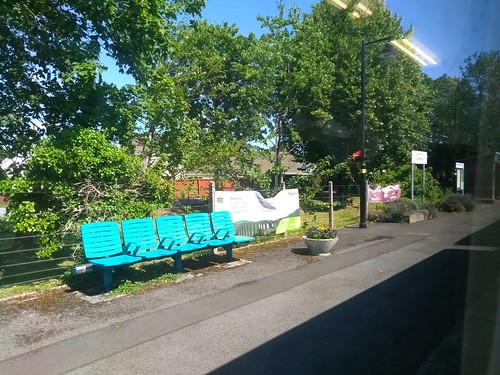
It doesn't have a beach but it does have some nice colourful murals arranged by the community rail partnership and apinted by local schools.


Aspley Guise

Famously the Least Used Station in Bedfordshire - at least it was in 2017, I have a nagging feeling that may have changed now but I'm not sure.

Built as one of seven new halts for a steam rail motor service between Bedford & Bletchley inaugurated in the autumn of 1905 it was initially constructed of old sleepers; it temporarily closed from January 1917 until -May 1919 as a World War 1 economy measure.


Ridgmont

The former station house, built in 1846 in the Cottage OrnΓ© architectural style, underwent a total refurbishment in 2014 managed by the Bedfordshire Rural Communities Charity with funding from the Railway Heritage Trust. 

A tea room, gift shop, disabled access and toilets, additional car parking, three small 'start-up' offices and a meeting room have been provided. 

The former Victorian booking office has been restored as a small heritage centre.

By way of contrast the station also serves the big Amazon.com warehouse nearby.

Lidlington

No, it's not named after the supermarket, it's been around much longer - long enough to get a mention in the Domesday Book when it was held by the Abbess of Barkway. It appears next in the historical records in 1247 when the Abbess (likely not the same one) erected a gallows to deal with the lawless, presumably so they could find christian forgiveness at the end of a rope.
Lidlington Station has been modified to have staggered platforms either side of the level crossing in order to reduce the time the barriers spend down, as with a number of others on the line.

Millbrook

Opened as 'Marston' in 1846, changed to 'Ampthill (Marston)' in 1850 and the to 'Millbrook for Marston' in 1877 to avoid confusion with the Midland Railway Ampthill station, and shortened in 1910 to just Millbrook. The station had much coal traffic and served the nearby brickmaking industry, via a siding opened in 1928.

The Millbrook Proving Ground vehicle test facility is nearby but brickmaking is now history.


Stewartby

Opened as 'Wooton Pillinge Halt' until 1928 when the 'Halt' was dropped the village was the site of a thriving brick making industry. In 1926 the London Brick Co. began to build a "garden village" for its employees at Wootton Pillinge. The village was named "Stewartby" after Sir Halley Stewart, former Liberal Party MP and the first chairman of the Wootton Pillinge Brick Company. Following the building of the village, the London, Midland and Scottish Railway renamed the station to Stewartby. The old boys network in action.

Kempston Hardwick

One of three halts opened by the London and North Western Railway in 1905 between Stewartby and Bedford. All three closed as a wartime economy measure during the First World War and two were closed during Second World War, never to reopen, leaving Kempston Hardwick as the only survivor. Its survival can be attributed to its convenient location for the nearby Eastwood's Brickworks which was served from 1928 by a private siding on the up side of the line. Bricks however were the downfall of the station buildings which were demolished after being hit by a lorry carrying the things. In 2003 only 38 passengers a month used the station though by 2017/18 that had risen to around 410 due to the creation of more local jobs.

Bedford St. Johns

St. Johns is was the first station in Bedford, on the Oxford to Cambridge line. After that line closed the station declined and in 1984 a new chord line was built linking the Marston Vale Line to Bedford Midland Station, and a new single platform Bedford St. Johns was built in the former freight yard. The old station site was abandoned, although some of the furniture, such as lamp posts, was not removed. The site has now been reclaimed by nature.


Bedford

Formerly 'Bedord Midland Road' this is where the line from Bletchley now terminates, meeting the Midland mainline from London St.Pancras to the East Midlands. 

Having suffered badly from the attentions of the Luftwaffe a replacement Bedford station 110yds North was opened in 1978 and the lines were re-aligned. This is the station that in 1984 the Marston Vale line was connected to and the old St. Johns station abandoned.
It's a half mile walk from the station to Bedford town centre and bus station, signposted and marked on the pavement with signs and big yellow footprints. The route takes about 10 minutes via marijuana-scented residential streets of Victorian and Edwardian houses and is light in road traffic at least until it emerges at the big roundabout by the Police Station and opposite the Bus Station.

Bedford town centre is an "interesting" place to visit on a Bank Holiday afternoon. At least it still retains it's post-war architecture, reminiscent of Bracknell town centre before it was destroyed and replaced by yet another giant privatised shopping mall.

I got a window seat in the Hallows Cafe & Restaurant, got coffee and cake (table service too) and was entertained by various locals shouting, swearing at, and threatening each other. The cast of this impromptu street theatre included a bus driver, a drunk, and a fat, pallid knuckle-dragger who really, really shouldn't have been allowed out in public shirtless and wearing white knee-length nylon shorts tight around his navel. The cake was nice, the coffee average. I walked back to the railway station and caught another Penguin back to Bletchley.

Tuesday, 27 August 2019

Blimey! It's like Piccadilly Circus round here!

23rd August 2019

The London Transport Museum's Hidden London programme has now added Piccadilly Circus station to its list of behind-the-scenes tours. Having previously visited Euston and Aldwych I signed up as soon as tickets went on sale for another 75 minutes exploring disused holes in the ground.
My plan to arrive in good time 30 minutes before the tour start was scuppered by signal failure on the Bakerloo, necessitating a more circuitous route from Paddington. Which meant I was five minutes late and only just in time to join the party in the main ticket hall of the "new", 1929 station. There we had a briefing on the construction of the new station and ticket hall directly under Piccadilly Circus and the statue of Anteros above, all of which is supported by the steel roof and supporting columns of the station below. This huge project took 5 years to complete and was London's "flagship" Underground station, decorated in Art Deco style using the best materials as befitted the "Hub of the Empire". Some of that decoration remains despite the 1984 makeover of the station.
Then it was down the long spiral staircase (the equivalent of a 15 storey building πŸ˜‰ ) to the disused tunnels of the earlier 1906 station.
Disused that is from a passenger point of view but carrying many cables and other services and used for storing engineering kit.
There's a lot of unique original glazed tiling still extant on the tunnel walls beneath the grime of decades and modern services clutter. Our guides gave a good presentation on the development of the original station.

As with the other central London Underground stations Piccadilly was used as a public shelter during the Blitz, albeit initially against the wishes of London Transport and much of the rest of the tour focused on this aspect of the station's history. As it wasn't a purpose built shelter conditions were not good and eventually consideration had to be given to the toilet requirements of several hundred shelterers and how to then remove the resulting matter from the station deep underground - it doesn't flow uphill after all.
In the old station stairwell an ejection system using compressed air was installed, some of the supporting structure is still evident at the bottom of the shaft.

As well as London's theatre-goers the station was also used to secretly store safely 150 works of art from the Tate collection and London Museum. these had previously been at Dover Street station (Green Park) but London transport wanted the space there for it's own wartime operations centre.

Where the new station has two levels of escalators to get from ticket hall to platform the old station had eight lifts and we were able to look up into the huge lift shafts from the lift lobby near platform level.

Returning to the ticket hall (thankfully not via all those stairs) we exchanged hi-vis jerkins for souvenir booklets at the end of the tour and then I had a chance to look around the ticket hall at things you usually pass without
noticing such as the World Time clock and original exit direction signs.

As usual another very interesting Hidden London tour and a chance to see places from which the public are usually excluded.

For more dates at Piccadilly and other venues check the Hidden London pages at the London Transport Museum website.

Wednesday, 14 August 2019

Revealed: What 200 people were doing in a field in Crayford on a Sunday afternoon.

Sunday 4th August 2019

Nice clickbaitey title πŸ˜€

So now the embargo has been lifted on this I can talk about what happened on the first Sunday in August. At the beginning of july I got an invite from Geoff Marshall of All The Stations fame to take part in something slightly silly and railway/tube related along with a couple of hundred other like-minded idiots enthusiastic people.
How would you like to come to Crayford wearing a tee shirt the colour of a London Underground line and stand about for an hour?

Well who wouldn't? Name added to spreadsheet, railway ticket booked.

The idea was to create a human version of the "Tube Map" - or at least the Zone 1 section of it because we're not that mad - and then video the result to be published on Youtube. Previously All The Stations had done something similar, the BR Double Arrow symbol. That only needed 100 people to be herded into place, the tube map would need at least double that (we'd hoped for 300).
One thing became apparent, getting enough people with enough of the right coloured tee-shirts wasn't going to be simple.

Hammersmith & City (pink) was always going to be a problem.

Everyone has a black tee-shirt so Northern Line definitely wasn't going to be a problem.
I chose Piccadilly (dark blue) because I was born near what at the time was the western end of it. Having decided on Saturday that my intended shirt had in fact faded to something nearer the Victoria line I went cheap tee shopping (Decathlon £1.99 as it happens) and as at that point there were plenty of Piccadilly and not enough District looked for a suitable green tee as well. It seems the clothing industry only now knows two versions of green, fluorescent lime or khaki, nether of which are close to the required shade.
 The event was held on the pitch at VCD Athletic / Oakwood Training Ground, Crayford. It wasn't hard to find, followed the trail of coloured tee-shirts from the station.
Once the goalposts had been moved out of the way and some group photos taken by the talented Luke Agbaimoni all that was needed was to arrange 200 people into a semblance of Zone 1 of the tube map. It took a while, with a few tweaks and rearrangements and checking from above by drone. Eventually we were ready for the actual filming. This was all done from Geoff's drone which he assured us had never fallen from the sky yet so we would be perfectly safe πŸ˜€
 And it didn't.

So what was the point of all this then?

Does there have to be a point? A lot of people, most of them having some interest in railways and or the Underground got together and did something essentially a bit daft and chatted, socialized (the football club bar was open and it was a hot day), and met people who they might only have known online or have met before only briefly. Not all "social media" activity is carried out through a screen.

Nobody fell over backwards Falklands penguin style following the drone as it flew over (and no one got that reference when I mentioned it at the time).

At no point did I hear anyone shout out "Mornington Crescent!", though it was a big field and I'd be amazed if nobody thought of it.

Everyone who was there seems to have enjoyed the experience and in these uncertain times that's not something to be passed over lightly.

The final result?

That's now live on Geoffs channel, go and watch it and "think yourselves accurs'd you were not there, And hold your manhoods cheap whiles any speaks that stood with us upon Human Tube Map day." 😜

Human Tube Map, The Video.


Saturday, 3 August 2019

Journey into the fiery furnaces of hell*

* Also known as Birmingham New Street πŸ˜…

25th July 2019

It started off well. A leisurely Pret breakfast and walk down to Shrewsbury station to catch a train for home. The forecast was for rail-bending record high temperatures though so I got an earlier train than I originally intended, hoping to get well on my way before everything melted.

It didn't work out that way.

The 1103 departure to Birmingham New Street waited at the platform and I was glad to see that West Midland Trains kept it running and with the air-conditioning going because it was already very warm outside. We rolled out of Shrewsbury on time and the journey to Birmingham was pleasant and uneventful, the train lightly loaded. Arriving at New Street I could probably have run and caught the 1304 Cross Country train bound for Bournemouth to get to Reading but I had an Advance Single ticket, valid only on the 1333 departure to Reading. That was probably my first mistake. Shortly after the 1304 train departed the cancellation of the 1333 to Reading was announced.
Oh well, get the 1404 Bournemouth train then, ticket now valid on any train because the booked train was cancelled. So stooged around in the station, got tea, got a pasty, used the snazzy new seats with USB charging built in to top up the phone, and listened to the announcements and watched the screens.
They weren't a pretty sight, nearly every train delayed as the temperatures rose and speed restrictions were imposed.

1404 Bournemouth moved slowly up the list. Right up until the single garbled announcement that it would now depart from Birmingham International instead of Birmingham New Street and that passngers should go to platform 7 to get a train to there to catch it. On platform 7 there was a train to London which didn't appear to be stopping at International so no one knew they were supposed to get on it until it had gone. A poor train driver who was waiting to take over an incoming train was the only uniform present so was soon besieged by confused and irritable passengers wanting to know what to do and where to go next. Fair play to the guy he did his best with the apps on his smartphone and concluded that we should all return to platform 1. The next departure from which should have been 1433 to Reading which was mysteriously absent from the departure screens and from my Train Track app. Only by checking carefully on Cross Country's web site did I find out that all the Reading trains had been cancelled and passengers advised to use the Bournemouth trains - or to wait until the next day when they would be happy to accept tickets from today. I did consider that option but getting a hotel room in the centre of Birmingham at that short notice proved to be difficult, expensive or a combination of both. So wait, sweat, and hope the 1504 Bournemouth train wasn't cancelled or diverted as well. 
I can't say I recommend Birmingham New Street as a place to hang about in >35℃ heat. We were exhorted over the PA system to carry water when travelling in the current hot weather. I took the more sensible course of actually drinking it. What goes in has to come out though and you have to hope you don't miss an important announcement whilst having a piss.

CrossCountry Class 220
The 1504 arrived at a packed platform 1 around 20 minutes late and the desperate scramble to get aboard began. When it moved off we were packed in in conditions that would be illegal if we'd been livestock. I was in the vestibule of coach D between the bike racks. The coach in which the air-conditioning had failed.

It was fucking hot. Before long I had little fountains of sweat coming out of my lace holes πŸ˜… Still, if anyone was going to pass out from the heat they'd have to do so standing up, there wasn't room to fall down. After Birmingham International a few people got off, whether that was their intended stop or whether they couldn't handle the sauna-like interior of the  Voyager any longer I don't know but it allowed some of us to move from the vestibule to the saloon. It was maybe a couple of degrees less hot in there. After Leamington enough passengers baled out for me to get a seat. Also the train manager announced that as soon as he could move down the the aisle he'd try to get the air-conditioning going in coach D. When he did so he got a huge round of applause πŸ‘πŸ‘πŸ‘ and the temperature dropped to "still bloody hot but a bit more bearable". Slowly we trundled south through Oxford to Reading. We arrived 2 minutes after the train to Sandhurst departed. Train Track app showed the next was due in about 40 minutes and the two after that were cancelled, which was a bit worrying.

I found a bench, got out my Kobo reader and finished reading Kate Williams' Rival Queens until the train arrived at platform 4 then grabbed a seat on board for the last leg. After just under 9 hours I arrived at Sandhurst station having completed what should have been a three and a half hour journey, on the hottest UK day on record. It was hellish though not in fact my longest disrupted train trip, that "honour" still goes to a journey to Glasgow in June 2018.


Friday, 2 August 2019

Shrewsbury

24th July 2019

After my trip up the Heart of Wales Line I had a day to explore Shrewsbury. Whichever way you pronounce the town's name it's a really nice place to visit with historical buildings around every corner.
Starting (if you arrive by train) with the railway station which is as impressive as a London Terminus.

Built in 1848 and Grade II listed since 1969 its imitation Tudor style was intended to match the real Tudor Shrewsbury School opposite, which is now the library.

At the south end of the station is Severn Bridge Junction signal box, the largest surviving mechanical signal box is the world and the station has an interesting selection of upper quadrant and lower quadrant semaphore signals as well as some colour light signals, a result of its joint LNWR & GWR heritage. Elsewhere if you like old half-timbered building then this is your
kind of town. There's a castle too, obviously, an Abbey, and a Roman Catholic cathedral.
There's also more modern building too, this is a working town not an open air  museum, with three shopping "malls" jointly managed, one of which seemed to be dominated by charity shops. Most of the usual chains and eating places are present (including Pret I was glad to see) and some nice pubs (better than Swansea, sorry Swansea) and I'd recommend The Loggerheads with it's multiple small bar rooms, and the Three Fishes Inn. Both have a good selection of real ales.
Most of the historic part of town is enclosed by a loop of the River Severn with the Welsh Bridge (5 arches) and English Bridge (7 arches) crossing the river on the west and east sides respectively. Given the very warm weather a boat trip on the Severn was an obvious choice of activity.
The Sabrina sails - or rather motors - around the loop of the river from Welsh Bridge to English Bridge and back again and was a pleasant trip with views of the town and riverside buildings.

Post voyage I went for a walk and a '99' under a shady tree in the large riverside park called The Quarry, part of which was being prepared for the big flower show and much of the rest was dotted with young mums'n'kids picnicking.

I spent much of the rest of the day exploring the town. There really is a lot of history here.


And here's the photos:


Shrewsbury

Tuesday, 30 July 2019

The Heart of Wales Line

23rd July 2019

The rail trip from Swansea to Shrewsbury via what is now known (and promoted) as The Heart Of Wales Line is high on any list of scenic railway journeys in the UK. Technically The Heart of Wales runs between Llanelli and Craven Arms but the trains run from Swansea to Shrewsbury which are more convenient start and finish points.

So I was up early on what was already a warm morning and forecast to be a hot day in time to check out of the hotel and find some breakfast before going to Swansea station ready to catch the 0934 departure for Shrewsbury. I was on an Advance Standard Single so trading cost against flexibility, which meant valid only on this train and no hopping on and off at intermediate stations alas.

If travelling from the Swansea end you'll want to get a seat by the window and facing "the wrong way" as the train reverses at Llanelli so you'll be facing "the right way" for the most scenic part of the trip.

There were quite a few other passengers aboard when we left Swansea and a lot more joined at Llanelli so bagging a decent seat was a must. Given the forecast temperatures I went for what I hoped would be the more shaded side of the train too - starboard to start which became port after the train reversed at Llanelli. Also took plenty of drinking water, this isn't a service run with modern air-conditioned rolling stock - our train was a two car Class 150 Sprinter. It did have free WiFi though, however this resolutely refuse to allocate me an IP address and eventually gave up the ghost altogether. It may have been due to the heat but the train electrical system did appear to be quite unwell resulting in no interior lights (cue ghost train screams in the tunnel sections) and a khazi door with a mind of its own πŸ™„

Anyway, the scenery, yes it's worth the trip.

Sugar Loaf Station. Sadly no one requested to stop at this most remote of stations and I was distracted so didn't manage to get a picture ☹️

This one is taken from the top of Cynghordy Viaduct though, which is quite a view.


At Builth Road there was quite an exodus of passengers and from there on we gained and lost quite a few as locals as well as tourists make use of this line.

The scenery continued to be worth the trip.

We gained a couple of well laden cyclists for a while who were so keen they almost got off one stop before they were supposed to (too many stations with names beginning Llan ?) and then stood by the door for the next several miles.


Most of the stations, even the smaller ones, appeared to be well looked after especially those under the care of community groups.

Still more scenery.

Between Knucklas and Knighton we crossed the border into England and lost the "Llans" and the terrain became more rolling than hilly.


Around Craven Arms there were more industrial buildings and eventually we crossed the River Severn into Shrewsbury Station.

My word it was hot in Shrewsbury town centre!

I found a cafe in the shopping centre and had a much needed cup of tea ⛾
then checked into the Premier Inn and turned the air-con down ❄


The Heart of Wales is definitely one to tick off the scenic railway must do list and will quite possibly get a revisit at some point, hopefully with some more time available to explore.

More photos from the Heart of Wales (and a bit of England too):

Heart Of Wales Line

Monday, 29 July 2019

Swansea

22nd July 2019

I needed to get to Swansea as the starting point for a trip on the Heart of Wales line. Checking for tickets on GWR's website I noticed that an Advance 1st Class single could be had for only a handful

of pounds more than an Anytime Standard Single. So the lure of a comfortable seat and sufficient legroom proved irresistible and besides which you get fed and watered in 1st Class. Which means the price differential is even less by the time you've had lunch and a couple of cups of tea. Given that there were only 2 other passengers in my section of the carriage I assume that the bargain fares are GWR's attempt to fill some seats that would otherwise remain empty. Worth checking when booking anyway.
It would prove to be by far the most comfortable and pleasant journey of a 3 leg trip over the next 4 days.

A late booking netted a good deal at the 4* Dragon Hotel a short walk from the railway station and convenient for the bright lights of Swansea city centre. 

Nice to have an air conditioned room which was quite big although with only a view of the backs of neighbouring buildings. I've noticed that as a solo traveller you rarely get allocated a room with a decent view.

The city centre did seem to be one big building site mind you, which made it difficult for someone from off to get their bearings.

An early evening explore revealed Swansea to have the usual complement of chain bars and restaurants so I settled on Turtle Bay more or less at random, which turned out to be a good choice. I very much enjoyed the curried goat and the waitress reminded me of a girl from Llansamlet that I knew back in the early 1980s. Maybe she was related, I wasn't going to ask.

Post-prandial wandering took me via the marina  to the huge expanse of Swansea beach, along which I walked from end to end in the warm evening. It wasn't busy, a few walkers and joggers mostly. It stayed dry too in spite of the gathering clouds.

Swansea is an interesting place which will probably be worth a longer visit at some point rather than just a Monday night stop-over.

I retired to The Three Lamps, a "new multi floor venue in the heart of Swansea" of which only the ground floor bar was actually open, and sampled a pint of their own beer from the on-site micro-brewery, which wasn't bad at all. From a seat by the open front of the bar I was able to watch the world go by for a while, which inevitably included the various dodgy characters who gathered in Castle Square outside. Then back to the hotel for an earlyish night as I had to be up in the morning to catch the 0934 to Shrewsbury.


More photos from Swansea:


Swansea