Wednesday, 19 April 2023

1989 Portable Technology, The Casio Digital Diary.

19th April 2023
 
A couple of days ago I was sorting through a filing box of old receipts and user guides to go for recycling and came across this user guide for a device I’d forgotten that I’d ever owned.
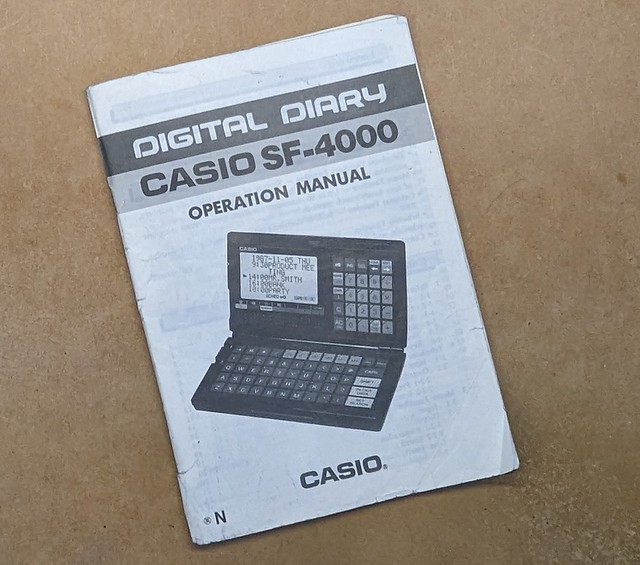
 
 Casio SF-4000 Digital Diary
 
My first “PDA” long before the days of smartphones or, for most people, the internet I’d bought this little clamshell device which could store a telephone numbers, appointments, memos, etc. and was a pocket calculator as well. I was even more surprised to find in the bottom of the filing box:
 
 Casio SF-4000 Digital Diary
 
A Casio SF-4000 Digital Diary. It looks well used because it was. I carried this daily and used it at work and you can see the outline of a label that had my name on it just in case I left it somewhere. This little device acted as a "gateway drug” and eventually I moved on to Palm Pilot devices and other things which came after them. I’ve not bought a paper diary in three decades.The “toys” got more expensive though, the receipt for the SF-4000 is still tucked in between the pages of the booklet and shows that on 1st April 1989 I paid W H Smith £3.99 (about £10.00 in 2023 money) and got a whole year’s guarantee - but not covering the supplied batteries. The SF-4000 had only been introduced 12 months previously so was still relatively new technology at the time.
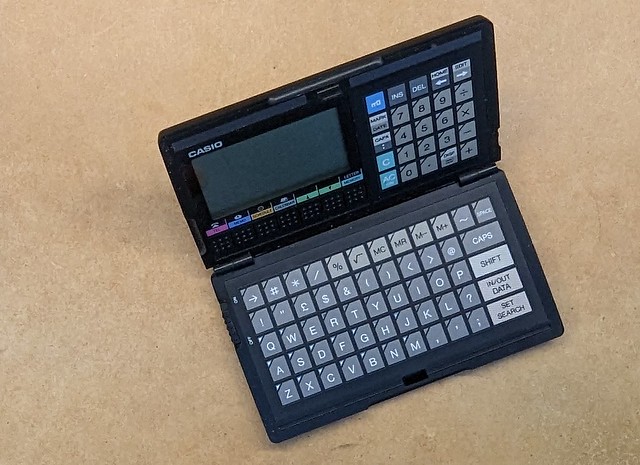
 
 Casio SF-4000 Digital Diary
 
How much technology did £3.99 get me? Well the web site Old Organizers Collection gives these specs:
 
Released in 1988 Made in Japan Memory 31902 bytes
Display Graphic LCD, 95 x 47 dots, 6 lines x 16 chars Keyboard 81 flat keys + 5 function keys
Batteries 3 x CR-2025 PC-Sync No
Size/weight 12.6 (W) x 7.4 (D) x 1.4 (H) cm / 125 g
Functions Phone book, Memo, Schedule, Calendar, Letter memory (to store words and phrases), Data item marker
Comment Casio made the same model for Tandy, the EC-319.
 
As you can see above that keyboard was QWERTY but in a way all its own, particularly the placement of the space button at top right. You really needed the operating manual too, inputting data into the device required some not-altogether-obvious key sequences and navigating is an art. There are dedicated buttons below the screen for the main what we would now call apps - Telephone Directory, Memo, Schedule, Calendar, and a word Memory plus Up and Down navigation keys. Left and right are on row 2 of the keyboard. On the left side of the lower case is the sliding power switch and on the right side of the upper case is a contrast adjustment wheel for the display. Ports and interfaces: Nope, 1989 remember? Although a photo on the above Old Organizers Collection website does show a serial data port on the main circuit board inside.
 
So the big question is after over thirty years stored in a box...
 

Will It Start?

 
It would be rude not to put three fresh CR2025 cells into it and find out, wouldn’t it? 
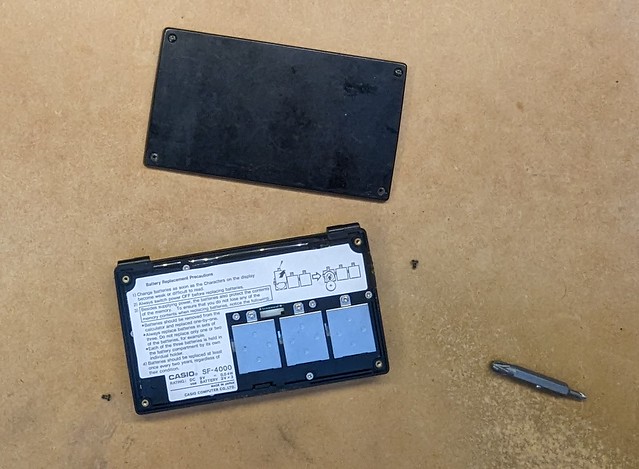
 
 Casio SF-4000 Digital Diary
 
 It’s very much not obvious without reading the manual how to get at the batteries. First you need to remove the bottom cover secured by 4 tiny crosshead screws. This reveals 3 metal covers secured with slightly different tiny crosshead screws and the instructions for changing the batteries. All the screws have threaded brass inserts to screw into - none of your cheap shite self-tappers into the plastic case here as would be found nowadays. Since as well as powering the device the three cells also protect the massive 32 kilobytes of memory it is important to replace the cells one at a time to avoid losing or corrupting the data on the device. Don’t let the batteries go flat either. A bit late by a couple of decades here, the batteries that were left in it were flatter than a witches tit but at least no damage had occurred internally, gotta love Lithium button cells that don’t leak everywhere.
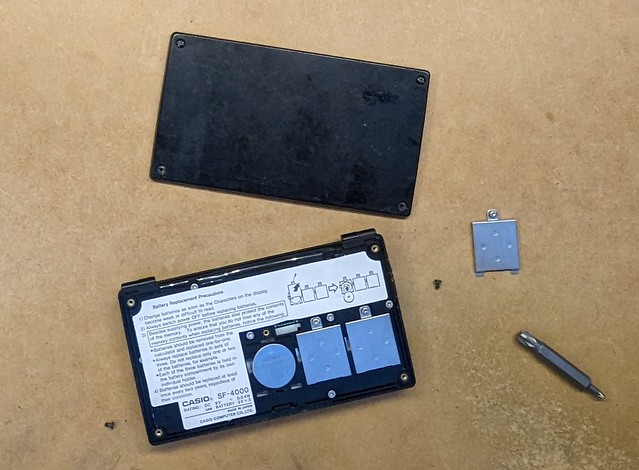
 
 Casio SF-4000 Digital Diary
 
 On the lower left is a recessed button to clear the memory. Remember that for later.
 
Fresh batteries installed, reassembled, and moment of truth time:
 
 Casio SF-4000 Digital Diary
 

It lives!

As you can just about see in the above photo much to my surprise it turned on. All the buttons seem to work too and there are no dead pixels on the screen. However when I switched it on I got this message:
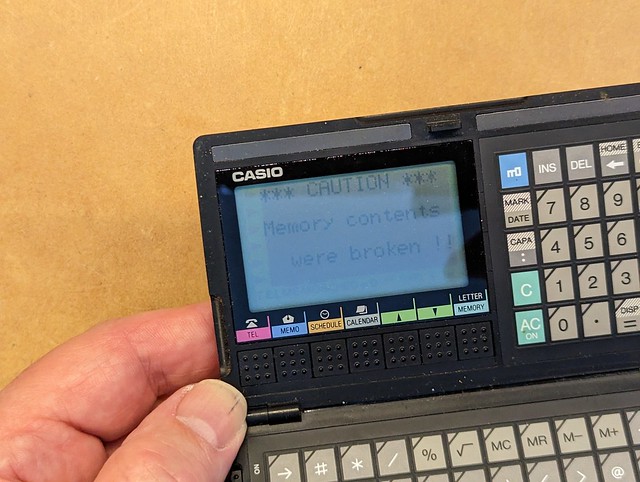
 
 Casio SF-4000 Digital Diary
 
*** CAUTION ***  
Memory contents
   were broken  ! ! 
 
So maybe leaving the batteries to slowly go flat over three decades was a bad idea. Attempting to add an item to the schedule worked right up until I tried to save (or Set in Casio terms) the entry at which point it complained “not enough memory”. I delved into the book to find out how to check the memory capacity and it reported about 64K of the 32K total was used. Something not right there. Back into the book to find out how to clear the memory and out came the screwdriver again.
 
Powering it up and pressing the hidden reset button resolved the errors. I could now with much RTFM make entries in the telephone directory. I could go to the calendar select a date and then put an appointment in the Schedule. The calendar works for any date from 1st January 1901 to 31st December 2099. 20th century years can be entered as two or four digits, 21st century years have to be entered as 4 digits. It would have given no Y2K problems even if it hadn’t been in the bottom of a box when all that was a thing.
 
So it works. I have no real use for it but it works. It’s interesting to see how far we’ve come with such devices since 1989. How many of today’s devices will work after 30+ years? Not many, certainly all the PDAs and most of the phones I’ve had since I had this Casio SF-4000 are long gone. 
 
It was and is a cool little tool and obviously very well made but thirty-four years on I think I’ll stick with my smartphone :-)

Thursday, 6 April 2023

465 - Transport for London's most un-London Bus Route.

 5th April 2023

London Buses Route 465 has the distinction of reaching the furthest distance from London, well measured from Trafalgar Square at least, of any London Bus. It runs between Kingston which used to be in Surrey until 1965 and Dorking which is still very definitely in Surrey. The route is jointly contracted out by TfL and Surrey County Council. For no particular reason other than Route 465 has the distinction of reaching the furthest distance from London I went for a ride on it, starting at Dorking Deepdene railway station because that was the easiest end for me to get to. For varying values of 'easiest' due to GWR's inability to run a reliable train service.

So an hour later than planned I was waiting at Dorking Station Stop A watching out for a red bus.

Route 465, ADL Enviro200 MMC SN17 MVP approaching Dorking Railway Station Stop A.

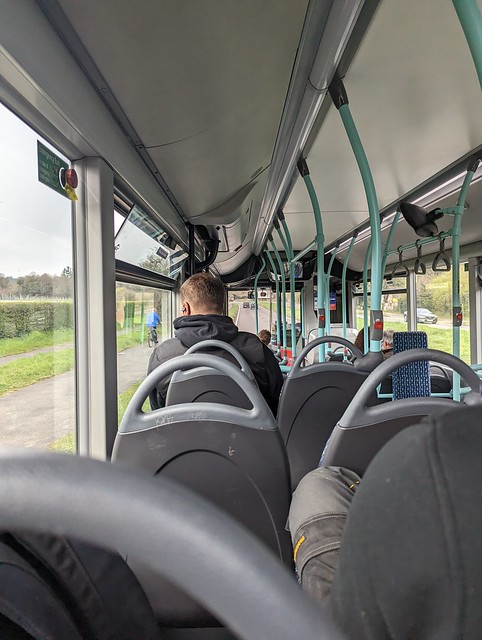
An ADL Enviro200 MMC fn1 reg. no. SN17 MVP duly appeared on time and I climbed aboard and waved my Oyster Card, found a seat at the back, and settled down for the 1h 13m journey to Kingston. I don’t think this was the most comfortable bus for a longish journey, the seats are small and there is hardly any leg room - I had to sit at an angle. It was busier than I’d expected though on a midweek afternoon, there being half-a-dozen on board when I joined.

 Route 465, who needs knee-room?

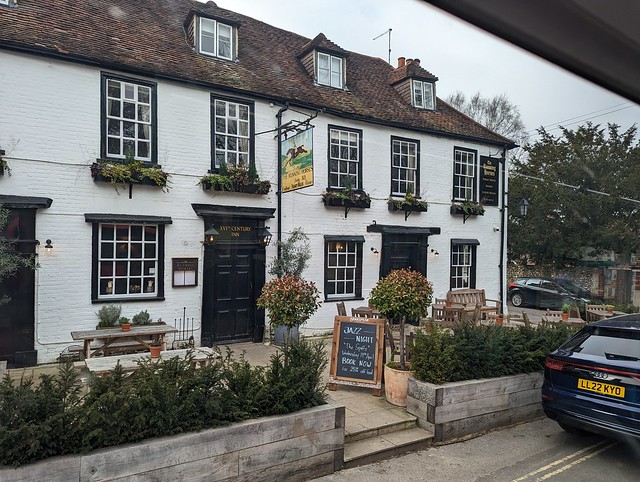
 The bloke in front of me was already settled into alternately sodcasting Tik-Tok or Instagram videos and having a text based argument via Google Translate, occasionally breaking off to talk to his companion on the other side of the bus. Heading out through Westhumble towards Mickleham the bus was held up by the inevitable Surrey Mamils heading up to the Zig Zag Road for the ascent of Box Hill and in Mickleham itself we halted outside the delightfully villagey Running Horses pub to allow the Dorking-bound 465 to pass by in the narrow street.

 Route 465, The Running Horses, Mickleham.

 So far, so slow but the other side of Mickleham the bus gets a faster run on some open roads, the A24 and A246 before turning north east to Leatherhead on the B2122.

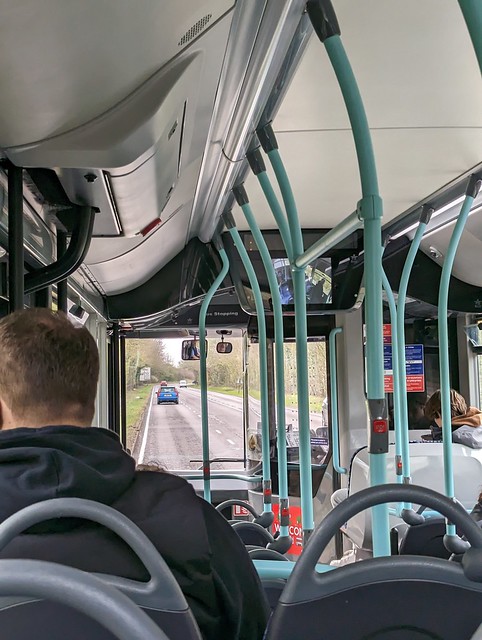
 Route 465, on the A246 Young Street towards Leatherhead.

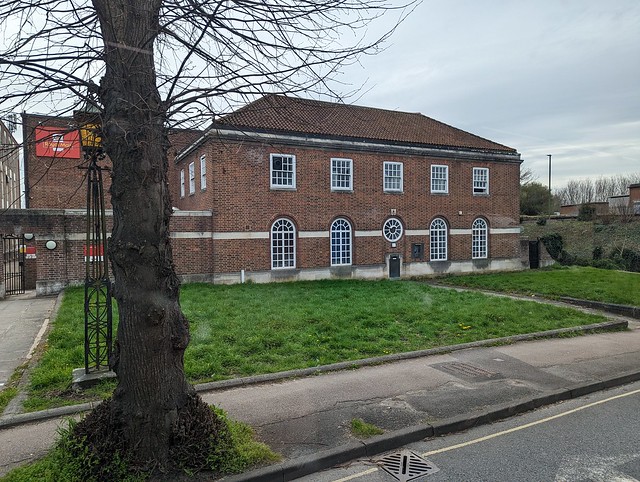
 Threading our way through Leatherhead town centre I suddenly recognised the Telephone Exchange which I’d visited long ago in a former existence and next to it the Royal Mail Delivery Office, the windows of which will remind British persons of a certain age of a children’s television programme fn2

 Route 465, Leatherhead Royal Mail, Play School windows, IYKYK.

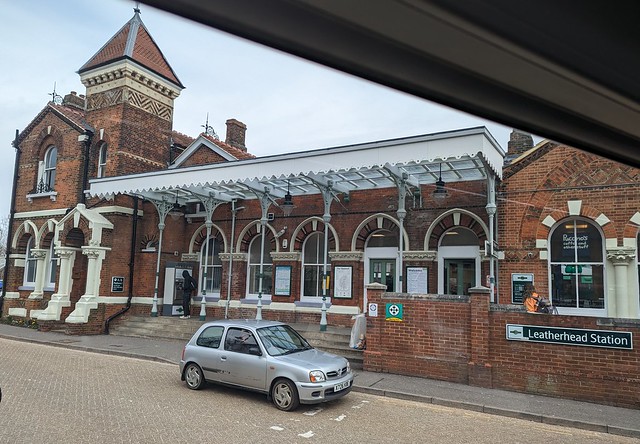
We followed a local bus into Leatherhead Railway Station forecourt which proved to be too small for all of us, the local bus, a rail replacement double-decker, and assorted cars resulting in a short wait while the gridlock was resolved and we could get on our way.

 Route 465, in a queue at Leatherhead Railway Station.

 North of Leatherhead we crossed over the M25 so were definitely getting more Londonish and I didn’t realize we were about to do that so completely failed to get a photo. Not long after that we passed The Star pub at Malden Rushett which I recognised from reading Diamond Geezer’s blog that morning. I was unable to get a photo of that either but DG did, being not on a bus at the time, so you can look at it there. We were now officially in that London, albeit a dangly outlying bit of it.

The next notable destination is Chessington World Of Adventures. I think I recall going there many moons ago with ex-no.1, her younger son, and her nephew. I can also remember when it was Chesington Zoo. The bus pulled into the little bus station but there wasn’t anyone on board up for that sort of adventure and no one waiting to get aboard.

 Route 465, clearly true at Chessington World of Adventures.

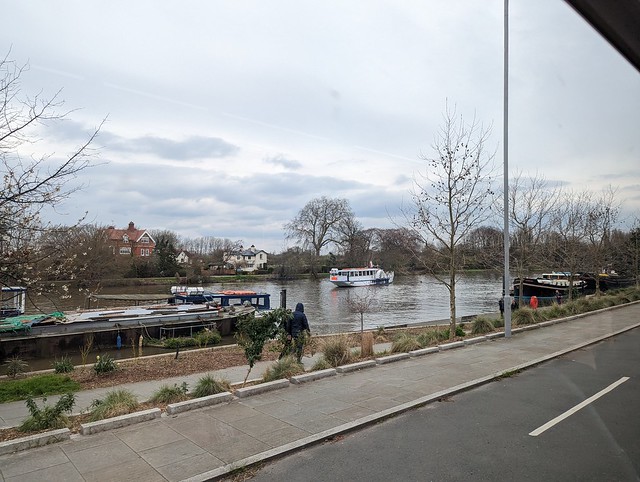
 From here north it got progressively more suburban, crossing the A3 near Tolworth and through Surbiton where the bus filled up quite a bit, unfortunately preventing me getting a shot of the marvellous 1937 Art Deco railway station building. About five minutes later we turned right out of Surbiton Road and followed the River Thames into Kingston town centre.

 Route 465, meets the Thames at Kingston.

 Kingston, or Kingston upon Thames (or before 1965 Kingston-upon-Thames) was until 2021 the location of Surrey County Council even though it was no longer in Surrey. The council then upped sticks and moved to Reigate having rejected (some might say wisely) moving to Woking. It’s a major shopping destination now of which I have a vague recollection of being dragged around by a couple of Slovaks fn3 one day but apart from that had only wandered around the town centre early one evening when the shopping crowds had dispersed. The 465 wriggles through the busy town centre, dropping most of its passengers off at Eden Street for the shopping centres before terminating at the Bus Station in Cromwell Road where I alighted and was glad to see that unlike so much of England the toilets hadn’t been closed.

 Route 465, end of the line, Cromwell Road Bus Station, Kingston.

 I went. And then I went for a walk around Kingston in search of coffee, decided it was still too early to eat, and then returned to the bus station to get the 1721 departure on the 465 back to Dorking. For some reason the TfL Go app completely ignored the existence of this bus insisting that the next departure wasn’t until 1751, even while I was sitting next to it for ten minutes in the bus station. Google Maps knew better. Google 1 TfL 0. Not for the first time.

The return journey was busier than the outward one but much more comfortable. I had intended grabbing one of the “priority” seats so I could have enough legroom to avoid cramp but as it turned out ADL Enviro200 MMC LJ16 EXW fn4 had enough space between all the seats so I could ride in comfort guilt-free. Albeit older this bus looked to have been refurbished with different moquette on the seats and onboard displays. Maybe they changed the seating plan. Ask someone who knows about buses, I’ve no idea.

My train home from Dorking ran on time for a change.


fn1. No I’m not, I looked it up online :-P.

fn2 Play School, if you know, you know.

fn3 Not entirely unwillingly I’ll admit.

fn4 I looked that one up as well.

Monday, 13 March 2023

Wells Cathedral & The Bishop's Palace

March 6th 2023
 
 
Somewhere in a box I have a print of a photo of Wells Cathedral taken on a Kodak Instamatic camera. I reckon it was taken some time in the late 1980s or early 1990s on a fleeting visit to the city and until now I’d not been back to England’s smallest city. So as spring approached I planned a slightly longer visit which inevitably triggered a weather warning for rain and snow because England.
 
The Cathedral
 
Wells Cathedral West front looks now much as I remember from the last time.
 
 Wells Cathedral.
 
You don’t get to enter through that door though but through a separate entrance to the right via the gift shop (of course) and reception where you can be relieved of your donation on entry (strongly suggested to be £8). You can then wander about the interior and with a few restrictions take photos. Or if you time it right take a free guided tour which lasts about an hour. Which is what I did as I’d arrived at 1055 and the tour started on the hour. I’d recommend taking the guided tour, you’ll learn a lot more.
 
The cathedral was built from around 1175 to replace an earlier church on the site since 705. They built from East to West in a wholly Gothic style and you can see (when it’s pointed out to you) how the quality of the decorative carving improves as the masons gained experience. As the cathedral was put into use before the building was complete the Saxon font from the previous church which lay slightly to the north was moved to a temporary location in the new cathedral. It’s still in it’s temporary location some 800 or more years later.
 
 Wells Cathedral.
 
 There are many notable features of the cathedral so to pick a couple of biggies:
 
The Jesse Window at is one of the best examples of 14th century stained glass in Europe. It dates from about 1340 and, considering its age, is still remarkably intact, having narrowly escaped being destroyed during the Civil Wars and so today is basically how medieval glaziers designed and created it and how it looked when it was made. It is particularly large and the colours are still vivid.
 
 Wells Cathedral.
 
The cathedral clock also dates originally to the 14th century although the mechanism has been replaced in the 17th century. There is a dial on the outside wall which was behind scaffolding on my visit. The more interesting face of the clock is inside in the North transept though. The dial represents the geocentric view of the universe, with Sun and Moon revolving round a central fixed Earth. Wikipedia describes it thus: The dial proposes a model of the universe. Against a background of stars, the Sun (the large gilded star on the outer ring) moves in a circle, and indicates the time using the 24-hour analogue dial, which is marked in Roman numerals from I to XII, then from I to XII again. Noon is at the top of the dial reflecting the position of the Sun in the sky at this time.

In the corners, four angels hold the four cardinal winds. These may be generating the power that makes the universe operate.

The minutes are indicated by a smaller star on the ring inside.

The inner circle shows the moon. A pointer indicates the age of the moon, between 1 and 30 days. The black and white disk above the centre shows the moon's phase. The white disk rotates once in a synodic month. The inscription around the moon phase indicator says sphericus archetypum globus hic monstrat microcosmum, which translates as This spherical globe here shows the archetypal microcosm. Howgrave-Graham suggests that the scribe erroneously put microcosmum, when macrocosmum is the more obvious word. Opposite the Moon circle is a weighted pivoted disc, containing a small painting of Phoebe, representing the Moon.[2] The inscription reads: Sic peragrat Phobe, or So progresses Phoebe.

At the centre of the dial, the ball represents the Earth, and the clouds suggest the same.

Above the clock and to the right is a figure, known as Jack Blandifers, or Blandiver, who hits a bell with a hammer held in his right hand and two bells hung beneath him with his heels. A set of jousting knights also chase each other every 15 minutes.
 
 Wells Cathedral.
 
And the same poor bugger gets knocked off his horse each time :-)


The Bishop’s Palace
 
 Having ‘done’ the cathedral I went for one of Costa’s finest flat whites and watched Wells’ finest dog-on-a-string-and-can-of-stella club in the market place and mooched over to the Bishop’s Palace where in exchange for sixteen of your finest UK pounds I got to explore a virtually deserted tourist attraction. I’d be surprised if there were more than half a dozen visitors in there. I’ll bet it’s not like that in the summer.
 
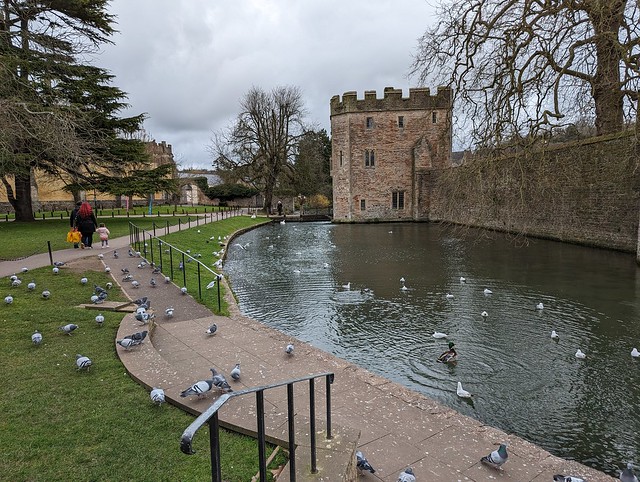
Located next to the cathedral the medieval palace and grounds date from the early-thirteenth century when Bishop Jocelin received a crown licence to build a residence and deer park on land to the south of the Cathedral. Entering from the market place via the gateway known as the Bishop's Eye you are confronted with a moat, gatehouse with drawbridge and ramparts topped with crenellations because being a bishop is as much about power, wealth, and authority as more spiritual matters. Also protecting yourself from the plebs.  
 
 The Bishop's Palace, Wells.
 
 800 years of successive and successful bishops have left their mark, adding bits to the palace and knocking other bits down, notably the former Great Hall built in the 1280s of which now only two walls remain, albeit impressive walls.
 
 The Bishop's Palace, Wells.
 
The interior rooms of the palace that are open to the public (the palace is still the bishop’s ‘office’) form a museum detailing the palace’s history. The long gallery has portraits of the majority of the bishops who have held the office.
 
 The Bishop's Palace, Wells.
 
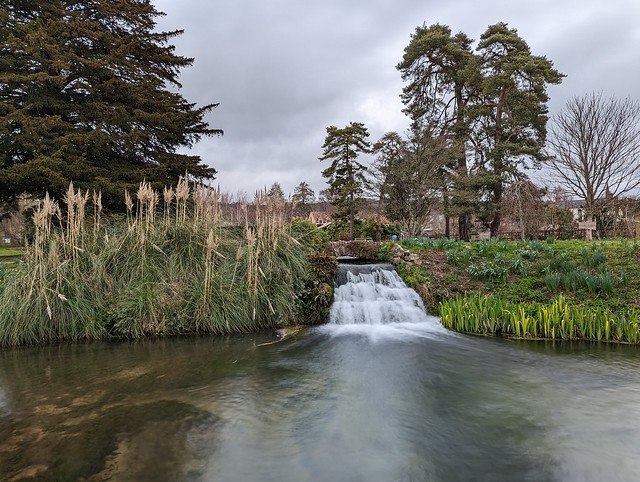
 Outside the palace gardens are a pleasant enough place to walk around and you can get some good views from a section of the ramparts. Allegedly you can see Glastonbury Tor. I couldn’t. The flowing wells or springs from which Wells gets its name are located in the palace grounds and water is channeled through streams and a waterfall into the moat.
 
 The Bishop's Palace, Wells.
 
 
The Bishop’s Palace is definitely worth a visit if you’re in Wells and on a fine day the gardens are probably a nice place to linger. In terms of bang-for-buck though I think the cathedral edges it.
 

Thursday, 23 February 2023

Deep in the Bush

Wednesday 22nd February 2023

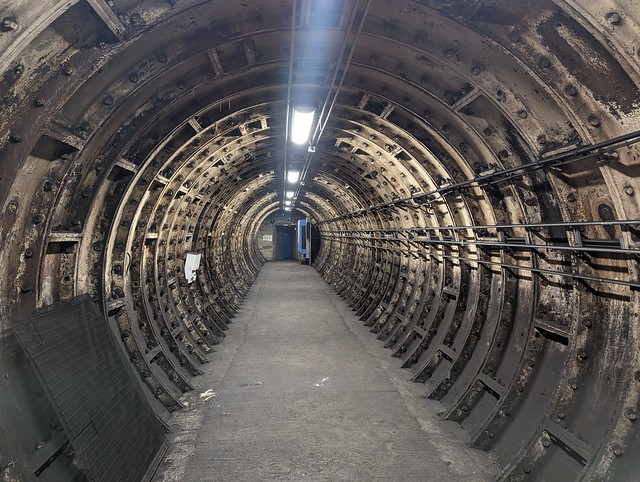
I had a personal tour of Shepherd’s Bush Underground station today.
 
 Shepherd's Bush Underground Station
 
I wasn’t expecting it to be a personal tour but I’d managed to book the 14:35 Hidden London Shepherd’s Bush tour and no one else had. So it was just me, the Hidden London guide, and the safety man that set off down to the platforms and then through locked doors to the parts of the station you don’t get to see as a passenger.
 
These include disused passenger tunnels from the several extensions and reconfigurations of the station, tunnels dug for ventilation, and former lift shafts whose function has been replaced by escalators.
 
 Hidden London, Shepherd's Bush, ventillation tunnel.
 
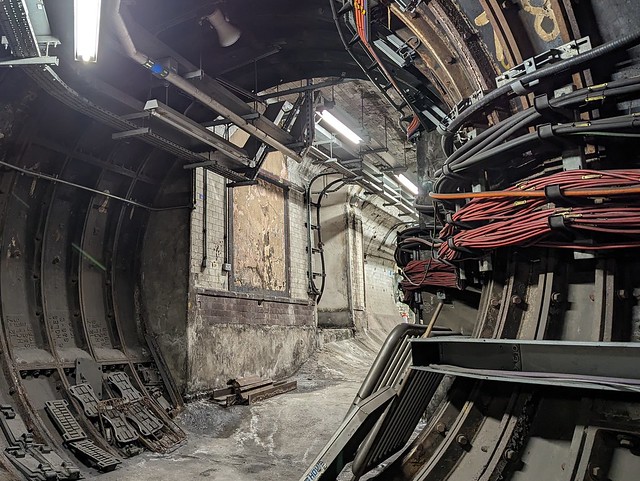
 As with the other Hidden London station tours I’ve been on it’s all atmospheric and grubby but underneath the dirt and later added behind-the-scenes infrastructure there’s a lot of original Central London Railway features.
 
 Hidden London, Shepherd's Bush, disused passenger tunnel and lift exits.
 
 Including these built in tiled poster cases at the end of one of the disused passenger tunnels.
 
 Hidden London, Shepherd's Bush, tiled poster frames in a former passenger tunnel.
 
Not having another 15 guests on the tour meant this time I could get pictures without other people in them for a change. My guide whose name rather embarrassingly has escaped my mind was keen and knowledgeable so I got the full show and as there was only two of us we were able to go into spaces where a full tour group would be unmanageable.
 
One of the other fun things about these tours is that you get to look out on the platforms from hidden spaces, to the amusement of the two young ladies who looked across the track to see two people waving and grinning from behind a ventilation grille.
 
 Hidden London, Shepherd's Bush, "Hello on the platform!", view through a ventillation grille.
 
 More photos in this Flickr Album
 
I can recommend this Hidden London tour, although I can’t guarantee that you’ll get the personalised version :-)


Thursday, 9 February 2023

Gone to the Tower

27th January 2023

To the best of my knowledge I had never in almost six decades stepped inside the Tower of London. A Christmas present of a year’s Historic Royal Palaces membership gave the opportunity to rectify that omission. It was much as I expected and yet in some ways not. For a start in January it was less crowded than I had feared. 
 
 Tower Of London, White Tower
 
Even so I’d had to book a timed ticket for entry, a lingering after effect of the COVID pandemic that’s now common to many public attractions. Arriving at my allowed time I joined the next guided tour of the grounds led by a Yeoman Warder. These are worth taking for a general scene-setting laced with some mild squaddie humour - the 33 YWs being  all long serving military personnel - and you get a slick, well practiced performance covering the history of the castle, majoring on the infamous and bloody bits.Those bits include  the well known beheaded queens, missing presumed murdered princes etc. but there’s a lot of other stuff covered as well including about the Yeoman Warders themselves.
 
After being dismissed on Tower Green by the former site of the scaffold you can explore on your own.
 
 Tower Of London, Tower Green.
 
 I went for an amble around the smaller towers and inner ward then past the armed guards into Waterloo Block to see the Crown Jewels which you’re not allowed to photograph. Several items were off site being prepared for this summer’s coronation of King Charles III. Where he will be crowned, not effing “coronated” as I heard said more than once in there.
 
Having been funnelled out through the “Jewels Gift Shop” at the East end of Waterloo Block I eschewed the Fusiliers Museum - regimental museums tend to be much alike - and headed instead for the cafe in the former Royal Armouries where I can tell you they do a decent cuppa and you get 10% off as a member. I can come back again for the Fusiliers.
 
 Tower Of London, Armouries, Hospital, & Fusiliers Museum blocks, Inner Ward
 
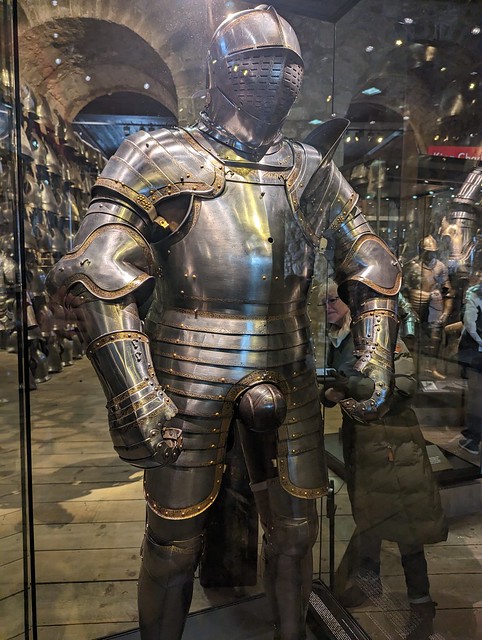
 After that it was time to follow the group of French students up the wooden stairs into the White Tower, the central keep that is the feature of many a classic view the Tower of London. This is several floors mostly stuffed with arms and armour including that of the ever present Henry VIII and his massive codpiece.
 
 Tower Of London, Armouries Exhibition, Henry VIII
 
 There’s a lot to see inside the White Tower, it’s really a museum within a museum, the Royal Armouries Collection is huge and due to the one way system employed to keep the tourists flowing I’m convinced there was a bit that I missed. Still, membership, I can go again. The Yeoman Warder on the earlier tour had warned that there was something truly horrific located in the basement, yet another gift shop to negotiate in order to reach the exit. There’s also an exhibition about the other methods of torture formerly employed at the tower but that’s located in the Lower Wakefield Tower across the inner ward.
 
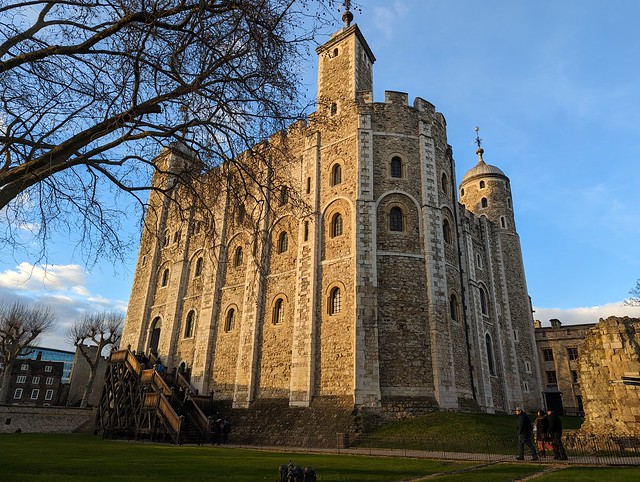
 Tower Of London, sunset at the White Tower.
 
Having explored most of the rest of the Tower’s nooks and crannies, or at least those open to the public, the day was drawing on and I was rewarded with a shot of the early evening sunset illuminating the White Tower before I handed for the exit. The Tower of London is one of the city’s biggest tourist attractions and worth a visit, probably needs ore than one. I’d avoid the main summer tourist season though, it’s probably absolute torture.
 
Visit the Tower of London  Official Web Site
 
 
Oh, and I can confirm that the ravens are still there. Most of them currently confined to an aviary to protect them from Avian Flu but one has escaped and is flying about scaring the shit out of tourists from the far east who are unwise enough to attempt to get a selfie with him.
 
 Tower Of London, Ravens Enclosure.
 
 Which means that there must be a different reason that the Kingdom appears to be headed down the crapper.


Sunday, 29 January 2023

Canary Wharf Winter Lights 2023

20th January 2023

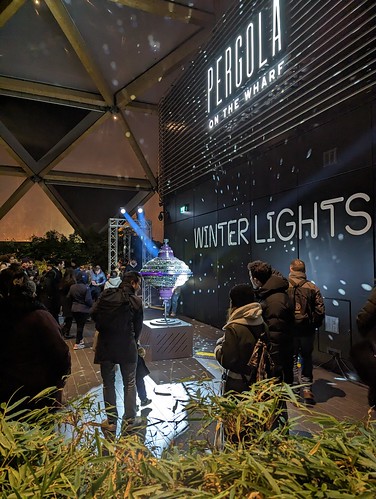
After a two year hiatus caused by that thing  it was good to return to Canary Wharf for the annual Winter Lights Festival, a display of Illuminated artworks situated around the business district on London’s Isle of Dogs. Some of these were quite impressive and some were a bit meh to be honest but it made for an interesting - and free - evening out.
 
 Canary Wharf Winter Lights Festival 2023, In(visible) by Daneil Popescu
 
Some, such as In(visible) by Daneil Popescu you actually get to walk inside although I baulked at the opportunity to queue up for ages in the cold night air to wander through the dangling fibre optics of Anima.
 
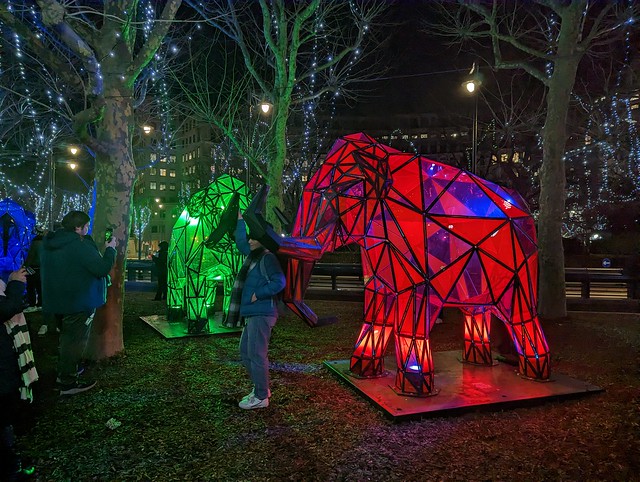
Down at Westferry Circus there were super-Instagramable elephants although I don’t think the guy with the massive LED floodlight on top of his camera had the right idea for photographing illuminated art.
 
 Canary Wharf Winter Lights Festival 2023, Permafrost - Sleeping Giants by Fisheye.
 
 There were some really good London skyline views if you turned your back on the elephants though.
 
 Canary Wharf Winter Lights Festival 2023, night view from Westferry Circus.
 
This year as part of the festival Canary Wharf Middle Dock got a visit from Luke Jerram’s Floating Earth  where it prompts the difficult discussions we all need to have about climate change and what we, as individuals and wider society, can do to make our lifestyles more sustainable. From London it will be going to Brescia in Italy. I hope that it will be travelling sustainably.
 
 Canary Wharf Winter Lights Festival 2023, Floating Earth by Luke Jerram.
 
 I made a short video showing some more of the exhibits


 And there are some more photos on Flickr here.
 
 Canary Wharf Winter Lights 2023
 
 I look forward to doing it again next year.