Sunday, 24 March 2019

Stonehenge Experience

24th March 2019

Last time I went to Stonehenge you could still walk right up to the stones, so it must have been in the 1970s. I vaguely remember the old visitor centre and car park. Of course back then the A344 still passed to the north of the monument, since then it has been closed and partly obliterated, the remaining part being used for shuttle buses to ferry the less able bodied or the lazy from the new visitor centre to the stones.

The new visitor centre contains an exhibition about the site, a ticket office, toilets, and of course a gift shop and cafeteria.

Entry is by timed ticket. I got in for "free" as an English Heritage member as do National Trust members but you do need to download a timed ticket and present this at the ticket office where an entry ticket will be issued. I was a bit early but was told not to take any notice of the time on the ticket and just go in anyway via the exhibition where my ticket was examined and ticked with a marker pen. The exhibition would be worth spending some time studying if you weren't at all familiar with Stonehenge. I gave it a brief tour and then headed outside, past the replica neolithic houses, and walked up the former A344 to the monument.

On the way there is a roadside memorial to Major Alexander William Hewetson, of the 66th Battery Royal Field Artillery, who was killed in a flying accident on 17 July 1913. In the early 20th century this was a  popular area for flying (and crashing) military aircraft. By the visitor centre is another similar memorial, the Airman's Cross,  erected in memory of two pioneer airmen, Captain Eustace Loraine and Staff Sergeant Richard Wilson, who were killed in a flying accident near Stonehenge in 1912.

On arrival at the end of the access road where the shuttle buses stop my ticket was checked again and I was allowed to join the crowds around the stones. The majority of whom seemed to be busloads of European teenagers, presumably on school trips. Along with them were the obligatory Oriental tourists and the occasional New Age pagan type. What they all had in common was an obsession with taking selfies.

I had downloaded the free app and audio guide before my visit - although I had to dig out an older smartphone as the app refused to play more than 1 second of the audio on my current one - so I put my earphones in which helped cover the noise from the student horde and made my way around the site with the guided commentary. Which was actually quite clear and informative. Worth getting if you're visiting, audio guide gadgets can be rented from the visitor centre if you don't have a suitable smartphone or tablet.


The stones remain an impressive feat of engineering whatever their purpose was.

There are plenty of theories and many of them have evidence to support them. I don't propose to go not them here though.

One thing is certain though, they had bugger all to do with the Druids. Not the original ones anyway. There were one or two modern ones amongst the crowds though.


Concern for the preservation of the underlying archeology and the misbehaviour of some visitors in the 1970s means you can no longer get within touching distance of the stones unfortunately.

The closest point that the fenced path gets is to the back of the monument where many of the stones are missing, affording a better view into the interior.

It's here that the press of selfie takers is thickest. In fact some visitors don't seem to bother looking any further. Stonehenge ✅
Walking back to the visitor centre I went the quiet way, up across the chalk to the Cursus Barrows and then behind the wooded area of the Fargo Plantation.

Up here there were hardly any visitors. It was a pleasant stroll back in the sunshine with the short turf underfoot, a gentle breeze, and the sound of birdsong (and the distant A303) in the ears.

That A303 of course may not be there in future if the plans go ahead to put it in a tunnel, depriving passing travellers of a free view of the stones. It might or might not also end the long traffic jams at busy times although more likely will just move them elsewhere.

So did I enjoy my second visit to Stonehenge? Yes, up to a point. Over the last couple of years I  have driven past it many times on the way to work somewhere or other so it made a change to turn off at the Winterbourne Stoke roundabout instead. Would I have visited if I'd had to stump up the £20 rather than got in "free" as a member?
Probably not if I'm honest. As with many of our heritage sites there's a certain amount of "disneyfication" that puts me off.

Anyway, Flickr Album of photographs of the stones and surroundings here.

Saturday, 23 March 2019

Dismantled railway walk, Finchley Park to Ally Pally

20th March 2019

This walk in North London, known as the Parkland Walk goes from Finsbury Park to Alexandra Palace Park, following (mostly) the route of the former Edgware, Highgate, & London railway from Finsbury Park to Highgate and then part of the branch line from Highgate to Alexandra Palace. The history of the line is complicated and covered in this Wikipedia Article.

The walk is now a linear nature reserve divided into two sections, total distance around three and a quarter miles (5km). This is the hilly part of North London and so the railway is sometimes on an embankment, sometimes in a cutting, and sometimes on a viaduct with some very good views over London.

This Google Map shows the route helpfully indicating where you can take in (or let out) fluids and the options for getting between the two sections. 


 The start, cross this footbridge over the railway from Finsbury Park.


As you leave it says Welcome to Finsbury Park, which is a bit odd.


If you're tall enough you can pause to watch the trains coming and going along the lines leading north from King's Cross and Moorgate.


 The path starts of looking like any other path through the trees but soon you find the first obvious sign that you're on what was the railway track, a bridge over the roadat Upper Tollington Park.


 At Stapleton Hall Road the disused railway passes over the road which passes above the Gospel Oak to Barking Overground line far below.


There is as you'd expect quite in an urban environment quite a lot of street art, or graffiti, or vandalism depending on your point of view.

Very pink though in this case.


 Where Mount View Road crosses the line, sorry, walk some maintenance seems to be ongoing to the structure of the over-bridge so you can't see it for scaffolding.


These arches in the retaining wall as you approach Crouch End Hill have been heavily decorated.

What I wonder is whether they bring ladders or abseil down from the top to reach the middle?

The 3 guys that were there at the time had plenty of paint cans but no obvious ladders.


 The most obvious railway relic on the southern part of the walk is Crouch End Station.

The platforms remain in fairly complete condition.


Only a small part of the station buildings remain, the greater part of it which was located on the road bridge having been demolished.


Beyond Crouch End Station on the right are the remains of a small brick structure, may be a line side hut which has been all but consumed by the growth of a tree.


 At Stanhope Road the railway bridge seems to be only half as wide as it should be.

Not sure if half has been removed or if the bridge that is there is a replacement just for the Parkland Walk.


Nearly at Highgate.

On the right a wildlife trail is being created featuring amongst other habitats a bug hotel, stag beetle loggery and a pond.


 At the very end of the southern section of the Parkland Walk in a rather wet cutting are the twin portals of Highgate East Tunnels.

These lead to the disused Highgate Station - the Great Northern Railway one not the Northern Line tube station nearby.

They are home to roosting bats and are not publicly accessible.


At this point you have to leave the route of the railway and walk up Archway Road past Highgate tube station and turn right onto Muswell Hill Road following the Parkland Walk North signs. There are a choice of three routes to the north section of the walk, probably the nicest being through Highgate Woods. I went that way, not least because by this point I was bursting for a piss and there are public loos in the woods. Also a cafe but it appeared to be in the process of closing for the day.

 You rejoin the Parkland Walk just east of the now demolished Cranley Gardens Station.

It was on the other side of this bridge but nothing remains now, a school having been built on the site.


What very much does still exist and is the best feature of this northern part of the walk is St. James Lane viaduct.


 From the path though it's not immediately obvious that you are on it, at least until you look right and see how far up you are.


This 17 arch viaduct provides good views to the east and south over Haringey. 


There is a clear view of the Olympic park, The Shard and The Gherkin.


And on this particular day a good view of a red helicopter circling over London.
Panorama of London from St. James Lane viaduct

 From the north end you can get see the viaduct arches, mostly housing garages.

You can also be shouted at "No consento! No consento!" by some bloke while taking the photograph and while walking away. Given the huge cloud of marijuana smoke emanating from the same location as the shout I guess he wasn't going to want to discuss the rights and wrongs of taking photos in a public place with a police officer 😜

 The end of the Parkland Walk is via this pedestrian subway into Alexandra Palace Park, past a puddle-splashng toddler, and to the thankfully still open cafe for tea and cake.

From there I walked up to the People's Palace and then down the other side of the hill to Alexandra Palace station to catch a train back into town.

 Alternatively I could have got a W3 bus back to Finsbury Park but I had more places to see. It's not a long walk but it's an easy one and has plenty of interest whether you're looking for wildlife or railway relics, or just a good view over London.

More pictures in this Flickr Album

And more pictures of Alexandra Palace in this Flickr Album

Thursday, 21 March 2019

Riding The Red Train

17th March 2019

At twenty to nine on a bright sunny Sunday morning I found myself outside Northfields Station on the Piccadilly Line in West London to catch a very special train to Upminster.

At Northfields
Today was the second 2019 excursion day for London Transport Museum's 1938 Stock tube train which has been restored to a high standard and for now at least is able to travel over the underground network. At least until the new "on train" signalling system is completed, which means the 1938 stock will no longer be compatible.

So I got a ticket for Journey 1: Northfields to Upminster departing at approximately 10:00 from Northfields and arriving around 90 minutes later at Upminster, travelling most of the way on the District Line tracks.

At Upminster
I can remember these trains in service as they weren't withdrawn from London until 1988. They certainly weren't in such good condition as this one then. 

Inside there are 1970s and 1980s adverts - odd to see adverts for tobacco products and betting - lights with bulbs rather than fluorescent tubes, and wooden slatted floors. The line diagrams above the windows are for the Northern Line, the last to see 1938 stock trains in service. This is slightly confusing when travelling on the District Line as your eyes are naturally drawn to check where you are.

The distinctive sounds of the motors and braking systems brought back memories. After a while I realised what was absent from a normal 21st century tube journey. No continuous audible announcements of destination and next stop, or exhortation to take all your belongings with you and mind the gap between the train and the platform. Although just before Upminster the museum volunteer looking after our car did come around and warn everyone that when getting off there would be a big step up from train to platform - Upminster was not built for diminutive tube trains.

In the afternoon the train made a second journey back to Acton Town via Baker Street and Rayners Lane but I wasn't on that one. I did see it on its way through West Ham though. 

I made this video of quite a lot of the trip - it's not easy to film in a bouncy 80 year old train in a tunnel but it captures the "scenery" and possibly just as important, the soundtrack.


Monday, 4 March 2019

Rain , Wind, and Steam

3rd March 2019

Many heritage railway places are closed at this time of year but a chance mention on Twitter alerted me to a special out-of-season open day at the Buckinghamshire Railway Centre near Aylesbury. For some reason I'd never visited this place despite it being only an hour and a quarter away. I'm quite surprised that we didn't go there with the school railway club, which was even closer. So with nothing else planned why not?

The reason for the special open day was to launch the newly restored Wightwick Hall locomotive back into service. (GWR, 4-6-0, No. 6989 if that sort of thing is important to you.)

They've spent more than forty years rebuilding this machine, which is incredible. That means I was still at school when they started. That's commitment.

At least the sun could have come out for the event. But unlike last weekend February had returned, wet and windy. Ideal for making pictures of trains but only if your name is JMW Turner. For those of us working in bits and bytes rather than oil on canvas it was a bit more challenging trying to keep the water out of the electronics.

The Railway Centre covers quite an area. Based around the disused Quainton Road Station built by the Great Central Railway and the Metropolitan Railway which ceased to see passenger services in 1963. It was also the junction with the excellently named Brill Tramway until 1935. The main entrance is in the building transplanted here from Rewley Road Station where there's a cafe and gift shop as well as the ticket counter. Admission was £14 Adult, £13 senior, and £10 child as this was a special event. It's slightly less on normal days.

Mildly depressing (apart from the weather) was being asked "adult or senior" when I bought my ticket. Cheeky bugger was almost certainly older than me as well 😄.

As were many of the visitors, especially the Men-Who-like-Trains™ although there were quite a few families out too.

No Thomas the Tank Engine, thankfully.

You could spend a few pleasant hours exploring this place which has a large collection of locomotives and rolling stock and several tons of bits and pieces dotted about the site, many with information boards adjacent. There's also two restoration sheds and a museum shed with more formal displays including a good collection of signs.

A return visit will have to be planned.

Today they had two trains running, the star of the show Wightwick Hall pulling a couple of carriages up and down about half a mile of track - it's a shame they didn't have access to the single freight line that still runs through the site - and a small Bagnall 0-4-0 saddle tank locomotive doing similar with an open ended brake van. It wasn't the weather for standing in an open brake van but I did ride on the Wightwick Hall hauled special. Standing room only which limited opportunities for photography.

I did manage to get some photos though which are in this Flickr Album.

And this atmospheric video with the atmosphere mostly moving sideways 😀

Tuesday, 26 February 2019

Chasing The Red Train

24th February 2019

London Transport Museum have a restored 1938 stock tube train. Today it got an outing on the underground running two excursion trips, first from Ealing Broadway via High Street Kensington and a complete circuit of the Circle Line to terminate at Moorgate. The second from Moorgate out to Amersham and then back to Ealing Common via Rayner's lane.


Had I been a bit more organised when tickets went on sale I'd have been able to ride the red train but instead I decided to see if I could intercept it along its route and capture it on film.

So I was at Acton Town rather too early on a Sunday morning to see it come in from Northfields Depot before reversing to pick up the lucky passengers at Ealing.

Failed to catch it at Turnham Green as it somehow managed to slip by me while I was travelling there but caught up with it again at Gloucester Road on its way around the Circle Line.
After an essential Pret stop I met the red train out in the wild west at Amersham and was able to get back to Harrow-on-the-Hill in time to film it there before it went on its way back to Ealing Common.


It really was an unseasonably warm day for February, clear skies and brilliant sunshine which made for excellent photography and filming conditions.

There will be few opportunities for the 1938 Stock (or as LT Museum have taken to calling it The Art Deco Train) to run over this route in future. Once the new signalling system is implemented on the sub-surface lines it won't be possible to take this 80 year-old train on the Circle Line. So when the next opportunity to ride the red train comes along I'm going to try a bit harder to grab a ticket!


Sunday, 17 February 2019

City of London Alleyways & Courtyards

16th February 2019

The City of London sometimes appears to consist mostly of shiny modern office buildings, all stainless steel, glass, ventilation grilles, CCTV cameras and private security guards. In amongst all that though weaves the city's history, old inns, bombed out churches, and little noticed details down narrow passages between and sometimes beneath the shiny new stuff. There are many walking tours to be had on which knowledgeable guides will show you bits of this "hidden London", frequently adding ghosts and ghouls to the mix. Or you could have a wander about on a Saturday afternoon when the city boys and girls are off spending their over-inflated bonuses elsewhere and see what you can find while the City is less busy. I did.

Lombard Court EC3


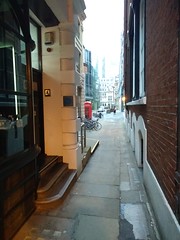
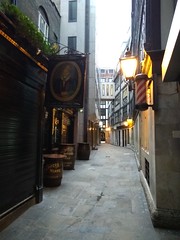
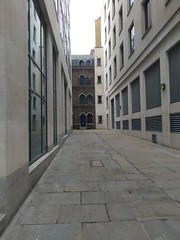
Running between Gracechurch St. and Clements Lane. with a kink in the middle so you can't see from one end to the other.
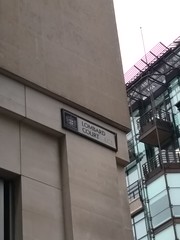
Lombard Court EC3 Lombard Court EC3 Parish Boundary Markers, Lombard Court Lombard Court EC3

On the wall of one of the modern buildings two old parish boundary markers have been remounted, one for St Benet Gracechurch, the other for All Hallows Lombard Street. Further up Lombard Court passes under the buildings for a short way and then becomes a very narrow road open to traffic rather than a footpath. Plough Court, another narrow passageway leads off to the right to Lombard Street.


Bengal Court, Castle Court, & Ball Court


In George Yard next to the back of the historic George and Vulture pub, once a haunt of Charles Dickens and perhaps also the notorious "Hellfire Club" a very small opening, little more than a doorway, leads to Bengal Court. This had several former names, taking its current one in the 19th century from the Bengal Arms Tavern that once stood in it. No more alas, now it's lined with more modern office buildings although on one side these have been given the appearance of old shop fronts. Sort of.

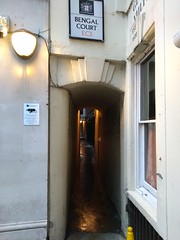
George Yard EC3 Bengal Court EC3 Bengal Court EC3

The other end of Bengal Court comes out into Birchin Lane, passing under the first floor of what is now a sandwich shop. Turning right and past two shops there is the entrance to Castle Court. There's no castle so it might be another one named after a long-gone pub. There is a barber's shop though, which seems to be a feature of many of these alleys, and a number of other small shops which enhance the feeling of "Olde Worlde London".
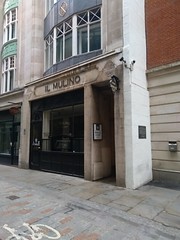
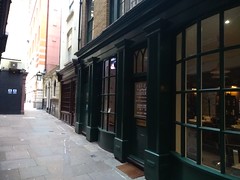
Bengal Court EC3 Castle Court EC3

Turning left into St. Michael's Alley brings you out onto Cornhill alongside the impressively carved doorway to St. Michael's Cornhill church. Burnt down in the great fire of London and apparently not rebuilt by Wren even though he is sometimes given the credit.
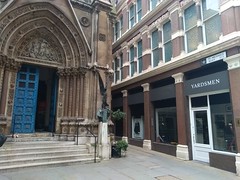
St. Michael's Alley EC3

Turn left along Cornhill for a short distance to find the atmospheric Ball Court on the left. This leads back up to Castle Court by Simpson's Tavern, quiet on a Saturday afternoon on account of it being closed but I suspect quite popular during the week. And probably has been since the early 18th Century.
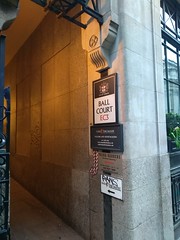
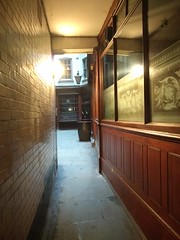
Ball Court EC3 Ball Court EC3 Ball Court EC3

Newman's Court, Sun Court, & White Lion Court


Returning down Ball Court and crossing Cornhill there are three alleyways which are dead ends. The first two, Newman's Court and Sun Court hold little of interest unless you count the yellow sign above Sun Court entrance, being service entrance and cycle parking for the offices above. Though wandering in and out of them taking photos probably gave interest to the people watching the CCTV.
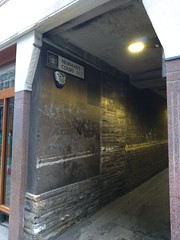
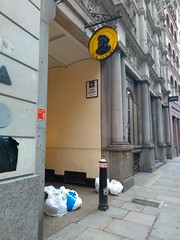
Newman's Court EC3 Sun Court EC3 White Lion Court EC3

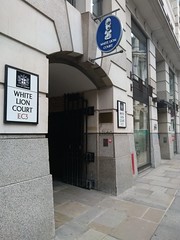
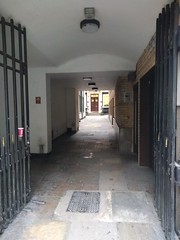
White Lion Court also at first glance appears to be similar to the other two but with a set of large iron gates. They were open, I don't know if they get closed. Maybe they do because there's something special up there. As well as a bicycle rack.
White Lion Court EC3 White Lion Court EC3 White Lion Court EC3

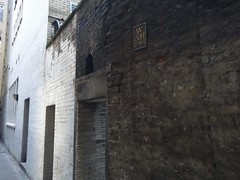
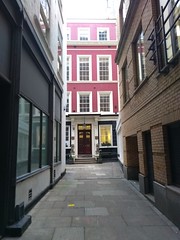
2 White Lion Court is a Grade II listed 18th Century 4 storey house with a basement and a red stucco front and stone lions guarding the front door. Also there's a curious small building to the left I can't find anything about which looks old. Heavy carving over the side door and a plaque, possibly a coat of arms on the other door. It looks like a very fancy garage so I suppose it could have been a coach house. Also two parish boundary markers on the house wall above. Apart from the front door of number 2 none of this is visible from Cornhill if you're just walking by.

St. Peter's Alley


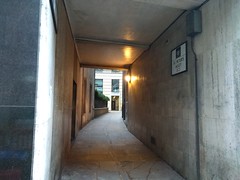
On the opposite side of Cornhill from Sun Court is St.Peter's Alley. This leads around the back of St. Peter upon Cornhill church and out to Gracechurch Street.
St. Peter's Alley EC3 St.Peter's Cornhill churchyard St. Peter's Cornhill

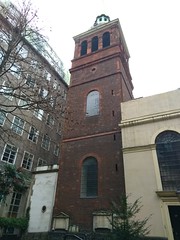
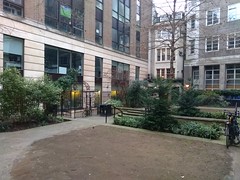
The church stands on the highest point of the City of London although it's not immediately apparent and don't expect far reaching views! It may also be the site of London's first church if it really was set up by King Lucius in AD 179. The present building replaces that lost in the great fire and this one is by Wren. It seems to have escaped the worst attentions of Herman Goering's boys as well. The churchyard has been turned into a garden on the site of the former burial ground. As a tour guide once pointed out to me if you have to climb steps to get into a churchyard in this city it's because you're standing on a pile of corpses. There are steps.

Star Alley


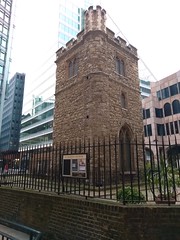
Cross Gracechurch Street, go through Leadenhall Market out to Lime Street then via Cullum Street to Fenchurch Street, cross over and turn left. A little way up is Star Alley. This leads under an office building and out into the open by the Tower of All Hallows Staining which has a very long history. Staining in this case meaning built of stone instead of wood as was more usual when the first one was built.
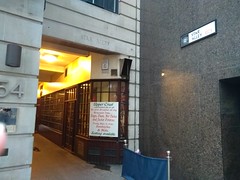
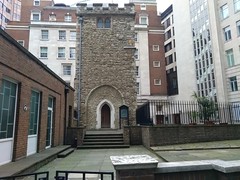
Star Alley EC3 Tower of All Hallows Staining EC3 Tower of All Hallows Staining EC3

Austin Friars Passage


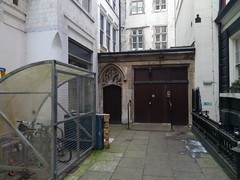
Austin Friars Passage off Great Winchester Street didn't appear to offer much of interest other than an ornate archway and a lot of white glazed bricks but half way down was a bit of older wall with another parish boundary marker. All Hallows London Wall this time.

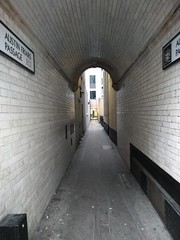
Austin Friars Passage EC2 Austin Friars Passage EC2 Austin Friars Passage


Tokenhouse Yard


A little to the north of Bank station Tokenhouse Yard runs between Lothbury and Telegraph Street. Most of it is a street, which incidentally crosses the course of the Walbrook, but at the north end there's a covered alleyway through to Telegraph Street and Copthall Buildings. The Token House from which it gets its name refers to a place where tradesmen's tokens were issued to be used in lieu of small denomination coins.
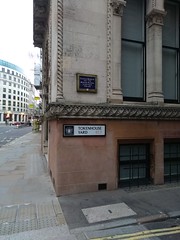
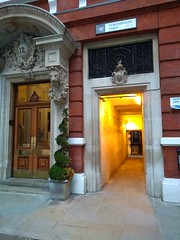
Tokenhouse Yard EC2 Tokenhouse Yard EC2 Copthall Buildings EC2 alleyway

Above the entrance to the alley is a cast iron grille and a carved stone City of London arms. Telegraph Street was formerly part of Great Bell Alley until 1859 and the opening of the General Office of the Electric and International Telegraph Company when it was renamed.

Mason's Avenue


Turning left up Telegraph Street, crossing Moorgate, up Great Bell Alley, and over Coleman Street brings you to Mason's Avenue. Now to me an avenue suggests something wide and tree lined, probably in Metroland but this is definitely an alley. What's more it has both an old pub and a barber's shop to end this little exploration.
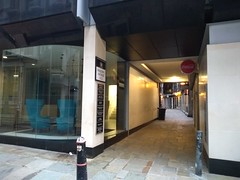
Mason's Avenue EC2 Mason's Avenue EC2

It being Saturday and this being the City The Old Doctor Butler's Head wasn't open, which was a shame as I could have done with a pint about this point. Old Dr. Butler was, not to put too fine a point on it, a quack. But a very successful quack, From the pub's own website:

History of The Old Doctor Butler's Head
One of the City of London’s most historic pubs, The Old Doctor Butler’s Head was originally established in 1610 - with the present building dating back to just after the Great Fire of London in 1666. 

The pub takes its name from one Dr Butler, a 17th century self-proclaimed specialist in nervous disorders. His 'miracle cures' included holding consultation on London Bridge, during which the unfortunate client would be dropped through a trapdoor into the torrent below. 

As a cure for epilepsy, he would fire a brace of pistols near his unsuspecting patient, to scare the condition out of them. In cases of the plague, he’d plunge the poor soul into cold water. 

So highly was he considered, that despite his lack of qualifications he was appointed court physician to King James 1. 

At a similar time, he developed a medicinal ale for gastric ailments, which was available only from taverns which displayed Dr. Butler's head on their signs. This led to him acquiring a number of ale houses in the capital - of which The Old Dr. Butler's Head is the last one standing.

The ale is no longer on the menu…

In this little exploration I've not even begun to cover the multitude of alleyways in the City of London but it was an interesting afternoon's exercise. If you want to know more then I can't do better than to point you towards the website Ian Visits whose section on London's Alleyways was the inspiration for my trip.

For this post I've tried something a little different and embedded the Flickr photos into the blog. Clicking them should take you to the original full size version.