Thursday, 9 February 2023

Gone to the Tower

27th January 2023

To the best of my knowledge I had never in almost six decades stepped inside the Tower of London. A Christmas present of a year’s Historic Royal Palaces membership gave the opportunity to rectify that omission. It was much as I expected and yet in some ways not. For a start in January it was less crowded than I had feared. 
 
 Tower Of London, White Tower
 
Even so I’d had to book a timed ticket for entry, a lingering after effect of the COVID pandemic that’s now common to many public attractions. Arriving at my allowed time I joined the next guided tour of the grounds led by a Yeoman Warder. These are worth taking for a general scene-setting laced with some mild squaddie humour - the 33 YWs being  all long serving military personnel - and you get a slick, well practiced performance covering the history of the castle, majoring on the infamous and bloody bits.Those bits include  the well known beheaded queens, missing presumed murdered princes etc. but there’s a lot of other stuff covered as well including about the Yeoman Warders themselves.
 
After being dismissed on Tower Green by the former site of the scaffold you can explore on your own.
 
 Tower Of London, Tower Green.
 
 I went for an amble around the smaller towers and inner ward then past the armed guards into Waterloo Block to see the Crown Jewels which you’re not allowed to photograph. Several items were off site being prepared for this summer’s coronation of King Charles III. Where he will be crowned, not effing “coronated” as I heard said more than once in there.
 
Having been funnelled out through the “Jewels Gift Shop” at the East end of Waterloo Block I eschewed the Fusiliers Museum - regimental museums tend to be much alike - and headed instead for the cafe in the former Royal Armouries where I can tell you they do a decent cuppa and you get 10% off as a member. I can come back again for the Fusiliers.
 
 Tower Of London, Armouries, Hospital, & Fusiliers Museum blocks, Inner Ward
 
 After that it was time to follow the group of French students up the wooden stairs into the White Tower, the central keep that is the feature of many a classic view the Tower of London. This is several floors mostly stuffed with arms and armour including that of the ever present Henry VIII and his massive codpiece.
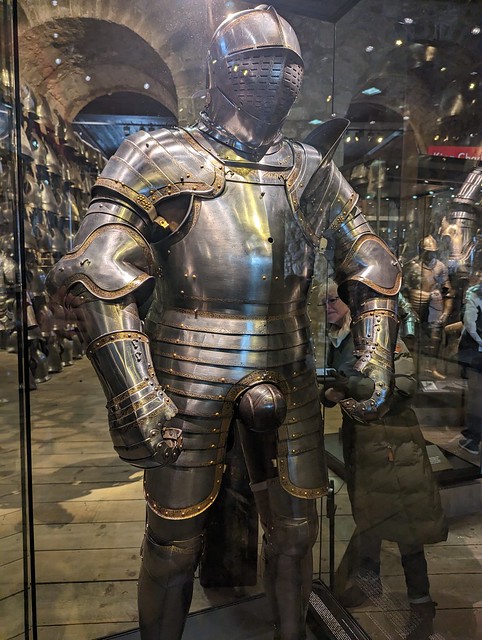
 
 Tower Of London, Armouries Exhibition, Henry VIII
 
 There’s a lot to see inside the White Tower, it’s really a museum within a museum, the Royal Armouries Collection is huge and due to the one way system employed to keep the tourists flowing I’m convinced there was a bit that I missed. Still, membership, I can go again. The Yeoman Warder on the earlier tour had warned that there was something truly horrific located in the basement, yet another gift shop to negotiate in order to reach the exit. There’s also an exhibition about the other methods of torture formerly employed at the tower but that’s located in the Lower Wakefield Tower across the inner ward.
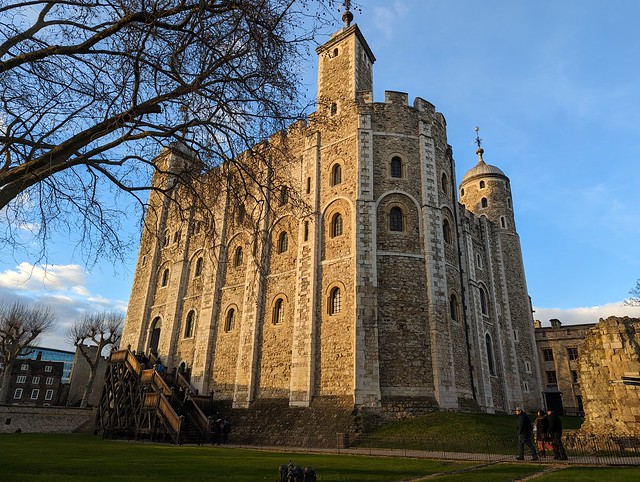
 
 Tower Of London, sunset at the White Tower.
 
Having explored most of the rest of the Tower’s nooks and crannies, or at least those open to the public, the day was drawing on and I was rewarded with a shot of the early evening sunset illuminating the White Tower before I handed for the exit. The Tower of London is one of the city’s biggest tourist attractions and worth a visit, probably needs ore than one. I’d avoid the main summer tourist season though, it’s probably absolute torture.
 
Visit the Tower of London  Official Web Site
 
 
Oh, and I can confirm that the ravens are still there. Most of them currently confined to an aviary to protect them from Avian Flu but one has escaped and is flying about scaring the shit out of tourists from the far east who are unwise enough to attempt to get a selfie with him.
 
 Tower Of London, Ravens Enclosure.
 
 Which means that there must be a different reason that the Kingdom appears to be headed down the crapper.


Sunday, 29 January 2023

Canary Wharf Winter Lights 2023

20th January 2023

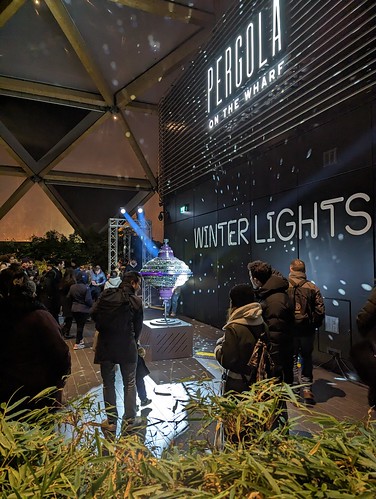
After a two year hiatus caused by that thing  it was good to return to Canary Wharf for the annual Winter Lights Festival, a display of Illuminated artworks situated around the business district on London’s Isle of Dogs. Some of these were quite impressive and some were a bit meh to be honest but it made for an interesting - and free - evening out.
 
 Canary Wharf Winter Lights Festival 2023, In(visible) by Daneil Popescu
 
Some, such as In(visible) by Daneil Popescu you actually get to walk inside although I baulked at the opportunity to queue up for ages in the cold night air to wander through the dangling fibre optics of Anima.
 
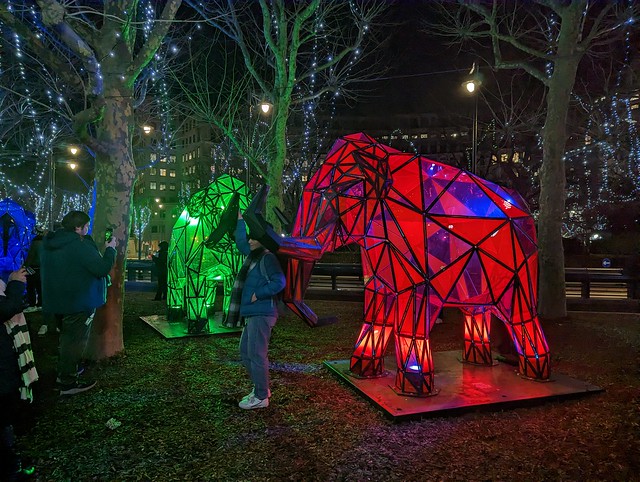
Down at Westferry Circus there were super-Instagramable elephants although I don’t think the guy with the massive LED floodlight on top of his camera had the right idea for photographing illuminated art.
 
 Canary Wharf Winter Lights Festival 2023, Permafrost - Sleeping Giants by Fisheye.
 
 There were some really good London skyline views if you turned your back on the elephants though.
 
 Canary Wharf Winter Lights Festival 2023, night view from Westferry Circus.
 
This year as part of the festival Canary Wharf Middle Dock got a visit from Luke Jerram’s Floating Earth  where it prompts the difficult discussions we all need to have about climate change and what we, as individuals and wider society, can do to make our lifestyles more sustainable. From London it will be going to Brescia in Italy. I hope that it will be travelling sustainably.
 
 Canary Wharf Winter Lights Festival 2023, Floating Earth by Luke Jerram.
 
 I made a short video showing some more of the exhibits


 And there are some more photos on Flickr here.
 
 Canary Wharf Winter Lights 2023
 
 I look forward to doing it again next year.

Monday, 16 January 2023

Hanwell

Hanwell is a town in the London borough of Ealing. It lies on the River Brent which forms its boundary with Southall to the west. The earliest known reference is as Hanwelle in CE 959. Apparently the name Hanwell possibly derives from a stream or spring where there are cocks - the chicken sort that is. There is enough of interest in and around Hanwell for a January afternoon’s walkabout.
 
Hanwell Station
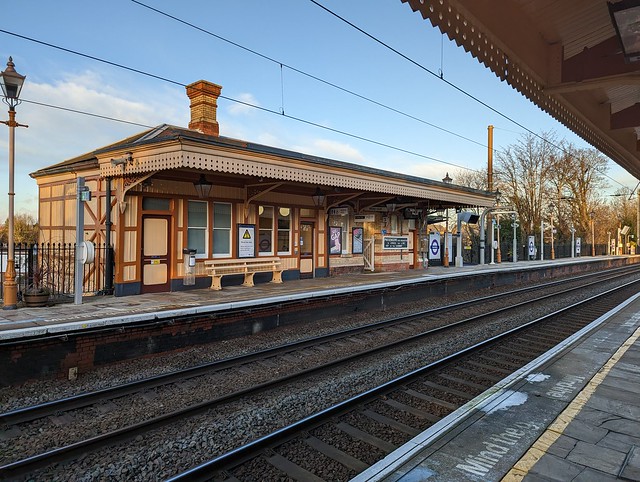
The Great Western Railway came to Hanwell in 1838 and built a station on the north side of the town. Now run by Transport for London as part of the Elizabeth Line trains run between Heathrow Airport and Abbey Wood, meaning that coming in from the west I had to change at Hayes & Harington. The station has been modernised to provide step free access but also much restored into its GWR station colour scheme which looks great.
 
 Hanwell Station, Elizabeth Line.
 
There are even some restored signs on the platform showing ‘Hanwell & Elthorne’, the name by which the station was known between 1896 and 1974.
 
 Hanwell Station, Elizabeth Line.
 
The Wharncliffe Viaduct
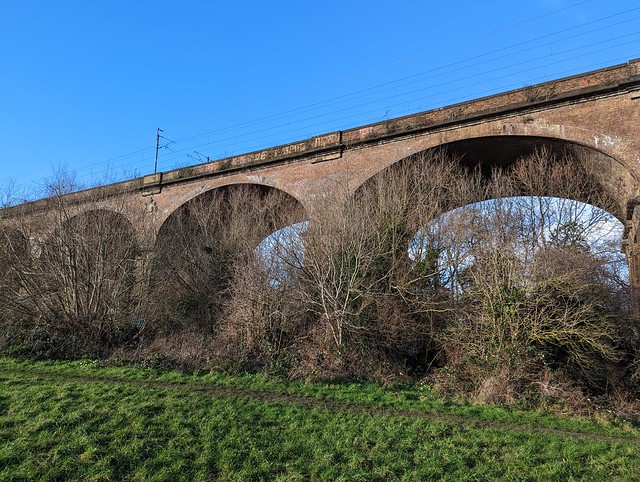
For the GWR to get west from Hanwell to Southhall it needed to cross the valley of the River Brent. To achieve this Isambard Kingdom Brunel designed his first major engineering construction project, the Wharncliff Viaduct. Built in brick with hollow piers it rises 66 feet (20m) above the valley and is 890 ft (270m) long with 8 arches. It was built in 1836-1837 ready for the opening of the GWR main line.
 
 The Wharncliffe Viaduct, Hanwell.
 
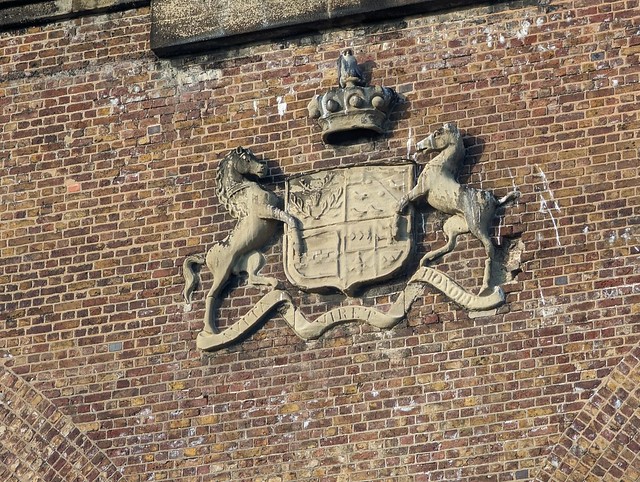
On the central pier on the south side is a carving of the coat of arms of James Stuart Wortley Mackenzie, Lord Wharncliffe, who was chairman of the parliamentary committee that steered the passage of the GWR Bill through Parliament. If you have money and influence you’re allowed to tag railway bridges.
 
 The Wharncliffe Viaduct, Hanwell.
 
Hanwell Flight of Locks
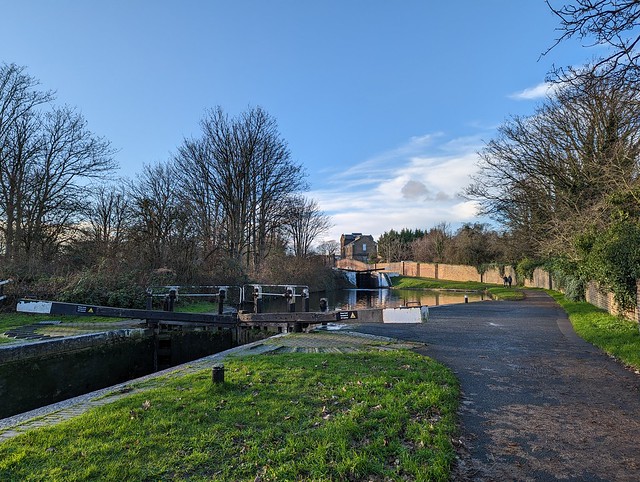
Lying just across the boundary in Southhall but named after Hanwell because it’s much closer are the six locks on the Grand Union Canal. These raise the canal about 53 feet (16m). The flight has a clever system of side ponds to conserve water by holding water let out of a lock to refill the one below. The flight runs alongside the former Middlesex County Lunatic Asylum (now a housing development and a psychiatric hospital) and low down in the high brick boundary wall are four small red doors. These are to enable the fire brigade to run hoses out to take water from the canal in the event of a fire in the asylum.
 
 Hanwell Flight of locks on the Grand Union Canal.
 
The Three Bridges
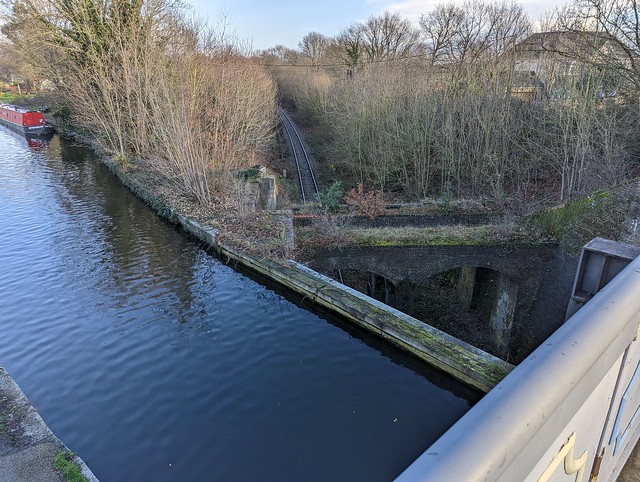
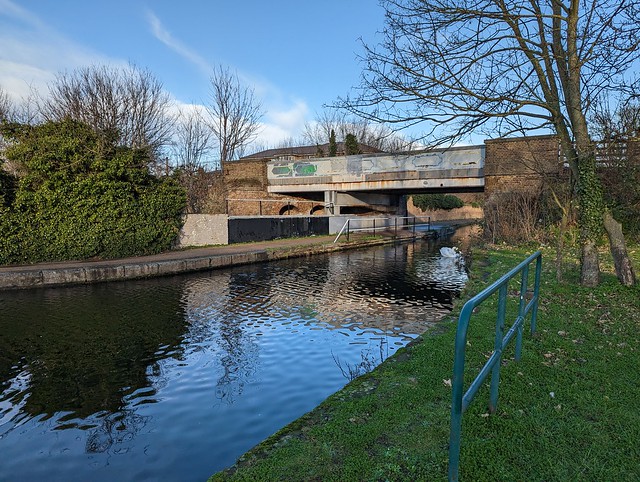
A little further west along the canal from the Hanwell Flight is another local landmark and another I K Brunel creation. The Three Bridges were originally known as Windmill Bridge and enable the crossing over of the canal by Windmill Lane and the crossing under the canal by the Great Western and Brentford railway at the same point.
 
 Three Bridges, Hanwell.
 
Technically there are only two bridges, road over canal and canal over railway which is hidden in a deep cutting. Although as shown in the photo above there is another bridge-like structure across the railway between the bridge abutments. It’s also very hard to get a decent photo of all three unless you’re standing on the railway. The Three Bridges project was Brunel’s last to be completed before his death in September 1859, so Hanwell can claim a “first and last”.
 
 Three Bridges, Hanwell.
 
Hanwell Clock Tower
Returning to the town centre there’s a nice and rather unusual modernist clock tower. This was built in 1937 to commemorate the coronations of King George VI and Queen Elizabeth (later known as the Queen Mother). Since then the design has occasionally sparked controversy, particularly from a local estate agent whose views were seen as arrogant and insulting. An estate agent being a dick, who’d have imagined that.
 
 Hanwell Clock Tower
 
It has survived though through bouts of neglect and threats of demolition and then restoration, the latest in 2002 to mark the late Queen Elizabeth II’s Golden Jubilee. Even the aforementioned estate agent relented in the end and accepted the clock tower as part of Hanwell’s streetscape. It tells the right time too, at least when I was there. 
 
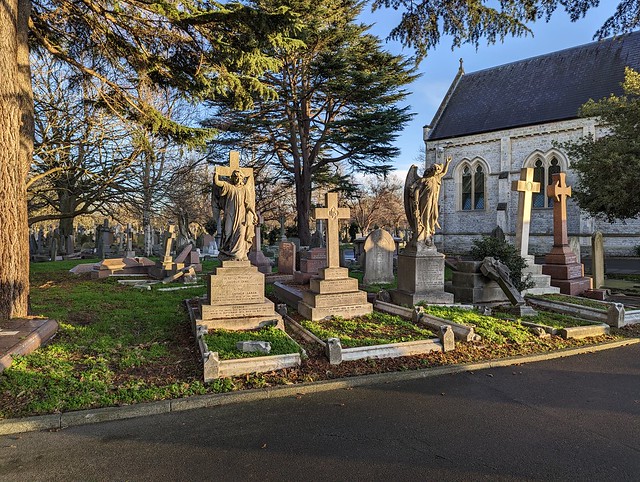
City of Westminster Cemetery, Hanwell.
The dead centre of town is actually to the eastern side of Hanwell town centre. In the 1840s the cemeteries in the middle of London were full to overflowing, some messily so, and alternative sites for interment needed to be found outside the city. In 1853 the St. George's Hanover Square Burial Board purchased 12 acres in Hanwell for a new burial ground. A Victorian Gothic revival style church was built, designed by Robert Jerrard and the first interment took place in 1854. In 1883 another 11 acres of land was added.
 
 City of Westminster - Hanwell Cemetery
 
The cemetery suffered bomb damage during World War 2 and repairs were carried out to the chapel afterwards including a new stained glass window on the south side. There are quite a lot of impressive Victorian and later memorials and mausolea to be seen and a few notable burials to be found if you have more time than I had. There are some public toilets too but these were closed due to “antisocial behaviour”. In 1987, the cemetery was subject to some Tory shithousery when it was one of three that Shirley Porter's Westminster City Council controversially sold to land developers for 15p. However, like East Finchley and Mill Hill, it was reacquired by the new City of Westminster in 1990, and renamed at that point as their Hanwell Cemetery. 
 
 City of Westminster - Hanwell Cemetery
 
North of the Uxbridge Road there is another large cemetery, the Royal Borough of Kensington and Chelsea Cemetery, Hanwell but since they close at 4p.m. in the winter there was no time to visit that one.
 
My afternoon exploring Hanwell done I walked back to the railway station and caught a #PurpleTrain back to the west.
 
All my Hanwell photos are here in this Flickr Album.

Wednesday, 11 January 2023

Along the Ravensbourne to meet a Tzar.
9th January 2023

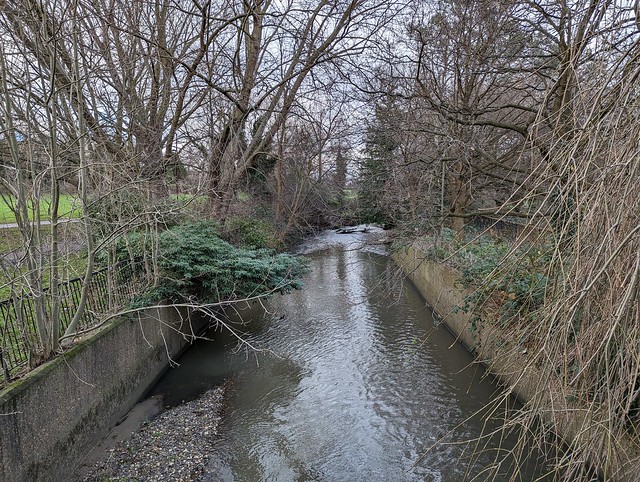
I started my first urban ramble of the new year at Catford Bridge railway station, a three train ride away from home. Leaving the station on the wrong side I crossed the tracks on the Catford Road bridge and turned right into Adenmore Road past the disused station building and left under the railway to my first sight of the River Ravensbourne in its concrete sided channel at the footbridge into Ladywell Fields. 
 
 Along the River Ravensbourne, Ladywell Fields.
 
I followed the path through Ladywell Fields back across the river and back under the railway into the northern part of Ladywell Fields where the Ravensbourne is less constrained in its course and out along Malyons Road, a long straight South London residential street developed in the early 20th century, One right were large two storey terraced houses and on the left similar but with some being maisonettes, the giveaway being the two front doors set back under the arched porches.
 
I had plotted a route on the map before leaving home but at the top of the road realised that I was more or less following the Waterlink Way and since this is well way marked from here on I followed the signposts and pavement roundels. These led me through local streets away from the inaccessible river to meet it again albeit briefly in Cornmill Gardens before it disappeared beneath Lewisham town centre.
 
 Along the River Ravensbourne, Lewisham.
 
Following the WW signs round the end of Lewisham Bus Station and through the tunnel under the railway I next saw the Ravensbourne over a brick wall where it runs parallel to the DLR past Elverson Road station and then into Brookmill Park.
 
 Along the River Ravensbourne, Brookmill Park.
 
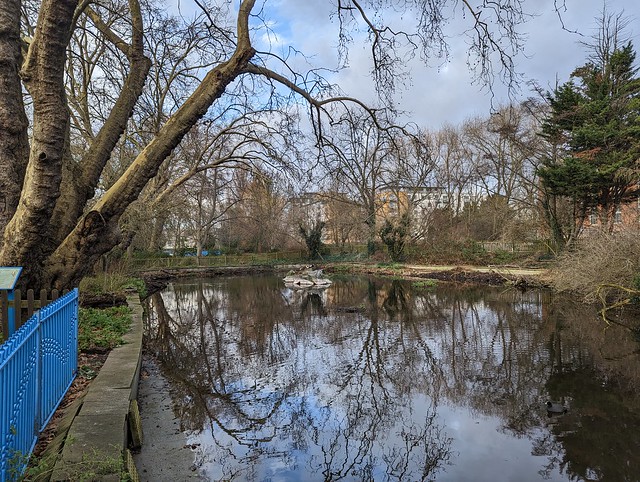
Brookmill Park held the welcome prospect of a Public Convenience but this is Britain in the 21st century so despite being shown on the map at the park entrance these proved to be locked up and to all appearances permanently closed. Still the lake was nice, it’s probably much busier in summer than January, the only person I encountered being the council street-sweeper who was taking pictures of the fallen tree across the path that prevented him getting his machine through.
 
 Along the River Ravensbourne, Brookmill Park.
 
From the top of Brookmill Park the way leads to Broadway Fields, across the Ravensbourne and beneath the elevated DLR into Deptford town centre. At Deptford Bridge you can see the Ravensbourne heading under the DLR but need to walk via local streets for some distance before rejoining it at Deptford Creek, north of Creek Road. We’re close to the confluence with the Thames here but public access to the waterside at Deptford Creek itself is very limited.
 
 Along the River Ravensbourne, Deptford Creek.
 
At the point where the Deptford Creek/River Ravensbourne meets the Thames there has been much new development. Handily this includes a Waitrose so I popped in and got a picnic lunch to eat by the riverside. The great writer and film maker John Rogers whose youtube videos partly inspire my urban walks would point out that the confluence of two rivers is a sacred place. He’d traditionally grab a can of Stella and a vegetable samosa for lunch but I’m not a fan of the former and Waitrose hadn’t any of the latter so I settled for a fancy veggie wrap and a diet coke. Eaten on a bench near the Oystercatcher bar outside which the landlady was walking a cat on a lead.
 
 Along the River Ravensbourne, Deptford Creek.
 
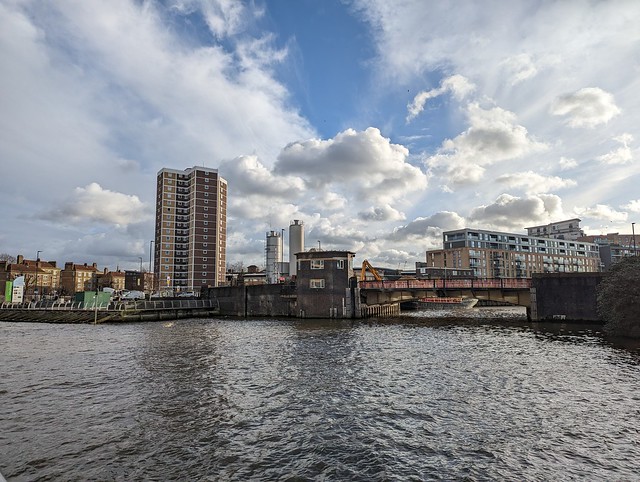
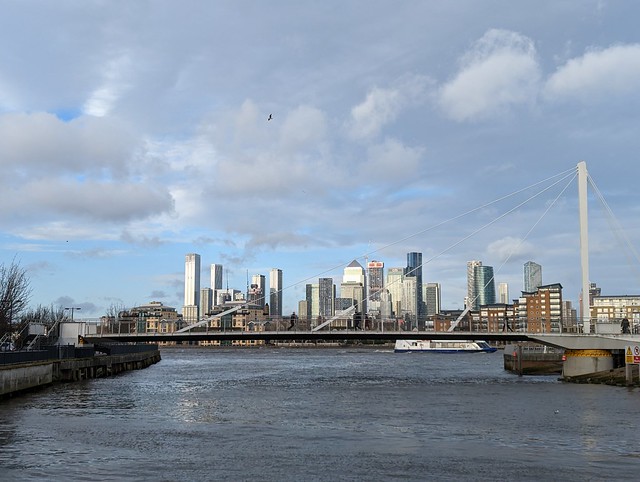
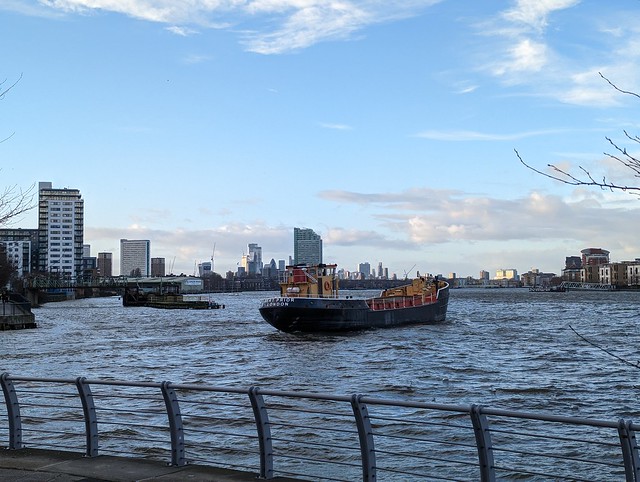
This was followed by a stop for coffee in Costa in no way prompted by the desperate need to use their loo. Refreshed and relieved I resumed my walk west along the Deptford river front but had to wait for the pedestrian swing bridge across the entrance of the creek to be swung back into place. The bridge had been opened to allow the exit into the Thames of the aggregate carrier Bert Prior, built in 1961 in the Netherlands and still plying the North Sea and Thames Estuary 62 years later.
 
 The Bert Prior exiting Deptford Creek.
 
On the west side of Deptford Creek there’s a monument to someone that you might not immediately associate with Deptford. A memorial to the Russian Tsar Peter the Great was erected in London in 2000 to commemorate the tercentenary of his visit to England in 1698. During his stay he met members of William II's court in England, and visited the Royal Observatory at Greenwich, the Royal Mint, the Royal Society, the University of Oxford, and various shipyards and munitions factories, including Deptford. Peter travelled with a huge entourage and for much of his visit resided at John Evelyn’s house Sayes Court near Deptford Dockyard. Evelyn had leased the house to a naval officer John Benbow who sublet it to the Tsar. Unfortunately during the stay Peter and his entourage trashed the place, damaging all parts of the property, the floors, walls, and doors, breaking furniture and windows and destroying soft furnishings, bed linen and the garden. Hundreds of pounds worth of damage was done, the equivalent of tens of thousands today. There must have been an awkward conversation between Benbow and his landlord! Although Evelyn sought and was granted compensation from the government.
 
 Peter The Great memorial at Deptford.
 
(The statue of Peter the Great depicts him with a very small head. Maybe he was the original man in the joke involving a mermaid granting a wish that you’re going to have to search for because I’m not repeating it here ;-)  )
 
Sayes Court House has long gone along with most of its gardens but as I followed the Thames Path west through Sayes Court Park, the remains of the gardens, I passed the ancient Mulberry tree some have said was planted or gifted by Tzar Peter the Great. I’m not sure that idea ties in with his other reported behaviour. The tree is in poor condition but reportedly still bears fruit.
 
 Mulberry Tree, Sayes Court Park, Deptford.
 
 My feet weren’t ready to stop walking so I carried on along the Thames Path to Rotherhithe where as the daylight waned I caught a bus back to Waterloo Station but that’s beyond this tale.

Sunday, 1 January 2023

Deadpool 2023


My traditional annual guess at notable people who won’t make it to 2024.


  • Neil Percival Young (Musician)
  • Gina Lollobrigida (Actress, Photojournalist, & Sculptor)
  • James Earl Carter Jr. (39th POTUS)
  • Michael Caine (Actor)
  • Anthony Dominick Benedetto a.k.a Tony Bennett (Singer)
  • Melvyn Hayes (English actor & voiceover artist)
  • Burt Bacharach is (American composer, songwriter, record producer, and pianist)
  • Sir Thomas Hicks "Tommy Steele" (singer & actor)*
  • June Lockhart (American TV & Movie actress)*
  • Elizabeth Lois Shields, née Teare (UK politician, former MP for Rydale)*

*New entry for 2023

Saturday, 24 December 2022

The Mousetrap

 Tuesday 13th December

 I finally got around to seeing Agatha Christie's The Mousetrap at the St. Martin's Theatre in London's West End. It's only been playing for 70 years so I don't know what took me so long.


Well worth the £30 I paid for my stalls ticket for the 3 p.m. matinee I reckon and despite the previous day's snowfall on London and the national rail strike I had no problem getting there - I did put a shovel and a flask in the car before driving to the tube station mind you, just in case we got some more 😀

I read quite a lot of Christie's books when I was young and the play is a classic of the "country house mystery" genre that she was so good at. I had a rough idea of the plot and of the actually rather dark subject matter, the "why" but not the "who".

So now I know #whodunnit.

Go and see it yourself, my lips are sealed 🤐


Thursday, 1 December 2022

Bye-bye Museum of London

Monday 28th November 2022

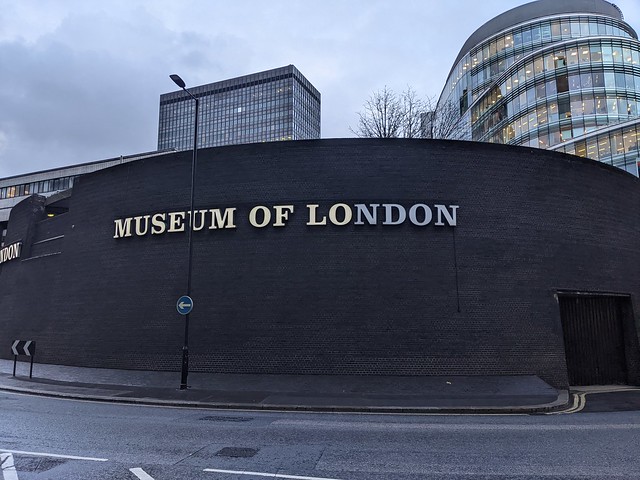
I took a last opportunity to visit the Museum Of London before it closes for ever on December 4th. Some time in 2026 a replacement “London Museum” should open in the former Smithfield Market buildings. Apparently they need to close now to begin moving the exhibits to the as-yet-unbuilt and as-yet-not-got-planning-permission replacement. This seems a bit early to me though it can’t be anything to do with making the existing site available for the planned redevelopment as soon as possible I’m sure.
 
 Museum of London, London Wall.
 
Anyway, time to re-acquaint myself with some of the exhibits in the existing museum which covers the whole time period from before London existed to the late 20th century.
Starting off at the same time as a large group of small, loud, and hi-vis clad school kids for the proper museum experience into the London before London bit, lots of pre-history artefacts, stones, bones and blades - the latter proving the most interesting to the smaller, louder visitors.
 
 Museum of London, London Wall. Swords.
 
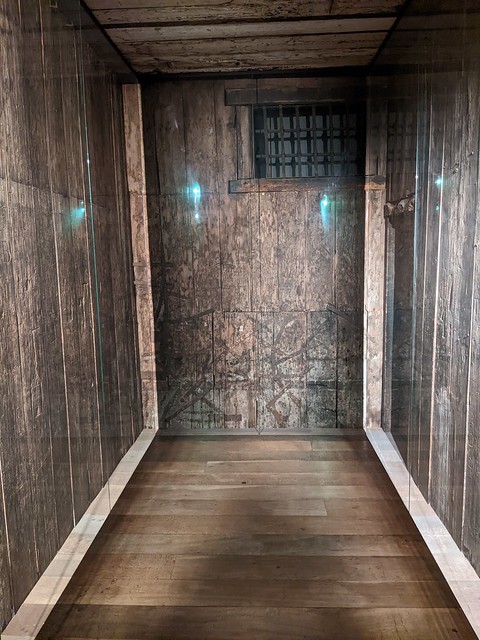
I managed to lose them somewhere in the Roman period and by Early Medieval could browse without fear of obstruction - or treading on one. There’s a lot of Roman London with reconstructed Roman “shops”. Also some high quality sculptures from the London Mithraeum, which is somewhere else I must visit. On through the middle ages, in the earliest parts of which London was abandoned and into the period when the city was really built up in size and importance. Through plague and fire, both of which have large displays, and into the Georgian era. Something I’d missed on previous visits (and nearly walked by again) is the Wellclose Square wooden prison cell c.1750, the walls of which are covered in incised graffiti.
 
 Museum of London, London Wall. Wellclose Square prison cell c.1750
 
Amongst the carved names and pictures I was able to make out the following ode:
 
"The Cubards Empty
To Our Sorrow
But Hope it will
Be Full to Morrow"
 
I hope the author wasn’t locked up for their poetry.
 
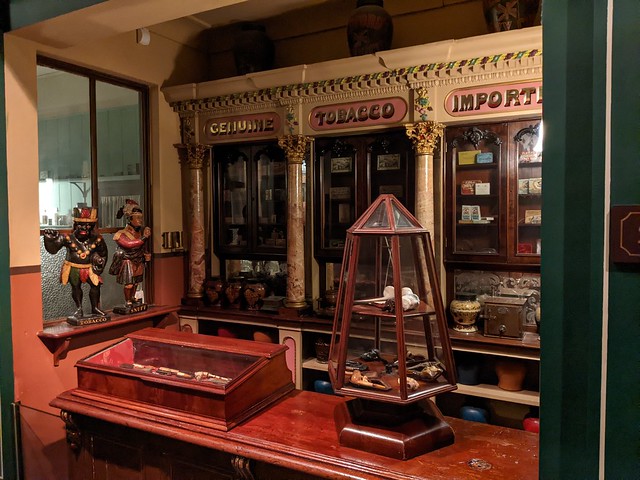
Descending the stairs to ground level you enter the 19th century, the age of empire, and the recreated Victorian street scenes with shops, bank, tobacconists, and even an easily missed (not in that sense) public urinal.
 
 Museum of London, London Wall. Victorian Walk.
 
 Museum of London, London Wall. Victorian Walk.
 
 Museum of London, London Wall. Victorian Walk.
 
I’ll be amazed if this gets recreated in the new museum - especially the tobacco shop - so I made sure to take photos of most of iy for posterity. After the Victorians the displays move into the 20th century, two world wars and the massive changes that they brought to the City of London and to the population therein. There is hardly a museum in this country that doesn’t play to this country’s pre-occupation with historical wars but despite the huge impact on London of the second bout of unpleasantness the Museum of London’s coverage isn’t too full-on, focussing on the people’s stories rather than trying to recreate the “experience”.
 
Coming now to the bit of history that’s not history for some of us there is quite a bit about post-war London and cultural change through the 60s, 70s, and 80s. So here’s three things that brought back memories for me.
 
The Protein Man’s Sign
 
Stanley Owen Green (22 February 1915 – 4 December 1993), known as the Protein Man, was a human billboard in central London in the latter half of the 20th century.
For 25 years, from 1968 until 1993, Green patrolled Oxford Street with a placard recommending "protein wisdom", a low-protein diet that he said would dampen the libido and make people kinder. His 14-page self-published pamphlet, Eight Passion Proteins with Care went through 84 editions and sold 87,000 copies over 20 years.
 
 Museum of London, London Wall. Placard carried by Stanley Green aka The Protein Man.
 
I can remember seeing him in and around Oxford Street when I used to come “up West” with a schoolmate.
 
The Firestone Factory Gates
 
The gates from the Art Deco Firestone Factory, Great West Road, Brentford. Shamefully demolished by the developer Trafalgar House the Sunday before it was to be made a listed building.
 
 Museum of London, London Wall. The gates from the Firestone Factory, Great West Road, Brentford..
 
I grew up in Heston and my grandparents lived in Hounslow and can remember them and my parents talking about this when it happened.
 
Watch With Mother
 
This was a cycle of children's programmes broadcast by BBC Television from 1952 until 1975, it was the first BBC television series aimed specifically at pre-school children. We listened BBC radio's equivalent Listen with Mother as well, which had begun two years earlier. Although mother was often too busy with housework to actually watch with us. The museum has a sitting area where you can watch a small black and white telly playing excerpts from The Woodentops, The Flowerpot Men, and Andy Pandy. (Google them, OK)
 
 Museum of London, London Wall. Andy Pandy.
 
This, imprisoned behind glass, is Andy Pandy. I had a pose-able Andy Pandy figure made of rubber with a wire internal frame. As the rubber degraded over time the sharp ends of the wire would be able to poke out. It was bloody lethal and the sort of thing that would even make a modern day cheap Chinese toymaker blush! (When we got older we formed a theory that there was something going on between that bear and Looby-Lou behind Andy’s back but that’s another story.)
 
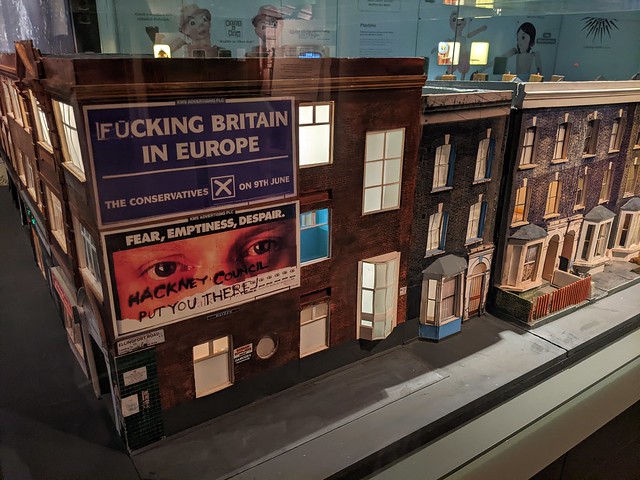
In a wonderful juxtaposition right next to the Watch With Mother room is Tom Hunter’s “Hackney Ghetto” sculpture from 1994.
 
 Museum of London, London Wall. Model of the "Hackney Ghetto".
 
I’d not seen this before. Interesting back-story and some things don’t change.
 
Whatever the new museum turns out to be it won’t be like this. Some people will no doubt regard that as a good thing. There was a display of ideas being proposed for the new museum and a story board liberally sprinkle with marketing-speak and corporate bolx but we’ll just have to wait until 2026 (if it’s not late) to find out.
 
You’ve got until Sunday 4th December to see what went before.
 
 Museum of London, London Wall.
 
 The above will be history.