Showing posts with label Yorkshire. Show all posts

Friday, 30 May 2025

May road trip journal, part 7

Day 9, Castle Douglas to Stoney Middleton via Nostell Priory. 228 miles.

When I departed Castle Douglas after breakfast my ETA at my next overnight stopping point was before check in time so I looked for somewhere to visit on the way. Nostell Priory, a National Trust property in West Yorkshire fitted the bill and I might as well make use of my NT membership for something other than free parking at Runnymede. The A75 got me to Gretna where I joined the M6 into England. At Penrith I left the motorway and crossed the Pennines on the A66 until joining the A1(M) at Scotch Corner and leaving it at Pontefract to head south west to Nostell Priory.

Nostell Priory

Nostell Priory is a Palladian house in West Yorkshire, on the road to Doncaster from Wakefield. It dates from 1733 and was built for the Winn family on the site of a medieval priory. The Winns were socially upwardly mobile textile merchants and the house was intended, as with so many such buildings, to show off their wealth and status. That wealth didn’t always match their ambitions. Robert Adam was commissioned to design additional wings but only one was completed so the frontage of the house is very obviously asymmetrical. Adam added a double staircase to the front of the house, and designed buildings on the estate, including the stable block where you’ll find the toilets, cafes, gift shop etc. The house has impressive interiors, Adam ceilings, lots of Chippendale furniture, lots of paintings, the usual stately home stuff. For me the most notable item was a longcase clock, with an almost completely wooden internal mechanism, made by John Harrison in 1717.

Nostell Priory, John Harrison's Clock

John Harrison was born but half a mile from the house and his stepfather worked on the estate as a carpenter. He developed an early interest in clocks and followed his stepfather into the carpenters trade, hence the wooden clock mechanism. Later he would become famous for developing accurate seagoing timepieces to solve the problem of determining Longitude at sea. Despite successfully producing such clocks he never received all of the monetary reward that was due (although he did eventually become a very rich man) and was badly treated by the establishment, the “gentlemen scientists” of which were loathe to acknowledge that a carpenter’s son had succeeded where they had not. Generations of sailors however have good reason to hold John Harrison in high regard.

Nostell kept me occupied for a couple of hours but I had to move on. I stopped for fuel near Wakefield and headed down the M1 towards Sheffield. For some reason known only to itself the sat-nav decided to go the “wrong” way around Sheffield which meant sitting in miles of crawling traffic before finally escaping into the Derbyshire Dales.

I arrived at The Moon Inn, Stoney Middleton at well past five o’clock, checked in and put the kettle on for a much needed cuppa. This time I didn’t need to put the kettle on the floor to plug it in. It was a nice room up in the first floor roof space, accessed by an outside door at the rear of the pub.

Stoney Middleton, The Moon Inn.

I had intended going for a chippy tea but it wasn’t open so ate at the inn instead. After dinner I’d planned on going for a wander around Stoney Middleton but looking outside saw that it was actually pissing down. Summer had arrived. Of course I had left my coat in my room. Since I’d have got wet going to my room I decided a better plan involved another pint and wait for the rain to let up after which I no longer felt the urge to walk around a wet Derbyshire village so I retired early.

Day 10, Stoney Middleton to Home. 181 miles.

I treated myself to a last holiday full English breakfast then checked out of the inn and since it was a fine sunny morning took a brief turn around the village.

Stoney Middleton, The Nook.

It’s quite picturesque, lots of stone buildings including a church and a toll-gate cottage which is also the Fish and Chip shop with the disappointing opening hours. In a little garden nearby to the tollbar is a large circular blue plaque bearing the following text:

BOOT AND SHOEMAKERS’ STRIKE

1918-1920

In tribute to the women and men of Stoney Middleton and Eyam who were on strike for over two years and set up their own co-operative factory. They sought the reinstatement of sacked colleagues, shorter working hours, a war bonus and recognition of their trade union, the National Union of Boot and Shoe Operatives.

Their action inspired workers in other local industries to join unions, and paved the way for better wages and working conditions for later generations.

Good on ’em, I say.

It was time to go home. Once again I picked a route avoiding the M25 despite the sat-nav insisting that it would be a whole 8 minutes quicker. Except it wouldn’t, it never is. I got home mid afternoon, unpacked and started on the big pile of laundry. The cupboards & fridge were looking a bit sparsely populated so I got a Ruby Murray delivered, shopping could wait until tomorrow.

Epilogue.

I’ve gone through the photos and got the album down to only 290 items. You can see them on Flickr here.

I drove a total of around 1,584 miles.

Accommodation cost was £962.31

Did I have a good time? Yes.

Would I do it again? Also yes, or at least something similar. I’d like to explore more of Dumfries & Galloway. I might stretch the driving to cut out the first and last nights stop overs although it’s a long way.

Should you visit Kintyre? If you haven’t already you certainly should.

Did I see the Beatle? No, I’m told he doesn’t live there anyway so there was no danger of that happening.

Tuesday, 2 July 2024

Saltburn-by-the-Sea

Looking for something to do for the rest of the day after my visit to Locomotion I decided to stay on the train from Shildon back to Darlington and go to the seaside at Saltburn-by-the-Sea. Being able to buy a ticket from Darlington to Saltburn and back while on the train from Shildon to Darlington using the Trainsplit app helped the decision no end.
 
The journey took about 55 minutes and was through new territory for me so I had an aha! moment passing through Middlesborough when I spotted the famous Tees Transporter Bridge in the distance, confirming that it never did get moved to a Native American Casino resort in Arizona  πŸ˜€
 
 Tees Transporter Bridge, Middlesbourough.
 
 Saltburn was very breezy. Also very hot so the breeze was quite welcome. The town sits on top of the cliffs and the beach, prom, and pier are some 120 feet below. The good news is that Saltburn has the oldest operating water-balance cliff funicular in the United Kingdom. The bad news is it isn’t currently operating since suffering a fire in January 2024 and as yet there’s no firm date for its repair and reopening πŸ™
 
 Saltburn-by-the-Sea, Saltburn Pier and Cliff Railway.
 
 So it was down the steps instead, 175 of them (I counted on the way back up) which as everyone knows is the equivalent of a 15 storey building πŸ˜‰ I went out to the end of the pier, as you always should, the views are good but the wind out there was blow-your-hat-off strength. 
 
 Saltburn-by-the-Sea
 
Then I walked along to Old Saltburn, the original settlement at Saltburn Gill. It’s much smaller than the Victorian town up on the cliffs but importantly right on the front is the Ship Inn so I took the opportunity to get a pint and find a relatively sheltered spot on the terrace to enjoy it.
 
 Saltburn-by-the-Sea
 
 A walk along the length of the prom and back followed by obligatory seaside chips (untroubled by seagulls thankfully) and then it was time to climb back up those steps and back to the station to get a train back to Darlington. I liked Saltburn-by-the-Sea, I’ll have to visit again, preferably when the funicular is back in operation because I do like riding those.
 
 Saltburn-by-the-Sea, Town Station, Cliff Railway

Monday, 31 May 2021

Pictures from a mostly damp week in Yorkshire.

17th to 22nd May 2021
 
First holiday of 2021, hopefully not the last.


 Embedding Flickr albums appears to be broken now so clicking on the image will take yo to my Flickr pages instead😞

Stoodley Pike

 
18th May 2021
 
My pre-booked leave coincided with the date the government let us go and stay away from home so I booked an Air BnB in Bolster Moor near Huddersfield in the hope of getting a little gentle hill walking in, weather permitting. In the event the Tuesday was the best day with the rest of the week descending into what can only be described as bloody wet. Lucky then that Tuesday was the day I picked for a walk up to the monument on Stoodley Pike, starting from and ending at the little car park at the Yorkshire Water facility by Withens Clough Reservoir.


The road up to the car park is narrow and rough, with enough potholes that I was a little surprised to meet a guy in an Aston Martin coming the other way. Not the ideal vehicle for that sort of road! There’s a height barrier at the car park entrance set at 6 feet, OK driving in but had to remember to duck walking out.
 
 Withens Clough Reservoir
 
The advantage of starting from Withens Clough is that the climb up to Stoodley Pike is less steep than from the north, following the Calderdale Way along the edge of the reservoir and then at the signpost turning right up onto the moorland with the sheep.
 
 Sheep near Withens Clough Reservoir
 
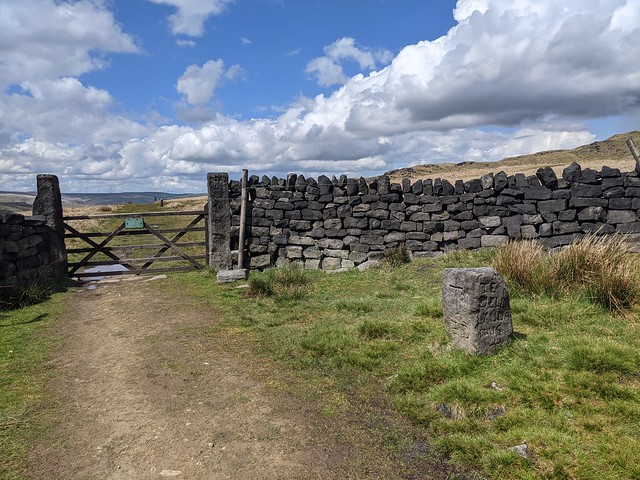
 At which point the weather turned Yorkshire enough to require putting on a waterproof coat before continuing upwards to a gate with a carved medieval stone marker nearby, the Te Deum Stone, this is a boundary stone or maybe coffin rest from when coffins were carried over packhorse trails from villages that did not have their own burial grounds. And I was able to look that up online as I passed because it also has a pretty good 4G signal!
 
 Boundary stone on the Caldedale Way near Withens Gate
 
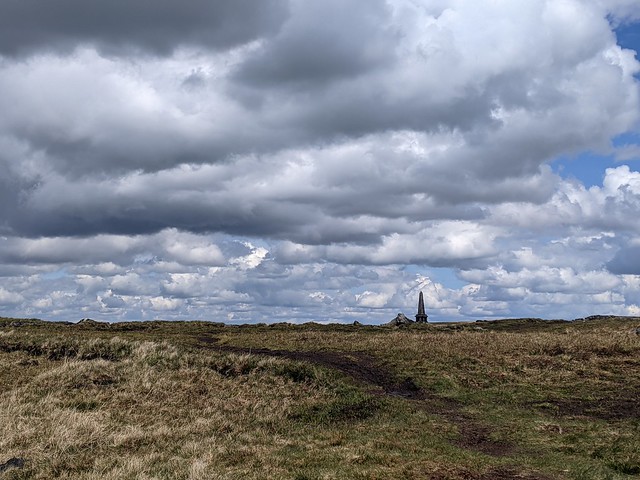
Through the gate I turned right up a slightly steeper and rather squelchy path towards the top of the ridge, my first sight of Stoodley Pike monument, and some spectacular views down to Todmorden and Makinholes below.
 
 First view of Stoodley Pike
 
 Calderdale & Stoodley Pike (panorama).
 
After a brief sit down on a convenient rock to take photos I carried on along the ridge to the monument, meeting other humans for the first time on the walk, not many though, some walking their dogs and others just getting out onto the hills. I imagine that it can get crowded in the main holiday period, the paths worn into the ground between the rocks and bogs would seem to bear witness to its popularity.
 
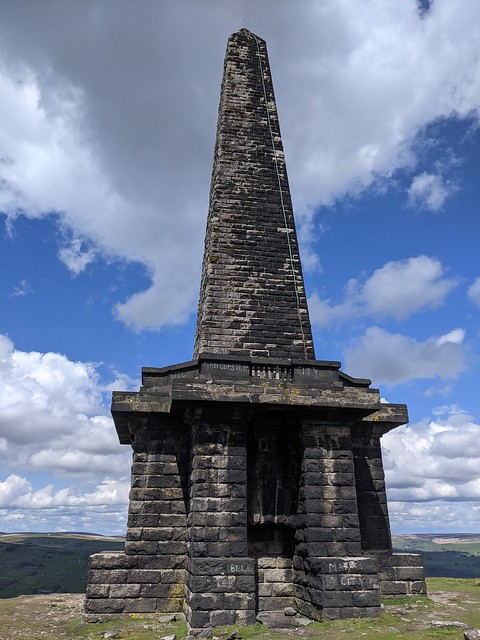
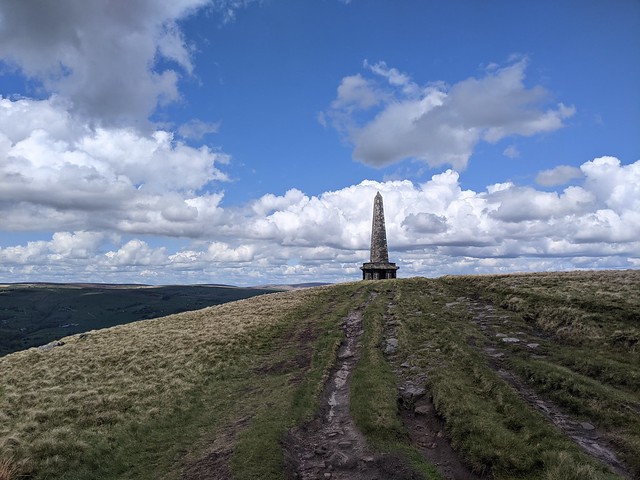
 Stoodley Pike Monument. Made it.
 
It’s a big bit of stonework which being 1300 feet up affords great views and can be seen from a long way off. The 121ft tall structure here is a replacement, completed in 1856, of a monument built in 1815 to commemorate the defeat of Napoleon. That fell down in 1854 after decades of Yorkshire weather and then being struck by lightning. The inscription on the monument tells the tale:
 
A PEACE MONUMENT
ERECTED BY PUBLIC SUBSCRIPTION
COMMENCED IN 1814 TO COMMEMORATE
THE SURRENDER OF PARIS TO THE ALLIES
AND FINISHED AFTER THE BATTLE OF
WATERLOO WHEN PEACE WAS ESTABLISHED IN 1815.
BY A STRANGE COINCIDENCE
THE PIKE FELL ON THE DAY THE RUSSIAN
AMBASSADOR LEFT LONDON BEFORE THE
DECLARATION OF WAR WITH RUSSIA IN 1854.
WAS REBUILT WHEN PEACE WAS RESTORED IN
1856
RESTORED AND LIGHTNING CONDUCTOR FIXED
1889
 
The “war with Russia” mentioned is the Crimean War October 1853 to February 1856. 
 
 Stoodley Pike Monument.
 
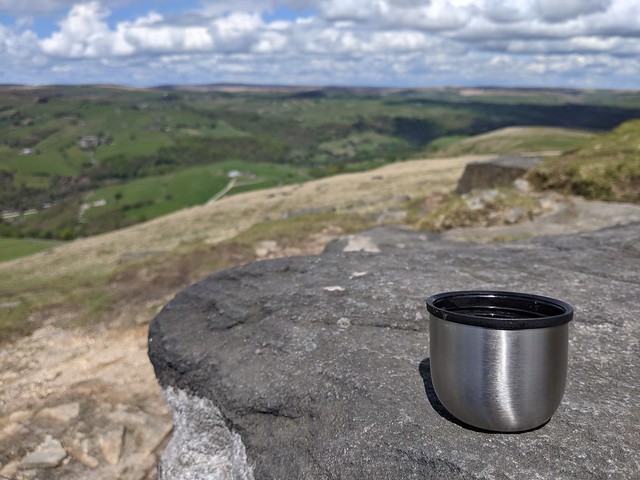
Target achieved. Break out the flask of coffee.
 
 Coffee break, Stoodley Pike Monument.
 
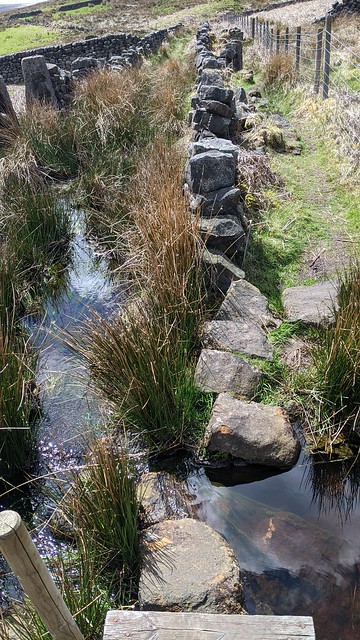
 Having sat for a while watching the comings and goings of the people (mostly over the precipitous side of the hill facing Mankinholes) and passing the time of day with other walkers I planned a route back down to the car initially following the Pennine Way east then turning south along a marked path to the west of Sunderland Plantation woods. The threat of more rain appeared to have gone away and the sun was pleasantly warm but now the risk of getting wet was from the bottom upwards, the path following streams and across bogs where the way was only discernible by looking for the yellow-topped wooden posts marking the route. I wouldn’t have wanted to go that way in bad weather.
 
 Footpath? Marsh? Wall? All three in fact but which is which?.
 
There’s a path here, believe it or not! Or a wall. Or a stream. Or maybe all three. Yes, it is as deep as it looks.
 
 Stone gatepost above Withens Clough Reservoir.
 
Having managed to negotiate the swamp without falling in I stopped by this stone gatepost and checked the way back to Withens Clough Reservoir. Apart from the sheep and the birds it was very quiet with not a soul in sight. Unless sheep have souls of course and even if they do you can’t see them so why we use that phrase? Emerging back onto the track beside the water via a gate in the drystone wall (confirming that I was on the path I thought I was on) and realising that it was only just after two o’clock I decided it would be good to walk around the far side of the reservoir and back across the dam to the car park.
 
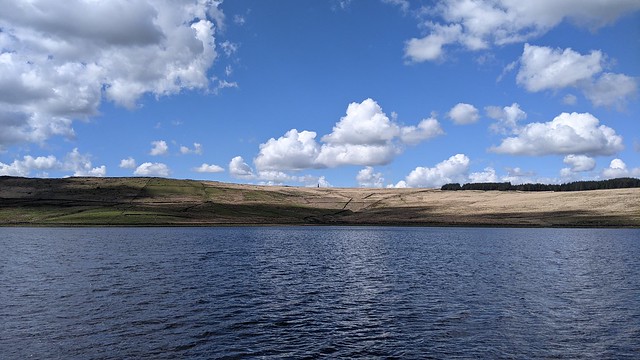
 View across Withens Clough Reservoir to Stoodley Pike.
 
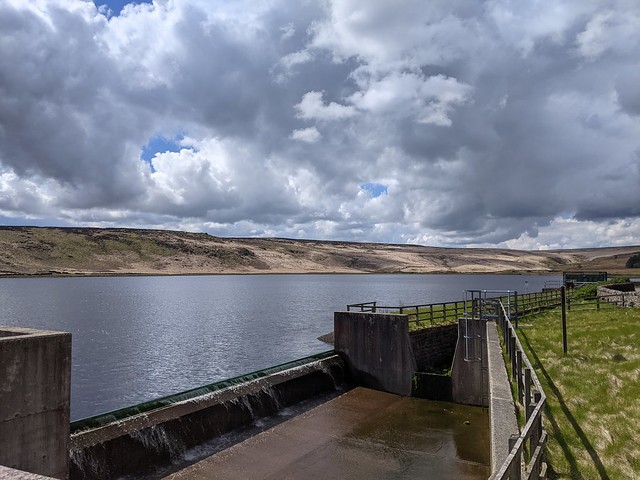
 The Withens Clough reservoir was constructed by Morley Borough Corporation in the early 1890s and it served the town via a 20 mile pipeline and intermediate service reservoirs in the borough boundaries. The path on the far side is partly on a narrow raised bank with the reservoir lapping at on side and a deep water-filled ditch on the other. Inevitably I was going to meet someone coming the other way walking seven assorted dogs on leads. She certainly had her hands full and it was fortunate we passed at a point where the path was at its widest. Once around the reservoir is obviously a regular professional dog walkers route and when I next saw her in the car park she loaded them all into a van and scraped (literally) out under the height barrier making a noise to set your teeth on edge.
 
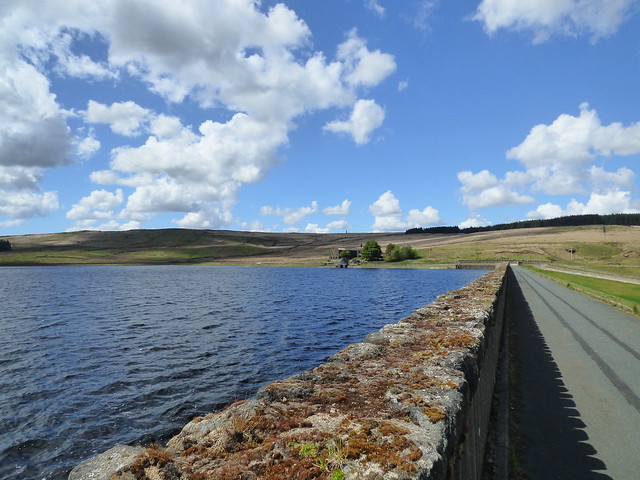
 Withens Clough Reservoir dam.
 
Withens Clough dam. Turn right at the far end back down to the car park.
 
It was a nice walk, moderately challenging, wouldn’t want to do it in bad weather though, such as any of the following three days.
 
Route statistics:
 
Distance walked 5.1 miles (8.2km).
Up 586m.
Down 596m.
Max height above sea level 411m
Total time 1 hr 48m excluding stopping, sitting, taking photos or drinking coffee.
Start/finish at Withens Clough Car Park, Rudd Lane 53.7058064N, 2.0214075W