Sunday, 12 September 2021

Open House london 2021. Part 2, some Very Victorian West London.

 Long post alert! Also if you're on a mobile phone you probably want to turn it sideways.

Tuesday 7th September

For my second Open House London 2021 trip I decided to follow the self guided walk around Barons Court and West Kensington. It was nice day for a wander around a mainly Victorian bit of West London. Pictures by me, words mostly by The Fulham Society who devised and published the route.
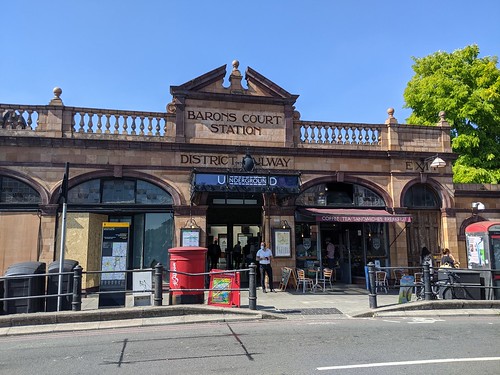
Barons Court Station.
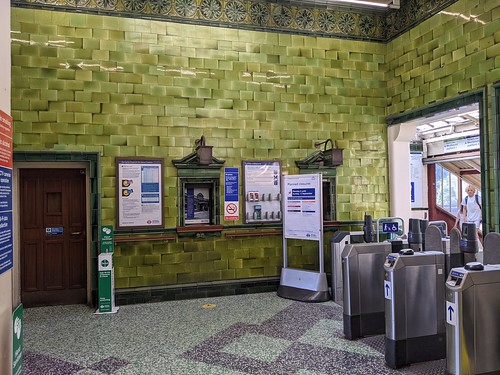
Barons Court Station, green glazed tiles.
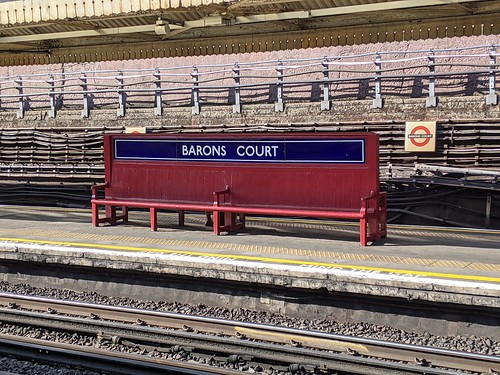
Barons Court Station platform bench & running in board combo.
Barons Court Station (1905 for the District Railway). Listed. The façade has fine tilework and Art Nouveau lettering. When the track was laid out in 1874 the area was still farmland, however by 1905, when the station was built, it was sufficiently developed to warrant a station of its own.
Nice green glazed tiles in the ticket hall and unique bench and sign combinations on the platforms.
From the station entrance turn left and then left again onto Talgarth Road.
135-49 Talgarth Rd, St. Paul's Studios (1891) 135-49 Talgarth Road – St Paul’s Studios (1891 by Frederick Wheeler) ‘designed for bachelor artists’. 149 was lived in by Margot Fonteyn and 151. Colet House, (1885) was built for Sir Coutts Lindsay, founder of the Grosvenor Gallery) and used by Burne-Jones for his largest painting, The last Sleep of Arthur in Avalon, which is now in Puerto Rico.
I can't imagine an artist wanting to work here now though alongside the very noisy A4 Talgarth road.
Go back round and past the station entrance and turn right into Barons Court Road which leads into Margravine Gardens.
 
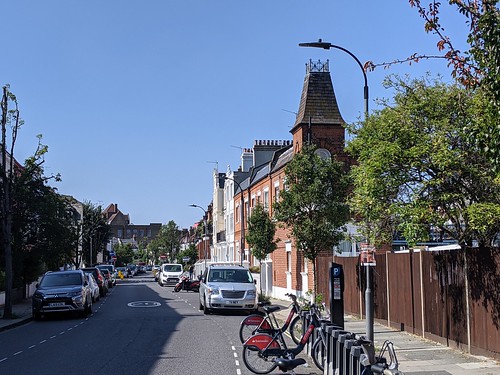
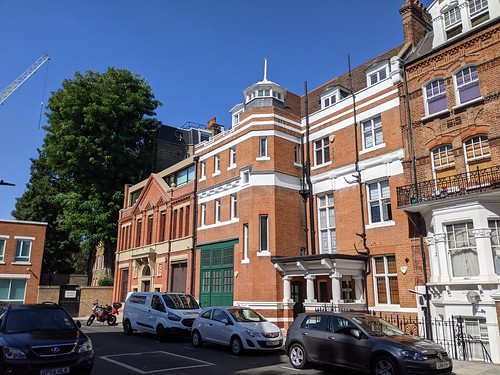
6 - 12 Margravine Gardens, Margravine Studios and related terraced houses with a distinctive turret. (1890) Nos 2-6 Margravine Studios (1890 Gibbs & Flew); Nos 6-12, houses related to the Studios (1890 Gibbs & Flew). The terrace has a distinctive turret. No 5, also built as a studio (1887/8 Harris and Wardrop), is a single storey building with the large distinctive studio window.
Although I'm not sure which building this refers to. Carry on and then turn into St. Dunstan's Road.
17 St. Dunstan's Rd. Built 1891 as a studio, converted to the Hungarian Reformed Church 1958. 17 Dunstan’s Road Hungarian Reformed Church. Built as a studio in 1891 by C.FA.Voysey for the painter W.E.F.Britten, altered for the Church in 1958. At the time it was built this was a rural spot. The house has the appearance of a country cottage with studio behind, but one that has been designed with great attention to detail e.g. the large sloping chimney, wide entrance with canopy and decorated iron railings. Originally it would have been very colourful with green paintwork and green glazed brick sills.(Shame it's now a rather dull blue.) Continue along St Dunstan’s Road, noting the gaps between the terraces especially 30/32, which were built by different small builders.
You'll need to look carefully to spot the gaps between the terraces since they're only about six inches wide.
At end of street ahead is the Charing Cross Hospital (founded in 1818) which moved to this site 1973, replacing the former Victorian Fulham Workhouse and Hospital.
Turn left and then left through the gate into Margravine Cemetery.
Margravine Cemetery, Lyons & Co. war memorials.
Margravine Cemetery, memorial to the workers who died in the Blakes munitions factory in 1918.
Margravine Cemetery, memorial in bronze to George Broad, foundry owner (c. 1895)
Margravine Cemetery, Victorian gravestones.
Margravine Cemetery, small headstones on children's graves.
Margravine Cemetery, octagonal Reception House, for storing bodies awaiting burial.
Margravine Cemetery, former Non-Conformist chapel.
On the left as you enter WW I and II memorials to staff of J. Lyons & Co, formerly based in Hammersmith. The memorials were originally erected in Sudbury, moved to Greenford and brought here in 2000.
Further on the right, the listed memorial to Adrian Smith (c1923), a tall cross on a base with a niche containing the figure of a gold prospector.
(Which I somehow managed to miss.)
On the left a notice signposts the recently restored memorial to those who died in an explosion at the Blake’s Munitions Factory at White City in 1918 .
Further on the right the Bronze memorial to George Broad (c1895) who owned the foundry which made the Eros statue at Piccadilly Circus.
All together now, "It's not Eros, it's Anteros!"
There is a wealth of Victorian and later funerary style in the Margravine Cemetery, and some nice shaded areas for a picnic lunch which was welcome as the day had turned out to be very hot.
On the north side by the reception house there was a cluster of much smaller gravestones, all for young children.

Continue along to the circle – go left to the listed octagonal Reception House, the only one remaining in London, where bodies awaited burial could be stored. Back to the circle and straight ahead to the exit gate, passing on the left the former Non- Conformist chapel.
No sign of what it's used for now though.
The Colton Arms, Greyhound Road. (1855) Out of the cemetery and down Field Road, passing on the left a large brick building, one of the Covered Tennis courts of the Queens Club. The club founded in 1886 is named after Queen Victoria, its first patron and was the world’s second multipurpose sports complex. It now has 28 outdoor courts and 8 indoor. It is also the national headquarters of real tennis, rackets, and squash.
Left into Greyhound Road, opposite Tasso Baptist Church (1887), and continue along to, on the left,
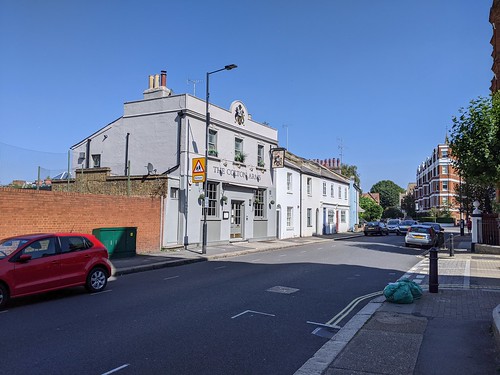
The Colton Arms (1855), is a much loved very local pub, once considered to be the smallest pub in London.
It doesn't look particularly small to me, maybe it's been extended? Unfortunately it wasn't open.
Queens Club Gardens, mansion flats (1894)
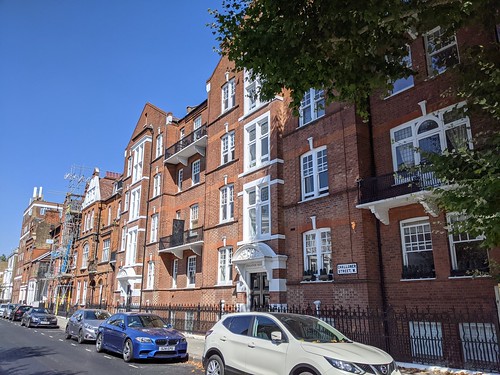
On the right, is Queens Club Gardens (W.H.Gibbs, 1894). It consists of 33 blocks of mansion flats named after literary and historical figures in alphabetical order –Arnold – Zenobia (three in Greyhound Road).
Advertisements for the new apartments described modern amenities such as ‘kitcheners’ (coal-fired ranges with oven and back boilers to [8]provide hot water) sculleries, coal bunkers, larders, ‘sumptuous decoration, gas lighting, electric bells, venetian blinds and fireproof stair cases.
The garden in the centre is private.
These are very ornate mansion flats with some nice details such as the lamps at the entrances.
Walk around 3 sides of gardens and out into Normand Road turn left and then left then right into St Andrews Road
Yeah, these instructions don't work too well. Turn left out of Normand Rd. into Greyhound Rd. The church is opposite and the path is to the right of the church at this point, take the path and you come out by the former vicarage behind the church in St. Andrews Road.
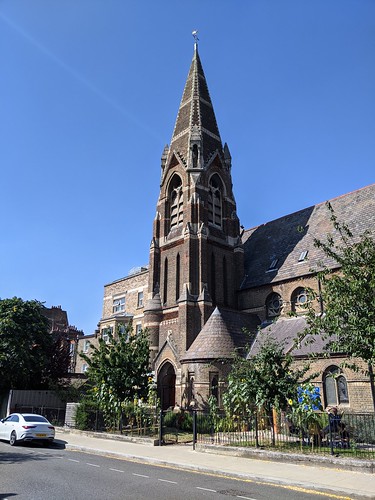
St. Andrews Church, St. Andrews Road. (1837, enlarged 1894)
Former vicarage of St. Andrews Church, now flats.
St Andrews Church (1837-4 Newman & Billing, enlarged 1894-6 Aston Webb). If open,(It wasn't today as far as I could tell.) do go in as the Sanctuary is magnificent and there is an Arts & Crafts stained glass window in the SE Chapel by Paul Woodroffe (1902).
Take the path on the right of the Church (see above) and walk through to look at the former very handsome vicarage, now converted to flats.
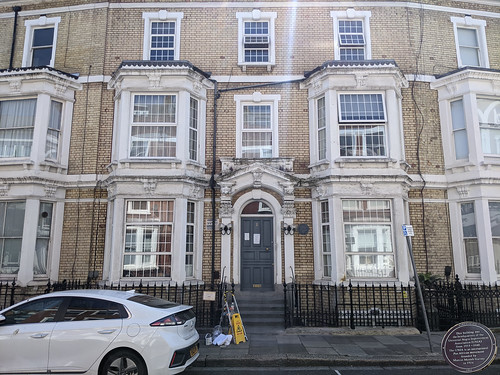
Perham Road in the sunshine, all the whiteness.
Artist's studio 3 Challoner Crescent (1899)
Continue ahead and at the end of the path turn right into Perham Road and turn right continuing to Challoner Crescent. Note Studio 3 Challoner Crescent (1899) – an eccentric building put to use for or by an artist.
1-4 Challoner Street, Aesthetic Movement houses maybe built as studios (1887)
Former West Kensington Congragational Church, Castleton Rd. (1882) Now the Bhavan Centre Institute of Indian Culture, since 1978.
Turn back up Challoner Street and on the right note Nos 1-4 (Francis L.Pither 1887) Aesthetic movement houses, possibly built as studios.
Further up, on the corner of Castleton Road, is The Bhavan Centre, formerly the West Kensington Congregational Church (James Cubitt, 1882-5).
It is now an Institute of Indian Culture, the largest centre for Indian Arts and Culture outside India . The institute moved to here in 1978. 800 students a week pass through its doors.
Details of courses and events can be found on its website bhavan.net
2 Beaumont Crescent, blue plaque to Marcus Garvey, publisher, journalist, and political activist. Turn right into Castleton Road and carry on to North End Road. Cross and turn right into Beaumont Crescent, where at No 2 there is a blue plaque to Marcus Garvey (1887-1940), who founded the Universal Negro Improvement Association in 1914
The Famous 3 Kings pub, North End Road (1902) Back to the North End Road and turn right towards the Talgarth Road, passing the Famous 3 Kings Pub (1902), with its splendid arched glazed entrance.
The pub was known as Nashville in the 1970’s and was a venue where the Sex Pistols played.
It is now promoted as “London’s best sports pub’ with multiple screens.
Which was enough to stop me going in even though this one was open.

Whiteleys Repository, Talgarth Road (1892-1901)
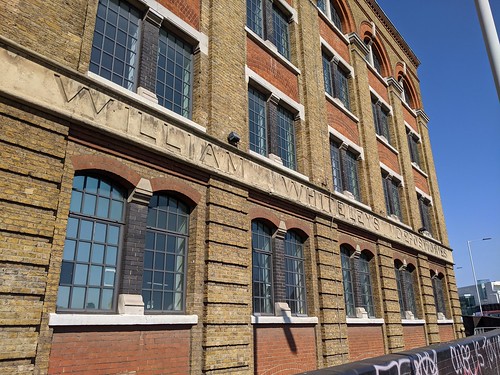
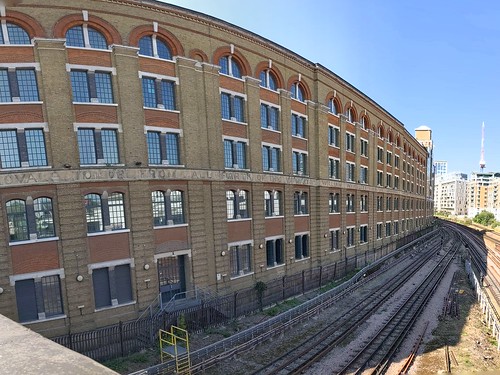
Cross (the still incredibly busy) Talgarth Road turn right and head for the bridge,(over the railway) where along on the left you will see the Whiteley’s warehouse along the railway, Whiteleys Repository, (1892-1901 Alfred Ridge). Originally Whiteleys Depository and Laundry. These warehouses supplied Whiteleys department store in Queensway.
This store at the time had no serious rival in London. The Whiteley slogan was ‘Everything from a pin to an elephant’ for sale under one roof.
Whiteley, who had himself a colourful ‘rags to riches’ story, was shot dead in 1907 by someone who claimed to be his son.
The family finally sold the business to Selfridges in 1927.
The handsome repository buildings have an industrial appearance and are especially impressive seen from the railway below. The area also contains a laundry block and stables as well as the 5 storey warehouse.
Mansion flats in Mornington Avenue.
51 Avonmore Road, blue plaque to Sir Edward Elgar (even though he only lived there for a year).
22 Avonmore Road, Arts & Crafts style home and sculptor's studio (1888)
Walk back along Talgarth Road and descend the ramp to Mornington Avenue turn right into Matheson Road and at the end is Avonmore Road.
Turn right to look at the main entrance to the Whiteley’s buildings at the end.
Turn back along Avonmore road, and on the left at 51, Plaque to Sir Edward Elgar 1889.
I wonder if people with blue plaques to the very famous on their homes ever get pissed off with people taking photos?
On the right Sir Compton Mackenzie lived at No 54.
22 Avonmore Road. Listed built 1888-9 by James Maclaren for the sculptor H R Pinker in Arts and Crafts style as his home and studio.
22A Avonmore Road is a working studio. Kenneth Armitage a British sculpture known for his abstract semi-bronzes lived here until his death in 2002. The house is now part of the Kenneth Armitage Foundation. The foundation makes an award of a fellowship which provides for an annual stipend and the use of the studio and residence.
Alongside, 20 Avonmore Road has plaques VR & 1887 and is possibly a former Post Office.
8 Avonmore Road, Studio House (c1880) 8 Avonmore Road – Studio House, c1880 was in 1891 the home of William Lockhart who was commissioned by Queen Victoria to paint her Jubilee celebrations. The picture now hangs in Windsor Castle.
In 1895 the portrait painter Edward Fellowes Prynne appears on the voters register.
Later occupied in 1949-57 by Gavin Maxwell, author of The Ring of Bright Water.
Gwendwr Gardens Park (1949) opened as a memorial to air raid victims in the area.
Retrace your steps back to where you turned out of Mornington Road, carry on along North End Crescent to North End Road.
Cross North End Road and turn right into Gwendwr Rd.
Gwendwr Gardens Park opened in 1949. In 1948 the area was donated to Fulham Council by the Gunter Estate for a memorial to the victims of German air raids in the area, particularly the Operation Steinbock raid on the night of 20 February 1944.There is an ornamental sunken garden, pond and tall shady trees.
Which were particularly welcome at this point although most of the other occupants were determinedly soaking up the late summer UV radiation.
Go back to North End Road, turn right and cross Talgarth Road. West Kensington Station is on your left.
Although first I took a walk up to Holland park because public conveniences are like hen's teeth in this part of London. There I managed at least to also get a coffee before the cafe closed promptly at half past three despite having a park full of potential thirsty customers.
Only in England.


With thanks to The Fulham Society Maya Donelan and Barbara Skorupska who conceived and compiled this walk in collaboration with Open House.
The dates, facts etc. about the places passed on the tour are theirs, the photos are mine.
Of course it doesn't have to be Open House Festival week to do this walk and the guide, along with those for other Fulham walks, can be found here on The Fulham Society web site.
   

The full Flickr Album of 41 photos can be found here.

Open House London 2021. Part 1, an old new church.


Saturday 5th September 

I live too far from London to really take advantage of the annual Open House Festival. Travel time cuts into the hours available to visit, especially on this Saturday with much of the south western Underground that I would normally use out of action for planned works. So mainline into Paddington it was and tube to Euston Square, a short walk along the Euston Road from which lies my first venue.
 
 St. Pancras New Church, the west entrance.
 
St. Pancras New Church was open for guided tours with the crypt also open for self-guided creeping about. The Open House London guide (web only this year) description says "Unique Greek-style parish church. Grade I listed building inspired by the ionic temple of the Erechtheum on the Acropolis. A notable feature are the Caryatids guarding the entrances to the crypt. On entering the building and having completed covid formalities there was a brief wait before our informal tour could begin while some church related activity completed at the far end of the nave. This is still a working church and the vicar, Revd. Anne Stevens was present in her “office”.
 
 St. Pancras New Church, what a big organ!
 
And an impressive place it is too.  St Pancras Church is in a Greek Revival style, built in 1819–22 to the designs of William and Henry William Inwood. Despite being a couple of centuries old it's often referred to as St Pancras New Church, in order to distinguish it from St Pancras Old Church, which stands some 940 yards away to the north.

I’m no architectural expert so what follows has been cribbed from the interwebs. The church is in a Greek revival style, using the Ionic order. It is built from brick, faced with Portland stone, except for the portico and the tower above the roof, which are entirely of stone. All the external decoration, including the capitals of the columns is of terracotta.

Henry William Inwood had travelled much in Greece and indeed was in Athens at the time that the plans for St Pancras were accepted. The Inwoods drew on two ancient Greek monuments, the Erechtheum and the Tower of the Winds, both in Athens, for their inspiration. Henry William brought back plaster casts of details of the Erechtheum, along with some excavated fragments, to assist with the design.
 
As for St. Pancras himself, there aren’t many churches in the UK dedicated to the 14 year old boy soldier, as depicted by his statue inside the church, supposedly beheaded for his faith in 304. Let’s face it, if someone says “St. Pancras” the first thing that comes to mind is trains rather than 4th century martyrs.
 
 St. Pancras New Church, caryatid columns above the crypt entrance.
 
Having been shown around the inside and outside of the above ground parts I walked down the south side to the entrance to the crypt, beneath four of the “famous” caryatids. There are another four on the north side and they are “famous” for the story that persists that they were constructed off site, of terracotta around a cast iron core, but when brought to site to be fitted were found to be a few inches too tall. The apparent solution was to slice the extra inches out from the middle to make them the correct height. Is it true? I don’t know but it would explain the rather awkward appearance they have around their midriffs.
 
 St. Pancras New Church, a pile of memorials in the crypt.
 
A few hundred former parishioners are buried in the crypt but you don’t get to “meet” any of them and the only memorials I saw were these piled up in one of the vaulted sections. There was an exhibition of photographs of the church spread around the walls of the crypt and a short video about the history of the church projected, in fine parish church “make do” style, onto a sheet in the chamber below the north entrance. The foundation stone of the church is inscribed in Greek, translated as "May the light of the blessed Gospel thus ever illuminate the dark temples of the Heathen”. In the video the vicar suggests that it might have been intended to counter the fact that the building is in what would at the time have been regarded as a pagan style, which raised a few chuckles.
 
 St. Pancras New Church, looking up at the north entrance to the crypt.
 
After St. Pancras Church my intended next Open House visit was to have been St. Bart’s Hospital but the queue for that stretched all the way around the courtyard and if I’d stood in the scorching heat for that long I’d have needed admitting to the place rather than just getting a look around. So instead I had a wander off around the Barbican, which is always worth a visit, and Smithfield for a refreshing pint.
 

Wednesday, 25 August 2021

Imberbus 2021

21st August 2021

The buses were back at the "lost" village of Imber on Salisbury Plain last Saturday having been forced to skip 2020 because of you-know-what. And so was I.
 
Here they are in pictures
 
Imberbus 2021
 
And here they are on video:


Enjoy :-)

Sunday, 22 August 2021

Marble Arch Mound

19th August 2021

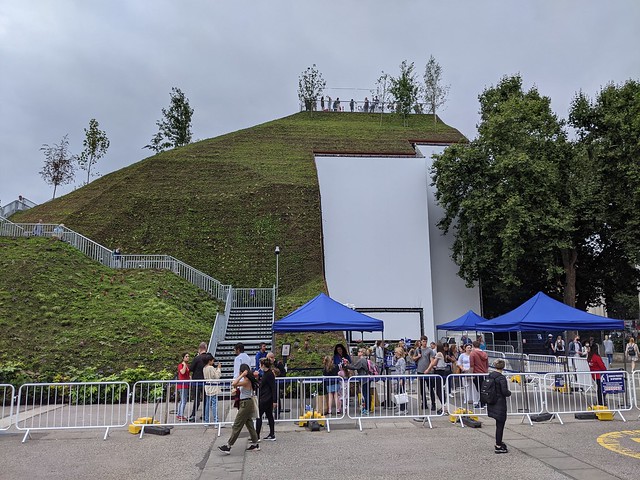
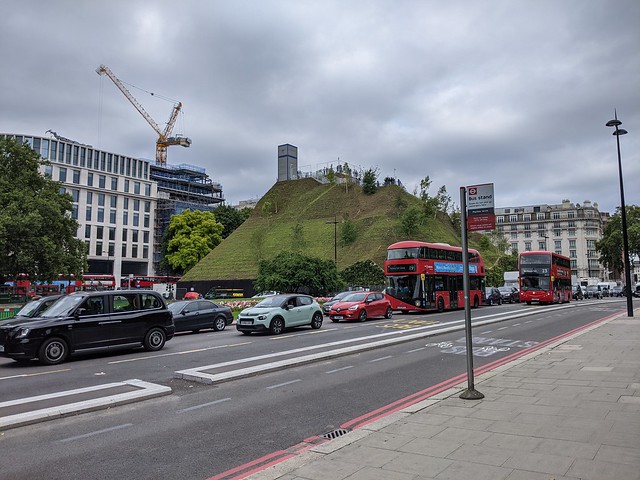
A green “hill” has appeared in the middle of the road junction at Marble Arch. The trials and tribulations of this £6m man-made edifice have been well publicised but as I was in London anyway and it’s currently free to visit I thought I’d give it a go. Besides, Ian reckoned it was worth it. 
 
With impeccable timing I arrived at exactly the same moment as the huge Ashura parade made its way down Oxford Street. Once they had passed I found my way round to the entrance clutching my pre-booked ticket printed out ready to present at my allotted time as instructed.
 
 Marble Arch Mound, a £6m artificial hill.
 
Only to find that they were just waving people in anyway. So in I went 15 minutes before my booked slot and climbed the metal staircase (you really don’t want to drop anything) to the viewing platform at the top.
 
 Marble Arch Mound, a £6m artificial hill. Edgeware Rd. / Bayswater Rd.
 
There’s a clear view up the Edgeware Road.
 
 Marble Arch Mound, a £6m artificial hill. View obscured by tree planted on the hill.
 
One of the few trees they’ve managed to grow has been placed so as to obscure the view east, which seems an obvious mistake as the only point of the structure is the elevated views it gives over this part of London.
 
 Marble Arch Mound, a £6m artificial hill. Hyde Park.
 
Looking south over Hyde Park reveals a lot of trees but little else. Further east you can spot Battersea Power Station, the London Eye and the Shard.
 
I spent maybe 20 minutes taking photos and trying to spot things that I recognised, see below, before making my way back down again and sloping off back to Soho for a pint.
 
 Marble Arch Mound
 
Diamond Geezer also went, the next day I think, and has posted his thoughts here more eloquently and in slightly more detail. I agree with his findings, don’t make a special trip but if you’re in the area make the most of it while it’s free and best book your ticket just in case it becomes suddenly very popular.

Hidden London - The Kingsway Tram Subway

19th August 2021

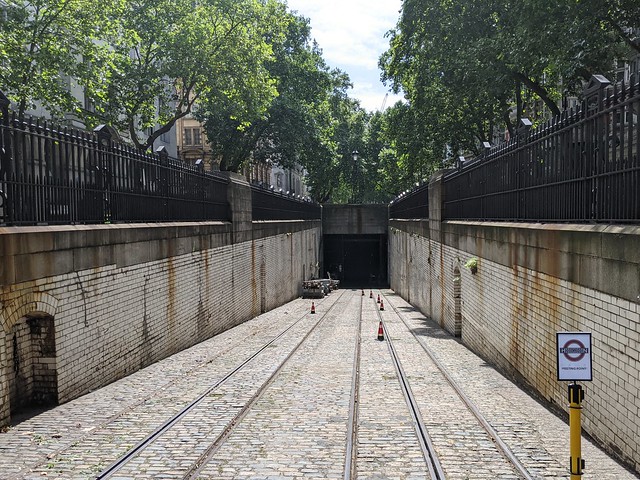
At the junction of the A4200 Southampton Row and A40 Theobald’s Rd. there is a set of metal gates flanked by ornate lamps beyond which a cobbled slope runs down to the darkened portal of a tunnel. Set into the cobbles (yes, I know they’re properly called setts) there are metal rails for this is the north entrance to the Kingsway Tram Subway and is somewhere I’ve long wanted to get into. Thanks to London Transport Museum’s resumed Hidden London tours, I now have.
 
 Kingsway Tram Tunnel, north portal.
 
A bit of history:
The Kingsway Tram Subway was built by the London County Council and opened in 1906, as part of the regeneration programme for the Holborn and Aldwych areas, which had become slums. The building of the new roads gave the opportunity to link the tramways in the north with those in the south but the occupants of the fancy new buildings wouldn't want to have to look at all those working class people who mostly travelled by tram. So after the pattern of New York and Boston it was decided to put the tramway below ground in a subway. The southern end of the subway emerged on the Embankment next to (later under) Waterloo Bridge, permission for the lines to continue over the bridge having been refused.
It had relatively short active life, closing in 1952, but despite this, the Subway underwent several major upgrades during its time, in particular the enlargement to enable the passage of double deck trams in 1930-31.
 
 Kingsway Tram Subway
 
More than half of the subway still exists to this day - complete with original features such as the longest section of surviving tram track in London (Croydon doesn't count in this context) and the remains of Holborn tram station with its steps to street level. Part of the southern section of the subway was repurposed in 1962-1964 as part of the Strand Underpass road and the very southernmost section between the underpass and Embankment under Waterloo Bridge was converted into a bar/restaurant, currently it is Proud Cabaret Club 
 
 
The northern section visited on the tour is mostly used for storage by Camden Council and others and has also been used as a film set several times. The tour isn't allowed to continue south into the part of the remaining tunnel which lies in Westminster council area. 
 
 Kingsway Tram Subway
 
 Kingsway Tram Subway
 
As usual with Hidden London tours it was all well organised and guided. If you get a chance go and have a look in the Kingsway Tram Subway yourself, it’s the only one of its kind in the country.


Saturday, 7 August 2021

Spa Valley Railway

 Tuesday 3rd August 2021

As things are opening up again - permanently or temporarily, who knows? - I decided that a visit to a heritage railway would be nice, especially as this one at least was happy to sell me one ticket rather than insisting on me paying for two, four, or more as was the case with some others.

The Spa Valley Railway runs from Tunbridge Wells in Kent to Eridge in East Sussex. At Eridge it shares a station with the Southern Railway main line with trains from London Bridge, East Croydon, Oxted and Uckfield. However that would be about three hours and five changes from here or about 90 minutes in the car. There's a large and reasonably priced car park at Eridge station.

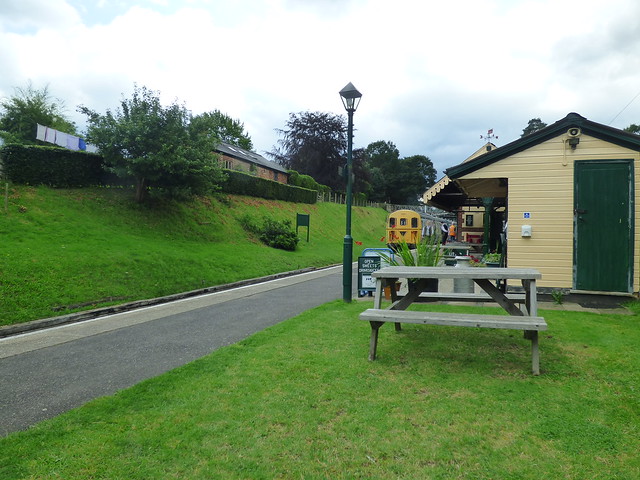
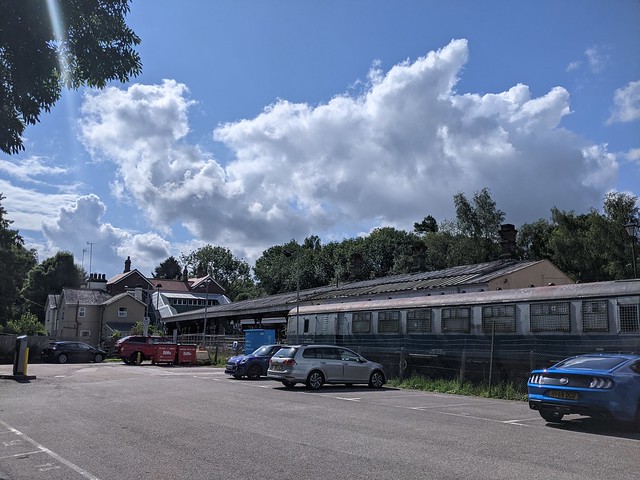
 Eridge Station

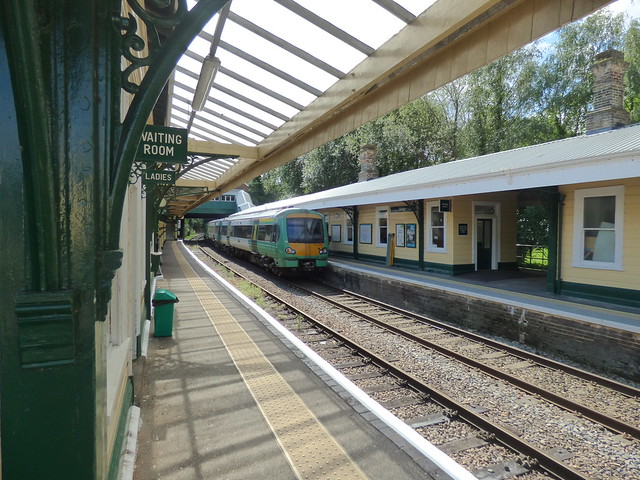
Eridge looks and feels like a heritage line station and apart from the dot matrix indicators on platform 1 it’s only the modern diesel trains arriving at and departing from this platform that give the game away. 

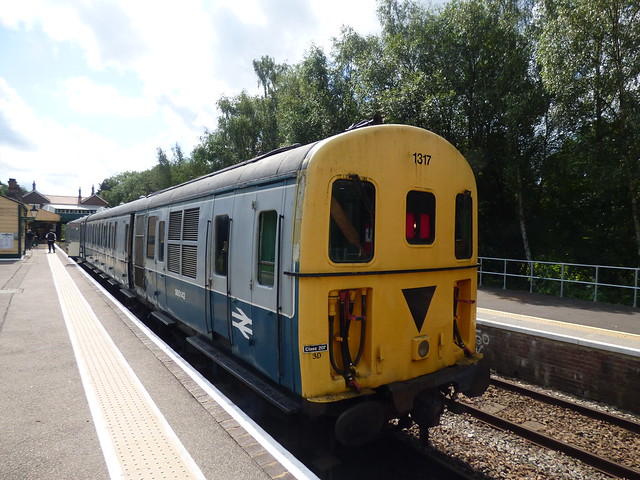
Today was a heritage diesel running day on the Spa Valley Railway with services being provided by a two car BR Class 207 “Thumper” DEMU running to the “Purple Timetable” which provided five journeys in each direction throughout the day.

An adult ticket cost £12 on the day (even if purchased online) or £10 if you’re not travelling on the spur of the moment and buy it online in advance. Buy it at the station and it’s £12. That’s not too bad for what’s actually an all day rover, cheaper than many other preserved lines and the timings allowed me to catch the 1115 at Eridge, have a bit of lunch in Tunbridge Wells and look around the town and the SVR depot before getting the 1325 at Tunbridge Wells to Groombridge which is good for filming, photography, and more importantly tea and biccies from the kiosk on the station. After a quick wander around the village which isn’t that exciting I returned to Eridge on the 1501. I should mention that not one of those trains actually departed at the scheduled time, usually it was about 5 minutes later :-)

 Class 207 DMU at Eridge Station, Spa Valley Railway.

Having grown up on BR’s Western Region I’m not familiar with the Class 207 trains of Southern Region, nicknamed Thumpers because of the engine noise I read, which are diesel electric multiple units built in 1962 and remaining in service until 2004 when slam doors were no longer acceptable on a modern railway. Unlike the trains I grew up with which had the engines slung under the floor these have an engine in a compartment behind the driving cab and guard’s compartment, which obviously takes up a lot of space which otherwise could contain passengers. They sound good though if you’re in the motorised unit that is and if you’re in the trailer you can barely hear the engine at all.

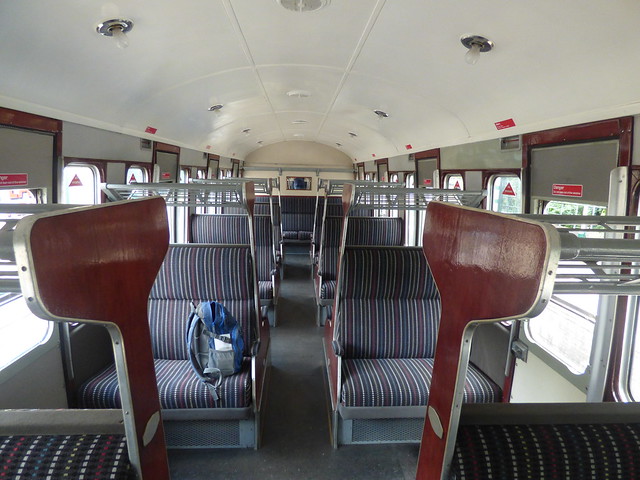
 Class 207 DMU interior, real seats! Spa Valley Railway.

In true 1960s style and unlike modern commuter trains the interiors have seats with actual springs in because back then the government didn’t insist that everyone travel in as much discomfort as possible. Quite a bit of standing space though for rush hour loadings and I expect the luggage racks above the seats were handy for reading the morning papers. No overcrowding today though, in fact I thought I was going to have this section of the train to myself until shortly before departure a young man & his companion/carer boarded. There had obviously been some sort of incident at the station which had upset him and he proceeded to have a minor melt-down for the duration of the trip, fortunately at the far end of the carriage mostly out of microphone range of my camera. I hope he calmed down enough to enjoy the rest of his day.

 73 140 at Tunbridge Wells West station, Spa Valley Railway.

Tunbridge Wells West station is where most of the SVR locomotives and rolling stock lives and you can wander around the engine shed and yard where there are a number of steam and diesel locomotives in either running condition or serious stages of rebuild. The SVR is based in the engine shed, the lines into the original station being truncated by the access road for Sainsbury’s and the station buildings now a hotel and restaurant named “Smith & Western” with a huge set of cow horns over the entrance. I expect they play both kinds of music but I didn’t venture inside to find out, instead walking up to the Pantiles shopping area and the Chalybeate Spring which gives the town its name but is still shut due to the Great Plague of 2020/21.

 Chalybeate Spring, Pantiles, Tunbridge Wells

I took a picnic up onto Tunbridge Wells Common which is conveniently located a short walk from the town and the SVR station. After which I caught the train to Groombridge.

 Class 207 DMU arriving at Groombridge station, Spa Valley Railway.

Groombridge is probably the best station on the line to see and photograph the trains. It also has the passing loop so on days when multiple trains run this is where they pass. It’s also the place today where the sun passed out of sight behind the clouds although at least the rain held off until I was back on a train. The station has a refreshments kiosk which serves a decent cup of tea. I took a walk into the village which lies on the Kent/East Sussex border, here delineated by the river Grom (one 'o') over which there is a very small bridge carrying the B2110, and from which the village takes its name although it has acquired a spare ‘o' from somewhere along the way.

Last ride of the day was back to Eridge. I had planned to visit the fourth station High Rocks which is in the grounds of the pub and national monument but when passing through there was a sign saying the attraction was currently closed and the gate from the platform very much locked shut. Some other time then, a return visit being on the cards maybe on a steam running day.

More photos Flickr Album

 Spa Valley Railway.

And glorious(?) HD video