Sunday, 22 September 2019

Tram, train, rain, tram.

Friday 6th September 2019

Manchester's Metrolink Tram system extends far beyond the city to the surrounding suburbs and nearby towns.

Such as Bury, 8 miles north-west of Manchester on the River Irwell and famous for black pudding and as the birthplace of Sir Robert Peel, founder of the Metropolitan Police and the Conservative Party. One of which facts probably makes him a hate figure, you can decide for yourself which.

The Metrolink trams are not low-floor vehicles, surprisingly since they run through the streets, and so require stops that are more like railway stations with quite high platforms. unlike the trams in Croydon where the platform is little more than a raised height kerb.

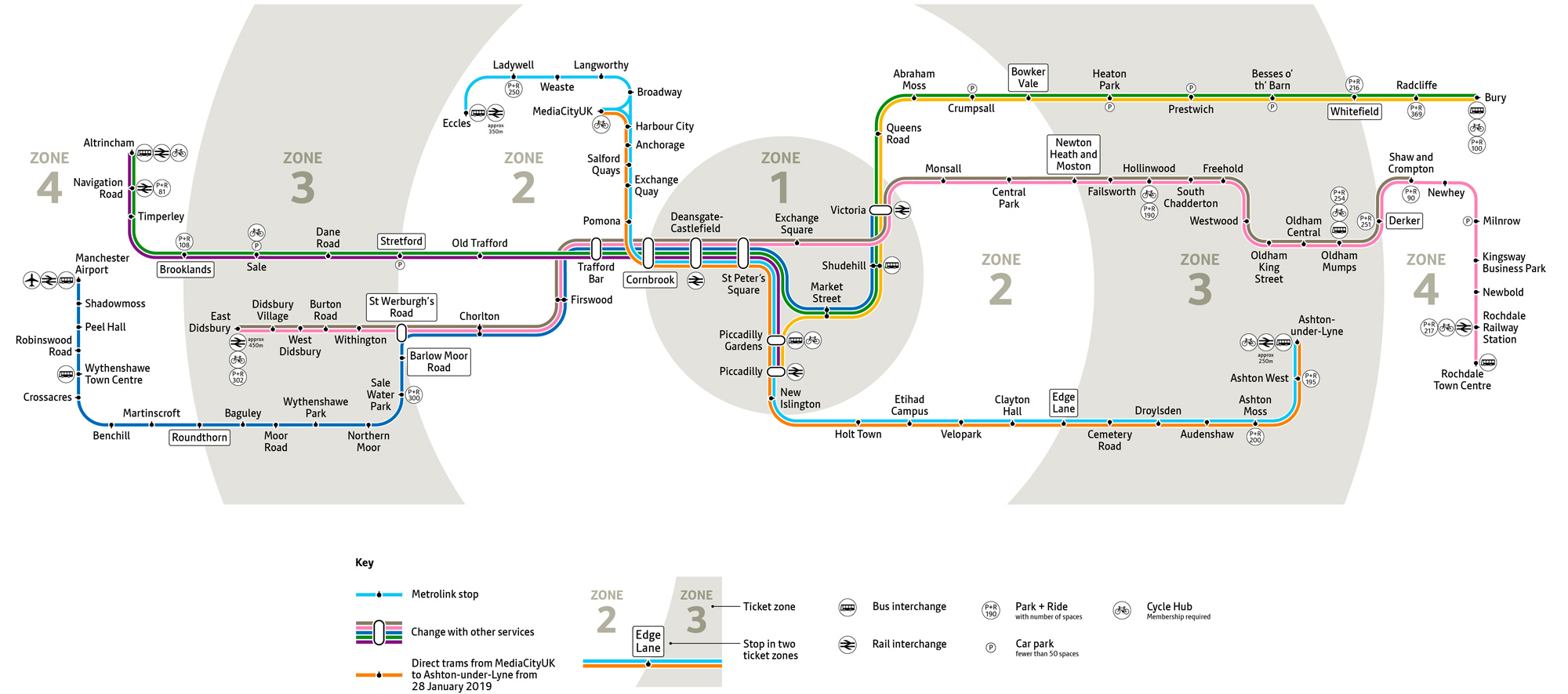
Handily for the visitor the system allows contactless payment with daily caps, almost like London's Oyster except that you need to touch in and touch out again at the end of your journey. Failure to touch out will result in a £4.60 incomplete journey charge. Failure to touch in will get you a stonking £30 "standard contactless fare". Since I can't see any journey that would cost that much why don't they just be honest and call it a penalty charge? Either way, don't forget to touch in and out. So I touched in using G-pay at St. Peter's Square and hopped on a "green line" service to Bury. The trams run for part of the way over what was the East Lancashire Railway line and there are some far reaching views of Lancashire along the way. The line terminates in the town centre at Bury Interchange. 

The original East Lancashire Railway however terminated at Bury Bolton Street station, about 5 minutes walk from Bury Interchange and the current East Lancashire Railway is still there.

The street level building dates from 1952, the previous one having burnt down after the war. The rest of the station and platforms are below in a deep cutting.

There was about an hour to wait before the next departure to Rawtenstall so I walked across Bolton Street and down the slope to the Bury Transport Museum which is connected with the heritage railway and housed in a former Castlecroft Goods Warehouse. Entry is free although as with any free museum they are donation-hungry. Chuck a few quid in if you can.

It's not a huge museum but they have managed to pack quite a lot in there. They have a wide selection of vehicles including buses, lorries, tractors, vans, cars, and even a steam roller.

There's plenty of hands-on stuff for children to play with too, though as it was Friday there weren't any, at least while I was there. I expect it's different at the weekend.

It certainly kept me interested until it was time to wander back to the railway station, purchase a return ticket to Rawtenstall (£12.50) from the traditional ticket office window and go down to the platform and await the 1455 departure.
It was a pleasant trip despite the weather coming over all "northern" and I made this video which covers the trip there and back.


Having returned to Bury it was Friday evening commuter time. It was also time for something to eat. Bury isn't short of fast food outlets which provided amply for that requirement.

I singularly failed to get any black pudding but I had nowhere to keep it until I went home anyway.

So I touched in at Bury Interchange and rode a somewhat busier tram back to Manchester city centre and walked back to my hotel.

Considering I'd forgotten that the steam railway was there until I actually got to Bury I consider that was a good afternoon all round.

Wednesday, 18 September 2019

People's History Museum

Friday 6th September 2019

I had few firm plans for what to see while I was in Manchester but this was one of them. In a former Edwardian pumping station next to the River Irwell, the People's History Museum "is the national museum of democracy, telling the story of its development in Britain: past, present, and future".

 The two main exhibitions are found in Main Galleries One and Two on the first and second floors respectively.

Main Gallery One covers the period from the Peterloo Massacre of 1819 until the end of the Second World War in 1945.

I'd already visited the excellent Peterloo 200th anniversary exhibition on the ground floor, so gallery one took the story on from there, covering the industrial revolution, reformers, workers' organizations, political parties, and the fight for universal suffrage. The display pictured above is the first thing you see on entry to the gallery, it says "Abuse of Power Two hundred years ago Britain's political system was corrupt and controlled by a few rich men. Without the right to vote, ordinary people had no power to change their lives." Reading that it's hard not to think that, apart from more people having a vote, the situation in 2019 isn't very different. 😞

The personal stories of ordinary people living through extraordinary times are the most interesting part of the way the exhibition presents the history of social change, along with many many physical and multimedia exhibits. There is a lot of information here although the way the space is laid out sometimes makes it hard to follow as you walk around.

Moving up to the second floor and to Main Gallery Two where postwar politics is the main theme, from the hopefulness of the new Labour government of 1945, through the difficulties of the 1950s and the swinging back and forth between Labour and Tory governments, both promising to deliver the best for ordinary people but by differing means, into the 1970s when ambitious union leaders led their members down a path that eventually led to Thatcherism, erosion of the hard-won rights of workers, and ultimately the rise of the right wing in this country to an extent I never thought I'd see. This gallery covers the period of my working life and evoked memories of standing on picket lines trying to stop the Tories from selling the people that which the people already owned and then the disappointment of Blair's New Labour, the part of her legacy of which Thatcher was most proud. The exhibition also covers the issues of the day such as the anti-war and nuclear disarmament movements, environmental, race relations and immigration, and LGBT+ issues.

It's not all doom and gloom. There's also the matter of how workers gained more time off and what they did with it (football, music, etc.) and a section on the Co-Operative movements, which began in Greater Manchester.

And then there's the banners section. A high ceiling allowing the display of many union and other workers society banners, both home and professionally made, which were carried when the people took to the streets to protest, to demand change, and to try to improve the lives of their fellow ordinary people.

I recommend that you visit this museum if you're in Manchester. It may not answer the questions of how and why we've ended up again with a rich, corrupt, lying, self-serving, un-elected shower of shit running our country but it will give you a better understanding of the journey that got us here.

It may also make you angry. If so that's a good thing, use that anger, protest, fight for what's right. Maybe it's not too late.

Opening times
  • Open: every day 10.00am – 5.00pm
  • Radical Lates: second Thurs each month until 8.00pm
  • Closed: 24, 25, 26 Dec, 1 Jan
Entry is free although they suggest a £5 donation which if you can afford it is a bargain so put your hand in your pocket.


Right, normal service involving mostly transport-nerdery will resume shortly, until then:


 ðŸ˜‰

Sunday, 15 September 2019

"Mancunium" "Cottonopolis", Manchester.

5th September 2019

According to Wikipedia, "Manchester is the third-most visited city in the UK, after London and Edinburgh. It is notable for its architecture, culture, musical exports, media links, scientific and engineering output, social impact, sports clubs and transport connections. Manchester Liverpool Road railway station was the world's first inter-city passenger railway station; scientists first split the atom, developed the stored-program computer and produced graphene in the city." Sounded like a good place for a long weekend away then. I've done the first and second.

After a long journey on a Cross Country Trains Voyager (which was only 36 minutes late into Manchester Piccadilly) and a slightly confused walk from the station (exits on different levels, should have come out the lower one on Fairfield St., I later worked out) I found the Pendulum Hotel and booked in. This is part of the University & Conference Centre, close to the city centre and stations, was cheaper than a Premier Inn, and much nicer. The view from my room was pretty much what you'd expect in a city centre hotel (see above). The staff (and the breakfast) made up for the lack of view. Oh, and the giant pendulum swinging back and forth in the middle.

First evening explore on foot around the city centre. They're right, there's a lot of architecture, from ornate red Victorian to shiny steel and glass 21st century. Plenty of history evident on the streets.

Having watched many of Martin Zero's Youtube videos exploring Manchester (it was one of the things that influenced my decision to go there) I found I kept recognizing random bits of the city, particularly around the River Medlock 😃

I also took a ride on a Metrolink Tram out to Media City where amongst the shiny new studio buildings and trendy bars and restaurants they have something that claims to be the Blue Peter Garden.

How can this be true? The real Blue Peter garden for those of us of a certain age will always be the one in London, famously not vandalized by Les Ferdinand and Dennis Wise 😈


Back in the city centre I was finding Manchester an easy place to get lost in. It took a couple of days to get my bearings. But  I found another place I recognized from a Martin Zero video, The Lass O' Gowrie pub in Charles Street.

A splendid looking Victorian glazed tile pub with a good selection of decent ales (and cheap for a city centre as well) and only a short walk from the hotel. I had found my temporary "local" for the duration of my stay.

Also this.

I've seen some interesting and unusual statues in cities but...


Thursday, 12 September 2019

Along the riverbank - Brentford

1st September 2019

After visiting Gunnersbury Park I walked down to Kew Bridge and bought a picnic lunch, sat and ate it by the river at Strand-on-the-Green, which would be a much nicer spot if the litter bins were ever emptied and the piles of broken glass bottles removed. I suspect this isn't a place you'd want to hang around at night.

As it was still a fine afternoon I decided to walk along the north bank of the Thames, following the Thames Path towards Brentford to see how far I'd get.

This section of the Thames Path mostly follows the riverbank, between the many and varied moored houseboats and new blocks of riverside apartments. 

Some of the houseboats are quite ramshackle though no doubt these permanent moorings are not inexpensive. Some, particularly those nearer Kew Bridge, have high fences on the landward side with gates and letterboxes, so the path runs through an alleyway.

Further along the moorings are more open and there are a variety of types of boat - mostly converted from commercial cargo barges. There are other tyoes of craft moored here too.

At Waterman's Park, a narrow strip of green space between the river and the A315 is the sad sight of the wreck of the 1910 Harbour tug Deepwater.

Until 2016 this was lived in as a houseboat until it and two other boats were taken into the possession of the local authority as having been abandoned by their owner. Shortly afterwards the Deepwater was damaged, allegedly by council workers, and began to sink. In spite of efforts by other local boat owners to refloat her she is now a sunken wreck. The council and local boat owners were involved in a  long dispute over plans to evict the existing boats and build a multi-million pound marina, so you can draw your own conclusions as to why Deepwater was allowed to sink.

Since then the council have got their way and the few boats and wrecks remaining are fenced off from the land, the former riverside community has been evicted, and the gentrification of this stretch of Thames riverside is set to go ahead.

No doubt the council's plans will cost a multiple of their projected costs and take many years of disruption before they are finally completed, after which another part of London's riverside will have been reduced to bland, sanitised conformity.


Further along the path diverts away from the river to the High Street and then back again to the river opposite John's Boat Works on Lot's Ait where there are many barges moored and being worked on.

This part of the walk at least has a bit more character and becomes a bit more "industrial". Then as we come to the mouth of the River Brent, from which Brentford takes its name, there are a number of moorings at Point Wharf Lane alongside blocks of new apartments.


At Brentford Dock the path again turns away from the river in front of MSO Marine's large boatyard and heads back to Brentford High Street.

Time was getting on so I turned left and walked up the High Street to find a bus (alas not the Routemaster that was running as part of Brentford Festival) to get me back to Osterley where I'd left the car.
Brentford High Street was until the building of the Great West Road in the 1920s the main road to the west from London and still contains a number of historic buildings, including quite a few former coaching inns.

Crossing over the River Brent again via the bridge in the High Street I was reminded that on a childhood walk with my Grandad he'd pointed out the area on the left bank looking downstream where he aid my Gran had been born, though even then the area had been redeveloped so the house no longer existed and since then it has been much altered again. 

After that little reminder of family ties to this area I crossed the road and caught a bus to Boston Manor Station and then a tube to Osterley.


Tuesday, 3 September 2019

Gunnersbury Park

1st September 2019

Gunnersbury Park lies in the London Borough of Hounslow, only about 5 miles from where I was born but I'd never been there (at least not as far as I remember) so it was a good place for a random Sunday afternoon excursion.

The house and grounds were purchased for the nation from the Rothschild family, it was opened to the public by Neville Chamberlain, then Minister of Health and later appeaser of right-wing dictators, on 21 May 1926. The park is currently jointly managed by Hounslow and Ealing borough councils.

I'd parked at Osterley and got the tube to Acton Town, having intended to go into town afterwards but in the event didn't do so. From Acton Town it's only a 10 minute walk to the museum and cafe at the mansion in Gunnersbury Park.

The museum is located in the larger of the two mansions, which were built at the beginning of the 19th century, replacing the original 1663 Paladian mansion, Gunnersbury House. The large mansion becoming Gunnersbury Park and the small mansion Gunnersbury House.
In 1835, the merchant and financier Nathan Mayer Rothschild purchased the Large Mansion and park shortly before he died. The Small Mansion and its grounds were acquired in 1889 by the Rothschilds, reuniting the original estate. The Rothschilds extended Gunnersbury further, acquiring most of the Old Brentford Common Field to the west, as well as land to the north.

Downstairs the drawing room, long gallery, and dining room have been restored to how they were when the Rothschilds lived, schemed, and entertained in them whilst finacing the British gonvernment's wars and the expansion of the British Empire, and investing in  various industries across the globe. 

The historic kitchen was closed while I was there although the Butler's Pantry was open for a comparison of conditions 'above' and 'below' stairs. 

Other publicly accessible rooms in the house are used as galleries to showcase an extensive and varied collection of objects connected to the local area and which I found very interesting, also being connected to the local area. (Despite having moved away when I was 8 if asked where I'm from I still say "Heston originally".)

I particularly liked the second floor Industry Gallery with it's collection of goods and artefacts from the many companies that established factories in the 1920s and 1930s along the "Golden Mile" of the Great West Road to the north of Brentford.

There are also galleries devoted to People and Place, Home, Toys and Games, and Entertainment. All linked to the local area - the Leisure Gallery includes a video installation covering the contribution of Ealing Studios and other nearby locations to Film and TV and includes some films I never knew had been partially made "round here".

In the middle of the house is the double-height Skylight Gallery which contains part of the Lucozade sign that I remember used to be on the side of the factory and visible from the M4 motorway. The sign was an example of “kinetic sculpture” in advertising, it lit up to make the Lucozade appear to pour from the bottle to the glass. It was installed in 1954, on the side of what was then known as the “Lucozade Annex” which was knocked down in 2004. The sign originally said "Lucozade aids recovery" but this was changed in the 1980s to "Lucozade replaces lost energy" as the powers that be decided it might be offensive to sufferers from HIV.

Back outside I decided to head south across the 200 acre park but that plan was thwarted as much of the centre is cordoned off by barriers where a huge new outdoor sports facility is being built. So instead I had to make my way around the edge of the park, passing the small mansion (also behind barriers) and Priness Amelia's Bath House. Princess Amelia was the favourite daughter of George II. Plans for her to marry Frederic (who later became Frederic the Great of Prussia) had come to nothing, and when her father died, Amelia lost her apartments at St James's Palace. She took a house in Hanover Square and used Gunnersbury House (the original one not the present one) and estate as a country summer retreat. It was she who landscaped the park in the 18th-century landscape style and made Gunnersbury famous with her parties and political intrigues.

I walked down to the southern tip of the park past the Potomac Lake (private fishing and almost unseen behind its spiked railings and surrounding trees) and exited into Lionel Road North, passed under the M4 on its concrete flyover and continued down to the River Thames at Kew Bridge where I got refreshments and then followed the north bank along the Thames Path to Brentford. But that's (possibly) a subject for a separate blog entry.

Until then here's a Flickr Album of photographs from Gunnersbury Park.


Gunnersbury Park

Saturday, 31 August 2019

Marston Vale Line (The D Train)

26th August 2019

Some of London Underground's former D Stock trains which were retired from the District line in 2017 have been "up-cycled" by Vivarail to become the new Class 230 main line trains, the first of which in service are operated by West Midland Trains on the Marston Vale Line between Bletchley and Bedford. They're been running since April, I finally got around to checking them out today.

Bletchley

I first came to Bletchley in 1979 for the first of three Post Office Telecommunications engineering apprenticeship courses. These were held at Bletchley Park a short walk from the station, then just a PO and CAA training school but shortly afterwards to become famous for it's previous use as the centre of code breaking in the second world war. Few knew then about "Station X" and those who did mostly didn't talk about it.

Now of course everyone knows and it is the home of Bletchley Park Museum

It's also the home of the National Museum of Computing which is on the same site but now a separate entity with it's own entrance and admission fees. I understand there was some kind of falling out between the two. I last visited when it was all one (and there were still people working there who'd been there when I was an apprentice!) and for my money I'd say the most interesting bits - the Bombe and Colossus machines - are in what's now TNMOC.

Ah yes, the train. The Class 230 arrived in the blazing sunshine. I am told (by @AMinorMuddle) that locally the Class 230/D Train is called the Penguin, I can see why 😀

Inside the new trains are very different from their District Line days. Clean and modern with a mixture of sideways and fore and aft seating, lots of charging points, cycle and wheelchair spaces, and toilets! At the same time they were also familiar. The sounds of the doors and of the traction motors, supplied with current in this version of the train from a diesel generator set under the floor but a battery pack version is also available, and they even smelled like D stock. I might have been hallucinating about that last bit because it was a very hot day and the ventilation system was only just coping, especially when stopped in a station.

Fenny Stratford

The town name is Old English meaning 'marshy ford on a Roman road'. The Roman road in this case is Watling Street. Fenny Stratford should be more famous than it is.
The world's first successful heavy oil engines were invented and built by Herbert Akroyd Stuart in Fenny Stratford. These engines were precursors to what is now known as the Diesel engine: Rudolf Diesel based his designs (1892) on Akroyd Stuart's proven inventions (1890) of direct fuel injection and compression ignition. An experimental model was used at the offices of the Fenny Stratford Times Newspaper, and the first production models were installed at the nearby Great Brickhill Waterworks where they were hard at work from 1892 to 1923. Perhaps we should call them Akroyds rather than Diesels?

Bow Brickhill

In spite of the brickmaking history of the area the village name is a combination of Brythonic (breg) and Old English (hyll) words for 'hill'. The 'Bow' comes from an Anglo Saxon personal name, Bolla. 

Caldecotte & Tilbrook should be a TV detective duo.

The railway station, about half a mile from the village, opened in 1905.


Woburn Sands

The village once had the unfortunate name of  Hogsty End until they changed it. The modern name is credited to a schoolmaster unable to attract business to his "Hogsty End Academy", and was one of the first to promote the use of the new name.

It doesn't have a beach but it does have some nice colourful murals arranged by the community rail partnership and apinted by local schools.


Aspley Guise

Famously the Least Used Station in Bedfordshire - at least it was in 2017, I have a nagging feeling that may have changed now but I'm not sure.

Built as one of seven new halts for a steam rail motor service between Bedford & Bletchley inaugurated in the autumn of 1905 it was initially constructed of old sleepers; it temporarily closed from January 1917 until -May 1919 as a World War 1 economy measure.


Ridgmont

The former station house, built in 1846 in the Cottage Orné architectural style, underwent a total refurbishment in 2014 managed by the Bedfordshire Rural Communities Charity with funding from the Railway Heritage Trust. 

A tea room, gift shop, disabled access and toilets, additional car parking, three small 'start-up' offices and a meeting room have been provided. 

The former Victorian booking office has been restored as a small heritage centre.

By way of contrast the station also serves the big Amazon.com warehouse nearby.

Lidlington

No, it's not named after the supermarket, it's been around much longer - long enough to get a mention in the Domesday Book when it was held by the Abbess of Barkway. It appears next in the historical records in 1247 when the Abbess (likely not the same one) erected a gallows to deal with the lawless, presumably so they could find christian forgiveness at the end of a rope.
Lidlington Station has been modified to have staggered platforms either side of the level crossing in order to reduce the time the barriers spend down, as with a number of others on the line.

Millbrook

Opened as 'Marston' in 1846, changed to 'Ampthill (Marston)' in 1850 and the to 'Millbrook for Marston' in 1877 to avoid confusion with the Midland Railway Ampthill station, and shortened in 1910 to just Millbrook. The station had much coal traffic and served the nearby brickmaking industry, via a siding opened in 1928.

The Millbrook Proving Ground vehicle test facility is nearby but brickmaking is now history.


Stewartby

Opened as 'Wooton Pillinge Halt' until 1928 when the 'Halt' was dropped the village was the site of a thriving brick making industry. In 1926 the London Brick Co. began to build a "garden village" for its employees at Wootton Pillinge. The village was named "Stewartby" after Sir Halley Stewart, former Liberal Party MP and the first chairman of the Wootton Pillinge Brick Company. Following the building of the village, the London, Midland and Scottish Railway renamed the station to Stewartby. The old boys network in action.

Kempston Hardwick

One of three halts opened by the London and North Western Railway in 1905 between Stewartby and Bedford. All three closed as a wartime economy measure during the First World War and two were closed during Second World War, never to reopen, leaving Kempston Hardwick as the only survivor. Its survival can be attributed to its convenient location for the nearby Eastwood's Brickworks which was served from 1928 by a private siding on the up side of the line. Bricks however were the downfall of the station buildings which were demolished after being hit by a lorry carrying the things. In 2003 only 38 passengers a month used the station though by 2017/18 that had risen to around 410 due to the creation of more local jobs.

Bedford St. Johns

St. Johns is was the first station in Bedford, on the Oxford to Cambridge line. After that line closed the station declined and in 1984 a new chord line was built linking the Marston Vale Line to Bedford Midland Station, and a new single platform Bedford St. Johns was built in the former freight yard. The old station site was abandoned, although some of the furniture, such as lamp posts, was not removed. The site has now been reclaimed by nature.


Bedford

Formerly 'Bedord Midland Road' this is where the line from Bletchley now terminates, meeting the Midland mainline from London St.Pancras to the East Midlands. 

Having suffered badly from the attentions of the Luftwaffe a replacement Bedford station 110yds North was opened in 1978 and the lines were re-aligned. This is the station that in 1984 the Marston Vale line was connected to and the old St. Johns station abandoned.
It's a half mile walk from the station to Bedford town centre and bus station, signposted and marked on the pavement with signs and big yellow footprints. The route takes about 10 minutes via marijuana-scented residential streets of Victorian and Edwardian houses and is light in road traffic at least until it emerges at the big roundabout by the Police Station and opposite the Bus Station.

Bedford town centre is an "interesting" place to visit on a Bank Holiday afternoon. At least it still retains it's post-war architecture, reminiscent of Bracknell town centre before it was destroyed and replaced by yet another giant privatised shopping mall.

I got a window seat in the Hallows Cafe & Restaurant, got coffee and cake (table service too) and was entertained by various locals shouting, swearing at, and threatening each other. The cast of this impromptu street theatre included a bus driver, a drunk, and a fat, pallid knuckle-dragger who really, really shouldn't have been allowed out in public shirtless and wearing white knee-length nylon shorts tight around his navel. The cake was nice, the coffee average. I walked back to the railway station and caught another Penguin back to Bletchley.
Tuesday, 27 August 2019

Blimey! It's like Piccadilly Circus round here!

23rd August 2019

The London Transport Museum's Hidden London programme has now added Piccadilly Circus station to its list of behind-the-scenes tours. Having previously visited Euston and Aldwych I signed up as soon as tickets went on sale for another 75 minutes exploring disused holes in the ground.
My plan to arrive in good time 30 minutes before the tour start was scuppered by signal failure on the Bakerloo, necessitating a more circuitous route from Paddington. Which meant I was five minutes late and only just in time to join the party in the main ticket hall of the "new", 1929 station. There we had a briefing on the construction of the new station and ticket hall directly under Piccadilly Circus and the statue of Anteros above, all of which is supported by the steel roof and supporting columns of the station below. This huge project took 5 years to complete and was London's "flagship" Underground station, decorated in Art Deco style using the best materials as befitted the "Hub of the Empire". Some of that decoration remains despite the 1984 makeover of the station.
Then it was down the long spiral staircase (the equivalent of a 15 storey building 😉 ) to the disused tunnels of the earlier 1906 station.
Disused that is from a passenger point of view but carrying many cables and other services and used for storing engineering kit.
There's a lot of unique original glazed tiling still extant on the tunnel walls beneath the grime of decades and modern services clutter. Our guides gave a good presentation on the development of the original station.

As with the other central London Underground stations Piccadilly was used as a public shelter during the Blitz, albeit initially against the wishes of London Transport and much of the rest of the tour focused on this aspect of the station's history. As it wasn't a purpose built shelter conditions were not good and eventually consideration had to be given to the toilet requirements of several hundred shelterers and how to then remove the resulting matter from the station deep underground - it doesn't flow uphill after all.
In the old station stairwell an ejection system using compressed air was installed, some of the supporting structure is still evident at the bottom of the shaft.

As well as London's theatre-goers the station was also used to secretly store safely 150 works of art from the Tate collection and London Museum. these had previously been at Dover Street station (Green Park) but London transport wanted the space there for it's own wartime operations centre.

Where the new station has two levels of escalators to get from ticket hall to platform the old station had eight lifts and we were able to look up into the huge lift shafts from the lift lobby near platform level.

Returning to the ticket hall (thankfully not via all those stairs) we exchanged hi-vis jerkins for souvenir booklets at the end of the tour and then I had a chance to look around the ticket hall at things you usually pass without
noticing such as the World Time clock and original exit direction signs.

As usual another very interesting Hidden London tour and a chance to see places from which the public are usually excluded.

For more dates at Piccadilly and other venues check the Hidden London pages at the London Transport Museum website.