Tuesday, 22 September 2020

Hammersmith & Fulham Self Guided Walk

Sunday 20th September 2020

London Open House this year was obviously affected by you-know-what and as part of that published a number of self-guided tours which you could (and at the time of writing still can) download and follow at your own pace and at your own time. So as it was reasonably easy to get to and looked interesting I picked the Hammersmith & Fulham route for a Sunday afternoon explore.
Hammersmith & Fulham Self Guided Walk
Along the route of the self-guided walk by Open House London 2020.
open-city.org.uk/selfguided-tours
Hammersmith & Fulham Walk - Stamford Brook Station Stamford Brook Tube Station (District Line), W6 0SB The District Railway has operated through here since 1869, but this station was only built in 1912. The tracks were doubled in the 1930s to accommodate the extension of the Piccadilly Line. London’s first automatic ticket barrier was installed here in January 1964. Out of the Oyster gate, de-mask, and cross the road and turn right, then left into King Street and right into St. Peter's Church.
Hammersmith & Fulham Walk - St Peter’s Square St. Peter's Square. The first houses to be built in the square were on the northern side, with the whole square complete by 1830. The statue in the middle of the garden, erected in 1926, is The Greek Runner, by Sir William Blake Richmond who lived locally. He also designed the mosaics in St Paul’s Cathedral.
Hammersmith & Fulham Walk - St Peter’s Square Having walked south through the gardens at an appropriate social distance from the picnickers I emerged into the street and turned left towards the church.
Hammersmith & Fulham Walk - St Peter’s Church, Black Lion Lane St Peter’s Church (Edward Lapidge) is in Ionic style with an impressive set of columns. I cut south through Verbena Gardens to the A4 Great west Road.
Hammersmith & Fulham Walk - “Draped Woman”, by Karel Voge Right next to the A4 is a cast concrete statue: “Draped Woman”, by Karel Vogel. Studio magazine said in 1962 that it “expresses his intention in a floating movement, repeating the curve of the road and taking up the slope of the opposite subway”. If you say so. I passed under the busy A4 via the subway into South Black Lion Lane.
Hammersmith & Fulham Walk - South Black Lion Lane On the left is the Black Lion pub which was doing a good Sunday lunch trade. Further down the lane, at the Thames, are Bell Steps: Here, Frederick Bell ran a ferry across the Thames (which is tidal down to Richmond).
Hammersmith & Fulham Walk - Blue Plaque, Edward Johnston To the right of Bell Steps is Hammersmith Terrace. One of the houses has a blue plaque commemorating Edward Johnston, CBE (11 February 1872 – 26 November 1944), the British craftsman and calligrapher most famous for designing the sans-serif Johnston typeface that was used throughout the London Underground system until it was redesigned in the 1980s. He also redesigned the famous roundel symbol used throughout the system.
Hammersmith & Fulham Walk - River Thames from Bell Steps From Bell Steps I turned left to follow Upper Mall alongside the Thames. The Old Ship Inn on Upper Mall dates from about 1722 and was also making the most of the sunshine before our PM decided to scapegoat pubs for the increase in Covid19 infections.
Hammersmith & Fulham Walk - Upper Mall Following Upper Mall the footpath passes under the first floor of some 1960s houses which front onto Oil Mill Lane and back right onto the river.
Hammersmith & Fulham Walk - Linden House, Upper Mall Further along Linden House which dates back to the 18th century and is the headquarters of the London Corinthian Sailing Club. It has a prominent flagpole (mast?) and apparently a problem with bicycle thieves.
Hammersmith & Fulham Walk - Sailing Club race starting box On the river side of the path is London Corinthian Sailing Club's race starting box, which won a Civic Trust award in 1964.
Hammersmith & Fulham Walk - Blue Plaque, Eric Ravilious At the junction of Upper Mall and Weltje Road is a blue plaque commemorating locally born artist, Eric Ravilious who lived at 48 Upper Mall in the 1930s.
Hammersmith & Fulham Walk - Rivercourt House A number of the buildings along the next stretch of Upper Mall are used by Latymer School, including Rivercourt House. Also a man having a fight setting his motorcycle alarm, with the number of people walking, scooting, and cycling along here it was anything but peaceful.
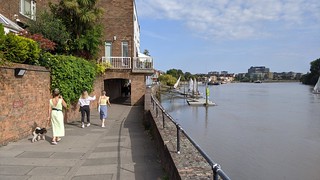
Hammersmith & Fulham Walk - Upper Mall Amongst the older mostly brick-built houses No.28, the lower building on the left of the picture is one of the few modern buildings on Upper Mall.
Hammersmith & Fulham Walk - The Dove pub 19 Upper Mall Where the road narrows to challenging social distancing width is the Dove pub at 19 Upper Mall. The pub, owned by Fullers since 1796, has one of the smallest bars in England. There is a terrace overlooking the Thames.
Hammersmith & Fulham Walk - Dove Pier Beyond the pub lies Dove Pier at the corner of Furnivall Gardens where there are houseboats moored at the pier and along the riverbank.
Hammersmith & Fulham Walk - Furnival Gardens Furnivall gardens were established after WW2 on the site of rundown industrial buildings and Hammersmith Creek, which was filled in in 1936. Stamford Brook reached the Thames here, and barges docked along the creek right up to King Street. There was too long a queue for the ice cream van unfortunately. The gardens are a popular place to watch boat races in years when that is allowed.
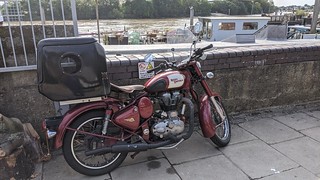
Hammersmith & Fulham Walk - Royal Enfield From India to Fulham. With added pet carrier. For cat or dog (or maybe just pizza) I don't know.
Hammersmith & Fulham Walk - Westcott Lodge The first house after Furnivall Gardens is Westcott Lodge, set back slightly from Lower Mall. Previously the vicarage of St Paul’s Hammersmith, which is just the other side of the flyover and which the walk passes later on.
Hammersmith & Fulham Walk - Furnivall Sculling Club
Hammersmith & Fulham Walk - Lower Mall
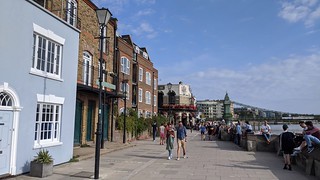
The next stretch of Lower Mall was fairly busy. Here is Furnivall Sculling Club Dr Frederick Furnivall (who originated the Oxford English Dictionary) founded The Furnivall Sculling Club for girls in 1896. Men could join from 1901. On the corner of Mall Road are two pubs with a rowing club between them: The Rutland Arms (1870, lost its top floor in WW2), Auriol Kensington Rowing Club (formed by amalgamation in 1981), and The Blue Anchor (licensed from 1722, and one of the oldest pubs in London). In another time I'd have been tempted to stop for a pint.
Hammersmith & Fulham Walk - Hammersmith Bridge
The previous photo was taken with my back to Hammersmith Bridge. Hammersmith Bridge is unwell. Designed by Sir Joseph Bazalgette and opened in 1887, replacing an earlier bridge built in 1827. It has frequently been repaired and is currently closed to all traffic including pedestrians, awaiting further extensive repairs. The towpath under the bridge is closed and river traffic is not allwed to pass under it due to the dangerous state of the structure. The coats of arms displayed at on the suspension stays at both ends of the bridge (and overpainted in green paint) are those of the City of London, Kent, Guildford, City of Westminster, Colchester, Middlesex and, in the centre, the United Kingdom
Hammersmith & Fulham Walk - Hammersmith Bridge The walking route was intended to pass under the bridge but with the path closed I had to make a short diversion up Hammersmith Bridge Road and back. This disused drinking fountain on the west side of the bridge abutment wall would have remained unseen had the path below the bridge been open.
Hammersmith & Fulham Walk - Riverside Studios Beyond the bridge and rejoining the riverside the next point of interest is Riverside Studios The site was redeveloped and re-opened as an arts centre with 165 flats above and around it (Assael Architecture) in 2019. It had been a film and BBC television studio since 1933. Amongst the first programmes made there was Hancock's Half Hour, as the show demanded a studio audience which Riverside could accommodate. During the 1950s and 60s it was the recording location for some famous programmes, including the science-fiction classic Quatermass and the Pit, early episodes of Doctor Who, and children's favourite Play School. The new building however lacks either round or arched windows to look through.
Hammersmith & Fulham Walk - Queen Caroline Street
I turned away from the river (or rather I should have done but didn't and had to retrace my steps for a bit) up Queen Caroline Street, named after the unhappy wife of George IV who lived in and had her rival court in Hammersmith. Along Queen Caroline Street are apartment blocks from three different eras, including a Peabody Trust estate.
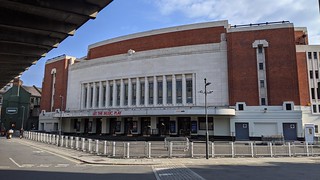
Hammersmith & Fulham Walk - Hammersmith Apollo At the top of Queen Caroline Street on the right and facing the flyover is the Hammersmith Apollo (now called Eventim Apollo). Designed by Robert Cromie in Art Deco style, it opened in 1932 as the Gaumont Palace, being renamed the Hammersmith Odeon in 1962, and became an important live music venue, featuring Buddy Holly, Miles Davis, Riverdance and SpongeBob SquarePants, among many others. The 1932 pipe organ was restored in 2007, and the building was refurbished by architects Foster Wilson in 2013.
Hammersmith & Fulham Walk - Hammersmith Flyover It's impossible to miss the Hammersmith Flyover. Although I've driven over it many times I'd never stood under it before today. The flyover was designed by G. Maunsell & Partners, and completed in 1961. It speeds up traffic from Earls Court to the Great West Road. It needed remedial work between 2010 and 2015, with weight restrictions on vehicles using it during that time.
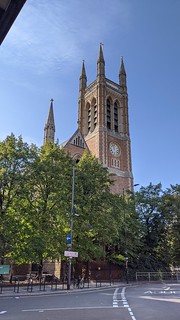
Hammersmith & Fulham Walk - St. Paul's Church Right next to the flyover is St. Peter's Church. The church is designed in the Early English Gothic Style, with lancet windows, powerful buttresses, a high roof and an imposing tower.In July 1882 the Duke of Albany laid the foundation stone, and the nave of the new church was consecrated on 13 October 1883. The architects were J. P. Seddon and H. R. Gough. Like St Peter's Church in Hammersmith, St Paul's lost a significant portion of its land, including that with graves, when Hammersmith Flyover, which can just been seen at top left of the picture, was built.
Hammersmith & Fulham Walk - Hammersmith tube station (District and Piccadilly lines) Across from the church is the end of the walk at Hammersmith tube station (District and Piccadilly lines). Parts of the old facade of the original station were re-used in the design of the interior of the station’s new north ticket hall, which was rebuilt in the 1990s by Minale Tattersfield. This though is the south entrance in the shadow of the flyover which handily leads through the small shopping centre where I puchased a late lunch and headed back down to the river to eat it before carrying on to Putney Bridge because it was only twenty to four and such a nice day for a riverside stroll.
Much of the information in this post was taken from the Open City downloadable PDF but I've added to it where some features weren't mentioned. 

More pictures are in the Flickr Album
Hammersmith & Fulham Self Guided Walk

And just for giggles I've plotted the route on this Google Map 

Sunday, 16 August 2020

Three Richmond Bridges at night.

 Saturday 15th August 2020

A little nocturnal exploration of three bridges that cross the River Thames close together at Richmond, South West of London.

Richmond Lock & Footbridges

This interesting structure was what drew me to Richmond on a dull, damp post-lockdown Saturday evening when I had nothing better to do. So I parked by the river in Ranelagh Drive and went for a little walk.

Designed by F.G.M. Stoney (careful how you search for him!), Grade II listed, and opened in 1894 it combines a low-tide barrage with a lock at one end with a pair of footbridges. 


The footbridges support the suspended sluice gates which are used to maintain a navigable depth of water in the River Thames upstream when the tide goes out. Until some time in the second world war there was a 1d toll charged to pedestrians when crossing the bridge. Now it's free but the four disused toll-booths, one at each end of each bridge remain in situ. The bridge closes at night at 2130hrs in the summer or 1930hrs in the winter so I had about 15 minutes to cross it and take some photos which was ample. 

Richmond Lock is the furthest lock downstream on the River Thames and falls under the jurisdiction of the Port of London Authority. 

For about two hours either side of high tide the sluice gates are raised up into the footbridge structure and boats can pass through under the bridge arches. At other times they need to go through the lock for which there's a charge - currently £7 and only payable by card because of You Know What.


From the footbridge walkway you can see upstream to the other two bridges.

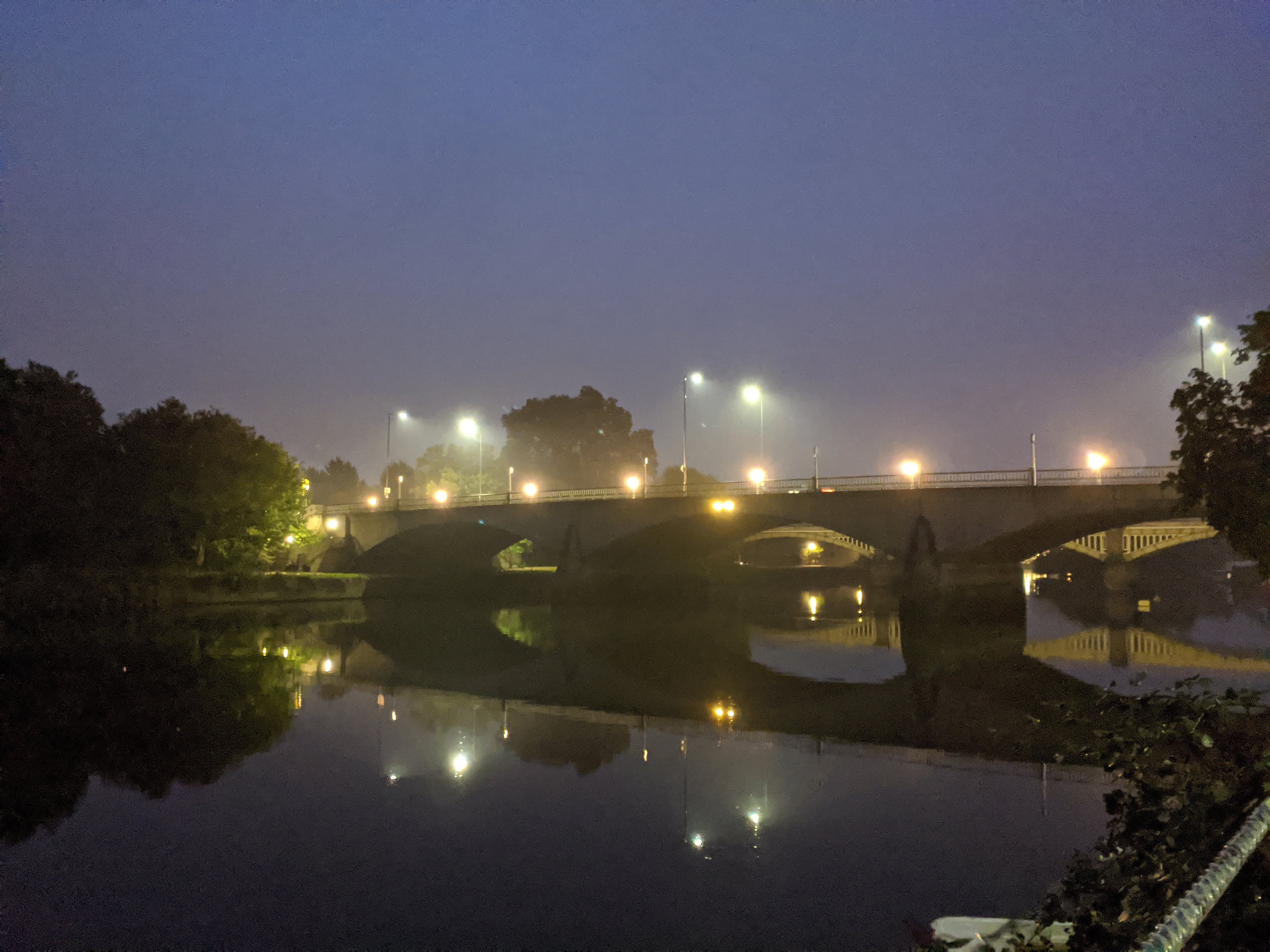
Twickenham Bridge

Despite lying between Richmond Lock and Richmond Railway Bridge this road bridge comprising three reinforced concrete arches is named Twickenham Bridge because it carries the road to the town of Twickenham, home of the world's largest Rugby stadium.

They couldn't call it Richmond Bridge of course because an 18th century arched bridge linking the two halves of Richmond already existed. Which I didn't go to on this visit. Twickenham Bridge was built in 1933 as part of the Chertsey Arterial Road - now the A316 which links southwestern suburban London to the M3 motorway at Sunbury - it was opened by Edward, Prince of Wales, (later King Edward VIII until he abdicated to marry Wallis Simpson, and was thereafter Duke of Windsor and an alleged Nazi sympathizer).

The bridge is Grade II listed, largely because of its Art Deco bronze lamp standards and balustrades. In 1992 the first Gatso speed camera in the UK was installed on Twickenham Bridge. 

Richmond Railway Bridge

Close to Twickenham Bridge the London Waterloo to Reading railway line crosses the River Thames approaching through the Old Deer Park on a viaduct.

Richmond Railway Bridge designed by Joseph Locke originally opened in 1848 when the line was extended from Richmond to Windsor. It was rebuilt in 1908 by the L&SWR chief engineer J W Jacomb-Hood replacing the 100ft iron girders with a steel truss design on the original piers and abutments as there were concerns over the integrity of the original structure. The main girders and decking were replaced again in 1984.


The Grade II listed bridge now carries multitudes of commuters (well not so much at the moment because of You Know What) on South Western Railway services.

I crossed back over the river and returned to the car past the night anglers and other characters lurking in the shadows just in time to get out of the returning rain.


This Flickr Album contains some more photos

The Bridges of Richmond

Tuesday, 9 June 2020

Level Crossing Closure

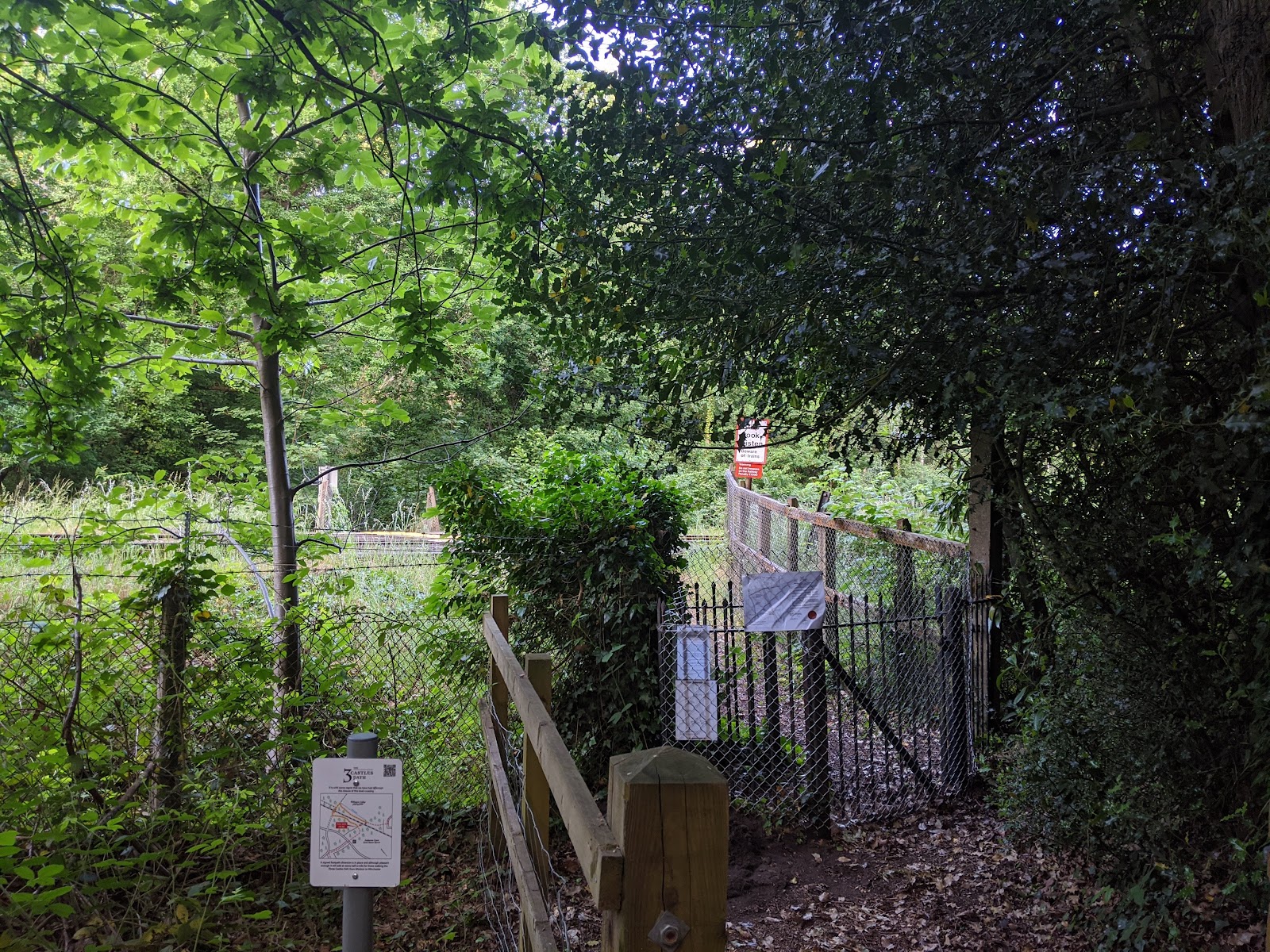
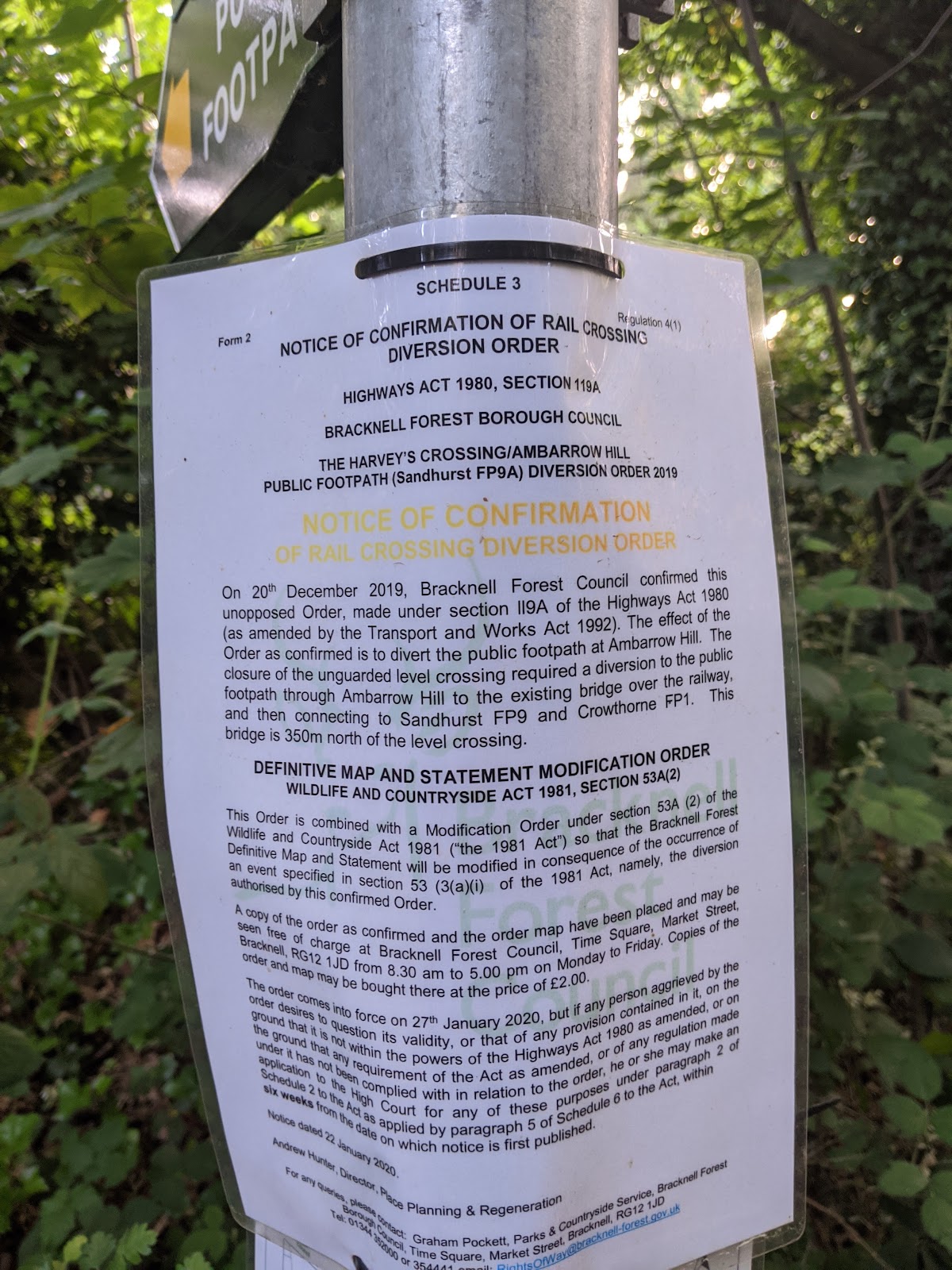
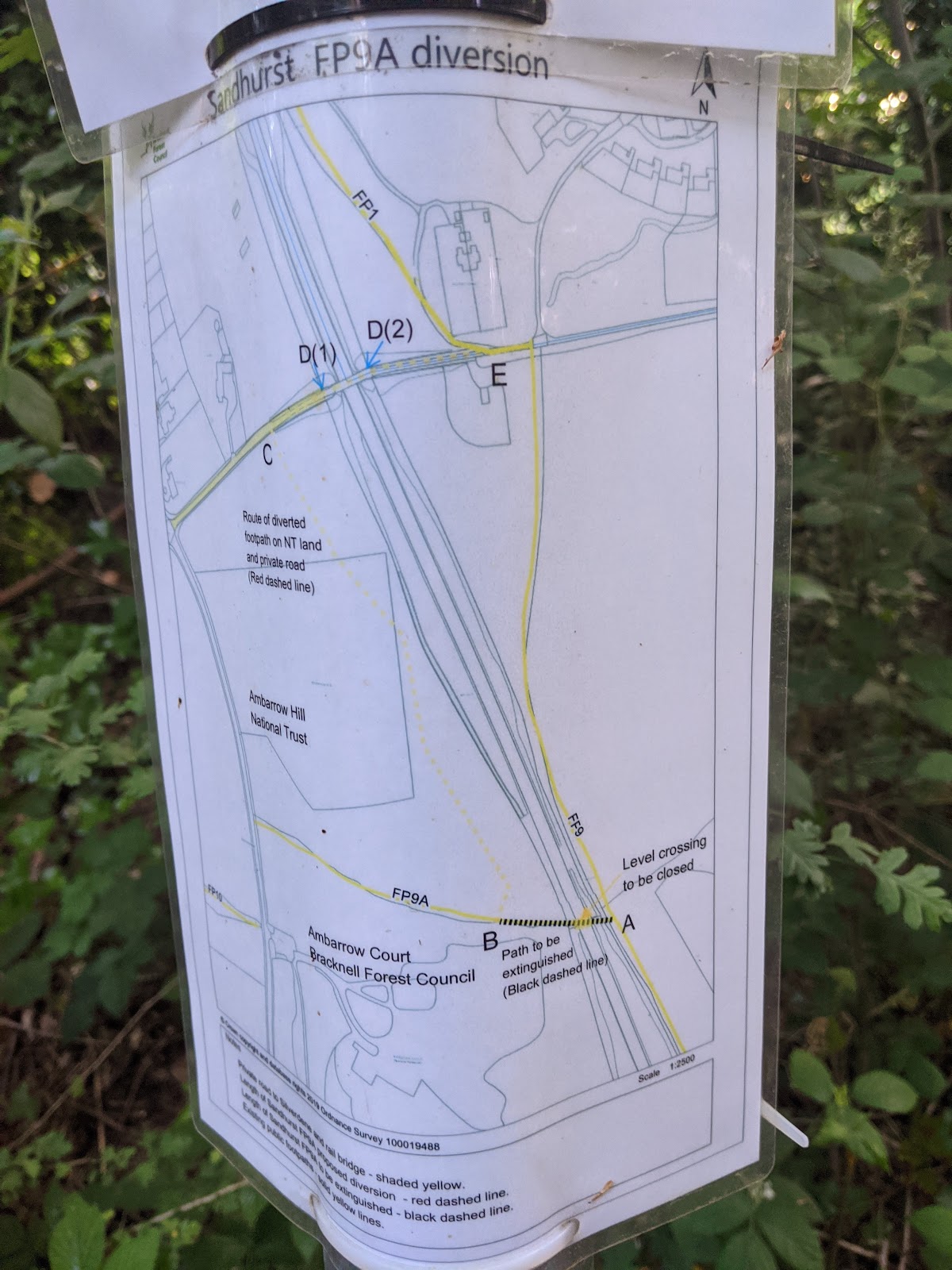
Sandhurst’s local level crossing has been closed. It’s quite likely that a majority of local residents didn’t even know that there was a level crossing being that it was on a footpath in the woods. Indeed until last year neither did I until I spotted on a map that a footpath crossed the railway near Ambarrow Wood and went to take a look. I found that it was fenced off and temporary closure notices were in place. A walk up that way yesterday evening to see if it had reopened revealed that the closure was made permanent in January 2020
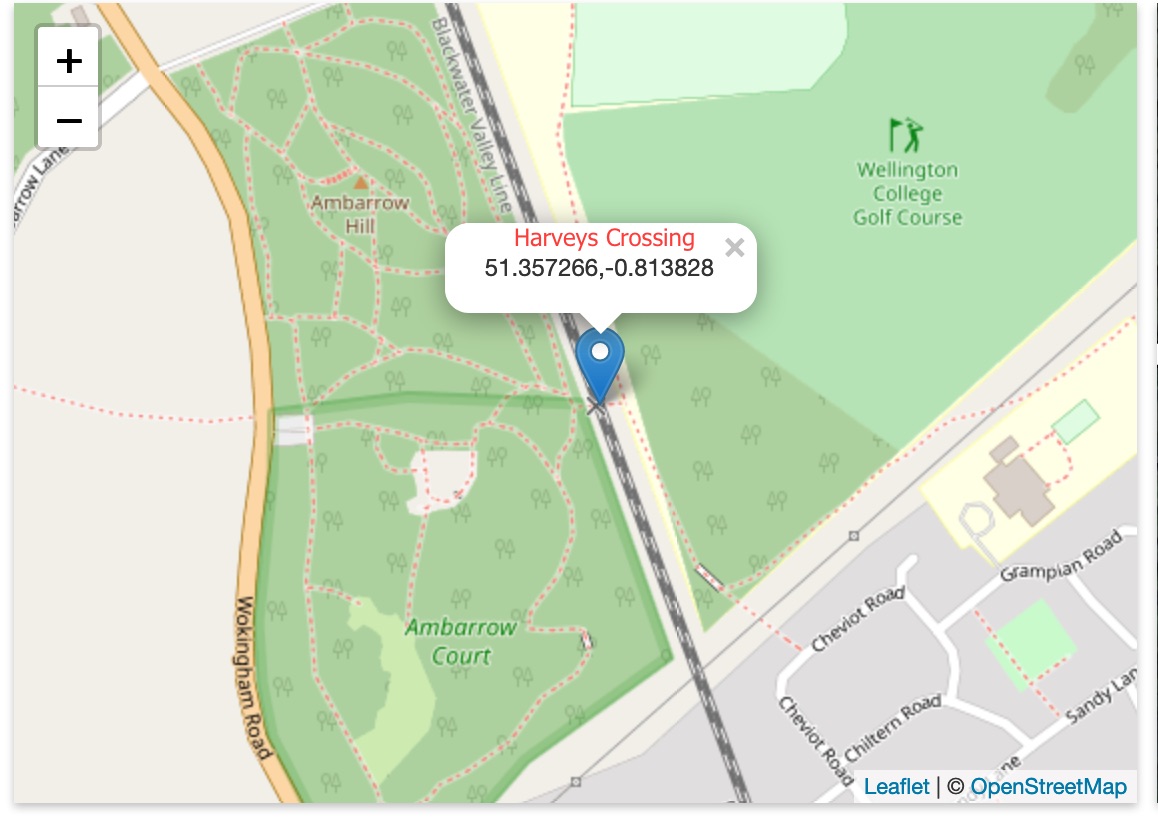
Harveys Public Level Crossing crosses (or rather crossed) the Reading to Guildford railway line south of Crowthorne Station on the West side of Ambarrow Court
Map of Harveys CrossingMap copyright OpenStreetMap contributors
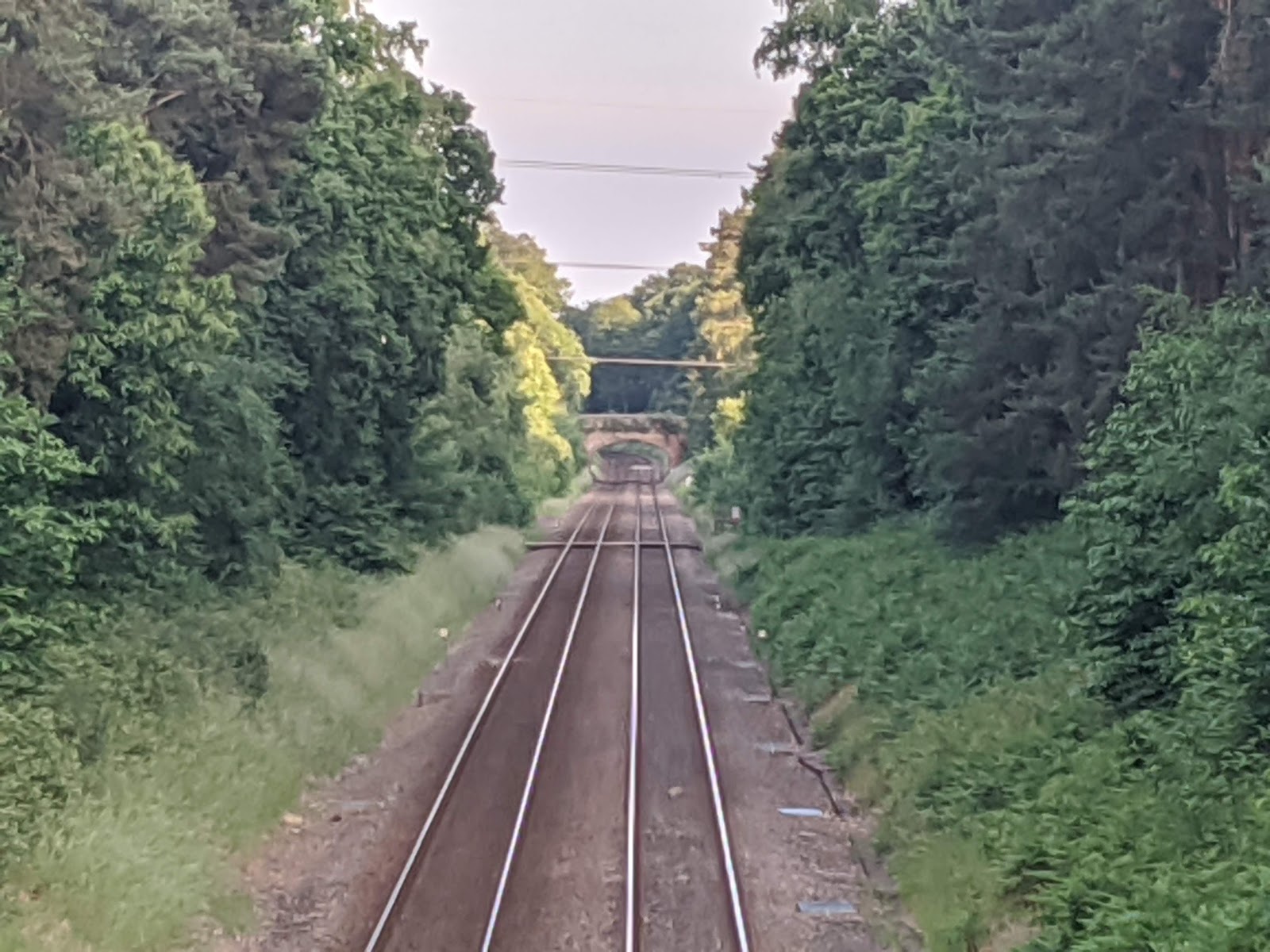
The crossing carried Sandhurst Footpath 9A across the two railway tracks on wooden boards and was protected only by iron “kissing gates” and signage warning to stop look and listen for trains. Around 80 trains pass this point each day at up to 70mph, although most will be going slower due to the closeness of Crowthorne Station. There is good visibility up and down the line in both directions.
I can’t find any record online of any incidents at the location but Network Rail seem to have a policy of seeking to close as many level crossings as they can anyway.
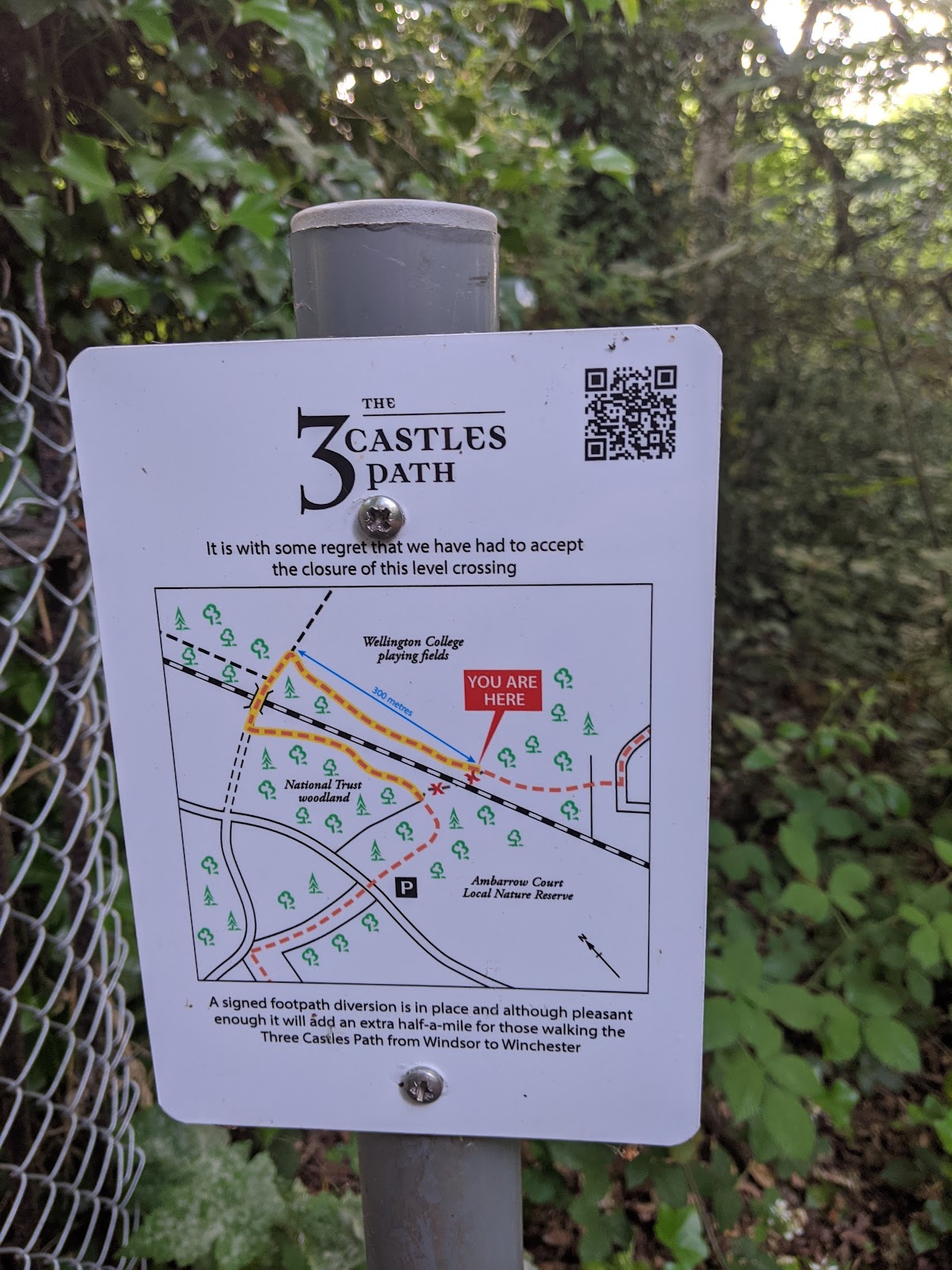
Footpath 9A and its crossing also formed part of the long distance Three Castles Path between Windsor Castle and Winchester Castle (the third being Odiham).
3 Counties Path sign
As a result this path is now half a mile longer, it being necessary to walk up one side of the line, cross over on Kiln Bridge, and walk back down the other side to regain the route. It’s not an unpleasant diversion but probably not as interesting as a pedestrian level crossing.
Harveys Crossing from Kiln Bridge
The crossing from Kiln Bridge to the north.
Harveys Crossing Ambarrow Court gateway
The crossing from the Ambarrow Court side.
Closure Notice
Official closure notice.
Diversion route
Footpath diversion route.
So now we no longer have a level crossing. Few will miss it I suppose. 
I wonder how long it will take the council to remove the Public Footpath fingerpost sign that still points through the chainlink fence across the railway tracks on the eastern side?

Sunday, 10 May 2020

Interesting times.

I’ve been avoiding writing about COVID19 like the plague. But here goes my ha'porth.
While others have produced many pages of words on their lockdown activities, how many books they’ve read, video conferences they’ve attended, or new skills they’ve learnt I’ve mostly been at work. Being declared a key worker right from the outset has meant the changes to my daily routine haven’t been that great. I still need to visit and interact with customers - albeit while trying to observe strict social distancing - and I already worked largely from home anyway. I haven’t needed to visit the main office, or rather I’ve avoided doing so even though most of the desk based people normally there have been despatched off to work from their kitchen tables but occasionally I’ve needed to visit a nearby site to access a printer. (Using my own printer at home being verboten for security reasons.) So work wise not so different from normal.
My planned trip to the far north of Scotland by rail was due to start on March 20th, so that didn’t happen. I’ve got most of the money refunded now and made a note of the companies who took a “tough luck, we’ve got your money now fuck off” approach to the situation for future consideration when trip planning. (Yes, I’m looking at you Caledonian Sleeper.)
That left me with a week off and nowhere to go, which has been my only real period of lockdown. In those early days of bog roll and other shortages I was glad I had previously stocked up for Brexit. Although I haven’t needed to use much of that stockpile since shop supply lines have since adapted. Shop once a week, Monday or Tuesday after 1400 hrs seems to be the way to avoid the worst crowds (though not necessarily the worst people) and still get most of what you want.
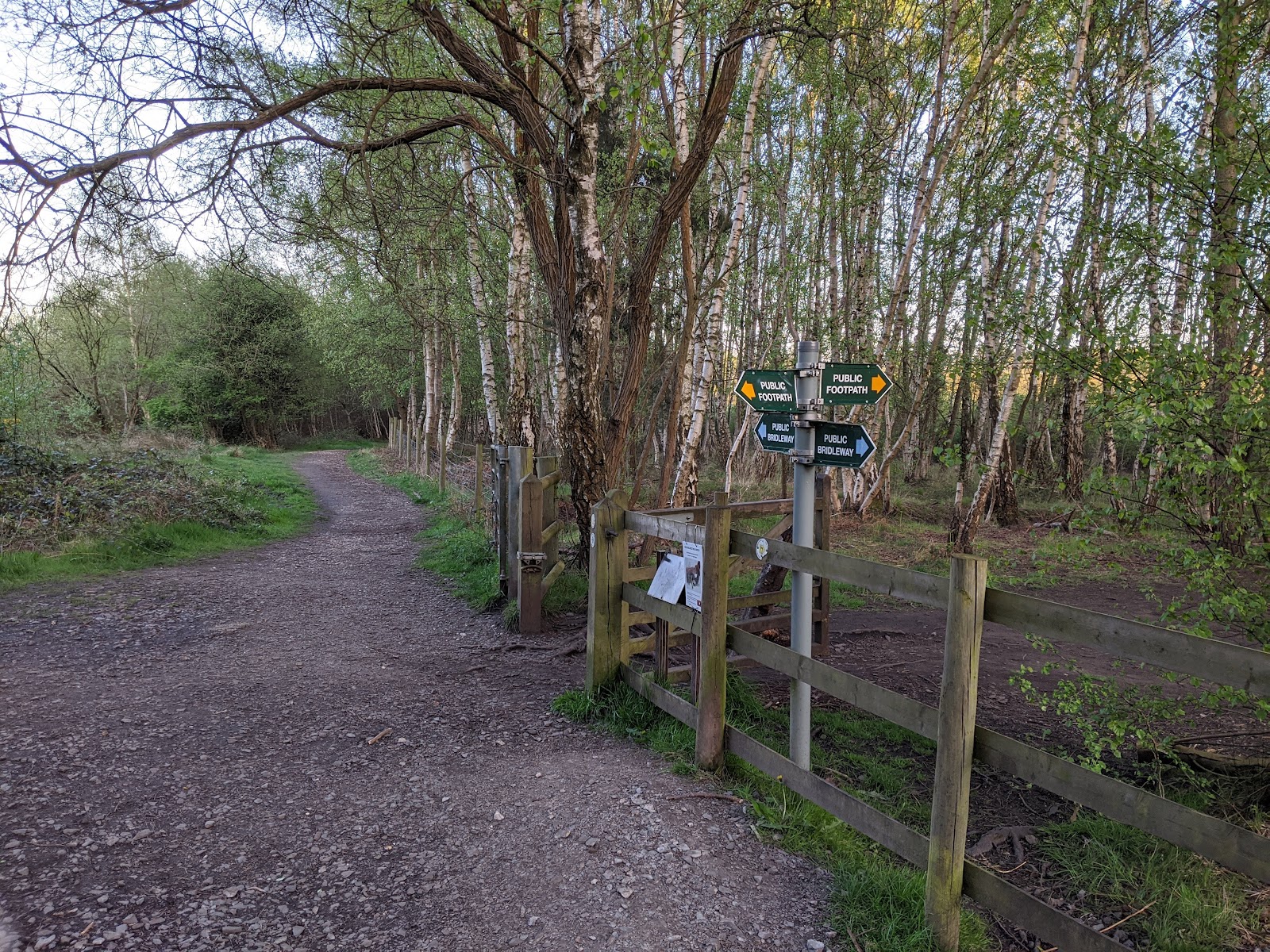
Signpost in the woodsFor my daily (well some days anyway) permitted exercise outing I’ve mostly headed to the nearby woods, scrub, and swamp of Wildmoor Heath or on a couple of occasions down by the Blackwater River.

I live in a built up area so it should be no surprise that with a lot of people needing to escape the confines of their four walls the open spaces will have more people in them than usual. It has apparently come as a surprise to the usual vociferous half-wits on social media though, encouraged by our appalling fourth estate (and in some cases Chief Constables). 
I’ve left it until 1830 or 1900 hrs before going out for a walk, avoiding most of the families with loud unruly kids and bikes. There have still been a few of the usual arrogant mountain bikers to try to avoid though. I think having a saddle stuck up your arse must do something to your brain chemistry. At least the weather has been conducive to outside activities. Although maybe if it had been pissing down we would’ve minded less about not being allowed out.
I did try going out very early one morning instead. It was bloody cold. And there were nearly as many walkers out as in the evening.
In spite of the generally good weather I’ve managed to get drenched at work a couple of times, just so I don’t forget what rain is I suppose. The joys of working outside. Now compounded by people who have no idea what 2 metres looks like and having to be alert to the possibility of attack by 5G conspiracy fuckwits.
I already lacked a social life before all this but evenings in have proved that there’s still very little worth watching on TV. I managed to stand about 3 days of government Corona-briefings before deciding I didn’t need to be depressed any further. Youtube has remained my channel of choice and Saturday evenings have been enlivened by the weekly Don’t Panic! livestreams from All The Stations. Also an epic and unintended 3h 10m livestream from Martin Zero the live comments section of which turned into a fantastic childhood TV nostalgia-fest 😊
Odette MichellIn other news I’ve read quite a lot of eBooks, although not as much as I expected. Where does all the time go?
I’ve spent too much time on Twitter. I’ve had to temporarily restrict my tweets to confirmed followers to get a break from the wilfully ignorant and terminally stupid who always seem to be looking for a fight. I’m so glad I don’t do Facebook as well. That particular plague seems to be infecting Cix as well unfortunately😞
I’ve had my first adventure into Zoom land. The talented and generally lovely Odette Michell did a “live” gig via Silsoe’s NAF Club. An award-winning artist live in your own front room can’t be bad, even on an 8” tablet 😀 Gotta love the technology.
Steve Knightley and Show of Hands youtube channel has whiled a way a few evenings with musical entertainment as well.
I eschewed the VE Day 75th anniversary bollocks. I was unsurprised when it was inappropriately used to whip up some jingoistic nationalism. Did the virus take a day off so that the Daily Mail could celebrate what it referred to as “Victory over Europe” day? 🙄
That’s “sort of lockdown” so far, I wonder what’s next?
We await the buffoon in 10 Downing Street's widely-leaked announcement that restrictions are to be eased from tomorrow. I have no doubt this will result in a fiasco, will make things more difficult at work, and quite likely unflatten the curve as well. Still the elite are hurting in the pocket and hoi polloi need to be sacrificed to ease their pain.
We are to stay alert apparently.
Good luck to you all.