Saturday, 7 August 2021

Spa Valley Railway

 Tuesday 3rd August 2021

As things are opening up again - permanently or temporarily, who knows? - I decided that a visit to a heritage railway would be nice, especially as this one at least was happy to sell me one ticket rather than insisting on me paying for two, four, or more as was the case with some others.

The Spa Valley Railway runs from Tunbridge Wells in Kent to Eridge in East Sussex. At Eridge it shares a station with the Southern Railway main line with trains from London Bridge, East Croydon, Oxted and Uckfield. However that would be about three hours and five changes from here or about 90 minutes in the car. There's a large and reasonably priced car park at Eridge station.
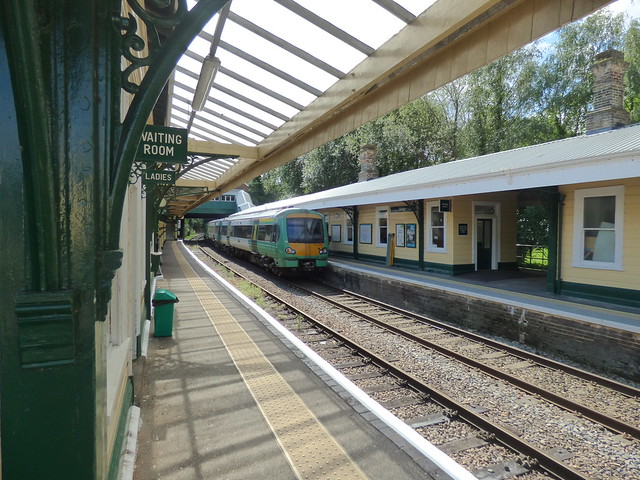
 Eridge Station

Eridge looks and feels like a heritage line station and apart from the dot matrix indicators on platform 1 it’s only the modern diesel trains arriving at and departing from this platform that give the game away. 

Today was a heritage diesel running day on the Spa Valley Railway with services being provided by a two car BR Class 207 “Thumper” DEMU running to the “Purple Timetable” which provided five journeys in each direction throughout the day.

An adult ticket cost £12 on the day (even if purchased online) or £10 if you’re not travelling on the spur of the moment and buy it online in advance. Buy it at the station and it’s £12. That’s not too bad for what’s actually an all day rover, cheaper than many other preserved lines and the timings allowed me to catch the 1115 at Eridge, have a bit of lunch in Tunbridge Wells and look around the town and the SVR depot before getting the 1325 at Tunbridge Wells to Groombridge which is good for filming, photography, and more importantly tea and biccies from the kiosk on the station. After a quick wander around the village which isn’t that exciting I returned to Eridge on the 1501. I should mention that not one of those trains actually departed at the scheduled time, usually it was about 5 minutes later :-)
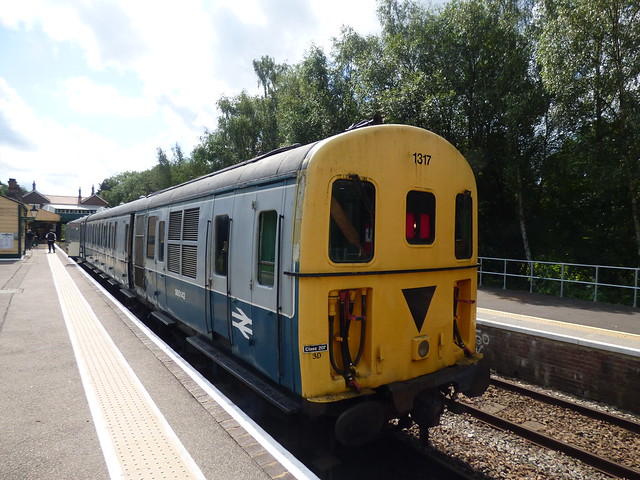
 Class 207 DMU at Eridge Station, Spa Valley Railway.

Having grown up on BR’s Western Region I’m not familiar with the Class 207 trains of Southern Region, nicknamed Thumpers because of the engine noise I read, which are diesel electric multiple units built in 1962 and remaining in service until 2004 when slam doors were no longer acceptable on a modern railway. Unlike the trains I grew up with which had the engines slung under the floor these have an engine in a compartment behind the driving cab and guard’s compartment, which obviously takes up a lot of space which otherwise could contain passengers. They sound good though if you’re in the motorised unit that is and if you’re in the trailer you can barely hear the engine at all.
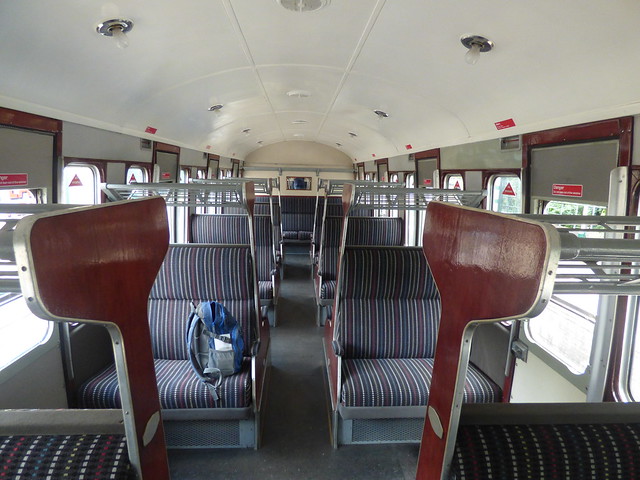
 Class 207 DMU interior, real seats! Spa Valley Railway.

In true 1960s style and unlike modern commuter trains the interiors have seats with actual springs in because back then the government didn’t insist that everyone travel in as much discomfort as possible. Quite a bit of standing space though for rush hour loadings and I expect the luggage racks above the seats were handy for reading the morning papers. No overcrowding today though, in fact I thought I was going to have this section of the train to myself until shortly before departure a young man & his companion/carer boarded. There had obviously been some sort of incident at the station which had upset him and he proceeded to have a minor melt-down for the duration of the trip, fortunately at the far end of the carriage mostly out of microphone range of my camera. I hope he calmed down enough to enjoy the rest of his day.

 73 140 at Tunbridge Wells West station, Spa Valley Railway.

Tunbridge Wells West station is where most of the SVR locomotives and rolling stock lives and you can wander around the engine shed and yard where there are a number of steam and diesel locomotives in either running condition or serious stages of rebuild. The SVR is based in the engine shed, the lines into the original station being truncated by the access road for Sainsbury’s and the station buildings now a hotel and restaurant named “Smith & Western” with a huge set of cow horns over the entrance. I expect they play both kinds of music but I didn’t venture inside to find out, instead walking up to the Pantiles shopping area and the Chalybeate Spring which gives the town its name but is still shut due to the Great Plague of 2020/21.

 Chalybeate Spring, Pantiles, Tunbridge Wells

I took a picnic up onto Tunbridge Wells Common which is conveniently located a short walk from the town and the SVR station. After which I caught the train to Groombridge.
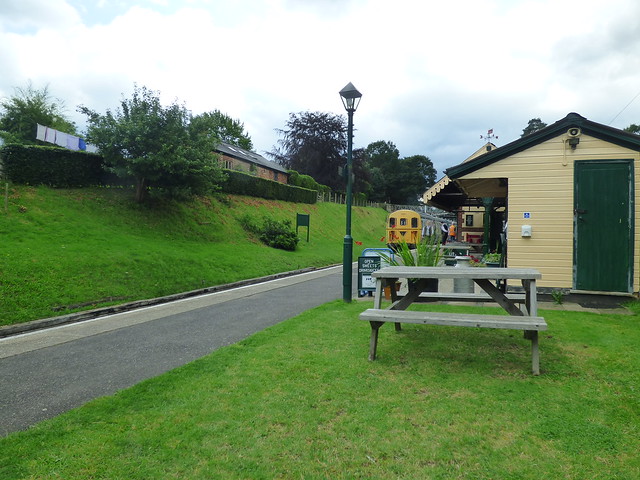
 Class 207 DMU arriving at Groombridge station, Spa Valley Railway.

Groombridge is probably the best station on the line to see and photograph the trains. It also has the passing loop so on days when multiple trains run this is where they pass. It’s also the place today where the sun passed out of sight behind the clouds although at least the rain held off until I was back on a train. The station has a refreshments kiosk which serves a decent cup of tea. I took a walk into the village which lies on the Kent/East Sussex border, here delineated by the river Grom (one 'o') over which there is a very small bridge carrying the B2110, and from which the village takes its name although it has acquired a spare ‘o' from somewhere along the way.

Last ride of the day was back to Eridge. I had planned to visit the fourth station High Rocks which is in the grounds of the pub and national monument but when passing through there was a sign saying the attraction was currently closed and the gate from the platform very much locked shut. Some other time then, a return visit being on the cards maybe on a steam running day.

More photos Flickr Album
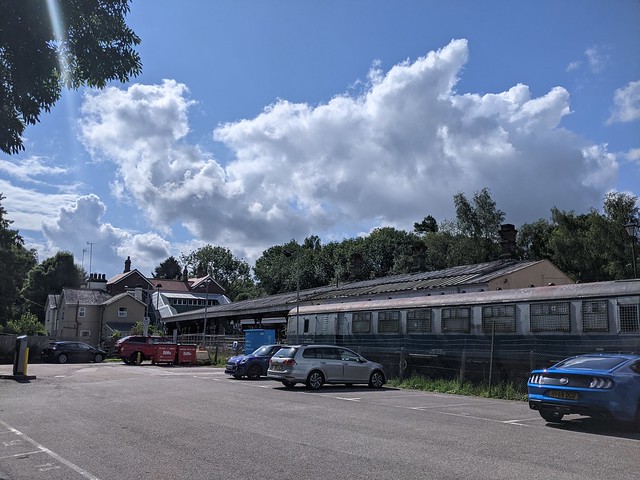
 Spa Valley Railway.

And glorious(?) HD video
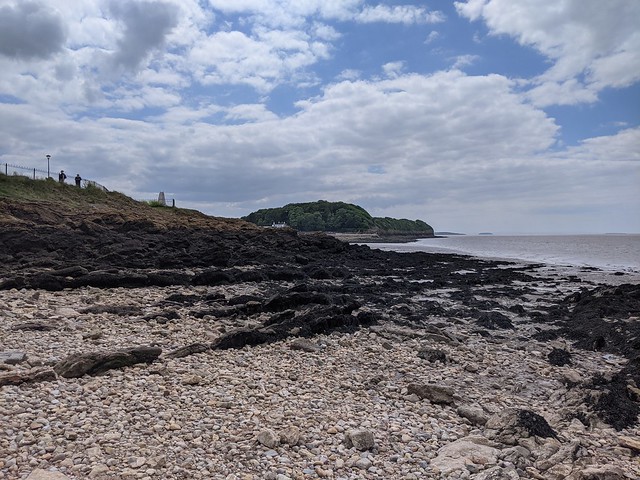


Saturday, 31 July 2021

The Source of the River Thames


Monday 26th July 2021

We’d got back our “freedom” and the rain had let up for the day at least according to the forecast. Time to pick a random destination and get back on the rails.
 
The source of the River Thames lies in a remote meadow near the village of Kemble in Gloucestershire - which used to be in Wiltshire. At least the official source is, some argue that it’s actually at Seven Springs about 11 miles further north at the source of the river Churn because that flows into the Thames and is further from its mouth. That would make it the longest river in the UK but must be wrong otherwise surely the river that runs through Reading,Oxford (yes, I know, Isis), and London wouldn’t be called the Thames and the rowing regatta would be held at Henley-on-Churn. Also the former TV channel would have been Churn Television although you could argue that would have been more apt.
 
Anyway the source in Trewsbury Mead has an official memorial stone and a signpost and all that so ignore the pedants. It’s also conveniently not too far from a railway station (Kemble) and a pub so that’s where I went to find the start of the longest river in England. No, the Severn is partly in Wales so you can delete the comment you were about to write.
 
 GWR Class 165 at Sandhurst
 
We now have a somewhat irregular service pattern on our railway line, introduced last year to go with the replacement trains that we haven’t got yet, which means that as far as I can make out the first off-peak service to Reading, to connect with the GWR main line, is at 1026. That would have got me to Kemble at 1140, plenty of time to walk to the source and then go and have a pub lunch. Unfortunately as well as being irregular the service is unreliable and that train was cancelled due to a points failure and the next was consequently about 20 minutes behind schedule arriving at Reading just in time to watch the 1153 to Kemble (the one an hour later than the one I should have been on) depart from platform 7. There is no 1253 train from Reading that stops at Kemble so I had to go to Swindon and wait for a train to Kemble that started there. Actual arrival at Kemble was 1341 a bit late for lunch (good job i’d bought a picnic on the way) but just qualifying for a 100% Delay Repay refund on my ticket. I’d have preferred to have been on time.
 
 Kemble Station showing the start of the abandoned Cirencester branch line to the right.
 
Kemble Station is small, with long platforms and a large water tower at one end of the down platform in traditional if faded GWR colours. Since this part of the line hasn’t been electrified it also still has its iron lattice footbridge linking the two platforms, not yet replaced in order to provide space for overhead wires such as has happened elsewhere. From the road bridge on the London side a spur of track can be seen leading off to the north. This is the remains of the Cirencester branch line, opened by the Cheltenham and Great Western Union Railway in 1841 and closed on 4th October 1965. This branch crossed the course of the River Thames north of Kemble at about where the A429 does now, making it then the highest/uppermost rail crossing on the river.
 
It’s about a mile and three quarters (2.8km) from Kemble Station to the source of the Thames, leaving the station north car park and turning left for a few yards then right onto a broad grass footpath and you are off the road for the rest of the walk except for crossing the A433.
 
© OpenStreetMapcontributors
 
A little way before getting to the A429 there’s a Thames Path sign pointing left over a wooden footbridge and shortly after you are following the River Thames. It might be a little difficult to spot unless there’s been a lot of rain though. On my visit it was visible only as a reed-filled ditch about 3 yards across.
 
 The River Thames, only a reed-filled ditch here.
 
Further along the path crosses a farm track which itself crosses the Thames on a sort of low bridge or culvert, so water must flow here in some quantity at times although it was bone dry today.
 
 The first "bridge" over the Thames, albeit very dry today.
 
The Thames Path rises to cross the A433 Tetbury to Cirencester road near where it crosses the Thames, which it the highest road crossing on the river although in contrast with the lowest crossing it requires neither bridge nor tunnel to do so, the river being small enough to be culverted so it’s hard to work out where the actual crossing is.
 
 At the A433, the highest road crossing the River Thames, or at least the course of it.
 
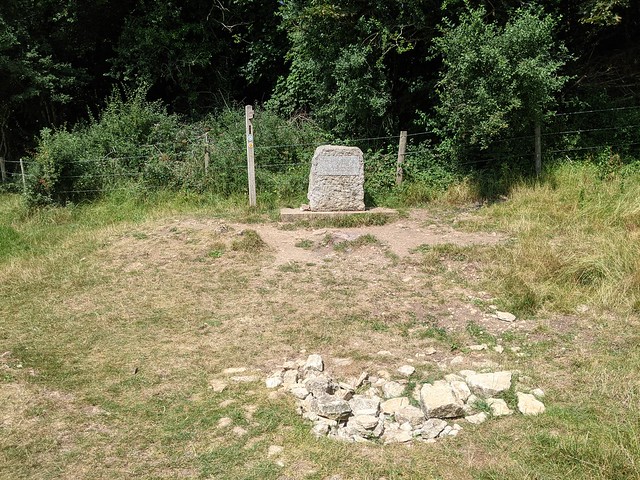
I followed the clearly marked path that climbed gently across the fields of Trewsbury Mead to the obscure corner the edge of the woods where the stone memorial and a pile of rocks in a shallow depression mark the official, accept-no-substitute Source Of The River Thames.
 
 The Official Source of the River Thames
 
The inscription on the stone, unreadable due to wear and bright sunlight, reads
 
"The Conservators of the River Thames
1857 – 1974
This stone was placed here to mark the
Source of the River Thames".
 
Alongside the stone is the first (or last) Thames Path footpath sign, pointing the way down the 184 miles of the national trail to the barrier at Woolwich, which is definitely a lot noisier and busier than this end. I ate a solitary picnic against the only suitable tree that I could find to shelter under from the now quite hot sun, not even disturbed by the middle-aged couple walked down from the other direction, took their selfies, and returned the same way.
 
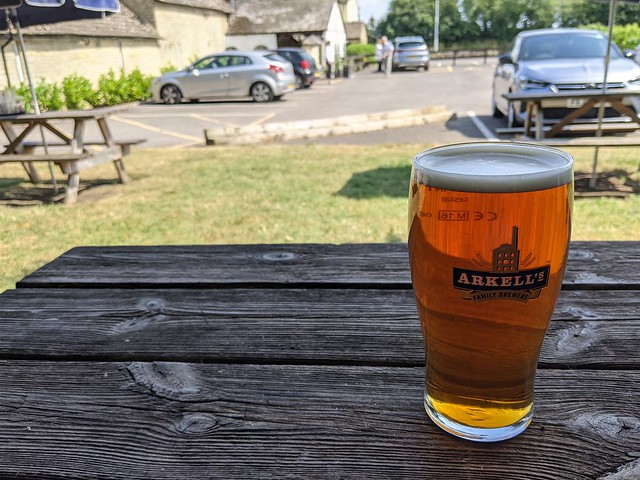
Then I returned along the Thames Path to the A433 and turned right along the road and under the railway to the Thames Head Inn. Because it would be rude not to really. It was the first time I’d set foot in a pub for over a year due to you-know-what but i remembered how it worked and enjoyed a nice pint of Hoperation IPA (ABV: 4.2%) sitting in the shade in the beer garden. I might have had another but had a train to catch from Kemble three quarters of a mile away down a country lane. A train which actually ran on time, as did the connection at Reading, making a better end to the day out than the beginning. 


 A welcome refreshment at The Thames Head Inn.

Thursday, 15 July 2021

Cats and Pigeons

More garden visitors on camera.

Saturday, 10 July 2021

Scenes from a Suburban Garden

Garden visitors.

Bought a "trail camera". Still working on the best location. The following is whittled down from about 300 shots mostly of plants waving about in the wind. Oh and quite a few of some fat bastard gardening but I deleted those 😀

Saturday, 26 June 2021

Clevedon

 
22nd June 2021
 
On the North Somerset coast facing South Wales across the Severn Estuary lies the small Victorian seaside resort of Clevedon. Just the place for an extended day trip which since it hasn’t had a railway since 1966 had to be by car. Some online pre-planning identified a hotel for an overnighter and a parking place on the clifftop within a short walk of the seafront and early on Tuesday morning that’s the destination I entered into the satnav.
 
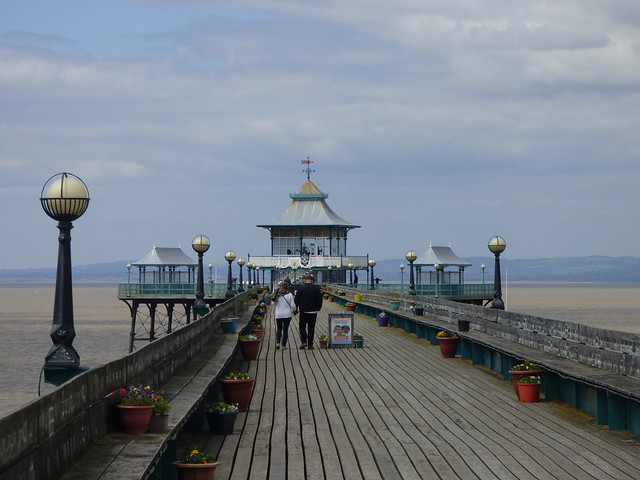
 Clevedon Pier from the east.
 
My main reason for picking Clevedon was to visit the pier, one of the earliest surviving Victorian piers and described by Sir John Betjemen as “the most beautiful pier in England”. My first glimpse from the clifftop footpath revealed the 1024 foot (312m) structure stretching out in to the estuary in the unexpected sunshine and I was struck by how “lightweight" it appeared compared to many other piers, the deck held high above the water on slender legs.
 
 Clevedon Pier
 
The pier opened in 1869, serving as a tourist attraction in its own right and as an embarkation point for paddle steamer excursions. Two of the spans collapsed during stress testing in 1970 and demolition was proposed, but local fund raising and heritage grants allowed the pier to be dismantled for restoration and reassembled. It reopened in 1989, and ten years later was awarded the Pier of the Year from the National Piers Society. Excursion steamers once again call at the pier in the summer season although I didn’t see any on his particular Tuesday. The pier has now reopened post-lockdown and entry was an entirely reasonable £3.50 per adult including gift aid. Up to date info including opening times is on the Clevedon Pier Website here.
 
 Clevedon Pier, pagoda.
 
At the end of the piers the Pagoda which operates as a cafe selling teas and coffees and ice creams. There’s also two shelters. And that’s it. No amusements, no funfair rides, no tacky shops. Just a Victorian pier. I liked it a lot.
 
 Second Severn Crossing from Clevedon Pier.
 
The tea was very nice as were the views up and down the estuary, you can even see the Second Severn Crossing carrying the M4 motorway from England to Wales. The prom at Clevedon  is almost devoid of the usual amusement arcades and other seaside attractions. There are a couple of seafront pubs and a good few restaurants. There’s also a fish and chip shop as is only right and as is only right I indulged in seaside chips with plenty of salt and vinegar. After which I walked along the front and up onto the south headland following the Poet’s Walk around the Iron Age hill fort and back into the town.
 
 Clevedon beach.
 
If you are looking for a sandy beach don’t look for it in Clevedon, it’s strictly pebbles and rock pools. This probably keeps most of the families with kids further along the coast at Weston Super Mare. I regard this as a plus point :-) At the west end of the seafront is Salthouse Fields, a large open area (occupied by the circus when I was there) with a children’s playground and a miniature railway (sadly not operating that day). Next to it is the other major feature of the seafront, the enclosed Marine Lake.
 
 Clevedon, Marine Lake.
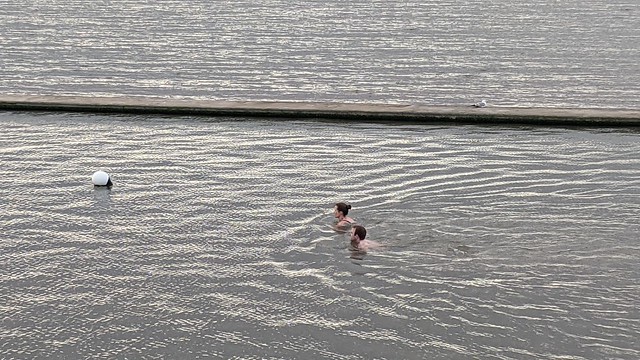
 Clevedon, Marine Lake evening swimmers.
 
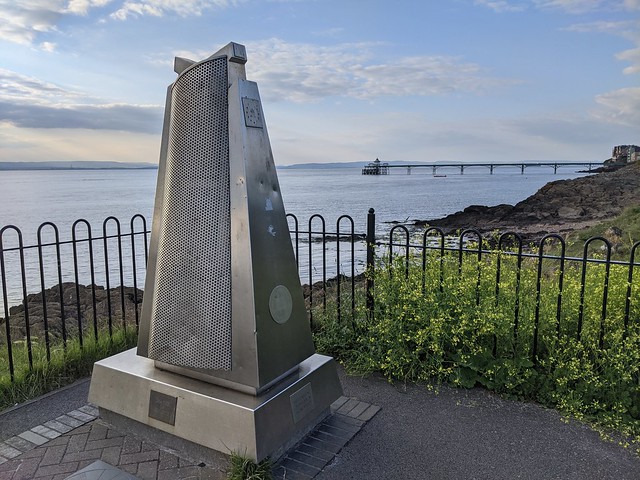
This was popular with swimmers, canoeists, and model boaters until quite late in the evening. I’m not convinced that it was very warm but they all seemed to be enjoying it anyway. As well as the usual gardens, Victorian bandstand, and shelters there is on the seafront the shiny stainless steel "Millennium Monument - The Spirit of Clevedon AD 2000”.
 Clevedon, Millennium Monument.
 
I’m afraid that it rather put me in mind of a large paraffin heater :-)
 
If you like Victorian seaside resorts I can heartily recommend Clevedon.

Sunday, 13 June 2021

Look down on London

Watching London from above

Saturday, 5 June 2021

Stabbed 2/2

5th June 2021
 
Jab no. 2 done.
 
Originally booked for the 11th June but the NHS sent emails and SMS to say that "As you’re in a high priority group, we’re now able to offer you earlier dates for your 2nd dose vaccination appointment.” To get an earlier appointment I first had to cancel the existing one on the 11th. I know what you’re thinking and so did I. In the event having cancelled the 11th June appointment I was then offered a list of available places and dates and sure enough first on that list was 11th June at Fleet, Hampshire, scrolling down bit however offered 5th June back at the Madjeski Stadium in Reading. The centre in Fleet being a little closer as the crow flies it came up top even though the available slots were later.
 
 Madejski Stadium aerial, August 2014
 
The vaccination centre is in the conference centre on the front of the stadium proper as shown on the above photo. It was a lot busier this time than on my previous visit bt well organised and with plenty of people in hi-vis pointing out where to park, where to go, which queue to join etc.
 
At the entrance jabbees were divided into two streams 1st jab given a green sticker and sent right into the Pfizer queue, 2nd jab given a red sticker and sent left into the AstraZeneca queue. After initial checks to see if you could remember your name and date of birth and had your appointment number (which caught out the man in front of me in the queue even though it should have been bloody obvious he would need it, cue frantic scrolling on phone) I joined the cubicle queue behind maybe 10 other people, two of whom were a couple going in together. The queue minder remarked that it was only now starting to get busy having been almost empty since opening time.
 
So into the cubicle and another check to see if you could still remember your name and date of birth, whether you were on any relevant meds, reactions to the first dose, had any COVID19 symptoms etc. I was again stabbed in the arm and my vaccination card filled in up-to-date. In and out in about 15 minutes.
 
Still no lollipops though :-(